Guy's Blog

Guy frequently keeps this blog updated with thoughts, challenges, interviews and more!

Tag: Book Reviews

It has been a splendid few days in Seattle so far, kicked off by a trapeze lesson with the excellent Milla Marshall at SANCA. The place was pretty empty, so there was no-one to hold the camera (Milla was busy spotting me through the tricky bits), but we did manage to catch this new trick on video:

There's no better way to get the aeroplane out of your spine! This was my third class with Milla, and I can highly recommend her. I also managed to get one go on the flying trapeze on Friday, so that's my adrenal glands thoroughly exercised.

On Thursday evening, Dan from Lonin took me shooting; it's been a while since I last shot, but I didn't disgrace myself. Dan is a fan of old British militaria (up to and including driving a 1980s military Land Rover), and he kindly let me blast away with his (semi-auto) Sterling SMG, his Browning Hi-Power (my favourite 9mm pistol), a WWII Webley revolver, and, to cap it all, a WWI era Webley .455, just like my grandfather carried in the Great War.

I spent most of Friday working on my new Vadi book (it's not all fun and games!). I'm reading around the period quite widely, and came across an interesting light history of the Medici banking empire on my brother-in-law's bookshelves. Medici Money by Tim Parks is well worth a look if you're interested. It's not a mighty and definitive scholarly work, but it explained some aspects of Italian financial history I hadn't grasped before, and it's a fun read. It's by the same Tim Parks that wrote Teach us to Sit Still, a very personal journey into meditation. As my regular readers know, I meditate a lot; if the Vipassana stuff Tim talks about is a bit heavy, you could try this instead.

While I'm on the subject of books: I'm staying at Neal Stephenson's house, and came across an advance reader's copy of his next novel (co-written with Nicole Galland), The Rise and Fall of D.O.D.O.. Let me put it this way- I meant to just scan the opening pages, but am now 400 pages in… It's classic Neal, in that you can't really categorise it, but it's a lot like Reamde in tone, with a bit of Baroque cycle in content, and it manages to fuse both classic SF elements (quantum physics stuff) with magic, in a way that's just a delight to read. Yes, we're friends so I'm biased, but I would never recommend a book just because a friend wrote it.

Friday night I was teaching in my Seattle sword home, the Lonin loft at SANCA, then all day Saturday (Fiore stuff, with a bit of Vadi), and all day yesterday (I.33 in the morning, Capoferro in the afternoon).  A big shout out to Dan Weber for organising the whole thing, Alex Hanning for running the I.33 group, and Michael Heveran for keeping the rapier flag flying amidst all this medieval stuff. Sunday's seminars were graced by Devon Boorman and three of his Duello students, one of whom, Greg Reimer, is a superb graphic designer who has taken my free Fabris photos and laid them out with Tom Leoni's 2006 translation… I have an advance reader copy of the first section, so it looks like I'll have plenty to do on my flight home next week!

But before then, I'm off to Vancouver tomorrow, to teach seminars at Valkyrie, and, while I'm there, go horse riding for the first time in about a decade… wish me luck! I'll report back in due course. If you're in or around Vancouver next weekend, come and train!


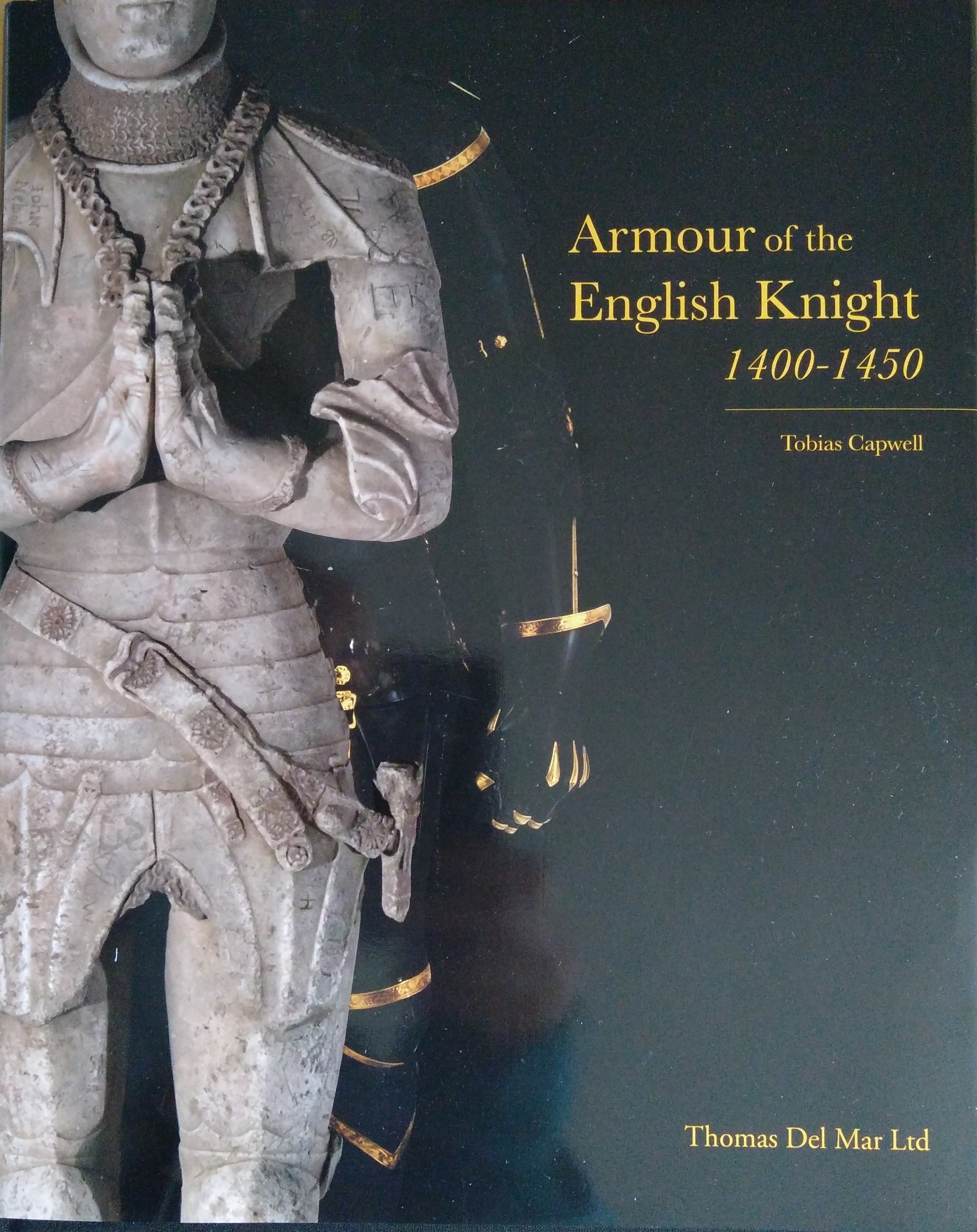
Armour of the English Knight, 1400-1450 is the best book on the subject of armour that I have ever read. I bought it last week at the Wallace Collection museum shop, and was simply blown away.

I’m not really an armour man; I prefer fighting out of armour, but I bought this book because I had just had lunch with its author, Toby Capwell, and when I asked him why the English knights preferred to dismount and fight on foot (eg at Agincourt), he said (charmingly) “I answer that in my book”.

And oh my does he ever.

This was the first time Toby and I had met, so you need not fear for my impartiality, but it’s not the first book of his I’ve read. Perhaps my favourite before this was The Real Fighting Stuff, a delightful survey of arms and armour in the Kelvingrove museum, where Toby was curator of arms and armour before taking up the same job at the Wallace. I should also point out that Toby is a serious practitioner of HEMA- primarily on the jousting scene. He’s one of us, but with better kit.

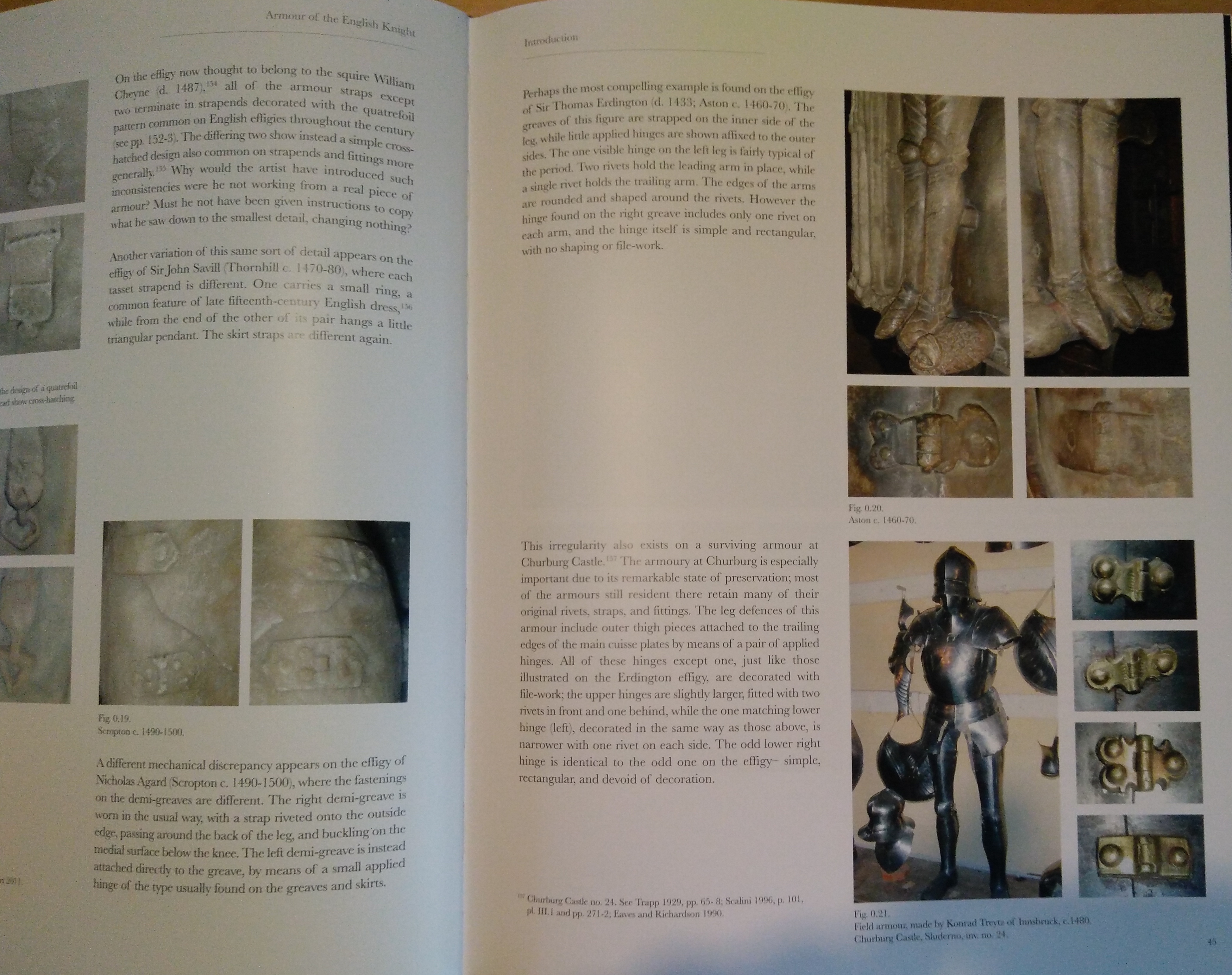
The basic premise of Armour of the English Knight is that funerary monuments can provide detailed information about the armour that the person being represented would actually have worn. This possibly controversial thesis is proven beyond reasonable doubt (to my mind) with a breadth of examples, including details of repairs to armour carved in the effigies that still exist on surviving pieces of armour.

He then uses this data to describe, in great depth and detail, how English armour developed over the course of 50 years or so.

The book is worth buying for the 60 page introduction alone. Or for the photos alone. Or for the rest of the text alone. It’s a coffee-table sized book, produced in exceptionally high quality.

Let me make a prediction: this book is, like most other high-end books on this topic, going to go out of print quite quickly. When it does, instead of paying a measly £50 for it you’ll end up paying hundreds. Because you’ll have seen it in your friend’s library, realised I was right all along and that you simply must have it, and you'll toddle along to amazon only to find you have to sell your house to get a copy: you’ll end up homeless, but with a really good book.

Save yourself the pain and get it now. It’s already over 250 dollars on amazon.com, so don’t even try it there.

Best get it from the Wallace Collection, here. It’s only £50 + shipping. It's £40 if you go there in person and buy it, so Londoners, that's your best bet.

Or you can get it straight from the publisher: It’s £54, EU £65, Rest of the World £75, including shipping. (It's a big heavy book, so those charges aren't unreasonable.

OK, that’s my public service announcement for the week- best get back to editing, and getting ready for my trip to Seattle on Wednesday.

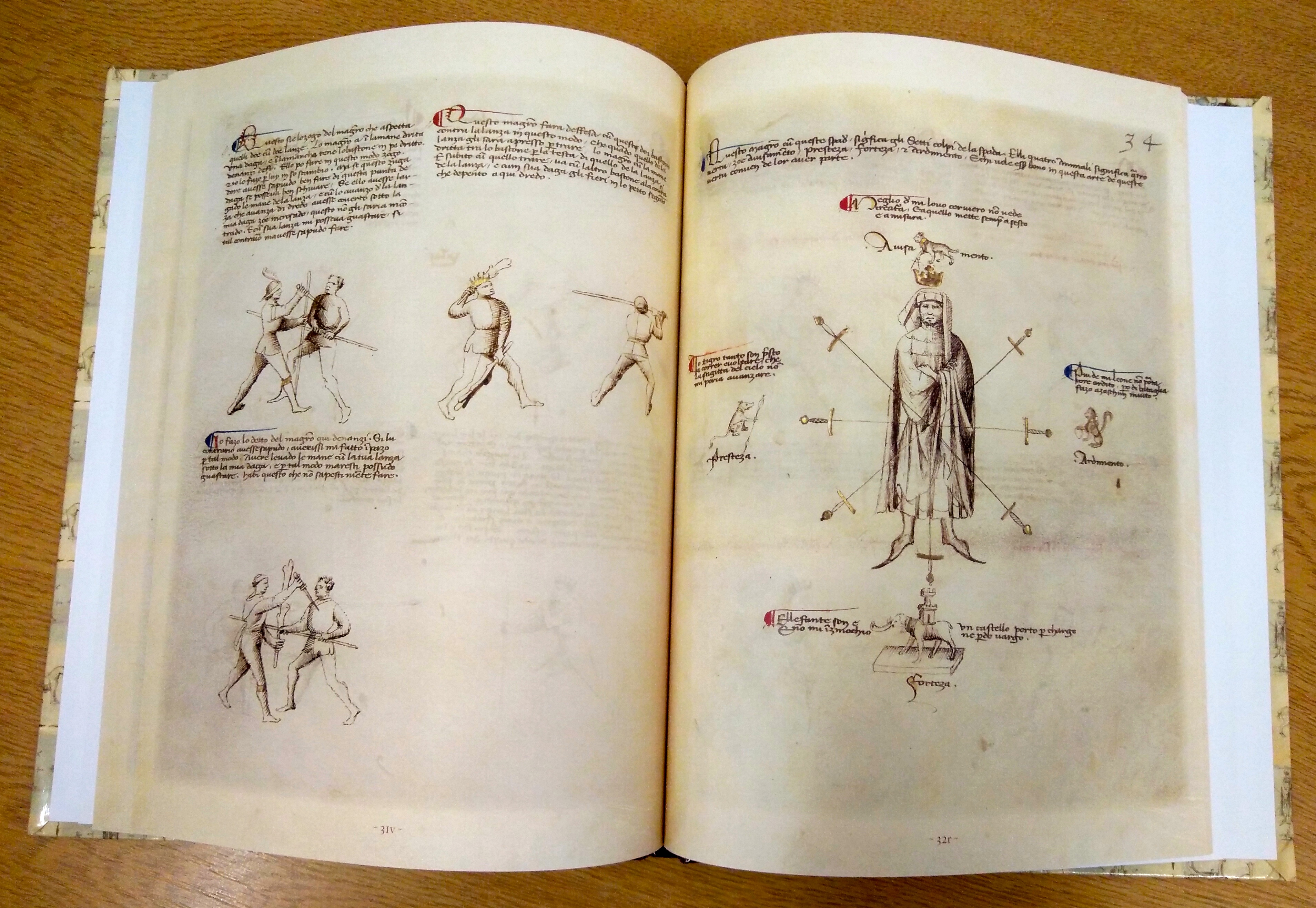
About a month ago I was checking through a pdf of Vadi's De Arte Gladiatoria Dimicandi, and thinking how lovely it would be to just pluck the manuscript off a shelf and curl up in an armchair with it. So I looked into getting a copy printed and bound locally. It was going to cost about £40. “Huh, that seems expensive” I thought to myself. “I wonder how much it would cost to get it printed by the company that does my print on demand publishing?” Then I thought- “you know what, I can't be the only person who wants one.” A quick email to my list triggered a deluge of “yes! do it! do it now! I want one!” responses, so I looked into the costs of getting it laid out and a cover designed.

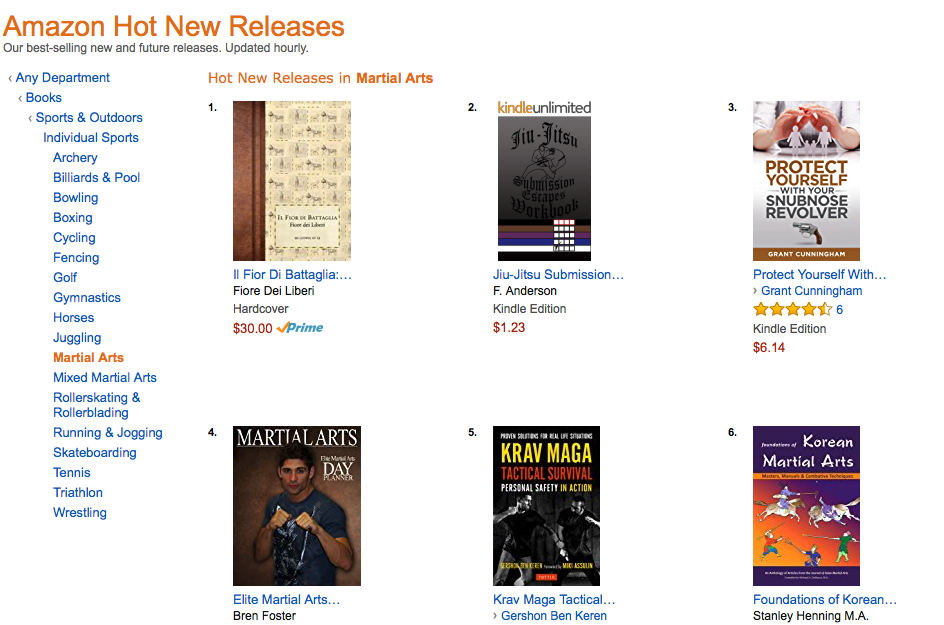
Then it hit me that I really better do Il Fior di Battaglia first. That's a way more popular manuscript, and sales of it could very well subsidize producing Vadi… four weeks later, my facsimile of Fiore dei Liberi’s magisterial Il Fior di Battaglia is #1 in fencing on Amazon (where he assuredly belongs!) as well as #1 in “hot new releases” in martial arts!

The notion of a 600 year old book being a “hot new release” is gloriously ironic, but there you have it. The only modern text in the book is a note in the back saying where the manuscript is, and some details about it. I wanted to keep myself out of these books as far as possible; I mention my Mastering the Art of Arms books, of course, but also Bob Charrette's ArmizareTom Leoni's translation of the text, and some other resources, on the grounds that most readers of the book will be interested. But this is Fiore's book, not mine. It is his manuscript, laid out, but not edited, translated or commented on. It's just its own pure gorgeous self.


Our spiffy logo

And now Vadi is laid out, uploaded to the printers, and I'm eagerly awaiting the proof copy.

The ease and sheer pleasure of producing these facsimiles has lead me to create a new imprint, Spada Press, which even has its own (very basic, don’t go there! ok, you can if you want, but I warned you) website up at www.spada.press  I expect I’ll shift all my book publishing over to that imprint, to help keep the various aspects of my work separate. Expect facsimiles of Meyer (the 1560 ms), at least one other Fiore ms, Marozzo, Fabris, and hopefully Capoferro, in the near future. I welcome requests!

On the subject of books: I have been delighted by the way my beta-readers have been responding to the first draft of The Theory and Practice of Historical European Martial Arts, which I released a 100 copies of recently. While they like the book, they have also made some really useful suggestions for improvement. I hope to get the book finished within the next four months or so. Also, the second edition of Veni Vadi Vici went to the editor at the end of last week— I have completely rewritten the book, reorganised it, and added a ton of material to the introduction. It’s probably 8 months or so from being published, but this was a major milestone in its production, and it is a much, much better book. Veni Vadi Vici was my first self-published book, and it really shows. The second edition has benefitted greatly from the constructive criticism of many readers, and the expert help of friends and colleagues. I hope it does them justice. I will be sending out ebook copies of the finished book to everyone who backed the crowdfunding campaign, and to everyone I can reach who has bought the well-meaning but flawed Veni Vadi Vici since it launched.

I would say that was a cracking start to 2017, wouldn't you?

I just uninstalled the Facebook app off my phone.

Shock! Horror! How could  I do such a thing?

Well, yesterday I gave a class to some students on a professional writing course at the University of Suffolk here in Ipswich. The topic was time management, and my advice boiled down to the following key points:

  1. Distinguish between ‘urgent' and ‘important'. Most things that come in appear urgent but are not important. Many things that are important (like writing the next book) do not feel urgent. Prioritise the important over the urgent.
  2. Create assets. Assets are anything that add value to your life. Value in this case is usually either money, or reputation, or both.  A book is an asset if it boosts your reputation, or makes money, or both. (My first book The Swordsman's Companion made me precisely no money between 2004 when it was published and 2013 when I self-published it. But it put me on the map as a swordsmanship instructor.) In the case of the students present their degree would be an asset, as would a blog they maintain, or work they do that can go in a portfolio to show clients. Facebook status updates? Not assets.
  3. Put first things first. Try to get some work done on an asset before checking email or anything else. Your inbox is everyone else's agenda. Your assets are your agenda.

On Monday morning this week I followed my own advice to perfection. I got up and did my meditation, had breakfast with the kids and walked them to school, then came home and produced the final videos for my Footwork course (which is now complete, with students enrolled and everything), and edited some videos for my Medieval Dagger course (which is also now complete). After about two and a half hours of full-on creative and productive work, my computer was tied up rendering video, so I took a break. I did some breathing training, took a shower and got properly dressed… And checked my emails for the first time that day. My creative intention had not had a chance to get derailed.

Back in 2006, in the days just after publishing The Duellist's Companion and right before my wedding, the server that hosted the school website and my emails broke. Five years of emails, my entire inbox, everything, gone in an instant. At a rather busy time in a self-employed person's life. But you know what? I can't think of a single bad thing that happened because of it. Not one. Everyone who mattered (such as my future wife) had other ways to get hold of me. Every important email got sent again by the person who hadn't gotten a reply yet. The wedding went off without a hitch (she showed up and said “I do”. Everything else is a blur). There are two takeaways from this. 1. Backups are important for your important work, but probably not so much for your emails. 2. Very few emails are truly important.

Whenever I talk like this, people jump up and down about how critical their rapid email responses are to keeping their jobs. My answer is in the form of a book: Deep Work by Cal Newport. To sum up, firstly, your job probably doesn't genuinely value your rapid response, they just expect it. Most knowledge workers don't put “I respond fast to email” on their CVs. You can train your co-workers off treating email like instant messaging. Sure, I'm in an unusual position, but Cal is not- he's a Computer Science professor, with all the admin crap that goes with that, so read his book and take his word for it. But you might find my contact page instructive in setting expectations. I'll save you clicking and quote:

Hi! You can email me, which I prefer, or find me online on FacebookLinkedInGoodreads, and Twitter, or if you like, try this spiffy form. Whichever you choose, please bear in mind that I don’t have a secretary, but I do have family, students, books to write and a school to run. This means that I think I’m doing pretty well if I answer your email within three working days, and any social media message within seven. After that time has expired, and there is still no response, try emailing again!

Then, when I reply to someone's email in two days, their expectations are exceeded and we're all happy.

Secondly, do you really want a job in which your primary value is not doing deep creative work, but simply reacting to emails? Really?

Getting and staying out of a reactive mindset is critically important to getting serious work done. Reactivity is not creative. Sure, creative work is often done in reaction to something; protest art, for instance, but the process of creating that art is not reactive, and a wise artist doesn't let anyone see their work until the first draft is done.

This goes to one of the most important ideas for living a worthwhile life: expanding your circle of control. Mr Money Moustache (one of my favourite bloggers) has written an excellent article on this here, but let me summarise it for you. You should spend your attention only on the things you can directly affect. By doing so, you become better able to affect the things you care about. Moaning about politics is a classic beginner's mistake. Writing to your congressman or MP, voting, organising or taking part in protests, standing for office, are all much more effective responses. If you're not planning on doing any of those things, then you shouldn't burn any mental effort on thinking about it. And moaning about the weather? Come on. The weather doesn't care. Either wear the appropriate clothing, or choose to do something else. By paying attention to the things you can affect, you become much more effective and your circle of control grows. Expending effort worrying about things you cannot affect takes away from those things that you can, and you become less effective, and your circle of control will shrink.

What has all this to do with Facebook? Well, 99% of the stuff in my Facebook feed I skip over. Of the 1% I react to, 99% is not stuff that I can directly affect. This is incredibly inefficient. But this morning I found I had checked my email and my Facebook feed before doing my breathing practice or working on an asset. And yet I had just the day before spent an hour being an ‘expert' and preaching to these students about putting first things first.

The thing is, Facebook is staffed by hundreds of people who are way cleverer than me, and whose paychecks depend entirely on making the site sticky. They need our eyeballs on those ads or they are out of a job. They are naturally very, very good at getting and keeping our attention. The only way to win is not to play. Getting off the scroll-scroll-click dopamine drip is very likely to enable me to increase the value I put into the world. Of course I will keep my Facebook profile and pages- they are a useful aspect of my business and personal life, great for organising parties, keeping up with far-flung friends, and all of that. But by increasing the barrier to entry (taking it off the phone), I will only be able to get on Facebook on my work machine, which means after I've done some useful work (because, you know, self-discipline and all that. Lack discipline? Use an app such as Freedom that prevents you getting onto the internet altogether, or blocks certain sites until a time you set).

This is the great thing about teaching. You teach that which you most need to learn, and by being forced to set a good example to your students (because who wants to be a hypocrite?) you get better at the things you care about.

Right, that's 1300 words of creative writing done. What next? Should I open up Scrivener and get to work on the next book? Or dash on over to Facebook and see who's been getting up to mischief?

It’s easy to forget that “blog” is shortened from “web log”, which is adapted from “ship’s log”, which is a daily record of every notable thing that happened on board ship; your position, distance travelled, direction, weather conditions, Seaman Jones flogged for impertinence, Midshipman Smith lost overboard in a freak encounter with a Kraken, that kind of thing.

So, in the spirit of the log, I thought I’d update you on my current position, progress, and floggings.

I am working on five major projects at the moment. They are (in order of likely to be finished soonest) Audatia’s Liechtenauer Expansion Pack and the Patron’s Duel Deck; Mastering the Art of Arms volume 3, Advanced Longsword, Form and Function; Sent: Surviving the Boarding School Experience; preparing to move to Ipswich in the UK, in June; and sorting through and fixing the damage done when I was sent to boarding school. I am also working on a few minor projects, such as organising and uploading photos of various books.

Audatia

Our dashing Patron

You may have read my post on playtesting the almost-perfect decks. Rami and I have received corrected pdfs back from Jussi Alarauhio, our fabulous artist, and they should be good to go on DriveThru cards very soon. The main delay has been that this is Rami’s side of the business, and he has been struggling with some family issues that have kept him away from work a lot over the last few months. I won’t go into details because it’s not my story to tell, but suffice to say no decent person would expect him to be doing much work at this time. I’m taking up the slack as best I can, but I can’t replicate his expertise. Still, I am confident that all the printed decks will be shipped to our backers and the print-on-demand service will go live, very soon.

Advanced Longsword

Just this very morning I sent back the 5th corrected pdf of the final version of the book; with only three minor fixes to do. The covers are also done; I’d be very surprised if I don’t get the book uploaded to the printers by the end of next week. Fingers crossed!

Sent (and other projects)

I received a grant from the Suomen Tietokirjailijat Ry (Finnish Non-Fiction Writers’ Society) last month to write this book, and I’m now 35,000 words into the first draft. I’ve not written much for the last week or so mostly because I’ve had a horrible cough for the last fortnight, and I only work on difficult tasks when I can give them 100%. The cough took the edge off my writing, so I stopped for a while and did things that take less brainpower, like for instance organising the photos of my copy of the 1568 third edition of Marozzo’s Arte dell’Armi, and uploading them for free download (or pay what you want) from my Selz account.


I’m also half way through preparing the free download of photos for Advanced Longsword, and of my 1606 Fabris and 1740 Girard.

It’s been really interesting to see the number of downloads, and the range of payments people have chosen to make. It has been downloaded 516 times, with the majority paying nothing (of course!); and a generous minority paying as much as 20e for the photos. It’s raised over 200e, which is very helpful.

Moving to Ipswich

This is a major undertaking, especially with two children. We know where in Ipswich we want to live, for the sake of getting the kids into schools we like, and we have some idea of what we are going to do there. After writing about it here, and posting the final destination on Facebook, the two most common questions I’ve been asked are:

1) What will happen to your school? This tells me that the asker thinks that the Helsinki Branch is “The School”, which is not accurate. It’s just one branch. The School will carry on exactly as before, and so will the Helsinki branch of it. While I can’t predict the future, given the excellence of the students running it, I confidently expect the branch to go from strength to strength. I wouldn’t have planned to leave Helsinki if that were not the case. As for the wider school, well, flights are cheaper from the UK than from Finland, so it should be even easier for me to get to visit the branches worldwide.

2) Are you going to open a branch in Ipswich? No. I have already gone to a foreign country and opened a school of swordsmanship. That went very well, but I have no plans to repeat the experience. As I wrote in this post, I consider myself now a consulting swordsman. I’ll be happy to come along and help any school in the UK that wants it, but I do not intend to open any kind of formal training establishment in Ipswich. At some point I imagine I will need a cadre of people I can train with and bounce ideas off, as I have done with my senior students here since forever, but I expect that will happen organically. Starting a branch is a huge undertaking, and I have other things to do.

I have already packed up my fiction books. Non-fiction next. Then woodworking tools. Then swords. Then disposing of unnecessary items, and packing the rest for shipping. This is a long and tedious process, but it does offer a great opportunity to get rid of clutter, and think really hard about how much stuff we actually need. My core fencing kit is three longswords (blunt, cutting sharp, and pair-drill sharp), two rapiers (blunt and sharp, plus matching daggers), two smallswords (blunt and sharp), two foils (left and right handed), schiavona, backsword, cavalry sabre, arming sword, buckler, mask, gloves, gauntlets, freeplay plastron, coaching plastron, stopwatch, teaching stick. But lately when I travel to teach, I bring absolutely nothing. Hmmm….

I spent much of yesterday afternoon in my shed, fiddling about, and thinking about what tools I absolutely cannot do without. I noticed that I have 21 different woodworking planes, and thirteen different hammers. Non-woodworkers might think that's a lot; craftsmen will wonder how I manage with so few. If you're interested in a more detailed exploration of the de-cluttering, packing, and moving process, as regards books, tools, or swords, then let me know in the comments here, and I'll start documenting it.

Stuff in the shed

Boarding School recovery

This is indirectly tied to writing Sent, of course, though oddly enough I haven’t had any real emotional issues when writing. My wife was worried that I might, but it’s been fine. The place I have got to, through talking to the right people, meditation (which has been really helpful), and just thinking about things, includes the following:

  • While there has been a definite emotional cost to the experience, it has come with some benefits (especially education).
  • Given the outcome (I am happily married, in a great job, with lovely kids and friends and so on), there is no reason to think that it was the worst course of action that could have been taken. I could have been eaten by a lion in Botswana, or died of cholera in Peru; who knows?
  • I am out of it. I got out. And I got out without incurring the kind of damage that I recognise in many of my peers.
  • Looking back I can see the many, many occasions in which I found a feeling of family and home in the kindness of the people around me.
  • I’m still having trouble with the mercilessness of it. Boarding school back then was wilfully, deliberately, spartan. And even that was an order of magnitude more civilized than even a decade before. But still, the whole idea of sending little children away from home “for their own good” is, except in really exceptional circumstances, utterly wrong.
  • The time is long past for a minimum age for boarding. Many of my friends chose to board, from the age of 15 or so, and loved it. While every child is different, and any specific age limit is arbitrary, we still recognise that people are legally adult at 18; can drive at 17, can smoke at 16 (in the UK at least); can watch certain kinds of movie at 15, or 12, and so on. So here’s a thought. The next Pirates of the Caribbean movie will have, in the UK, a 15 certificate. Is a child who is not yet mature enough to watch Pirates of the Caribbean old enough to be sent away from their parents to boarding school? I think not. So I think I will campaign to introduce a minimum age for boarding. That will keep me busy in the UK, I think…

Floggings

There are no floggings to report. If you think there should have been, you can take it up with my wife.

It’s time for a change of pace.

I have been a full-time professional teacher of historical swordsmanship since March 17th 2001. By which I mean it was my one and only job, source of income, and so on. This has had all sorts of benefits, not least that I have accumulated a huge amount of experience in teaching and researching the art of arms. These days, most students who come to one of my seminars for the first time, or have their first private lesson, find it an eye-opening experience. But I realised in 2014 that I do not want to end up being the little old man still teaching day-in-day-out after 50 years; the archetype of the old martial arts teacher. There is nothing wrong with that, of course; it just isn’t me. And that came as a surprise, because it is exactly how I had imagined my life would go.

Up until 2013, about 90% of my income came from the Helsinki branch of the School, with 10% coming from seminars in other branches or for other schools. Then I started self-publishing my books, starting with Veni Vadi Vici. That went well enough that I had the bright idea of re-issuing the out-of-print The Swordsman’s Companion, and The Duellist’s Companion. This turned out to be a game-changer; by the end of 2014, with  The Medieval Longsword also out, they were bringing in enough money every month to pay the mortgage, and accounted for about 50% of my disposable income. This is the financial background that has made it possible for me to wind down my regular teaching at the Helsinki branch (I taught my last class to date (NOT my last class ever, of course!) on my 42nd birthday: November 30th 2015).

I had been a swordsmanship instructor who also wrote books; now it's fair to say I'm a writer who teaches swordsmanship. And to be honest, while I do miss my students, I don't miss having so much of my waking time taken up with class. It's given me much more freedom to write, and play around with training routines, and play with my kids. And I will be taking advantage of that freedom to take my family to the UK in June this year, for at least a year. We are still not decided exactly where, but that question should be settled by the end of this month. I have no intention of starting another branch of my school there; I have my hands full with the branches I already have. Besides, I've been there and done that; I feel no need to do it again. But I may well be looking for training partners, and of course I'm reasonably available for seminars. There is a thriving HEMA scene in the UK, and I look forward to taking some part in it.

For most people in my life, students, friends and family, these changes will make no difference at all. For a few senior students it will come as something of a change, and for me it will make all the difference in the world. Here's why:

When I started my School back in 2001, a strict and clear hierarchy was necessary. I was responsible for the safety of a whole bunch of absolute beginners; they had to do as I said, or someone would get hurt and it would be my fault. As the School developed, and a culture of safe training was firmly established, my iron grip relaxed and classes became much more organic; students had more input, and there was no need for the strict discipline that we had had before. I think people learn better in a relaxed and friendly environment. But at the same time, a hierarchy was established, the sort that is common to most martial arts. Teacher at the top, senior students outranking juniors, and so on. We have skill-levels, but actual rank is not tied directly to them; we have Free Scholars (literally students who have the freedom of the school; they can open the salle for training at any time, that sort of thing), Class Leaders, who are Free Scholars that have been examined and passed for leading basic classes, and Provosts, who are the senior student responsible for a branch. The problem is that all rank promotions come from me directly. Senior students can recommend their peers, and I wouldn’t appoint a Free Scholar without consulting with the existing cohort, but ultimately, it’s down to me.

This means that I have to be super-careful not to play favourites. For promotions to have meaning and value, they must be based on  transparently applied objective criteria. This leads to me being quite isolated from the students; I have to be really careful not to like any of them more than any other. But as a human being, of course I happen to gel with some more easily than others.

One of the legacies of my boarding school experience is that I find it far too easy to detach. In fact, problems of proper attachment are pretty much the hallmark of institutionalised children. So there is a switch in my head, which is either on the “student” position or the “friend” position. And there are no grades in between. It ought to be a rheostat, but instead it’s binary. Over the course of the last 15 years, some of my students have been adept at flicking that switch back and forth, and some have never allowed it to swing into the “student” position.

So what? You might reasonably ask. So, the people I have spent most of my time with, and with whom I have the most in common, have to be kept at arm’s length.

Sure, in any profession, you need a certain level of detachment. A beginner in their first class, or a senior student working hard on a difficult problem, need a teacher that is able to see them in full “student” mode. But even after a decade in class, most of my students have never seen the inside of my home. That’s just plain weird.

This is one of the reasons that I enjoy going to events and teaching seminars outside of my School; I’m not holding the keys to their next diploma; I’m not their judge. So I can interact with them on a much more natural level. And it’s ok to make friends.

I have been feeling this way for a long time. Years in fact. But it’s been a slow-growing realisation of what the problem is. I have always disliked rank exams, because I’ve always disliked the feeling of judging my students. Where you happen to be on the path is far less interesting and relevant to me than how far you have come.

I stopped wearing my all black training uniform, familiar to you all from my books, in favour of a much less forbidding combination of blue t-shirt and white-ish trousers in November 2014. The first time I wore the new threads in class, there were some raised eyebrows, but the world did not end, and the students were taught properly. My blacks had become an armoured carapace for keeping me separate, so I took them off.

Now to my main point for students of The School of European Swordsmanship: Students, my lovely students, if you want ranks and skill-levels, here is what you must do: set up a grading committee, organise panels of examiners, and do it yourselves. I will advise if asked, I’ll sign certificates; I’ll even sit on examining boards. But I will not ever run another exam solo. And if I happen to feel like I have some kind of history with the student being examined, I’ll recuse myself from sitting on their exam board.

As one long-term student of mine put it: “you’re divorcing the School to marry your students”.

If Sherlock Holmes can be a consulting detective, and Moriarty a consulting villain, then dammit, I can be a consulting swordsman. I am delighted to help you with any sword problem you may have, but I am done being in charge. It is not and never has been my nature to command and control. Within the context of a class, of course it is sometimes necessary to exhort students to greater efforts; to tell them what to do. But every class I’ve run for ages now has begun by asking the students what they need from me that day. This often surprises students having their first seminar with me; most teachers just get up and teach their class plan. I co-create the class plan with the students in the first 5-10 minutes of the seminar. On my last teaching trip to the USA, the organiser called this “a very adult way to run a class”. Because it assumes a certain level of competence in the teacher, and a certain level of interest and engagement from the students.

When Salvatore Fabris was fencing master to the King of Denmark, who was in charge?  Which is more likely: “drop and give me 50, your kinginess!” or “Your Majesty, I would strongly advise a few push-ups at this juncture. 50 would be an excellent choice.”

Or as I put it to my students: If I’m Fiore dei Liberi, that makes you Niccolo d’Este, Marquis of Ferrara.

So, my Lords and Ladies, how can I be of service?

Hello.

Do you find yourself explaining the same thing over and over to various friends and colleagues? Wouldn’t it be easier to just explain it once, and then send the explanation to anyone who needs it?

In my case, I tend to explain all sorts of things regarding swords, as teaching swordsmanship has been my job for the last 15 years. But lately, more and more people have wanted to talk to me about writing books. This makes sense, given that I have written half a dozen of them, plus hundreds of articles and blog posts, and these days about half my income comes from the books I’ve had published in the traditional way, or published myself. When I found myself explaining the process I use to write and publish books for the hundredth time, I thought that perhaps it was time to follow my own advice and write the process down so anyone who wants to can use it.

A History Lesson

Back in 1999 a friend of mine suggested I should write a book about how to fight with swords. I had been teaching swordsmanship for about five years by that point, in a club I helped to found in Edinburgh in 1994. This friend was quite persuasive, so I set to, in my spare time from my cabinet-making job. A year later I had left woodwork to start The School of European Swordsmanship, (in Helsinki, Finland), which kept me busy in the evenings and weekends, but left much of every day free to write. It took me another two years to get the first draft ready. What with publisher’s delays and endless edits, the book, The Swordsman’s Companion, did not see the light of day until June 2004.

The day I sent off the final final draft I sat down to write the next book, which became The Duellist’s Companion. That only took two years, including the madly slow publishing process; so about 18 months of writing time.

My last book, every bit as difficult, and much more advanced than either of these two, was written in under three months of actual writing time, spread over the course of a year.

What changed?

I learned how to do it.

The process

Never, ever, try to write a book. It’s too big. Write a word, or a line, or a paragraph, or maybe even a chapter. You can start with a question, the more specific the better. “How do you use a sword” is too general. “How do you hold a medieval longsword” is much better. So, break up the topic into lots of very specific questions. “How do you defend yourself from a thrust to the belly from a low guard on the right?” is good. “How do you defend against thrusts” is less good, unless you already have three or four related and very specific questions answered, and you can summarise them.

One question = one episode/article/paragraph/chapter.

A little question can be answered in 200-3000 words. Just about right for a blog post, or a facebook update, something like that. A big question can be answered in 3-10 thousand words. Perfect for a short ebook.

5-10 big questions on the same topic can be edited together into a book.

Now what about fiction?

Well, I’ve never published a novel, so I’m no expert on this, but I have several friends who have. And some of them have written books about it. Storyteller Tools by M. Harold Page is a very useful book, and so is Jump Start Your Novel, by Mark Teppo. I recommend them both highly. There is no reason why this process would not work for fiction too, though it doesn’t solve the issues of creating engaging characters or thrilling plot. The thing you sit down to write is a scene; many scenes, properly ordered, make a novel. For fiction writers reading this, I’m sure you can draw the necessary parallels.

Step 1: to plan, or not to plan, that is the question!

This is very much down to your personality and experience. If you have an enormous question that can be broken down into 6-12 big questions, then right now you could get a piece of paper and a pen, and organise the questions into your table of contents. The trick to ordering them is to keep in mind the prerequisite knowledge for each answer. I can’t explain to you how to hold a sword if you don’t know what a sword is. For every question, it is usually best to assume that your reader knows absolutely nothing. It’s been my experience that most students coming to me can’t even stand or walk properly. (Really. Most people have problems with their gait.) So I start with how to stand. It’s never wrong to go too basic; it is much better that readers skip over stuff they know (or think they know) to get to the “good stuff”, than it is for readers to be baffled or frustrated because they don’t have the background you imagined, and so can’t follow your thread.

Let’s take my book The Medieval Longsword as an example. The enormous question I’m trying to answer is: “how do you fight with a medieval longsword?”

The table of contents doesn’t look like a list of questions, but here it is, with the questions added.

Introduction to the Mastering the Art of Arms Collection: “how does this book fit into the other books in the series?”

Foreword by Christian Cameron: “does anybody famous and cool who knows about swords think this book is good?”

Introduction: “how does Guy know what he’s talking about?”

Chapter One: Tools of the Trade: “what equipment do I need?”

Chapter Two: General Principles: “what are the fundamental ideas behind how swordfights actually work?”

Chapter  Three: Footwork: Stepping and Turning: “how do I move?”

Chapter Four: One Strike, One Defence: “what is the basic attack, and the basic defence against it?”

Chapter Five: More Strikes, More Defences “what other attacks and defences should I know to start with?”

Chapter Six: More Strikes, and More Guards “what are the less common attacks, and the other guard positions?”

Chapter Seven: Counter Remedies,  Their Counters, and Improving

the Guards: “how do the fighters continue after the first attack and defence?”

Chapter Eight: Counters to the Break,  The Sword in One Hand

and Exploiting Mistakes: “what other cool techniques are there?”

Chapter Nine: Binds, Malice and Deceit: “what tactics are best?”

Chapter Ten: Preparing for Freeplay: “I want to fight my friends without killing them. How do I prepare for that?”

Chapter Eleven: Freeplay! “and how do I actually do it?”

Chapter Twelve: A Final Summary:  The System by Numbers: “how do I remember all this stuff?”

Appendix A – Warming: Up “how do I warm up?”

Appendix B – Glossary: “what do all those funny Italian words mean?”

Acknowledgements: “who helped in the writing of the book?”

Indiegogo Campaign Contributors: “who bought the book before it was even published (bless them)?”

Bibliography: “what other books were needed to write this one?”

Knowing all those questions in advance, it was quite easy for me to plan the book out, and then just write each chapter as it came. I didn’t write them in order though, I answered the question I wanted to answer each day.

Writing a series is a bit different. In The Swordsman’s Quick Guide for example, the questions are far less naturally connected: “what are the fundamental aspects to mastering any skill?” (The Seven Principles of Mastery); “how do I choose a sword?” (Choosing a Sword); “how do I train myself up to freeplay standard?” (Preparing for Freeplay); “what is the ethical dimension of swordsmanship?” (Ethics); “how should I teach a basic class?” (How to Teach a Basic Class (forthcoming)). As I add to the list, I may end up with a coherent book, or I may not. It doesn’t actually matter. But at this stage there is no point in sitting down to plan the whole series, because I don’t have one enormous question I’m trying to answer, just a series of smaller ones.

Step 2: define the questions as closely as possible, and answer them

This is what you will write today. “How do you set up a table-top role-playing game for 3-8 players?” is a good question. “How do I cut lap dovetails for a drawer front?” is a good question. You can write your answer straight out, if that’s natural. Or talk into your phone, and type up the answer, if that’s easier. Or call a student or friend, somebody who has asked the question, and explain it over skype, recording the call. Then type that up.

Step 3: send your answer out to test readers

Only the people who do not already know the answer, the people who would actually need your book, can tell you whether it solves their problem. So you need to find these people (I’m assuming you have some kind of social network, or at least one actual person has asked you this question), and ask them to read it for you, and let you know honestly what they think.

I’ve been writing for a long, long time, and still I get all sorts of negative feedback from my test readers. Positive comments are nice, but negative comments have a much greater capacity to improve the work, so that’s what you need from your readers. Beg them to be merciless.

Apply as much or as little of the feedback to your draft as you like, then sit on it while you go to step four:

Step 4: rinse and repeat

Find and answer at least two more really specific questions, following steps one and two. You now have three or more short pieces, of about 3-10 thousand words each. Go back and re-read the first one, in the light of the other two; you’ll probably find a few more corrections or additions to make.

Step 5: give readers a way to contact you

This is absolutely critical. Your readers must have a way to get in touch, because you absolutely depend on them for critical feedback. You exist to solve their problems; you have to know whether you are doing that well or not. Give them as many ways as possible; email, website, facebook, twitter, phone, snail mail address; every medium that you are willing to be contacted on. Then let them contact you in the way that suits them best. Put this information at the beginning and end of each article.

On the advice of a friend, I got myself a Facebook account in 2010. Within three weeks, somebody in America had got in touch to ask me whether it would be ok to use The Duellist’s Companion as the curriculum for his rapier school; of course he’d insist every student bought a copy. Would that be ok?

Hell yes! By offering a low-barrier-to-entry, unintimidating means of getting in touch, I made it easy for this chap to ask the question. I would have been perfectly happy with email. I prefer it. But it’s not about what I prefer, now is it?

Step 6: cover design

If you have the budget for it, by all means get somebody with artistic flair to make you a cover for each of your pieces. If the questions are closely related, you can go with a series cover, like my The Swordsman’s Quick Guide, but if they are not, use separate covers. You can pay anything from about 30 euros up to over a thousand per cover. At this stage though it’s perfectly ok to just do it yourself. It doesn’t have to be great. Because we are not nearly done. When your complete book is ready, then I would highly recommend hiring a professional cover designer if you can possibly afford it. But for now, it’s not such a big deal.

Step 7: (optional) publish the articles

At this stage you have a few articles, which will either be stand-alone parts of a series, or chapters of the book. You can greatly expand your circle of test-readers by publishing them. It’s probably best to publish them in two-week cycles, rather than all at once. Because while you’re beavering away writing articles 4-6, you can be publishing 1-3 one at a time, and giving the impression of massive productivity. Go you!

Beg for feedback, reviews, any kind of reader response. To get this, make sure your readers have a means to get in touch.

Your sales at this stage are not the point. It’s ok if they are tiny. You sold five booklets at 99 cents each to people you didn’t know this month? Excellent!

You know that an article is ready to publish if you can honestly say to yourself that you are doing the readers a favour by publishing it. That’s the barrier. Will reading this improve their lives at a level commensurate with the price I’m charging?

Before you publish, make certain that at least one test reader is a competent copy-editor. The sort of person who notices  the double space I just put in between “notices” and “the” in this sentence. If you have no friends with this very specific skill, then hire somebody. I recommend Becca Judd, who edited Swordfighting for me, and Advanced Longsword.

Step 8: compile and edit the book

The book of your dreams does not exist. I sat down to write THE BOOK in 1999, and I failed miserably. There are a million other books, all at least as much worth reading. But I did manage to write A GOOD BOOK. And that’s plenty good enough.

You can produce a simple compilation volume (which you should probably do anyway), or you can edit the articles together into a complete new book (with a bunch of extra material, I would suggest; perhaps no more than 60% previously published stuff). There is nothing stopping you from writing extra material for your completed book as you go along, choosing for early publication only the parts that lend themselves easily to being answered as a separate article. Let’s say you have 6-10 articles that together make most of a book. By putting them in order, you can see what’s missing; an introduction to the book as a whole, sure, and usually some kind of conclusion section, but you may also realise that there are logical gaps in your narrative. So fill them.

This process is much easier if you are using a decent word processing program, like Scrivener, which allows to re-order your individual chunks (scenes, questions etc.), and to visualise really clearly how everything fits together.

Further questions:

1. How long should my book be? There is no rule about how long a book must be. I have paid good money for short books and not regretted it. The Dip, by Seth Godin, is a good example. And I’ve failed to finish many thicker books because I got bored half way through. So length is a poor guide to quality. As a basic rule, anything under about 3000 words is probably too short to charge for. Anything over about 40,000 words is definitely a proper book. Swordfighting is about 95,000 words; Advanced Longsword is only about 40,000, but has a lot of photos.

2. When should I produce a compilation volume? How many articles do I need first?

You should produce a compilation volume when the maths tells you to. When you can offer a 30% or better discount on the compilation over buying the parts separately, go.

For example, episodes of The Swordsman’s Quick Guide are 3.99 sold separately. 4×3.99= 15.96. I sell episodes 1-4 together for 9.99; a saving of over 35%. And it does sell. If you’re selling them at 99cents and the compilation for 4.99, then you’d want at least 7 articles: 7x.99= 6.93 6.93/4.99= 1.39

Only six articles would give you a discount of 19%:  5.94/4.99= 1.19.

3. How do I price my work? Regarding pricing, the best approach is to aim for the top price bracket common in your field. Very short romance? .99 cents is probably as much as you can charge; how to write a book? 4.99 seems reasonable 🙂 You need to ask yourself the question “why the hell would anyone want to read this book?” and answer that in your marketing material (for advice on marketing your book, Joanna Penn’s How to Market a Book is superb); then ask “what is this book worth to the reader?” Nobody cares how much you sweated and bled over it in the long dark watches of the night. They only care about what it’s worth to them. And if they don’t know you, then it’s probably not much. Examine your own browsing and buying behaviour; it’s amazing how many books you’re interested in that you don’t buy!

And Finally

Lots of people seem to want to be writers. Damned if I understand why. Far fewer seem to actually want to write, which makes more sense. Writing is hard work, bad for your health (especially if you sit down to do it), and exhausting. To be a writer, just write stuff. To write a book, write lots of stuff on the same theme and edit it together. It is actually pretty simple. But simple and easy are not the same thing, so here are a couple of further thoughts to lower the barriers a bit.

Discipline is Freedom. This is key. The ability to push past discomfort in pursuit of a long-term goal is the fundamental skill that underpins all success.

Constraints Liberate. This is a catchphrase of the Dark Angels (the organisers of the writing course I went on in September). It is very hard to “just write a book on any topic, long as you like”. It is much easier to write a book of between 40,000 and 50,000 words on how best to create a card game based on swordsmanship (for example). The more specific the task, the easier it is to accomplish. So impose some specific constraints on yourself. 2000 words on how to tie a cravat, by 5pm Friday. No problem. When I was at school we had a discussion in class about this. My English teacher Mr. Thornberry, set us a challenge. On the first week, we could write anything we liked. On the second, he set us a specific task. We then read the essays out loud, and it was obvious that the second set were much better than the first.

Break it up even smaller. A book is too big to hold in your head at once. A chapter might be too big too. So write smaller. A paragraph describing the problem in clearer terms might naturally grow into the chapter you were thinking of.

Make it personal. If you try to write to the world, guaranteed not everyone will like it, want it or even understand it. Instead, try writing an email. We can all do that.

“Dear Jeremy,

Ok, if I understand your question correctly, you want to know which end of the sword to hold. While opinion may differ somewhat among my colleagues, those of them that actually win fights all agree that you should hold the blunt end; we call it the “handle”. (continue for another few paragraphs)

yours,

Guy

Then strip off the “Dear Jeremy” and “yours, Guy”, edit it a bit, and you have a chapter.

It can liberate your creative juices to simply have a specific person in mind for your work.

If I’d known how much work the first book would be before I wrote it, it would probably have never been written. If I’d known how it would change my life, I’d have written it even if it was ten times as hard to do.

And if I’d had this method? I’d have written it in a quarter of the time.

I have created a pdf of this article, which you can download free. This is an experiment with the “pay what you want” model; I'll be very interested to see how many people download it, and how many choose to pay for it. I have been thinking about moving all my ebooks to “pay what you want”, but I have to be sure I won't starve doing it!



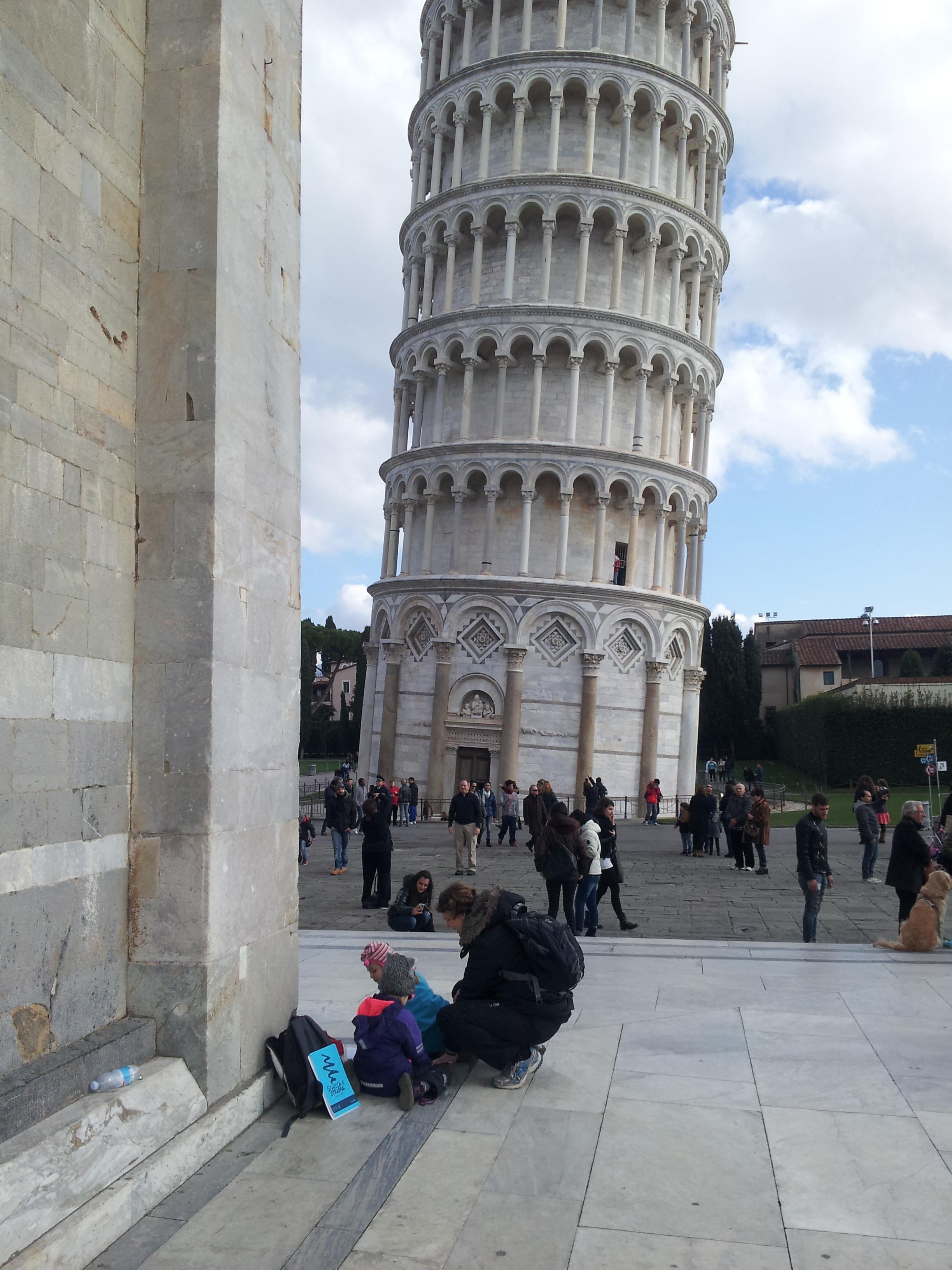
Is this the most famous tower in the world? And is it perfect? Note the two perfect little artists in the foreground, supervised by Mrs Guy.
Is this the most famous tower in the world?
And is it perfect?
Note the two perfect little artists in the foreground, supervised by Mrs Guy.

I understand perfectionism. In some areas of my life, I can see every flaw in what I am doing, and so it feels like everything I do is not nearly good enough.

Good enough for me, that is. But usually, it’s plenty good enough for accomplishing its goal. Let’s take a basic sword strike for an example. My mandritto fendente right now is just a great big mess of inefficiency and flaws. Compared to what it could be, anyway. Compared to what it was five years ago, it’s actually not too bad. I certainly hit a lot of people with it.

That strike is the most common blow in all swordsmanship. What kind of swordsman would I be if I didn’t use it at all, just because it’s not perfect yet? Or if I didn’t expose it to feedback, in the form of resistant opponents or knowledgable peers?

As my writing career has developed, more and more people are coming to me for advice, and excessive perfectionism is one of the more common problems they want help with. It is very hard to let a piece of writing go out into the world when you know it could be better, even when you are well into the realms of diminishing editorial returns, so I thought I’d put together a blog post (laden with imperfect writing, alas) with some mental tricks you can use to make it easier.

Please note that this is intended to help people whose problem is excessive perfectionism. Not to justify sloppy editing or to support writers who let stuff out the door too early. Every published work needs at least two drafts, then editing by at least one, ideally more, external editors, then a final draft incorporating the edits, then proofreading (for typos etc.), then layout, then a final round of proofing, before it should be released. About 10% of the first draft of The Swordsman’s Companion made it into the final version. And I only changed about 5% of that for the second edition. About 90% of the first draft of my second book, The Duellist’s Companion, made it into the final book. (I’m working on a second edition now…)

1. This book is not the final product.

The published book is not the final product. Especially when we are talking about a really discrete work (such as a stand-alone novel, or an interpretation of a specific treatise), it feels like a finished thing in itself, which makes it especially hard to let it go out into the world. But think of this: by denying it publication, you deny it the possibility of perfection. Because you are witholding it from its most keen-eyed critics. The feedback you get from readers who have paid for the book will make the second edition so much better than the first. Look at the first edition as the final editorial pass; the necessary editing round before the second, better edition.

2. This book is only one piece of a larger whole.

Your work over your lifetime is the larger whole. As a training manual, my second longsword book, The Medieval Longsword, is so much better than my first (The Swordsman's Companion). Material I cover in my dagger book I didn’t have to repeat in Veni Vadi Vici. So the work is not finished anyway; any given book is part of an incomplete whole. This lowers the barrier to publication, because it makes each publication feel less of a major event.

3. This book is not the ONE TRUE BOOK.

There is no perfect book. Even a perfect book about swordsmanship, if one could exist, is useless to people who want to learn computer programming. So, this book is the next step in your development as a writer. And it cannot help you develop if it is never published. Because you learn more about what you should have done in it after it’s been published than you can possibly know before.

4. Am I doing my readers a favour?

If you can honestly answer this question with a yes, then publish. You owe it to them. Your book, however flawed, cannot change anybody’s life if you don’t get it off your desk and into their hands. If you’re not sure, then give it to a few likely readers (ideally not your close friends), and ask them if they think the book would be worth paying for. If yes, then go. If no, well excellent, ask them why and you just got another round of editing.

Yes, I just wrote yet another post extolling process over outcome. This is the key to surviving your perfectionist streak. Let every project go out as a work in progress, as a step in the right direction. At the moment of your death, if you have nothing more pressing to think about, you can then review your life’s work and judge it as harshly or as mercifully as you please. Because you will actually have a body of work to look back on, and, for better or worse, it will be finished.

Good morning, and Happy Monday.

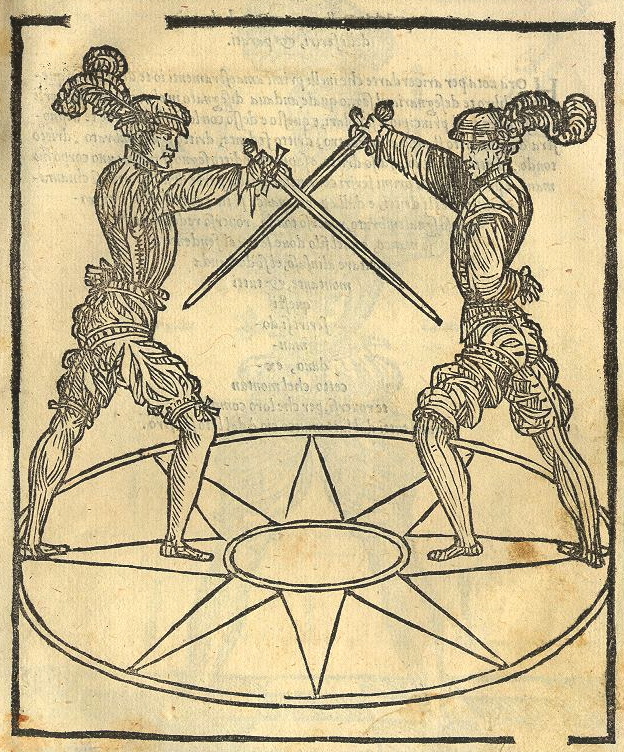
When I got back to my salle last week, after a 3 month absence, I found two rather hastily constructed Marozzo stars on the floor, left over from Ilkka Hartikainen's Bolognese swordsmanship seminar. I have always liked the design (readers of my The Swordsman's Companion will remember there's a reproduction of it on page 82) and it makes teaching some footwork patterns much easier.

from the 1536 edition, in the Corble collection.

Plus, I love geometry.

So I decided to start by ripping up the crappier of the two stars (in peeling electrician's tape, not centred according to any logic, nor put together to within any identifiable tolerances, and clearly knocked up in 10 minutes at the beginning of a seminar), and redoing it to my standards. We started by drawing a straight line from one side of the salle to the other, parallel to the longest wall, and located by centering it on the wall pillars. This line was 629″ long [Europeans: 1 inch is 2.54 cm. Do the maths! When working with proportions, I always think in inches.], so we ran a tight string from one point to the other, and then I went along with a 4′ straight edge [1 foot is approx 30 cm] and an indelible marker.  Then Zoe, Janne and I spent nearly an hour deciding on exactly where the centre point of the star should be. We eventually settled on siting it so that the North point and the East point were both accurately aligned with the two thrusting targets fixed to the pillars. (The original was placed any old how.)

Marking the large circle

From there, using a trammel beam, my large self-made dividers (in ash wood), and a long straight edge, we drew the perpendicular line from the centre, and, most difficult, drew the large circle. It has a radius of 51″, because my inside leg measurement is 34″, and my long pace guard position varies between 32 and 37″ depending on circumstance. 34 x 3 = 102. 102/2=51. The inner, smaller circle has a radius of 17″.

I finished the star the next day. Marking the diagonals and so on was very simple. [If you would like me to write up full geometrical instructions, let me know and I'll shoot a video.] At the moment it is just in indelible pen. I will buy some floor paint and paint it in one day soon…

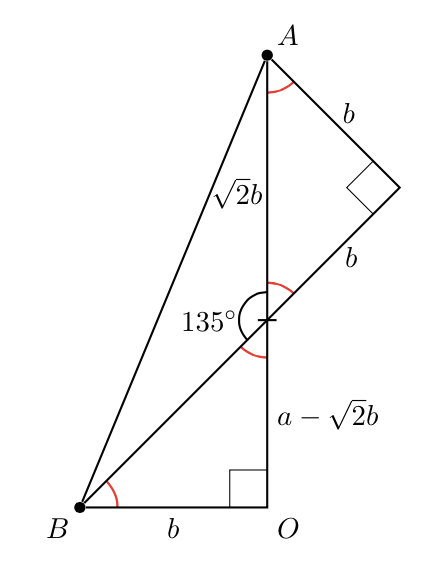
Anyhow, last Thursday I was in the salle, in a geometrical mood, when I got talking to Ville Tilvis (who readers of The Swordsman's Companion will know from the photos on pp 125-7) about the volta stabile. I do it as a 135 degree turn. That got Ville (a maths teacher) thinking… and he came up with a very elegant and (as he is the first to say) rather useless but (I think) extremely cool proof regarding the optimal ratio between guard width and guard length, for a perfect volta stabile. It's 1:1+√2, or approximately 1:2.41

Ville's triangles. Read the pdf if all is not perfectly clear!

So, given a guard length of eg 34″, measured from ball of the foot to ball of the foot, your feet should be 14.1″ apart.

You can download Ville's article here: volta-stabile geometry.

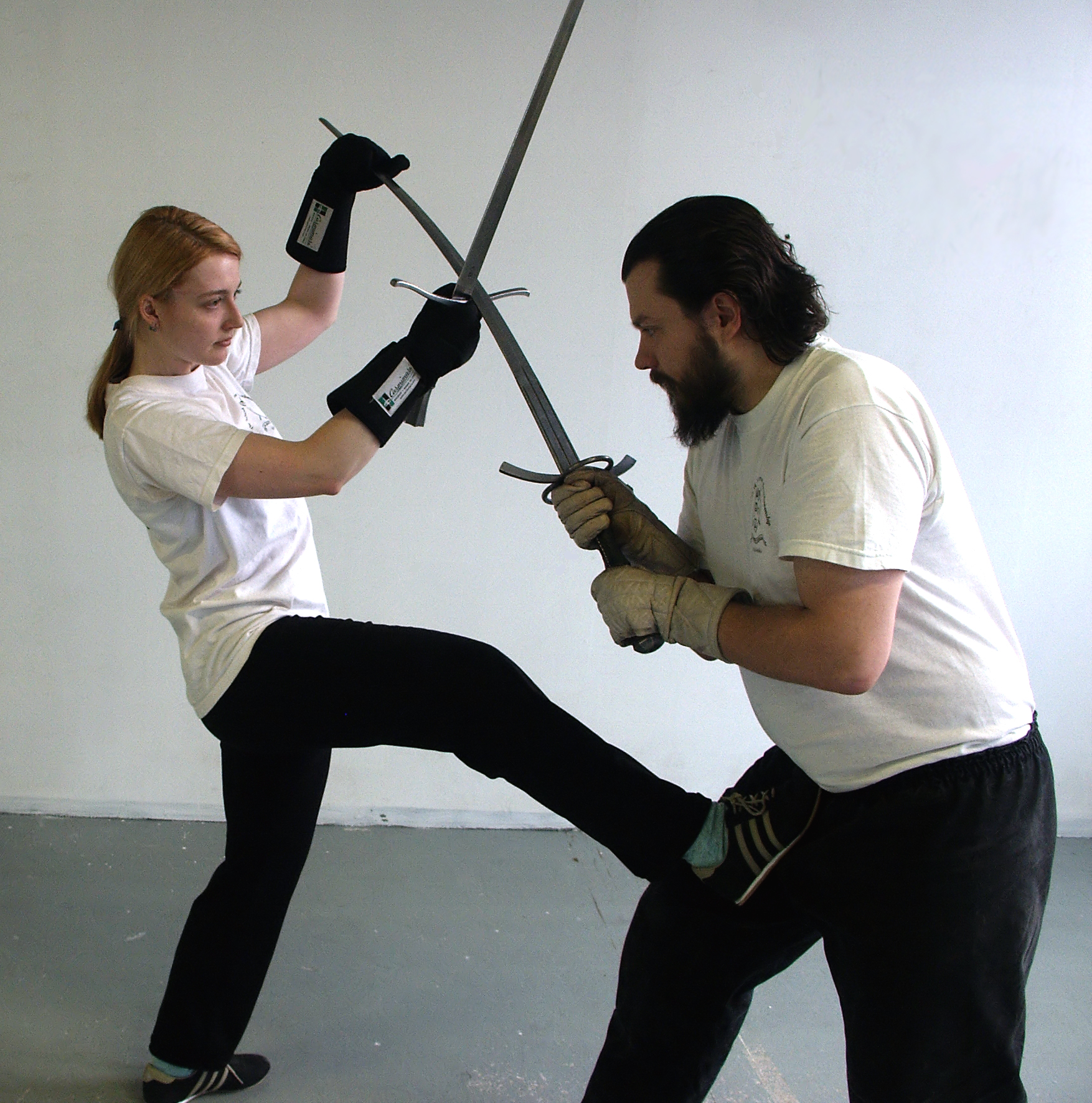
Fifteen years ago today, my employer Patrick Baxter laid me off from my job as a cabinet maker. Exactly one year later, I opened the School of European Swordsmanship in Helsinki. We began with a free demo class, which was hopelessly over-attended; so much so that the demo class turned into a lecture instead. The school has never looked back. Much has changed over the years, but not the value of a good kick in the crotch: allow me a moment of nostalgia, posting this from the photoshoot for The Swordsman's Companion:

Zoe Chandler kicks Miika in the nuts: for The Swordsman's Companion.

As I have written before, I didn't do this by myself. Right now, I'm in Italy, as you probably know, and have not swung a sword for months (except at the lovely Armizare 2015). Yet, on at least three continents, and without any direct help from me, students who consider themselves a part of the School of European Swordsmanship have been training, fencing and teaching the Art of Arms. In this, I see myself as a catalyst, rather than a source; because of the work I do, the barriers to entry to an authentic training life are significantly reduced, allowing many more people to enter the Art. But I don't, can't, do it for them; I just help them do it a bit better. So while I have been immersed in Italy, the School has carried on just fine without me. I even get emails from students I've never met, telling me that my books or videos have helped them accomplish something. This is profoundly satisfying, as I'm sure you can imagine.

Here's an example, from Mexico:

The joint winners. Well done!

Another victory for the Italian tradition Mr Windsor, I tied for first place on steel longsword and placed 2nd on rapier at our national HEMA tournament. It was my first steel longsword tournament and we used a variation of this ruleset (http://www.hroarr.com/concerning-the-rules-of-tournaments/) where we didnt count “points”, instead we tracked wounds over a round robin with the top fighters of my country, most of them with international tournament experience, and I tied on first place with Arturo Medina (former champion of our anual Albion steel tournament and 2nd place at combatcon 2012) with the least wounds over the tournament.

All of this thanks to your books, The Duellist's Companion, and your series of Italian longsword, I cant wait for the next book to publish because as I said before, I have no other teacher than your books and videos, and the way you transmit the principles of Italian fencing has allowed me to rank this high.

All my gratitude to you, from México.

José Luis Zamarripa


I am leaving for America and Canada this week; teaching at Lonin this weekend, and VISS the weekend after; back in the saddle again! And then home to Helsinki, and back to my salle, at Easter. I am looking forward to seeing you all again; it feels very odd to be away from home on this particular date.

I'd like to take this moment to thank every teacher, every student, and every colleague, who has supported this work; whether you started yesterday, have run a branch for years, or were teaching me something useful 30 years ago, thank you. It's been wonderful.

Fourteen is a significant number in all traditional arts; seven years of apprenticeship, seven years a journeyman. Now, I have to create a masterpiece. What, I ask, would you have me do next?

Search

Recent Posts

Categories

Categories

Tags