Guy's Blog

Guy frequently keeps this blog updated with thoughts, challenges, interviews and more!

Category: Fiore Translation Project

On Monday this week I sent the final draft of From Medieval Manuscript to Modern Practice: the Dagger Techniques of Fiore dei Liberi off to the editor. Hurrah! There's a lot of admin work to do from here, checking edits, sending to layout, making sure all the links work etc., but let's put it this way: if I became incapacitated, my highly competent assistant could get the book finished and into your hands no problem. Some authors call this the “truck draft”, as in, if I were hit by a truck, the book would still come out.

Which means that it's ready to preorder, in ebook, paperback, or hardback. I expect the book back from the editor this month, and back from layout in October, so if all goes well it should ship in mid-November.

You can find it here.

So what's the book about?

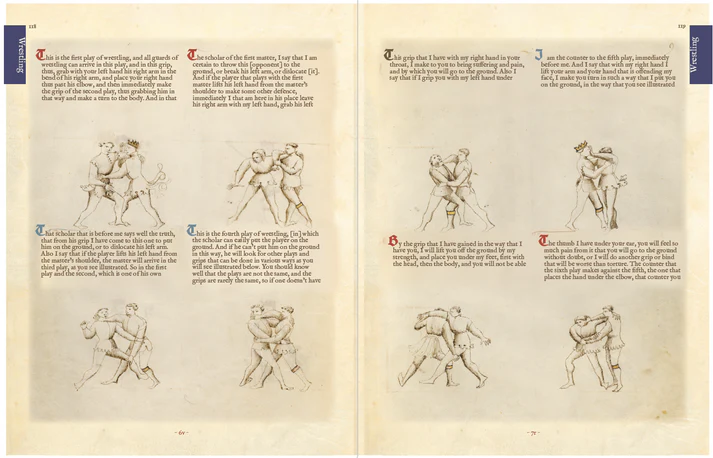
It's my complete interpretation of Fiore dei Liberi's dagger plays. Every single one of the 76 plays we see in the Getty manuscript is there, with the illustration from the manuscript, my transcription, my translation, my explanation of how it works, and a link to a video clip showing my interpretation in action.

There is also a comprehensive introduction about Fiore himself, the treatise, and the four known manuscript versions of his work, and various asides and digressions about elements of practice. Going by word count, the actual dagger plays and interpretation text are about 60% of the book, so there's a lot of extra material.

Sound like fun? Preorder here.

Here's an example of what you'll get (it will look better when the layout is done by a professional: this is just me pasting stuff into an email program).

The Seventh and Eighth Plays of the Ninth Master

F18v
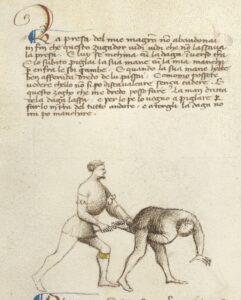
Fiore's 7th play of the 9th master, dagger between the legs, interpreted by Guy Windsor
La presa del mie magistro non abandonai in fin che questo zugador vidi vidi che non lassava la presa. E luy se inchina cum la daga in verso terra. E io subito piglai la sua mane cum la mia mancha per enfra le soi gambe. E quando la sua mane hebbe ben afferada, dredo de lu passai. Comomo possete vedere chello non si po discavalcare senza cadere. E questo zogho che me dredo posso fare. La man dritta dela daga lassa, e per lo pe lo vegno a piglare per farlo in terra del tutto andare, e a torgli la daga no mi po manchare.

I will not abandon the grip of my master so that this player saw that he could not leave the grip. And he leant down with the dagger towards the ground. And I immediately will grip his hand with my left hand between his legs. And when his hand has been well secured, I will pass behind him. As you can see, he cannot dismount [from my grip] without falling. And this play that is after me I can do. The right hand leaves the dagger, and I will come to grab him by the foot to put him completely on the ground, and I will not forget to take his dagger from him.

Fiore's 8th play of the 9th master, with the leg lift, interpreted by Guy Windsor

Questo scolaro che me denanzi a fatto lo principio, et io fazo del so zogho la fine de mandarlo in terra como ello ha ben ditto. Per che questo zogho non habia corso in larte, volemo mostrare che in tutta liei habiamo parte.

This scholar that is before me has done the start, and I do the end of the play, by sending him to the ground as he has well said. Because this play is not common in the art, we want to show that we have a part in all of it.

This technique is fascinating, and lots of fun to practice if you’re careful. It works best if the player is pulling back on contact, or you can create some space for it by a sneaky backfist to the groin with your left hand. Having made the cover, you slam their wrist into their groin, then let go with your left hand (unless you already did to do the backfist) and reach around their leg to grab their wrist again from behind. This is quite easy because you are just finding your own right hand. Then let go with your right hand and bring that around too. You’re now holding their wrist between their legs from behind. If you just yank upwards they will fall on their face, or you can grab their ankle and yank that up for extra vim. Fiore recommends doing the disarm too, which we see in the first image.

You can see this play here: guywindsor.net/dagger064

I'm hoping it's really obvious to you whether this is your kind of thing or not. If not, no worries, there's plenty of other material for you. But if it is your thing, you can preorder here. And if you think your friends will like it, do share.

It’s an exiting time this week. We have a brand-new book out today, and, as it’s my birthday on Saturday (I'll be 51), we’re also running a birthday sale on all ebooksaudiobooks, and online courses. Hurrah! Just use the code GUYSBIRTHDAY30 to get 30% off at checkout (code is valid for all digital products- not print books or t-shirts).

First up, the new book:


I have completed my translation of Fiore’s Il Fior di Battaglia, as found in the Getty manuscript. You may recall I produced an affordable facsimile of the Getty a few years ago. Well, we’ve now produced an updated version, that reproduces the Getty manuscript in its entirety, in full colour, and as close as possible to the size of the original. But there’s a twist:

The second half of this volume is a second reproduction of the manuscript with the original Italian text replaced by my English translation. This recreates the experience of reading the original Italian as closely as possible. The book also includes an introduction to Fiore and his life and times, the provenance of the manuscript, and suggestions for further study.

This way, you get the original, and the translation, in one volume… for the same price as the original facsimile-only edition. Because we can. And it’s my birthday.

The excellent Katie Mackenzie has done a gorgeous job on the cover and layout:

A page from the translation laid out on the facsimile
Sample page from part 2

The translation section includes tags on the pages so you can find the section you want from the page edges. You can find it here:

Glorious Getty!

I don’t know if the book will get to you in time for Christmas- much depends on how busy the printer is, and the shipping options you select at checkout. But we’ve done our best to get it out fast enough that there’s a fair chance…

You can also get an audiobook of me reading my translation (remember to use your discount code!) here.

This birthday sale will end on Tuesday December 3rd, so timing is everything…

The code: GUYSBIRTHDAY30

Ebooks and audiobooks: https://swordschool.shop

Courses: https://courses.swordschool.com

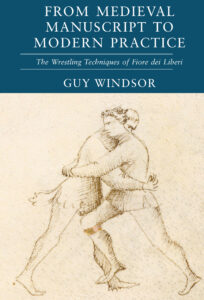
I’m delighted to let you know that From Medieval Manuscript to Modern Practice: the Wrestling Techniques of Fiore dei Liberi is now out on the Swordschool shop! For the next week only, you can get 10% off the hardback, paperback, and ebook here. Use the code wrestle10 at checkout to apply the discount.

This book is the academic basis of my interpretation of Fiore’s wrestling plays, following the format I pioneered in the first book to come out in this series, From Medieval Manuscript to Modern Practice: the Longsword Techniques of Fiore dei Liberi.

I start at the very beginning, and provide a transcription and translation of the full introduction from the Getty Manuscript, then for each play, I provide the drawing from the manuscript, transcribe the text, translate it, and interpret it, with a video clip of the action in practise. The book also includes an essay by Jessica Finley comparing the Italian wrestling with German medieval wrestling, and a bonus section where I transcribe and translate the wrestling plays from the mounted combat section.

The book provides the “what” and “why” of Fiore’s wrestling plays. For instruction in how to train Fiore’s wrestling, you will need my online course which I created with Jessica Finley, so I have also discounted that by 45%, here.

These discounts expire on March 14th.

What the world really needs right now is obviously a better beginners’ guide to training in Fiore’s Art of Arms, right? So I have created one. So what's special about that?

I always, always, try to instil self-direction into my students. My job is to make myself redundant. I do this in practice by giving even beginners in their very first class some agency to choose what we cover. By the time they get to the seniors class (usually in a year or two), classes are entirely student-led: we cover whatever they need my help with that day.

Books are a very linear model, and while I can lay out my usual path through the enormous range of the Fiore syllabus, that restricts the reader’s agency to an unfortunate degree. But actually, very few of my readers ever read from cover to cover. Everyone skips ahead to the things they are most interested. And why not? They’ve bought the book, they can do whatever they want with it. 

So I have figured out how to include gradually increasing levels of choice for the reader/student in these workbooks. The series will comprise several workbooks. The first is the Beginner’s Course, of eight lessons each with about as much stuff as I’d cover in a single 90 minute class. In the first class of the first book, you get one simple choice. In the second class, there’s more freedom.  At every stage, if you need prior material to successfully approach the topic at hand, that will be flagged up. So even if you skipped that section for some reason, you can go to the specific prerequisite material and practice that before returning to the thing you want to do next.

There are as many correct paths through the syllabus as there are students to walk them. In this new series I have finally figured out how to represent that on the page. 

Every technique, every drill, is presented as written instructions with images from the source manuscript, and over 40 video clips. Each video is linked to with a QR code on the relevant page, so you can just point your smartphone at the page and it will open the video for you. There is abundant space for your own written notes, which is especially necessary when you are not working through the material in the order it appears in the text. 

It’s a choose your own path training manual.

Part One covers the following material:

Unarmed techniques

The four guards of abrazare (wrestling)

The first six plays of abrazare

The four steps (footwork)

The three turns (footwork)

With the Dagger

The four blows of the dagger

Disarms against forehand, backhand, and rising dagger thrusts

Counters to the disarms

Arm locks and counters

How to fall safely

A basic takedown/throw

With the Longsword

Six ways to hold the longsword

The seven blows of the longsword

How to parry and strike

How to counter the parry with a pommel strike

How to counter the pommel strike

The exchange of thrusts

Breaking the thrusts

Training on the pell


That's a lot of material- but thanks to the format it’s presented in, it should be thoroughly attainable.

The book is in layout now; all the video clips have been edited and uploaded, the QR codes created, and so on. We even have the covers. 

There is a limited number of pre-order slots available, which will help pay for the layout and cover graphic design work, and the editing costs. Pre-orders are for the print version, but also include the ebook. 

I hope to get the ebook version out to those that pre-order in a week or so, and the print workbooks ready to ship by the end of this month.

The workbook should be more widely available in May.

You can preorder the right-handed layout here: https://guywindsor.gumroad.com/l/aw1RHpreorder

And the left-handed layout here: https://guywindsor.gumroad.com/l/aw1LHpreorder

It’s always the way. You bring out a new book, and somebody comes up with something that makes you jump up and down going “I wanted that in my book!!! Why couldn’t that have come out a month ago!!!”

It’s actually a good feeling. Because no book is the last word on any subject, and no non-fiction book is ever truly finished (which is why we have second editions, third editions, etc etc.).

You may have heard that I’m into bookbinding. I got into bookbinding while I was researching Vadi, and came across the auction house catalogue for the sale of the manuscript to the Biblioteca Nazionale di Roma. The catalogue included a collation of the manuscript, which is a description of the way the pages are bound together. It’s extremely important because it can give you a great deal of insight into what might be missing from the manuscript. I’ve written about that here.

So a couple of weeks after my new Fiore book came out, Mike Chidester (who was one of the inspirations for the book) sends me this email:

A few weeks ago, while trying to do preparatory work on the second facsimile project, I ran into problems with the Getty museum on the subject of how many pages are missing from their online offerings. The reproductions department sent me six scans (the inside and outside covers and one flyleaf) and swore blind that that was all of the missing pages. I was pretty sure that was wrong, and ultimately my questions were bounced to the manuscript department, which sent me this arcane formula:

This is an example of a collation statement, which tries to capture the exact way in which the manuscript is bound together. Manuscripts are built up out of quires, which are stacks of paper that are folded in half and then sewn down the middle, so that each sheet (bifolium) becomes two pages (folia). Medieval manuscripts are often bound in quires of 4 (quaternions), which is the number of parchment sheets of roughly A4 size that you can expect to harvest from a single goat. The number actually typically ranges from 3-5 (ternions to quinternions), because perfect plans rarely survive contact with reality.

The Getty manuscript is a normal-seeming manuscript of 49 numbered folia, so one might expect 7 quaternions (for 56 total folia), with several blank pages at the beginning or end. Instead, when I created a visualization of this diagram (inspired by work I've seen Daniel Jaquet and others do), it turned out like this:

Two single bifolia bound into the spine, and then a series of very large quires—quinternions and a sexternion. What's more, any student of Fiore knows that folio 38, which contains dagger plays, is misplaced; specifically, it belongs between folia 14 and 15, which are the end of quire III and the beginning of IV. Since folio 27 is also bound into the book as a single leaf, we can surmise that 27 and 38 were originally a single bifolium, forming the outside layer of quire IV—making it a septernion, or seven-sheet quire. At the time, I thought that this was a ridiculous number of pages for a manuscript quire. What little I knew. (Excerpt reproduced with permission. Personal correspondence, May 27th 2020).

Finally, finally, finally, we have a collation statement for Il Fior di Battaglia. And the mystery of how folio 38 ended up where it did is solved. It used to be the first page of the next quire, and at some point the vellum tore along its fold, the pages fell out, and what should be folio 15 got bound back in in the wrong place. That binder needs a good slap round the back of the head, of course. But it’s always a relief to get confirmation of a theory. Until now, there was no way to be certain beyond all doubt that the naughty folio 38 wasn’t in fact in its original place (if, for instance, it appeared in the middle of an intact quire), and Fiore just decided to strip a page of dagger plays and dump them between the pollax and the spear plays. 

O happy day, calloo callay! But now of course I have to edit the introduction section of From Medieval Manuscript to Modern Practice.

Not this year though. 

In a sword fight there is no time to think. You see, you act. The essence of training is to adjust your instinct so that the instinctive response is also the correct one. I’ve spent decades training my instinct, and  I apply this to literally all parts of my life. I don’t decide what to do when I get up in the morning, and I certainly don’t plan my week/month/year. I do whatever my gut tells me is the right thing, and figure out why afterwards.

I’m spending a lot of time in my shed at the moment. Not to get away from the wife and kids- in fact the best times are when one or other of them join me, and sit in the chair I keep there for the purpose chatting to me while I chisel. Or when my youngest is cutting stuff up on the bandsaw, just for fun. I’ve completed the major project I was working on (a Pilates ladder barrel for my wife), and have spent almost all my time in there since re-organising my tools and making better tool storage solutions, such as this saw till.

Please note, I should probably be doing that sabre video class for the Solo course, but I’m not. I will, but not until my instinct tells me it’s time. I wondered why I was spending so much time out in my shed, and eventually it came to me. This is a period where the normal illusion of control (I can go here, I can do that) has been stripped away. We actually have exactly the same degree of agency we’ve always had, but as good citizens we are deciding to obey the government guidelines and stay home (yes really please do). The environment seems stranger and more hostile than usual, and it makes us feel helpless. So I have been spending my time in an environment I can control, and exerting that control in a clear and obvious way by making things, particularly things that change that environment for the better. This is the linear opposite of stressing about the plague. 

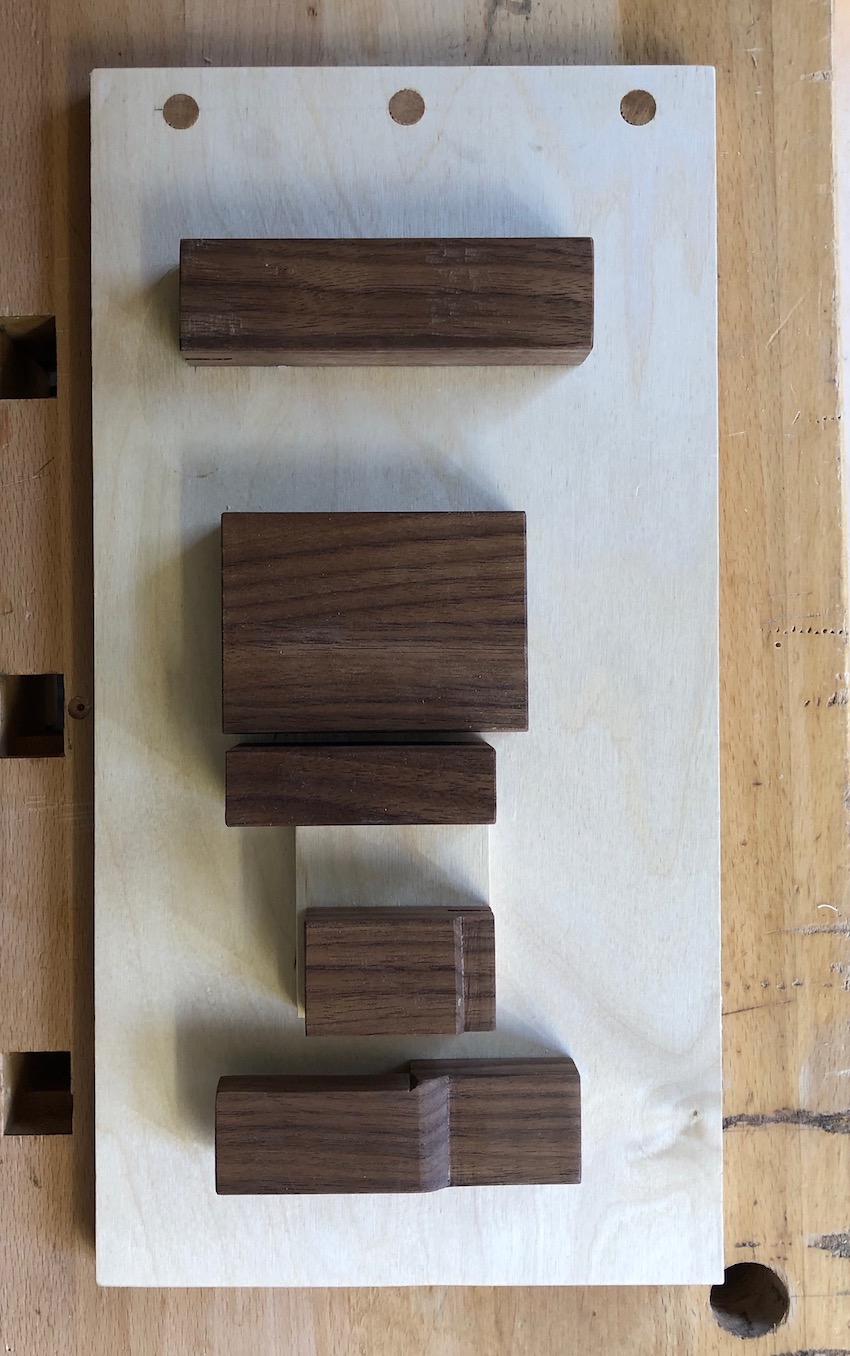
When I figured that out, I thought “good job, brain! nice one” and carried on making this:

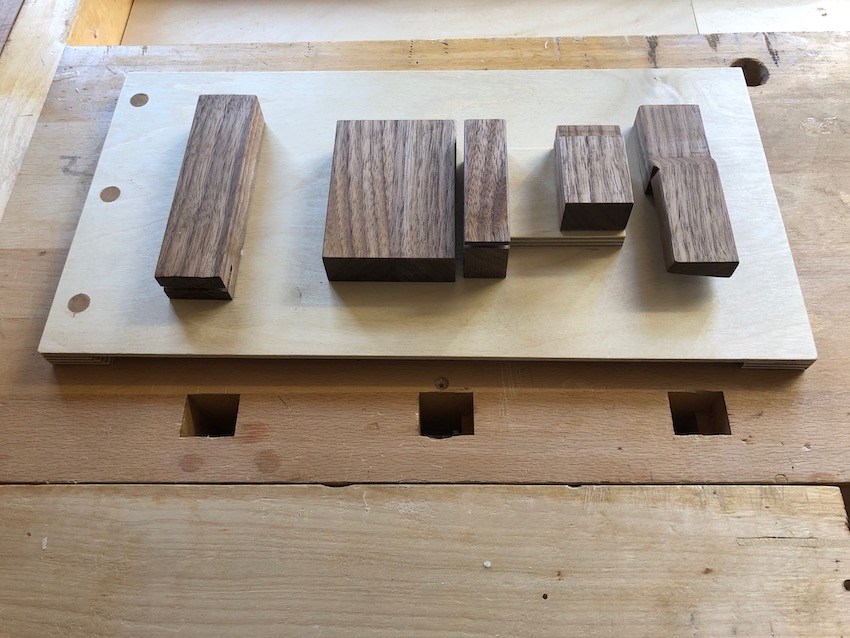
Here it is from another angle.

What the hell is that? I hear you ask. Well now…

I don’t know if you have ever written a book. I have, several in fact. And every single one is like being constipated for a year or more, before finally it forces its way painfully out, and you lie spent from the struggle clutching this thing you’ve made. I should probably have written ‘pregnant’ for ’constipated’, but I was present for the birth of my children, and actually, giving birth seems to be orders of magnitude harder than producing a book. 

My latest extrusion is done and dusted, and the hardback pre-orders have been sent out. Hurrah!

In it I take you through all of Fiore's longsword techniques on foot out of armour. Each play is shown with the drawing from the treatise, my transcription and translation of the text that goes with it, my commentary on how it fits into the system and works in practice, and a link to a video of the technique as I interpret it. The book contains a detailed introduction describing Fiore's life and times, and extensive discussion of the contexts in which Fiore's art belongs.

You can get the ebook (in all formats) from my gumroad shop here: https://gum.co/longsword1

It’s available to pre-order from Amazon in any one of their national stores, just search for its ASIN: B08629VNKY

But before you go dashing off to buy it: it’s Fiore sword geekery in the extreme. Please ONLY buy it if you are really into the historical side of historical swordsmanship, and/or you want to know how I think Fiore’s art is put together. This is not a basic introduction to how to hold a sword.

Or you can get the ebook for free… if you can tell me what the object pictured above is for, let me know in the comments, and the first correct answer will get the ebook. Note, that the object is lying on my bench, and may or may not be correctly rotated in the images.

I will also give out a free ebook to the best answer, correct or not!

I will post a picture of the object in service, and the best answer(s) next week.

Producing a book is a marathon, not a sprint, but the finish line for From Medieval Manuscript to Modern Practice: The Longsword Techniques of Fiore dei Liberi is in sight!

I’m in my study plodding through the first draft of the the laid-out print file. This is simultaneously very exciting (my NEW BOOK! HURRAH!), very nerve wracking (I’ve got to find EVERY error!), and very tedious (I’ve got to go through every page with a fine-tooth comb. For instance, in the bibliography I had the publication year for Domenico Angelo’s School of Fencing wrong. Doh!). This is simultaneously the best and worst part of publishing: the best because you can see that the book is real, not just a thing in your head; the worst because the temptation to rush through the last few hurdles is extreme. 

I have Basil Poledouris’ soundtrack to Conan the Barbarian on repeat coming in through my noise-cancelling headphones. This helps.

Here’s the back cover blurb:

In the late 14th century Fiore dei Liberi, an Italian knightly combat master, wrote a magnificent treatise on the Art of Arms. He called his book Il Fior di Battaglia, the Flower of Battle, and it is one of the greatest martial arts books of all time, describing how to fight on foot and on horseback, in armour and without, with sword, spear, pollax, dagger, or with no weapon at all. Guy Windsor has spent the last 20 years studying Fiore's work and creating a modern practice of historical swordsmanship from it. In this book, Guy takes you through all of Fiore's longsword techniques on foot out of armour. Each technique (or “play”) is shown with the drawing from the treatise, Guy's transcription and translation of the text, his commentary on how it fits into the system and works in practice, and a link to a video of the technique as Guy interprets it. The book contains a detailed introduction describing Fiore's life and times, and extensive discussion of the contexts in which Fiore's art belongs.

This is essential reading for any scholar of the Art of Arms, and will also provide fascinating insight to all martial artists and historians of the medieval and early Renaissance eras.

What do you think?

I don’t have a draft of the cover yet, but my friend Siobhan Richardson is starring in the image above (by Dahlia Katz) for it. I think it looks fantastic, and really tells the story of the book.

Staring at the pages of the new book means that I will soon also be staring at the bills coming in from my editor (Andrew Chapman) and my layout artist (Bek Pickard). Both these fine humans totally deserve to be paid for their work. And of course they will be no matter what – I would never stiff a freelancer.

I used to crowdfund my books through Indiegogo to cover the costs before publication. I don’t do that any more because the platform fees are rather high, and they also tend to hold onto the money for weeks. Instead, for the last couple of books I’ve taken limited pre-orders for the hardback, through my Gumroad account. It’s much more efficient- I get paid at the end of the following week, and the platform fees are way lower. I’ve set it up to allow maximum 75  pre-orders.

If you pre-order the hardback I can’t guarantee that it will be faster than ordering it through your usual bookshop (online or bricks-and-mortar) when it's released, because sometimes the shipping takes forever. But you will get immediate access to a pdf of the current draft (no images, but the video links all work), the ebook version the moment it's ready, and your book will printed and shipped before the book goes into general distribution. 

So, if you would like to order one or more copies of the new book, go here! https://gum.co/longsword

Greetings!

I have been beavering away on the Fiore Translation Project, and have completed the work on the Stretto plays. Hurrah! You can find them here: https://gumroad.com/l/ftp4

I am now working on bringing the four parts of this series together into a coherent whole, starting with the defences of the dagger against the sword, and ending with the conclusion to the Stretto plays. This covers the entirety of the longsword on foot out of armour. I hope to have that complete book in your hands before Christmas, but dashing off to Australia next week makes it something I'm not willing to promise!

It's true I'm a Fiore man through and through, at least when it comes to Longsword. But, I do hear good things about that Meyer chap, though he was born a full century after Fiore must have died, and tended to wear outrageous trousers when fencing. So I have teamed up with the excellent Alex Beaudet who has compiled the MS A.4º.2 version of Gründtliche Beschreibung der Kunst des Fechtens into comic-book format (CBZ). You can get that for free (or pay what you want) here: https://gumroad.com/l/meyerThat all should keep you busy while I'm cracking on with the compilation!

I've been working on The Fiore Translation Project for about a year now, working through all of Fiore's longsword plays out of armour on foot. The work so far has been published here on this blog in 24 instalments, taking us all the way from sword against dagger to the end of the zogho largo section, and which have also been published as three ebooks:

The Sword in One Hand

Longsword Mechanics

The Plays of the Zogho Largo

I have just completed the work on all the stretto plays. I made the decision not to publish them bit-by-bit on the blog because I am going to compile the entire work into a proper book, and I want to keep something back from the public domain to encourage readers to go buy the book!

However, I will be making the Stretto Plays available to buy on its own on my Gumroad account in due course, so that people who have already got the first three can complete the set.

Watch this space for updates!


You There is a critical feedback system between transcription, translation, and interpretation. Getting the words in the original language right is a good first step, which allows for better translation, which enables better interpretation, which in turn may resolve issues of translation or transcription. It would be foolish to begin with interpretation and try to make your translation work from there, but when there is some doubt regarding the transcription or translation, sometimes one version works in reality, and the other doesn’t. For this reason I’ve been hesitant to translate the mounted combat section. Sure, the language is quite clear and straightforward, but still, it seems odd to me to publish a translation of descriptions of actions that I haven’t tested in reality. This is a common problem for historical martial arts translators, but doesn’t seem to bother those translating fiction so much. Though I reckon Sir Richard Burton was careful to test every translation in practice when working on the Kama Sutra.

If you find this process inherently interesting, you'll enjoy my book From Medieval Manuscript to Modern Practice.

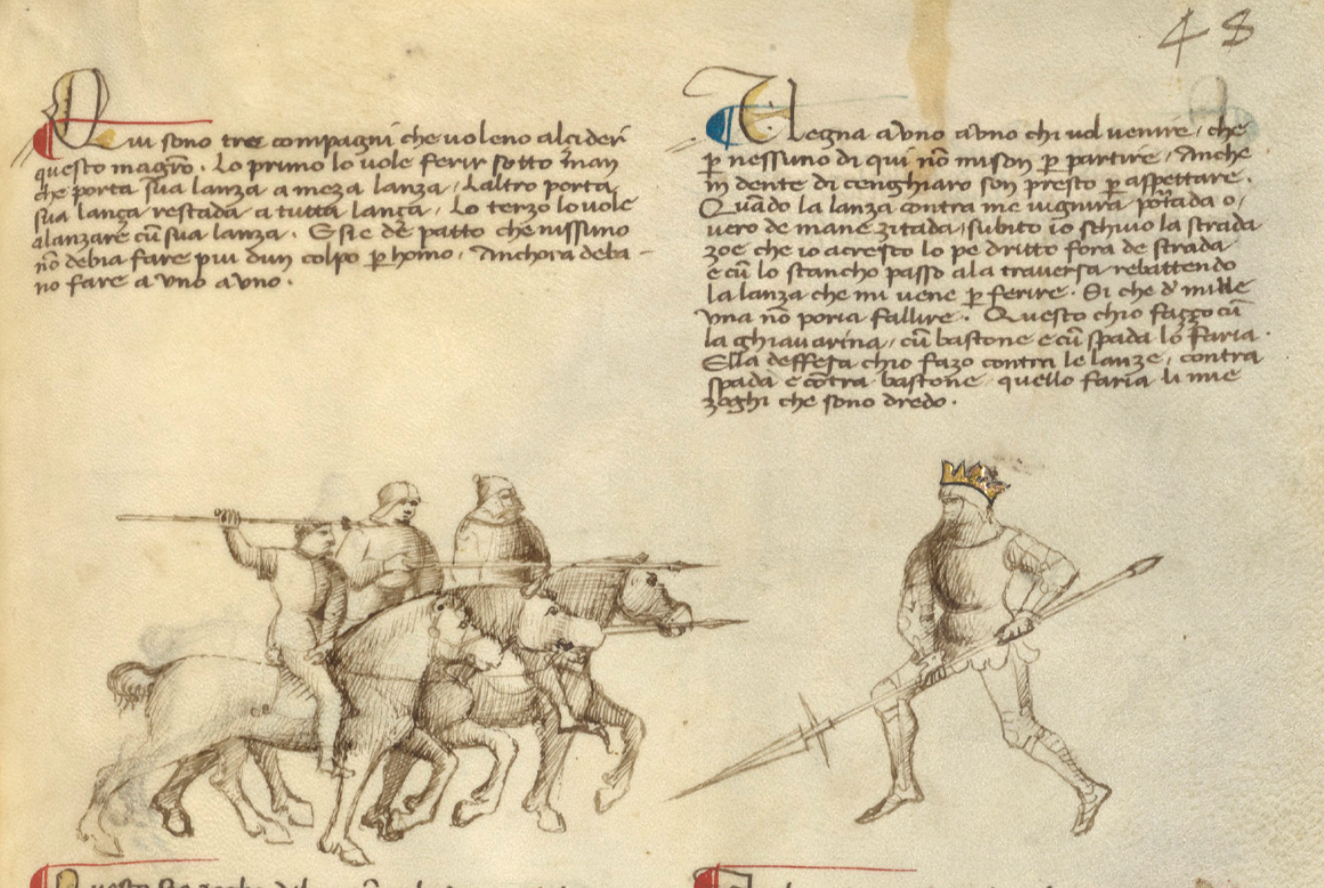
I had the opportunity recently to work on the plays on foot against attackers on horseback, from folio 46r. I went to visit Jason Kingsley (of the Modern History youtube channel), who has a superb riding facility, and is an expert jouster and horseman. I am neither, so we had a go at recreating the plays of the ghiaverina on foot, which meant that Jason did the riding, and I got to stay on the ground, which was much safer all round.

Now that I’ve worked through them, here’s my transcription and translation. I’ll comment as I go.

Qui sono tre compagni che voleno alcider questo magistro. Lo primo lo vole ferir sotto man che porta sua lanza a meza lanza. L’altro porta sua lanza restada a tutta lanza. Lo terzo lo vole alanzare cum sua lanza. E sie de patto che nissuno non debia fare piu d’un colpo per homo. Anchora debano fare a uno a uno.

Here are three companions who want to kill this master. The first wants to strike under-arm so carries his lance by the middle. The other carries his lance couched by the end. The third wants to throw with his lance. And it is agreed that none of them may make more than one blow per person. Also they must do it one by one.

This is an interesting set-up. As we have seen elsewhere, there are three different kinds of blows each represented by a different companion. Though they want to “kill” the master, there is an agreement in place that they will only make one blow each, and will come one at a time. Fiore uses the expression ‘a meza lanza’ and ‘a tutta lanza’ in the same way that he has used ‘a meza spada’ and ‘a tutta spada’ (see the discussion of the crossings of the sword for more information). I’ve translated them as ‘by the middle’ and ‘by the end’; ‘a tutta lanza’ means that the whole lance is extended, as you can see from the image. So how does the master handle them? Effortlessly, it seems:

Vegna a uno a uno chi vol venire, che per nessuno di qui non mi son per partire. Anche in dente di cenghiaro son presto per aspettare. Quando la lanza contra me vignira portada o vero de mane zitada, subito io schivo la strada zoe che io acresco lo pe dritto fora de strada e cum lo stancho passo ala traversa rebattendo la lanza che mi vene per ferire. Si che d’ mille una non poria fallire. Questo ch’io fazzo cum la ghiaverina, cum bastone e cum spada lo faria. E’lla deffesa ch’io fazo contra le lanze, contra spada e contra bastone quello faria li mie zoghi che sono dredo.

Come one by one who wants to come, I’m not for leaving here for any of them. Also in the boar’s tooch I am ready to wait. When the lance will come against me, carried or thrown from the hand, immediately I avoid the way, thus, I advance my right foot out of the way and with the left I pass across, beating away the lance that comes to strike me. If there were a thousand, not even one would fail. This that I do with the ghiaverina, I do with a stick or a sword. And the defence that I make against the lance, against the sword and against the stick I will make my plays that follow.

The first line of this reminds me of Margaret Thatcher’s famous remark “the lady’s not for turning”. It’s the same construction: ‘non mi son per partire’: ‘I’m not for leaving’. The ‘fuck you’ is clear in the subtext. He re- iterates that this action is done against the lance whether it is held or thrown, though he uses a new locution: ‘schiva la strada’, which literally means ‘avoid the way’, and of course means ‘get out of the way’. This is perhaps the sixth or seventh time we’ve seen the instruction to step the front foot out of the way and pass across.

I always assumed that this would be quite hard to do, and so the next line about being able to do it a thousand times was hyperbole. Well, you’d get tired after about a hundred, but otherwise, this is way easier to do against a mounted lancer than it is to do against one on foot. Jason is a superb mounted combatant, as one would expect the companions to be (at least by our modern standards). As his lance approached me, the point was rock-steady, and because he was on a horse, he didn’t come straight at me- his lance was angled off to his right by perhaps 30 degrees. This gave me plenty of space and time to do the action, and the steadiness of the lance made this absurdly easy to do. The only real challenge was being careful not to hit him or the horse, which of course would not be an issue if we were doing this in earnest.

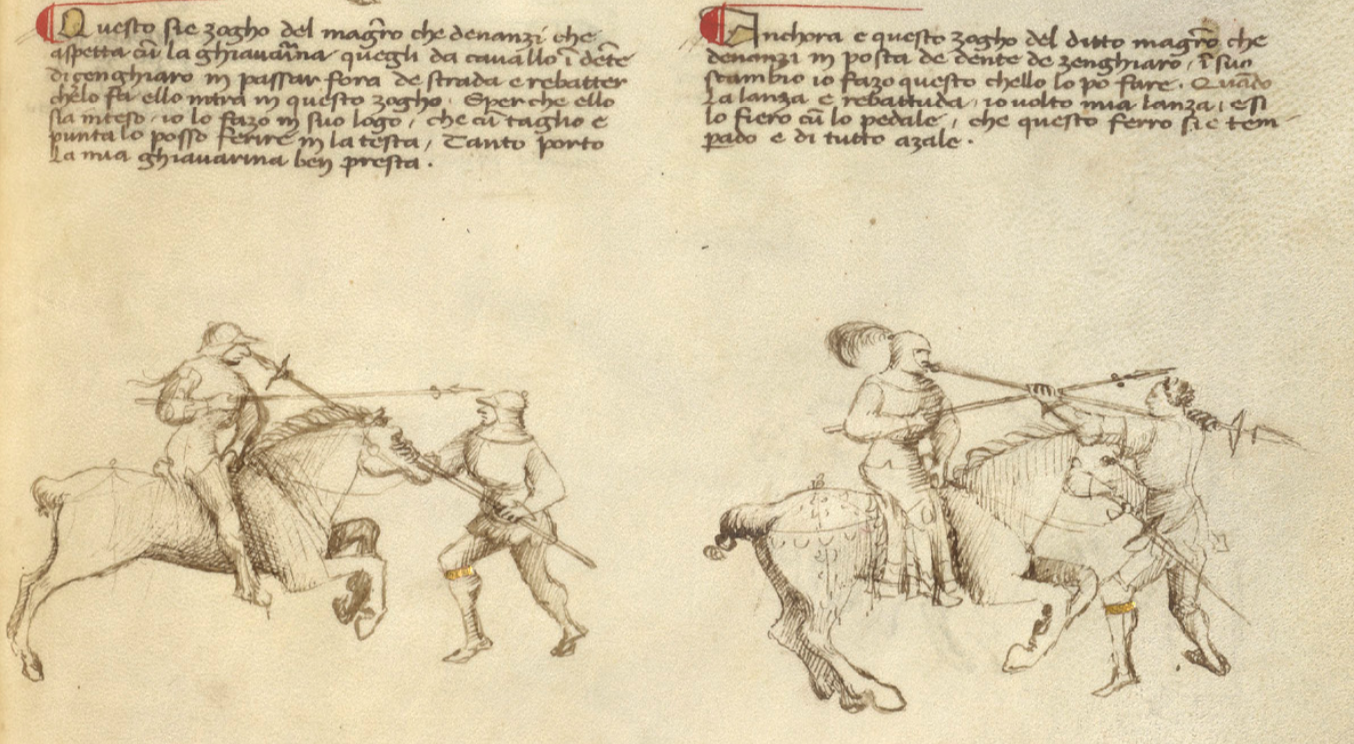
The plays that follow are these two:

Questo si’e zogho del magistro ch’e denanzi che aspetta cum la ghiaverina quegli da cavallo in dente di zenghiaro in passar fora de strada e rebatter chelo fa elo intra in questo zogho. E per che ello sia inteso, io lo fazo in suo logo, che cum taglio e punta lo posso ferire in la testa. Tanto porto la mia ghiavarina ben presta.

This is the play of the master that is before, that waits with the ghiaverina, for the one on horseback, in boar’s tooth, passing out of the way and beating and then enters into this play. And because he understood it, I do it in its place, that with cut and thrust I can strike to the head. Thus I carry my very quick ghiaverina.

In terms of interpretation, this is easy enough. Having stepped out of the way and beaten the incoming lance aside, you can strike with cut or thrust. The language is a little awkward, with some apparently redundant phrasing, such as ‘and because he understood it’. Likewise at the end, ‘tanto’ usually means ‘a lot of’, but it’s one of those words that has a range of uses (such as in ‘ogni tanto’, every now and then). I take this last line to mean essentially ‘this is why I’m carrying a ghiaverina. It’s very quick and takes care of those pesky horsemen’.

If you’re familiar with the plays of the spear on foot, then this last play of the ghiaverina will come as no surprise.

Anchora e questo zogho del ditto magistro ch’e denanzi in posta de dente de zenghiaro, in suo scambio io fazo questo ch’ello lo po fare. Quando la lanza e rebattuda, io volto mia lanza, esi lo fiero cum lo pedale, che questo ferro sie temperado e di tutto azale.

This is also a play of the aforesaid master that is before me in the guard of the boar’s tooth, in his exchange I do this which he could do. When the lance is beaten aside, I turn my lance and then strike him with the butt, the which iron is tempered and completely of steel.

As before, in terms of interpretation this is perfectly straightforward. Because the butt of your ghiaverina is shod with steel, you can turn the weapon and hit him with the butt instead of the head. We’ve seen this before in the counter-remedy of the spear, on f39v, where he also mentions that the butt (pedale) is shod.

The language is a bit less straightforward though. I read ‘in suo scambio’ to mean ‘in his exchange’, in other words, in his technique. Others (Hatcher and Leoni, for instance) both read it to mean essentially ’in his stead’, in other words ‘I can do this instead of that’. From a practical perspective, it makes no difference, of course. Likewise though there is no doubt about the sense of it (hit him with the butt because it’s shod with steel), the specific locution is tricky. “Ferro” is iron, of course. And it also has the connotation of ‘the metal bit attached to a stick’, as in the English word ‘ferrule’. Temperado is ‘tempered’, as steel may be, and as iron cannot be, a fact Fiore would certainly have known. The last word, ‘azale’, is probably a version of acciaio, steel as Florio’s dictionary has azzale for steel. (See here: https://www.pbm.com/lindahl/florio/065.html)

I may be making a meal of this, but I think it’s useful to show my working (as my maths teacher used to insist on).

So, what do these plays look like in real life? Here are Jason and I (and the inestimable Warlord) working through them, in the latest instalment of his excellent Modern History TV:

See also: my interview with Jason Kingsley on The Sword Guy, here.
and my book From Medieval Manuscript to Modern Practice.

Search

Recent Posts

Categories

Categories

Tags