Guy's Blog

Guy frequently keeps this blog updated with thoughts, challenges, interviews and more!

I have been teaching a lot over Zoom since the Coronavirus epidemic screwed my usual teaching schedule. The primary benefit is that people and groups who couldn’t afford to fly me out to teach them can zoom me in instead. But it comes at a cost: it is astonishingly tiring to teach through a screen. I’ve been thinking about why that would be, and have come up with the following thoughts:

1. There is much less personal interaction. The sound quality and lag times mean that you can’t talk naturally with the group. Everyone takes a turn to speak, and it is really hard to generate useful discussion. My classes are usually very interactive, but teaching online is much more like giving a presentation. It’s all on me, all the time.

2. It is very hard to read the students. So much of my job is feeling the room, adjusting what I’m teaching on the fly to take the students’ affect into account. If they are flagging a bit, I’ll ginger them up or slow things down; if they are over-challenged, I’ll ease off; if they are under-challenged I’ll up the complexity. 90% of the information I get from a class isn’t verbal. It’s the sound of their feet, or their blades, or their breathing. The pattern of movement across a group. Very very often, they say they want one thing, their bodies say something else, and the body is always right. But not online- most of that information is just not available so I’m left with the unreliable verbal communications only, and what I can see on the screen, usually a partial image on a dodgy webcam.

3. 90% of swordsmanship is learned from the person you’re crossing blades with. That can’t be done over the internet, so we’re left with the 10% of material that can be taught online. This is less true when the students have a training partner in the room with them; I can usually tell the partner what to do to create the environment the student I’m working with needs. But it’s very clunky compared to being there.

4. The computer itself is built as a distraction engine. I’m conditioned to use it to check email, check social media, play videos. It takes a small but consistent mental effort to not do that. This is a form of ego-depletion, a drip drip drain of executive function, making the whole process more tiring. My students deserve and get my undivided attention, but giving them that on a computer is much harder than in real life. To get real work done I usually turn everything internet-related off. But unplugging the internet would naturally bugger the zoom call. I’m thinking of having my zoom account on a separate profile on the computer, one with nothing else in it.

But, and it’s a huge but, it is getting easier, and I am getting better at it. At the end of every zoom class I teach, I ask for feedback on what could be done better. The students are having to think harder for longer to find things to critique, which is excellent.

You can find the current online class schedule here: https://bookwhen.com/swordschool

If you have a topic you’d like me to cover, and/or a specific time you’d like me to do it at, feel free to ask!

I've been thinking a lot about teaching over the last dozen years or so, and have put together an online course to help historical martial arts instructors teach better. You can find it here: https://swordschool.teachable.com/p/how-to-teach-historical-martial-arts-or-anything-else

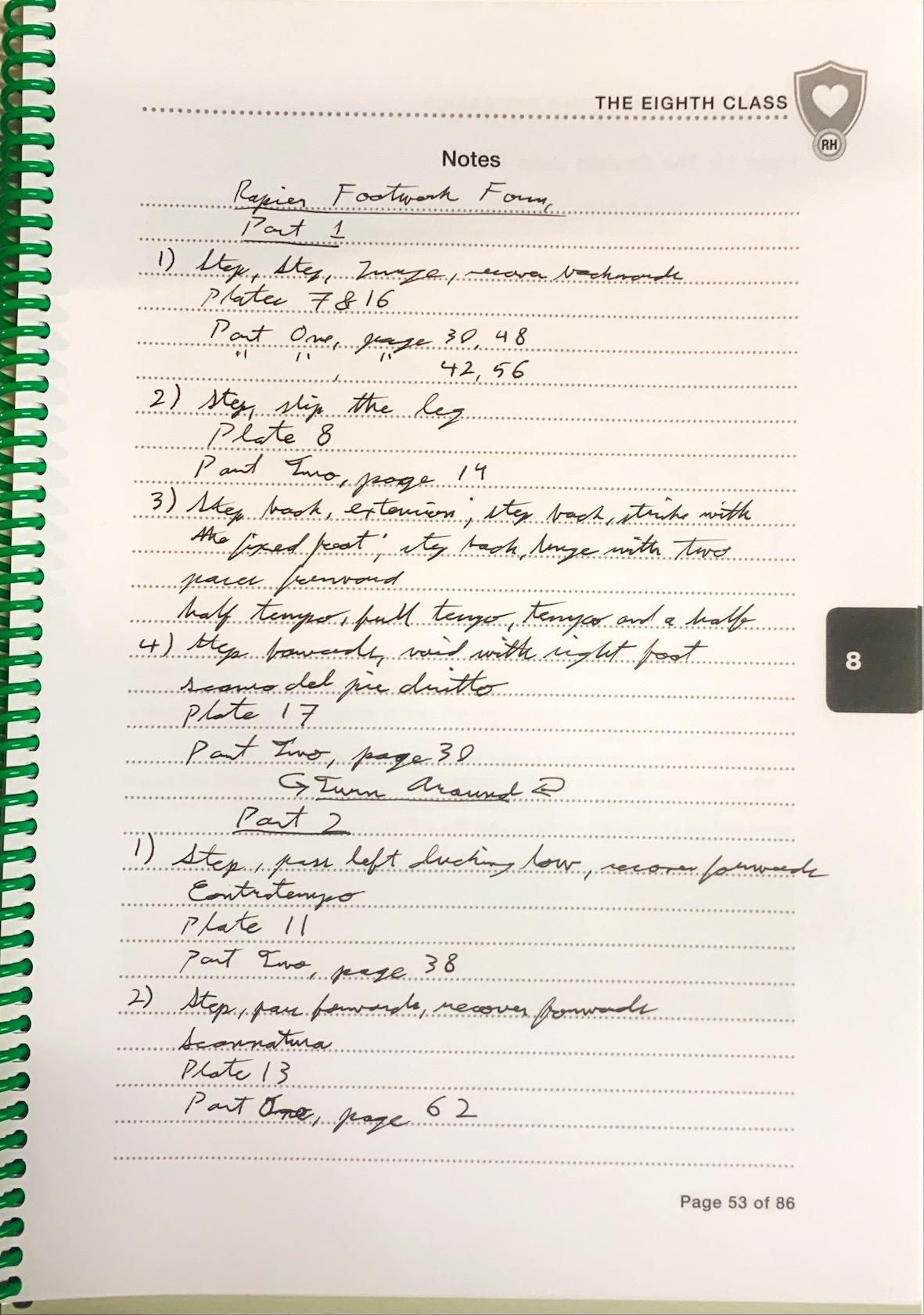
It is hugely satisfying for an author to see their work put to work. I received an email recently from Anthony Klon, who is using my Rapier Workbooks. He described how he's using the area for notes to make cross-referencing the steps of the Rapier Footwork form with the translation he's using.

I’ve been working through the Rapier workbooks and hit upon this idea. I was really struggling with having to flip back and forth between workbooks, scanning the TOC, then finding and reading a section and going back to Tom Leoni’s translation to see the original context. So it occurred to me to organize the footwork form like this. Every step in the form has 4 entries in this outline:
1) the action described in your text (eg, step, step, lunge, recover)
2) the terminology, if applicable (eg, the scannatura)
3) the plate in Capoferro where the technique can be found
4) the workbook volume and page number where the corresponding lesson on the technique may be found.

Now there’s far less flipping back and forth. If I get stuck or want to perfect a part, it’s easy to go straight to the plate or page for revision.

You can see the footwork form here:

Do you want to learn precise control over the sword, for enhanced speed, power, and the ability to deceive the opponent?

In this seminar we will cover some basic handling drills, then move on to the specifics of shortening the path the sword must take. Beginners require a long movement to generate speed and power, experts accomplish the same action in a much shorter path, which of course takes less time.
These skills apply to any weapon, but we will focus on the longsword, with applications from both Fiore and Liechtenauer.
The seminar will run from 7pm to 8.30pm UK time, and there will be time for questions etc built into the schedule.

I highly recommend watching the general mechanics seminar recording first:

https://vimeo.com/475021509/e974ae88fb

This seminar will take the concepts taught in the general mechanics seminar for granted, so please do watch it first.
The seminar Zoom meeting will start about 10 minutes beforehand. The class itself will start on time at 7pm, and end on time at 8.30, but I'll stay online to take questions and hang out for a while afterwards.

Please note that the time is 7pm UK, which is (for example) 5 hours ahead of EST.

You will need:

  • As much space to move in as you can reasonably manage.
  • A longsword or longsword simulator.
  • A practice partner is optional, but helpful.
  • Common sense, and a commitment to safe practice.

Reserve your place at https://bookwhen.com/swordschool

Tickets cost £10. Free tickets will become available on Thursday 19th. Lack of cash should not prevent anyone from learning.

Feel free to share this with anyone you think may want to improve their longsword skills.

There’s a sword meme going round the internet which features some self-important prick that can’t hold a sword properly and has the posture most commonly associated with a lifetime spent hunched over a porn site, and words along the lines of the following:

While you were out partying, I studied the blade.

While you were having pre-marital sex, I studied the blade.

While you were taking drugs, I studied the blade.

Now the enemy is at the gates, and you have the audacity to beg me for help?

This sort of fuckwittery boils my blood. It was clearly written by a fantasist who has zero knowledge of what actual swordspeople are actually like, and it is egregiously annoying because it calls my profession into disrepute. Especially the last line. What, exactly, does the original writer think a swordsman can do against threats in this modern age? And since when does mastering a particular skill entitle you to sneeringly withhold it from those who did other things? My doctor has never, not once ever, said to me “I spent years in medical school learning to heal the sick while you were fooling about with obsolete weaponry. Now you’re sick, and you have the audacity to come to me?”

And what’s with the horrible notion that training with blades requires some kind of hermity asceticism? It's unhistorical, unrealistic, and while a degree of temperance is required to train to a high level, there are entire branches of martial arts that include mind-altering practices of one form or another. And I'd bet money on the notion that a lot of people have trained to become proficient with the sword precisely to get laid.

So I’ve fixed it:

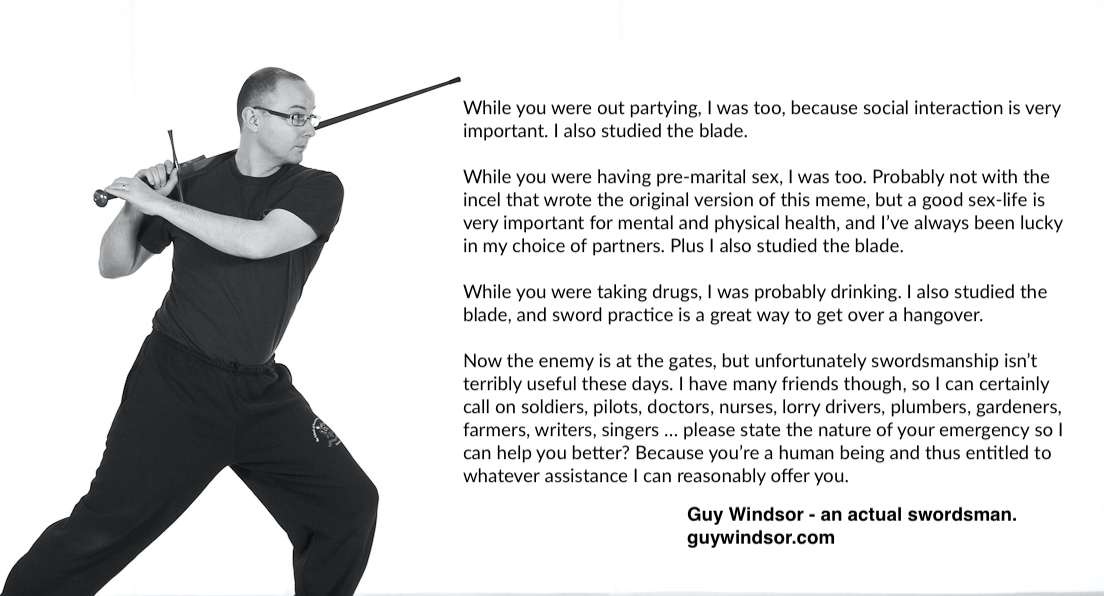
While you were out partying, I was too, because social interaction is very important. I also studied the blade.

While you were having pre-marital sex, I was too. Probably not with the incel that wrote the original version of this meme, but a good sex-life is very important for mental and physical health, and I’ve always been lucky in my choice of partners. Plus I also studied the blade.

While you were taking drugs, I was probably drinking. I also studied the blade, and sword practice is a great way to get over a hangover.

Now the enemy is at the gates, but unfortunately swordsmanship isn’t terribly useful these days. I have many friends though, so I can certainly call on soldiers, pilots, doctors, nurses, lorry drivers, plumbers, gardeners, farmers, writers, singers … please state the nature of your emergency so I can help you better? Because you’re a human being and thus entitled to whatever assistance I can reasonably offer you.

Less catchy, perhaps, but way better.

A long time ago in a country quite far away.

I have finally managed to articulate my health goals precisely. It’s just this: I want to play tick-tock-tick-tock-bong! with my grandchildren.

In case you don’t know the game, it’s simple: you hold the (enthusiastically willing, squealing with glee) child upside down by their ankles. Swing them a few times side to side like a pendulum, yelling ‘tick’ one way and ‘tock’ the other. Repeat a few times, then lift them straight up in the air as high as you can, and drop them straight down so their head is maybe six inches off the ground, BONG! Lift and drop BONG! Lift and drop BONG! Lower them gently to the ground, and repeat according to demand.

This requires the following things:

1) being fit enough to do it safely (for both of us): it’s a bit like a two-handed overhead press, with a kid weighing up to maybe 25kg.

2) having the sort of relationship with my kids and grand-kids, that this is natural.

I’m 46, my youngest child is 11. She might have her last child at age 40, and kids tend to get too big around age 8,  that puts the window at being able to do this at 37 years from now, when I’ll be 83.

So the question to ask of any activity or intervention is this: will this make it more or less likely that I’ll be able to play tick-tock-bong at age 83? My fitness routines, diet choices, and interactions with my kids are all covered by this goal.

Let’s take diet first:

I’m running blood sugar tests; I’ve written up something about them starting with The Myth of the One True Diet. Read that if you don't know what I'm going on about.

A diabetic friend gave me a spare continuous blood glucose monitor, the Libre Freestyle, which lasted for 14 days. After my initial horror at seeing the size of the needle I was about to stick into myself (by normal standards it's tiny. By mine, it's like a 6″ nail), I found the monitor a huge improvement over the finger-prick method; not least, it automatically took readings all night, and it never forgot to run the experiment (though the 8 hour memory was not ideal; I had to remember to take a manual reading (tapping my phone to the sensor) right before sleep, and right after waking, or I’d get a gap in the data. It starts deleting the older records when the memory fills up. The sensor is small, easily installed, and I could do all my usual activities with it in place, and once I got over the needle shock, it was extremely unobtrusive. I think it ached a bit once because I’d slept with my weight on it, but that’s it. And the data is awesome. It takes a reading every 15 minutes, plus whenever you manually check.

My goals after running this experiment is to avoid unconscious blood sugar spikes, and to reduce my fasting blood sugar level a tad below the middle of the normal range. I absolutely do not intend to avoid all sugar forevermore- life is for living, and my Dad’s home-made marmalade is awesome. But being able to completely avoid sugar spikes without significant effort is very useful, and because I know what spikes it, I can avoid or embrace at will.

It’s important to establish a baseline, so I am going with fasting blood sugar at 12 hours exactly from the last calorie consumed. Simply avoiding the spikes has brought my average morning reading down from about 5.6 mmol/L to about 5.0 (which is the middle of the normal range). One reliable effect has been that exercise quickly raises my blood sugar a little (presumably as my muscles split glycogen into glucose), and no amount of exercise that I’m actually willing to do pushes my blood glucose down. This is a different body response to many people.

Another side-effect is my trousers are looser in the waist than they were. That’s no bad thing- lockdown encouraged some unhelpful habits.

I’ve also found that my previous time restricted eating protocol wasn’t doing me much good. I was doing 14:10 (last calorie in about 7pm, breakfast at about 9am). So I changed it.

At the moment, this is the protocol I’m following:

Monday to Friday: 18:6 time restricted eating (TRE). So, last calorie in about 7pm, first calorie in the next day at about 1pm. I find this works well for me; I don’t need to eat in the mornings, so skipping breakfast is no hardship. And it dropped my morning blood sugar level very quickly. I’m not terribly strict about it though: if I’m going out to do something at 12, and don’t want to be hungry for it, I’ll eat before I go (which is still a 16 hour fasting window).

At the weekends, I eat breakfast if I want to. Last Saturday I wasn’t hungry before taking my daughter to her riding lesson, so I ate when I got home at 11.30 (a bit over 16 hours since last calorie in). Sunday though, I felt like breakfast, and yes it did include marmalade on toast. And the angels sang.

I should also mention that I’ve had problems with acid reflux for the last couple of years (badly enough that the doctors shoved a camera up my nose to inspect my oesophagus). It’s been resistant to the usual interventions such as omeprazole, and over-the-counter treatments like gaviscon. One thing that I really, really, have to avoid is eating a big meal within three hours of going to bed. The consequences are truly disgusting. This puts a cap on my last-calorie-in time at 8pm at the absolute latest, 7pm better, which means when I wake up I've usually been 12 hours or more without food already. I’ve also found that this 18:10 pattern may be helping with the reflux (though I’ve no idea why).

Dinner is the main meal of the day, which we all take together (which is totally in line with the tick-tock-bong goal). We almost always cook proper food from scratch, with a decent amount of vegetables.

Thanks to reading David Sinclair’s Lifespan, I’ve also started supplementing with NMNs, and Longevinex’s resveratrol formula. If you want the details of why, I suggest reading the book. It’s very complicated, and I’m not a biologist. Suffice to say these supplements and the TRE all follow the basic rule of there being an acceptable, measurable, downside that is much lower than the probable upside.

Regarding exercise, the positive constraint of my morning training sessions has been a lifesaver (perhaps literally!). There was a time in May when I got up for my morning training and did three squats and one push-up, and thought ‘fuck it, that’ll do’. Not having seminars to stay fit for made it a serious self-discipline challenge to stay fit. I’m not a fan of using self-discipline when you can create external constraints instead. I’m a teacher first, martial artist second, swordsman third. If I wasn’t teaching swordsmanship, I’d be teaching something else. Students can bring out the best in me. So, I started the morning training sessions (Monday, Wednesday, Friday) knowing that if there was even just one student expecting me to be there to lead a session, I’d be there. It takes no mental effort, it’s a law of nature for me. It’s the same mental posture as “I have no choice”. The sessions have developed into a lovely small group of regulars (and newbies always welcome: you can join us here), such that I actively look forward to our sessions, and I am much more thorough about exercise than I ever would be on my own. We’ve even started working through my hellish ‘health qigong form’. Which means I’m practising every day to get it polished up such that I can teach it properly. Something I've been meaning to do for ages, but suddenly am finding easy. The students need it, ergo I do it. No discipline required.

You can see a sample session here:

None of this guarantees anything of course. My kids might choose not to have children, for instance. Or I could lose both my legs in a freak lightsaber accident. But luck favours the prepared. The probability is that whatever I do I’ll be alive at 83; both my grandfathers were heavy smokers who lived into their 90s. Both my parents are thankfully still alive too. The question is, at their age, will I be alive and well enough to chase toddlers over climbing frames? Fit enough for tick-tock-bong?

Framing the problem in such simple terms makes everything much, much easier. It's specific, and it includes physical strength and fitness, and mental health and connection. So that's my goal. What's yours?

The day has dawned… the newly updated Solo Training course is live, and ready. It is a huge amount of material, enough for years of training. I am offering it at half off the regular price of $600 (plus tax in Europe), for one week only. The discount is available for the one-off purchase, or you can spread the cost over ten instalments. Join us here.

As with all my courses, there is a cast-iron satisfaction guarantee- if you buy it, try it for up to 30 days, and don’t like it, then you get all your money back.

If you are currently unemployed or in difficult circumstances, email me and I will gladly send you a 90% discount code, or let you in for free. No questions asked. These are hard times for many people.

One student on the course, known as ‘The Anonymous Scandinavian’, had this to say about it:

”It has been a great pleasure for me to study as a student in the Solo Training Course. I have experience in martial arts beginning from the 1982 and I have done my share of teaching too.

To see new training methods and approaches to individual problems has been a refreshing experience! The pell-part totally blew my mind and next day I had one in my yard.

I sincerely recommend The Solo Training Course as a tool of self-improvement for both the beginners and more advanced students of Historical European Martial Arts regardless of their style or discipline.

Solo training is the secret behind all truly excellent martial artists' accomplishments. All world class sword people and martial artists spend much of their training time on solo training.

If you live miles away from the nearest fellow martial artist, don't worry, this course does not require training partners. Instead we cover everything you can reasonably do alone to improve your swordsmanship skills.

If you have regular access to a school or training partners, you can still dramatically up your game by incorporating intelligent solo training into your schedule. This course will teach you how. On this course you will learn ways of developing your mind, your body, and your technical skills, no matter what your starting point is. From absolute beginner to senior martial artist, we have you covered.

The Solo Training course includes these standalone courses:

  • Meditation for Martial Artists This course covers four different kinds of meditation, aimed at improving your state of mind and making you a better martial artist.
  • Fundamentals: Breathing This course will teach you how to breathe properly, and how to develop anaerobic and aerobic fitness without injuring yourself.
  • Fundamentals: Footwork This course will teach you how to move like a martial artist, whatever style you wish to practice.
  • Recreating Historical Swordsmanship from Historical Sources This course will teach you how to study the sources and create useful training syllabi from them. Most of such work can indeed be done alone.

Plus:

Jessica Finley (author of the book Medieval Wrestling) will teach you solo wrestling training.

Gindi Wauchope (professional historical swordsmanship teacher from Melbourne, Australia) will teach you Bolognese swordsmanship, with the sidesword, sword and buckler, and the two-handed sword.

I will teach you to train alone with

  • The Longsword
  • The Rapier
  • The Smallsword
  • The Spear
  • I.33 style Sword and Buckler
  • Sharp Swords and Cutting practice

As well as give you instruction on:

  • How to build a pell and a wall target
  • How to create handling drills for any weapon
  • Solo training drills for a range of weapons (with more being added over time)
  • Stick handling drills to improve strength and weapons control
  • Instruction on how to create a daily practice, and to train for longer term goals

Sometimes all this choice can be overwhelming, so there are over 30 trainalong workout routines lead by me, each about 40 minutes long, and requiring very little space or equipment. Just hit play and join in!

The breadth and depth of this course is spectacular, providing years of training material.

As with all Swordschool Online courses, you are welcome to try it for 30 days, and request a refund if it doesn’t do it for you. You are always welcome to email me with questions, and send me video clips of anything you may want help. Despite the name of this course, you are NOT ALONE. Over 900 students have taken this course so far: join them!

Chris Kerr, in Canada, says this about it:

There are a lot of reasons why we train solo: there are no martial arts groups in our area; we’re starting the martial arts group in our area but have to learn first; we’re on vacation; we’re in another country with different traditions. I’ve been all of these at various points.

This course is excellent. Guy Windsor is engaged and responsive: you aren’t just buying a series of YouTube videos here. With his years of experience and his focus on and dedication (and interaction) with his students, this is a course to take seriously – and it’s pretty much unique, so get it while you can!

You can find the course here. The discount ends on September 27th, so don’t miss it!

Please feel free to share this with anyone you think may be interested.

Search

Categories

Categories

Tags