The AI revolution has been growing behind the scenes for a very long time, and now with chat bots like Chat GPT and image bots like Midjourney, the iceberg is breaking the surface. It puts me in mind of the machine-tool revolution in woodwork that occurred in the 60s and 70s, and the quartz revolution in watchmaking around the same time. The short-term result of both of these was that a lot of old-fashioned craftspeople went out of business, and it became much easier for lower-skilled workers to make decent quality furniture and watches, and much cheaper for ordinary people to buy a functional chair or timepiece.
What we see in both cases, and indeed in just about every case I can think of where new technology comes along, was a change in the market, which became much more democratic, and much broader, with a lower low end, and a much higher high end.
Let’s start with the woodwork example, as woodwork is millenia older than horology.
There is nothing in woodwork that you can’t build with just hand tools. Ships? Check. Lace cravat in limewood? Check.
This is Grinling Gibbons’ cravat, hand carved in about 1690, currently held in the Victoria and Albert museum.
You can see how he (probably) did it in this astonishing video of Clunie Fretton’s partial reproduction.
Until recently, every woodworking project, including that cravat, went from tree to finished product with practically no mechanisation. All power was muscle power, human or animal. The tree was felled with axes, split with wedges, sawn by hand, planed by hand, and finished by hand. The circular saw dates back to the 18th century, when it was driven by wind or water power, and used in saw mills to cut trunks into planks, but it took a century or so to become widespread.
Mechanisation first occurred at the largest scales of woodworking: tree felling with chainsaws, ripping with giant circular saws, the planer-thicknesser (known as a jointer-planer in the US), and so on.
At one extreme, we have craftspeople making extraordinary things out of wood entirely with machines; at the other, we have craftspeople making extraordinary things out of wood with no machines at all. One great example of the latter is Tom Fidgen, author of a wonderful book The Unplugged Woodshop, who doesn’t use any machines at all! Yet he does run an online woodworking school… I wonder which makes more money?
At the level of the individual artisan working at the bench, the cataclysm of modernity didn’t really strike until the 1960s, with the development of smaller electric tools such as hand-held routers. This quickly lead to the demise of many companies making professional grade hand tools. It became very difficult to buy a decent saw or plane; all you could get was mass-produced low-grade wobbly crap. Just compare a Record plane from 1950 with one from 1975, and the cost-cutting is obvious. Plastic handles, parts made of bent mild steel rather than cast, etc. This was not the companies’ fault: the market for the high quality stuff just wasn’t big enough any more to be profitable.
But from the ashes of rubbish hand-tools, phoenixes have emerged, beginning with Lie-Nielsen Toolworks, founded in 1981. The top end of the market is now way, way, higher than it ever was before. Such as this saw from Skelton Saws:
The Chippendale, from Skelton Saws, a snip at £750
And planes from Karl Holtey, that begin at around £1k, if you can find them. Most are much more expensive.
Karl Holtey planes: the pinnacle of the art
Which make my beautiful, immaculate, Florip saws look very cheap! I have five: their bench saw, tenon saws both rip and crosscut, and dovetail saws rip and crosscut. Oh my goddess, these are amazing, and all five together cost about the same as one Skelton. But of course, about ten times what I'd pay for the cheapest options. Likewise, you can get a really high end plane from Clifton (an old brand that was going bankrupt, and was rescued by one of the few surviving handsaw makers in the UK, Thomas Flinn), Lee-Nielsen, Veritas, etc for a tenth of the price of the equivalent Holtey, but yes, about ten times what the crap in the big box store will cost you.
You can get an idea of what it takes to make a really cheap plane work properly in this video by Rex Krueger.
Putting these tools to use, most craftspeople fall somewhere in between the high-tech and the hand tool-only. I have always had a romantic and aesthetic preference for hand tools, so avoid machines where practical. But here’s the thing: from the perspective of the end-user, it is impossible to distinguish a board that has been dimensioned by machine and finished by hand, and one from which every shaving was taken away through manual labour.
There is no difference- you only get to see the final surface. Likewise, an article written by ChatGPT will be like a rough-sawn board. Usable for some applications, but by the time a craftsperson has planed it smooth, sanded it, and applied some polish, nobody will know if she wrote it from scratch, or edited it from an AI generated draft. Most end-users, most of the time, couldn’t care less how their book was written or their furniture was made. It either meets spec, or it doesn’t.
It’s also worth noting that mastering woodworking machines is in its own way as demanding and difficult as mastering hand tools. You can’t just dump a load of wood in the machine shop, turn everything on, and hey-presto! Out comes new furniture. It’s just that it expands the lower end, and speeds up production: less-skilled workers can get useful work done, and more skilled workers can work dramatically faster, especially in getting sawn lumber dimensioned and planed all round.
The major downside of machines in woodworking (other than the noise and the dust) is that one can tend to make the furniture that the machine can handle. The machines become a limiting factor. If you can’t fit a board onto your planer, you might rip it down the middle so it will… when cutting dovetails, I usually lay out the tails so close together that it’s impossible to cut them with a router (the cutter shank won’t fit through the gap between the tails).
Anyone who knows about such things will immediately see that these were hand-cut. This has nothing to do with practicality, and everything to do with satisfaction. It’s sticking one finger up to the machine-tool revolution, and quite silly because a) it doesn’t make the joint stronger and b) I’m perfectly happy to use machines for other things. The groove for the drawer bottom in this very drawer was cut with a router, and I used a planer-thicknesser to bring the front and sides to thickness.
If you are unfamiliar with woodworking machines, you can see a state of the art modern set-up here in Matt Estlea’s overview video of the making of his Roubo-style workbench, “Bertha”.
Same craftsman, different jobs, so different tools.
Of course, most furniture isn’t made by any kind of craftsperson. It comes from factory assembly lines, in massive quantities at an extraordinarily low cost. It is literally cheaper to buy a table from IKEA than it is to buy the wood to make the same table yourself. The same people who are (probably rightfully) worried about how AI will steal their jobs are almost certainly wearing clothes made on machine looms, and using furniture mass-produced by industrial processes. And probably wearing quartz watches.
The Craft of Horology
Speaking of watches, here is one of the best watches in the world:
from https://www.casio.com/intl/watches/casio/product.AE-1500WH-1AV/
The Casio AE1500. Yours for about £30. Reliable, waterproof, multi-function, does everything you could possibly ask of a watch… Except make your craftsmanship spidey-sense tingle with glee. Which this handmade IWC perpetual calendar watch (you won’t need to adjust the date, month, or moon calendar until the year 2100) certainly does.
Get this: using only gears, springs, and levers, this watch can handle date changes, including leap years. It’s all 100% mechanical. The mind boggles. Is that worth paying about a thousand times as much for the watch? Some people certainly think so. The Casio does all that the IWC can do with ease, and more, at about a thousandth of the cost. Though, if I’m 100% honest, if money were no object, the high-end watch I’d get would be the Rolex GMT Master II, with the pepsi bezel. What can I say? The heart wants what it wants. Rolex got me with their advertising in the 80s, and I’ve never quite lost the urge. I found this genuine ex-dealer wall clock on Etsy, and I love it to bits:
Getting back on track now (please admire the deftness with which I didn’t go down the wooden timepiece rabbit hole), the quartz revolution almost destroyed the Swiss watch industry. Before those cheap, reliable, tacky watches came along, all watches were purely mechanical. The fancy ones were self-winding, and had interesting complications like GMT functionality and/or showed the date, but that was about it. And when cheaper, more reliable, tackier watches became available, there was a winnowing of watch companies that is heartbreaking to contemplate. In 1970, there were approximately 1600 Swiss watchmaking companies. By 1983, there were about 600 left.
One brand that made a tremendous success out of cheap quartz watches was Swatch. They went on to buy up some of the struggling fancy brands (Breguet, developer of the Tourbillon escapement (patented in 1801). Breitling. Even James Bond’s Omega) and made them profitable. At the same time, Patek Philippe, Audemars Piguet, Vacheron Constantin, and Rolex doubled down on the exclusive luxury end of the market and went from strength to strength, because they are not competing on price or time-keeping accuracy. They are competing on craftsmanship and artistry. It’s worth noting that Rolex and Patek Philippe particularly were actively developing their own quartz movements in the early days, so they were not in any sense Luddite about their approach to watchmaking. But they recognised a fight they'd never win, and so chose new ground to compete on.
Since the quartz apocalypse, there have been some astonishing new entrants into the field, such as Richard Mille and Kari Voutilainen (whose watches start around the 200 thousand dollar mark, about ten times what the IWC watch costs), or Finnish watchmakers S.U.F Helsinki, whose watches start at about a tenth of the IWC. These newcomers are not just filling the gap left by the older brands that failed and were bought up; the market for this kind of art/craft is much, much, larger than it ever was. In terms of price, it goes approximately like so: Casio: x 100 = S.U.F Helsinki: x 100 = Voutilainen. The gap between the bottom end and the top is almost infinite: there are new watches by new makers out there that cost millions.
People will still pay for craftsmanship
What does all this have to do with AI? Well, it’s the power-tool, quartz movement, equivalent for knowledge workers of all kinds, including programmers, graphic designers, and writers. Bill Gates reckons (in his article The Age of AI Has Begun) that this is the biggest thing since the graphical user interface, and he’s pretty well placed to make that assessment.The article is relatively fair-minded, and highlights some pros and cons. Pros include better cheaper healthcare, cons include the risks of AIs being misused by the malicious, and major disruption to the livelihoods of knowledge workers.
Here is what will happen, because it’s what always happens:
The market will split. There will be some people out of work because AI does their job better and faster than they can, and they can’t adapt fast enough. There will be some people who successfully position themselves as the hand-tool/mechanical watch artisan equivalent: poets, literary fiction writers, and so on. And there will be most people in between who learn to use the new tools, and use them to make more stuff, faster, and better.
There is space in the market for the cheap, practical, gets the job done for not much money solution. And there is space for the artisanal, bespoke, gets the job done for a lot more money solution.
On the left of my wall clock, there’s a version of my publishing imprint Spada Press’s logo, done on vellum, by the incomparable Nora Cannaday (whom I interviewed in episode 28 of The Sword Guy podcast).
Spada Press logo by Nora Cannaday (nee Kirkeby, hence the signature), at https://noracannaday.com/
It’s a one-off work of art. I also have this one, that I use in all my books:
Spada press logo, by Robert Simpson, at https://www.squircle.co/
Done precisely to spec, by the excellent Robert Simpson, using digital tools (which graphic designers were up in arms about in the 80s and 90s), and which has now been reproduced thousands of times in printed books and ebooks.
Which one is “better”? That really depends on what you want. They are both exactly what I asked for and are both excellent.
The real question is, who benefits from all this progress?
Back in the 80s, one teacher at school was banging on about how, with the new desktop publishing, you could do in a morning what used to take a week. I asked if you’d expect to get the rest of the week off, then? He said no…
And this is how it will go. If you are working for yourself, or it’s your company, then increasing productivity is usually a good thing, up to the point that it decreases the value of your product, and until your competitors become similarly more productive. If you work for someone else, this will just mean that you are expected to produce x times as much, for the same money or less.
In Gates’ article, he wrote:
“When productivity goes up, society benefits because people are freed up to do other things, at work and at home.” (Emphasis mine)
This is the most egregious rubbish. When productivity goes up, people are expected to do more work in less time. End of story. AI will mean either redundancy or more product for the same pay, for most employees affected by it.
Mark Hurst at Creative Good is a technologist who is usefully sceptical of various aspects of the modern techscape, including AI. He makes the point in his article ChatGPT’s dangers are starting to show that the companies involved in AI development are working to “privatise the gains, and socialise the losses”.
One critical area where the law has simply not been written yet is the use of copyright material to train AIs. To my mind, it’s a blatant violation of the rights of the creator to use their work (usually writing or graphic art of some kind) to train a machine to create other art in that style. Creators should have the right to decline such use, or to get paid to allow it, just as they might licence a film studio to make a movie out of their novel. I think it will be extremely difficult to prove what material the AI has used- for instance, any chatbot AI probably has access to every blog post ever written. But those posts are in most cases copyrighted to the writer. How do you prove that the AI stole your work? This is a solvable problem, I just hope that our society does the work to solve it. Making the owners of the AI liable for any infringements would go a long way towards motivating them to program the bot to behave ethically.
I think that dangerous new technology requires some kind of regulation. Cars, for instance. You need a licence and insurance to drive one. With AI, the primary worry is that ignorant people will mistake an algorithm with access to a finite (though very large) database for the arbiter of truth. And unscrupulous people will use AI to manipulate us into buying more stuff we don’t need, or voting for the wrong people. These are genuine concerns, but I am more concerned with the people who will become redundant, because they either don’t adapt, or re-brand, or their specific area is simply no longer needed by anyone. There can and should be some provision for them.
There is nothing inherently moral or immoral in AI. It’s a tool. It can and will be used to make our lives easier and better; and it can and will be used to make our lives worse. This is true for every tool ever made. Swords bring justice and defend the weak. Swords murder the innocent. It’s not the tool, it’s what we do with it. I could brain you with my #7 plane, stab you with a chisel, or use a chunky steel watch as a knuckleduster, which is how Mr. Bond broke his Rolex in On Her Majesty’s Secret Service (the book, not the movie). Though the tools you have access to will tend to guide your choices, whether you're conscious of it or not. When you're holding a hammer, you look for nails. I'm much more likely to joint an edge with my #7 that I am to hit anyone with it.
When I was thinking about getting a new (to me) car back when I lived in Finland, I considered getting a four-wheel drive, because it's that much less likely to get stuck in the snow. I asked a friend who really knows cars, and he said: “with four-wheel drive, you still get stuck, but in worse places”. Tools guide choices.
It's also true that all new technologies have unanticipated, often unanticipatable, consequences, for good or ill. I'm not a prophet, so won't make any predictions about the unanticipatable. But the obvious (to me at least) negative consequence of chatbot AI, like ChatGPT, is that we will outsource our thinking, and so become less good at it. Plato famously decried writing things down as bad for the memory. Folk are continuously ascribing all sorts of things to Plato and others (as Abe Lincoln famously tweeted: don't believe everything you read on the internet), so I'll quote him at length. He puts this story into Socrates' mouth:
The story goes that Thamus [a mythical inventor of writing] said many things to Theuth [a mythical king of Egypt] in praise or blame of the various arts, which it would take too long to repeat; but when they came to the letters, “This invention, O king,” said Theuth, “will make the Egyptians wiser and will improve their memories; for it is an elixir of memory and wisdom that I have discovered.” But Thamus replied, “Most ingenious Theuth, one man has the ability to beget arts, but the ability to judge of their usefulness or harmfulness to their users belongs to another; and now you, who are the father of letters, have been led by your affection to ascribe to them a power the opposite of that which they really possess. For this invention will produce forgetfulness in the minds of those who learn to use it, because they will not practice their memory. Their trust in writing, produced by external characters which are no part of themselves, will discourage the use of their own memory within them. You have invented an elixir not of memory, but of reminding; and you offer your pupils the appearance of wisdom, not true wisdom, for they will read many things without instruction and will therefore seem to know many things, when they are for the most part ignorant and hard to get along with, since they are not wise, but only appear wise. (Source: http://www.antiquitatem.com/en/origin-of-writing-memory-plato-phaedrus/)
He was right, but I think we'd all agree that the loss of memory skill is worth the upside of writing. I think ChatGPT threatens to create a net dumbing effect on its users. Nicholas Carr warned of a similar effect of the internet itself, and most particularly Google, in his book The Shallows: What the Internet is Doing to Our Brains. He was not wrong. I don't know how many times I've explained to my kids that googling a search term is not the same thing as researching a topic. So we should be watchful for any feeling along the lines of ‘I'm too busy/tired/stressed to do this myself so I'll just get the bot to do it'. The main red flag for this is whether something you used to do yourself becomes “too difficult” if you don't have access to the AI helper.
Banning the new technology, as some people whose livelihoods are affected by it are calling for, is never an effective solution. It has been tried over and over again, just about every time a new, revolutionary, technology comes along. Banning nuclear weapons didn’t stop North Korea from getting their hands on them. It simply doesn’t work. I bet the horse-drawn carriage makers did their damndest to get those nasty mechanised car things taken off the streets. Or restricted to the speed of a horse. And guess what? Some carriage makers went into business making bodies for cars, and some people still drive horse-powered carriages for fun. But yes, an awful lot of them just went out of business. I don’t say ‘adapt or die’. But I do say ‘regulate and adapt, or die’.
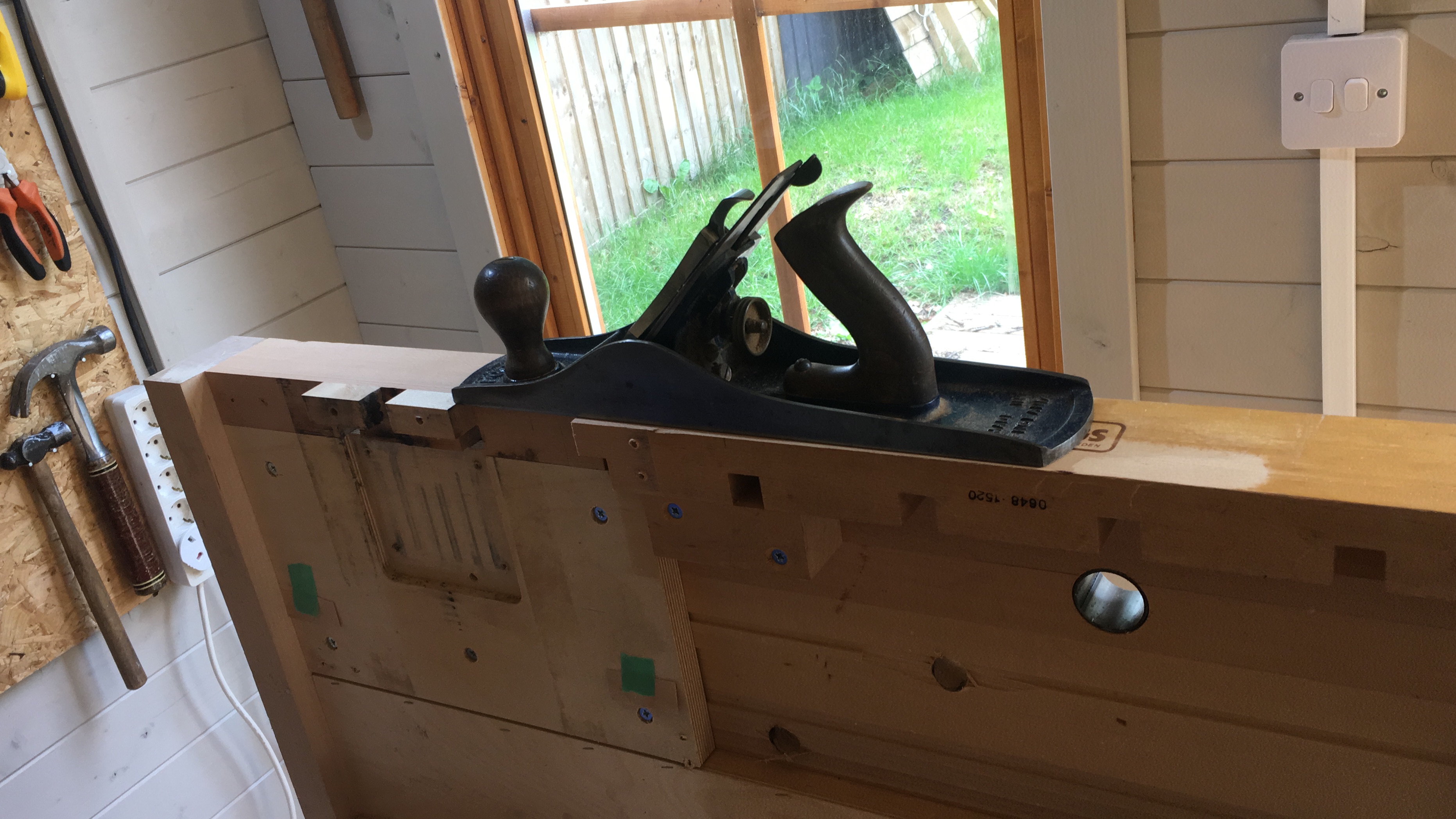
Personally, as a self-employed swordsmanship instructor and writer, I can see how using AI could help me produce better books, faster, by (for instance) creating outlines, rough first drafts of specific chapters, back-cover blurb, etc. But there is no way for ChatGPT to run a seminar for me, or to conceive of the idea of a new training manual for the Art of Arms. Also, I’m very much at the bespoke, luxury, end of the market. Absolutely nobody has an existential need for a swordsmanship lesson, so automation is not a concern. You can probably tell from the headline photo, in which I'm wearing a vintage hand-winding Roamer watch from the 50s, and using a Record #4 hand plane from the 30s that belonged to my grandfather, that I'm aesthetically always on the side of the old ways. I teach swordsmanship, not shooting.
A Roamer watch, a Record plane. And the first five saws in the saw till are my Florips.
Swords, spears, and bows used to be state-of-the-art weaponry, but were superseded by guns. Swordsmanship and archery devolved into competitive sports (throwing javelins did too), and even twenty years ago there were precious few swordmakers in the Western world. But there has been a renaissance of historical martial arts, and a consequent renaissance in the craft of swordmaking. That doesn’t help those smiths who went out of business a couple of centuries ago, but it does suggest that there will be a resurgence of appreciation for older ways of doing things in the future. It’s hard to think of a technology where this doesn’t apply.
Music? CDs and tapes killed vinyl… but vinyl came back stronger than ever. We now have streaming at the bottom end, and vinyl at the top, with CDs in the middle.
Ebooks were supposed to kill print stone dead… only for print to survive, thrive, and for high-end leather bound editions to become more popular, and more profitable, than ever. Brandon Sanderson’s latest kickstarter, for a leather bound 10th anniversary edition of his Way of Kings, raised just under seven MILLION dollars! (I could get a thousand Breitling watches for that! not to mention a thousand Holtey planes!) But print is dead, right?
Midjourney image generation does not threaten David Hockney, or Lina Iris Viktor. It does threaten folk making a living producing graphics for websites. Chat GPT does not threaten poets like Simon Armitage or Amanda Gorman. It does threaten writers making generic blog posts for other people's websites (who, incidentally, keep pitching me to write completely off-topic crap for this site!).
It’s not my place to offer advice to people in different circumstances to mine (and unsolicited advice is usually obnoxious). But as I see it, if you work in areas likely to be affected by AI, you have two options. Either master the new tool and use it to make your work even better, or brand yourself at the other end of the market. Both work, and both have value. There will always be people looking for the cheapest option, but there will also always be people looking for the hand made option, and who are willing to pay for it.
Joanna Penn got me thinking about AI as it affects writers, and she has written about it extensively on her blog, here: https://www.thecreativepenn.com/blog/
John Harrison, winner of the Longitude prize, and maker of clocks, including all-wood clocks (you can jump down that rabbit hole yourself!): https://en.wikipedia.org/wiki/John_Harrison
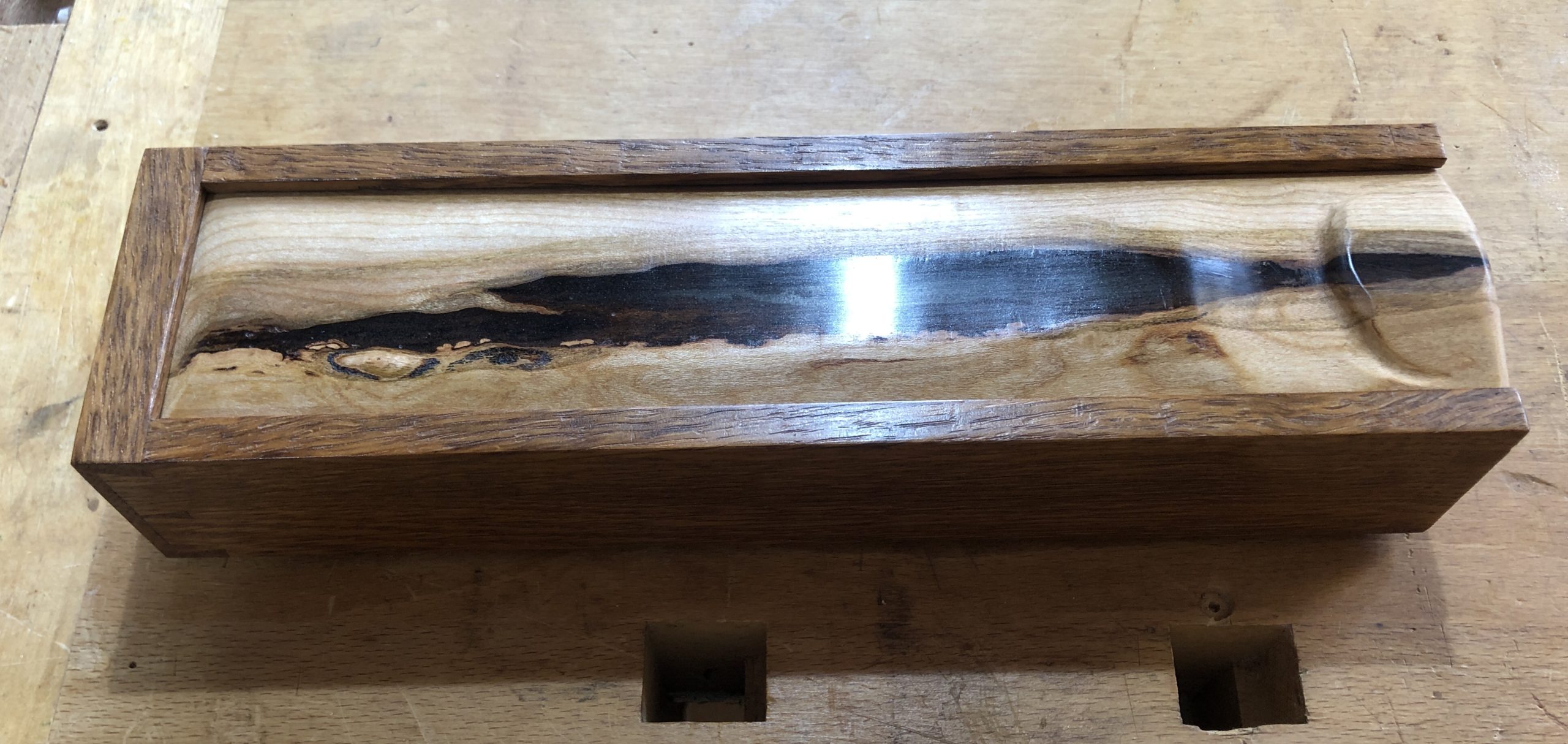
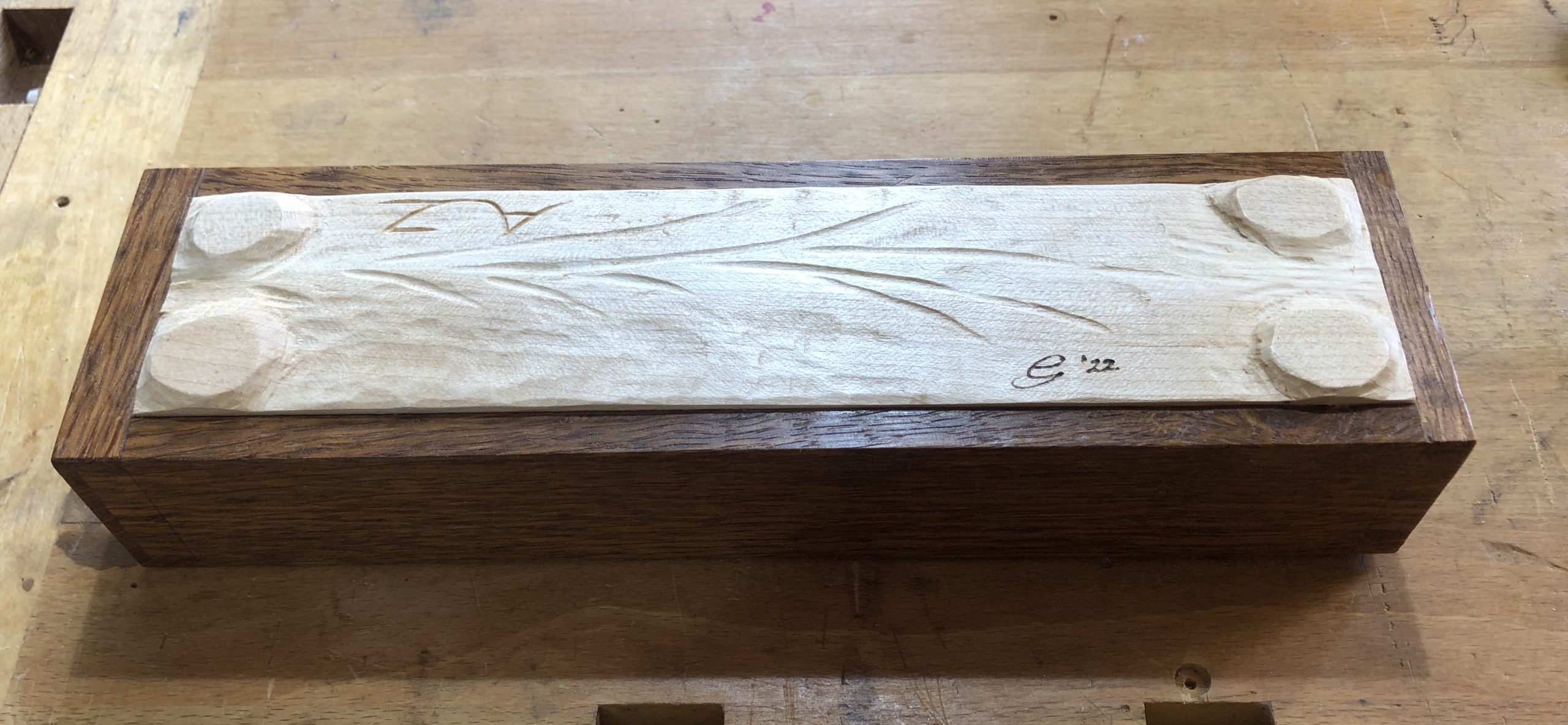
Pencil Box in Brown Oak, Maple, Cherry, Walnut, and Resin
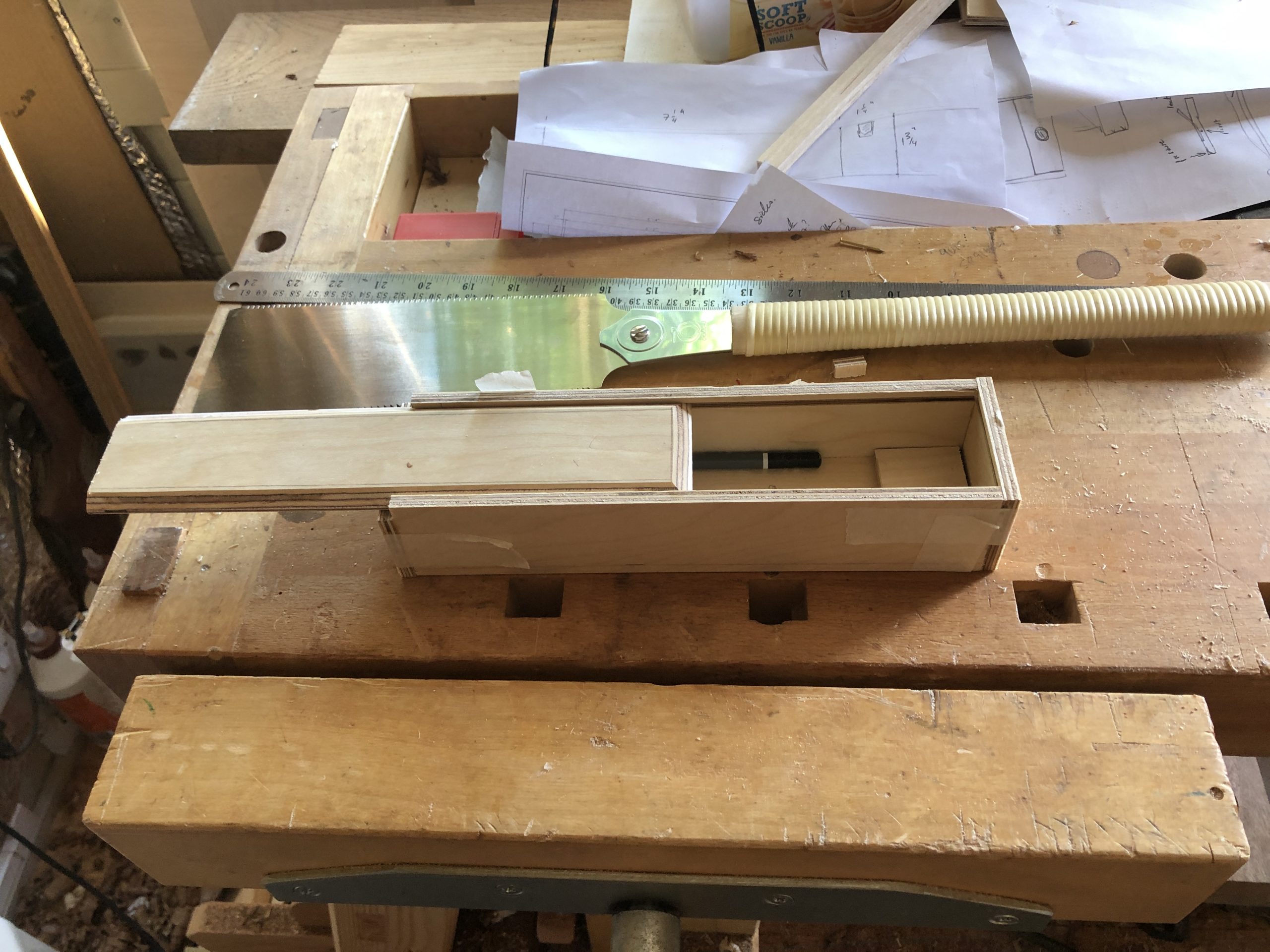
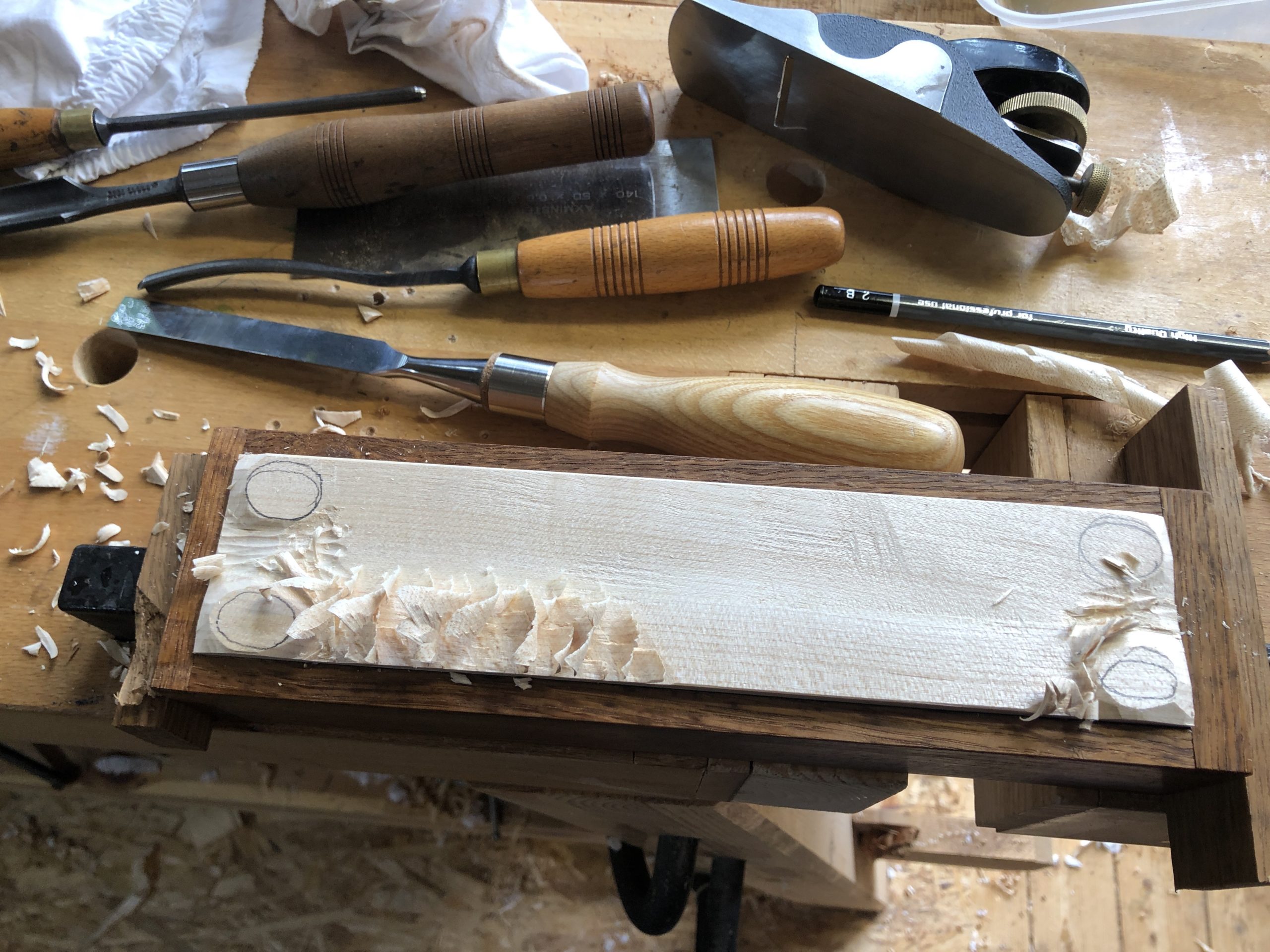
On my recent trip to the USA I was sitting in my friend Heidi Zimmerman’s garden when she dropped a truth bomb on my head. We have been close friends for a long time, but she doesn’t have anything I’ve made in her house. This unacceptable state of affairs had to be rectified, and we settled on a pencil box. I had complete artistic freedom, it just had to hold pencils. Oh, and a sliding top, not hinged. I’ve never made one before so I bashed out this in plywood:
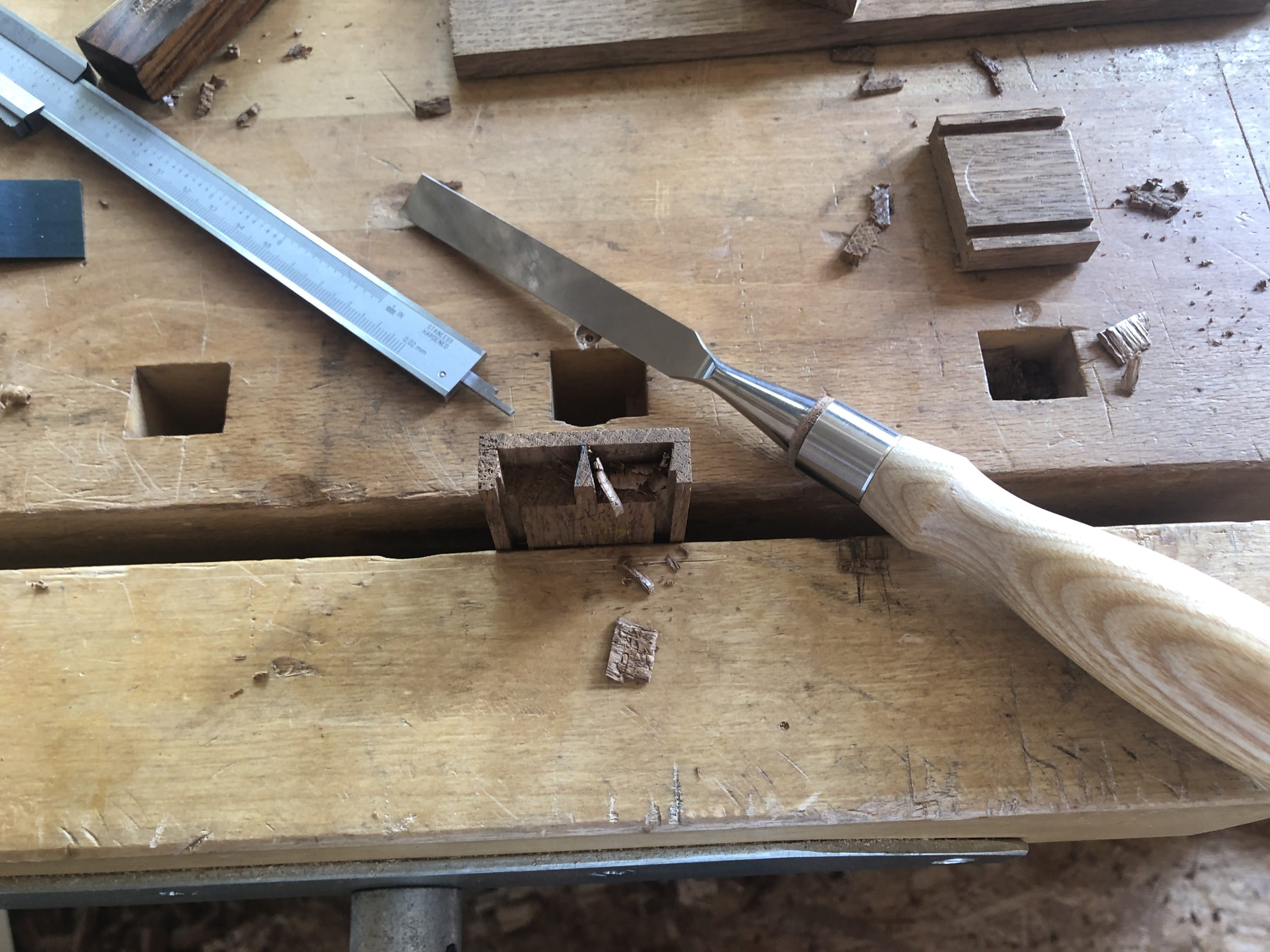
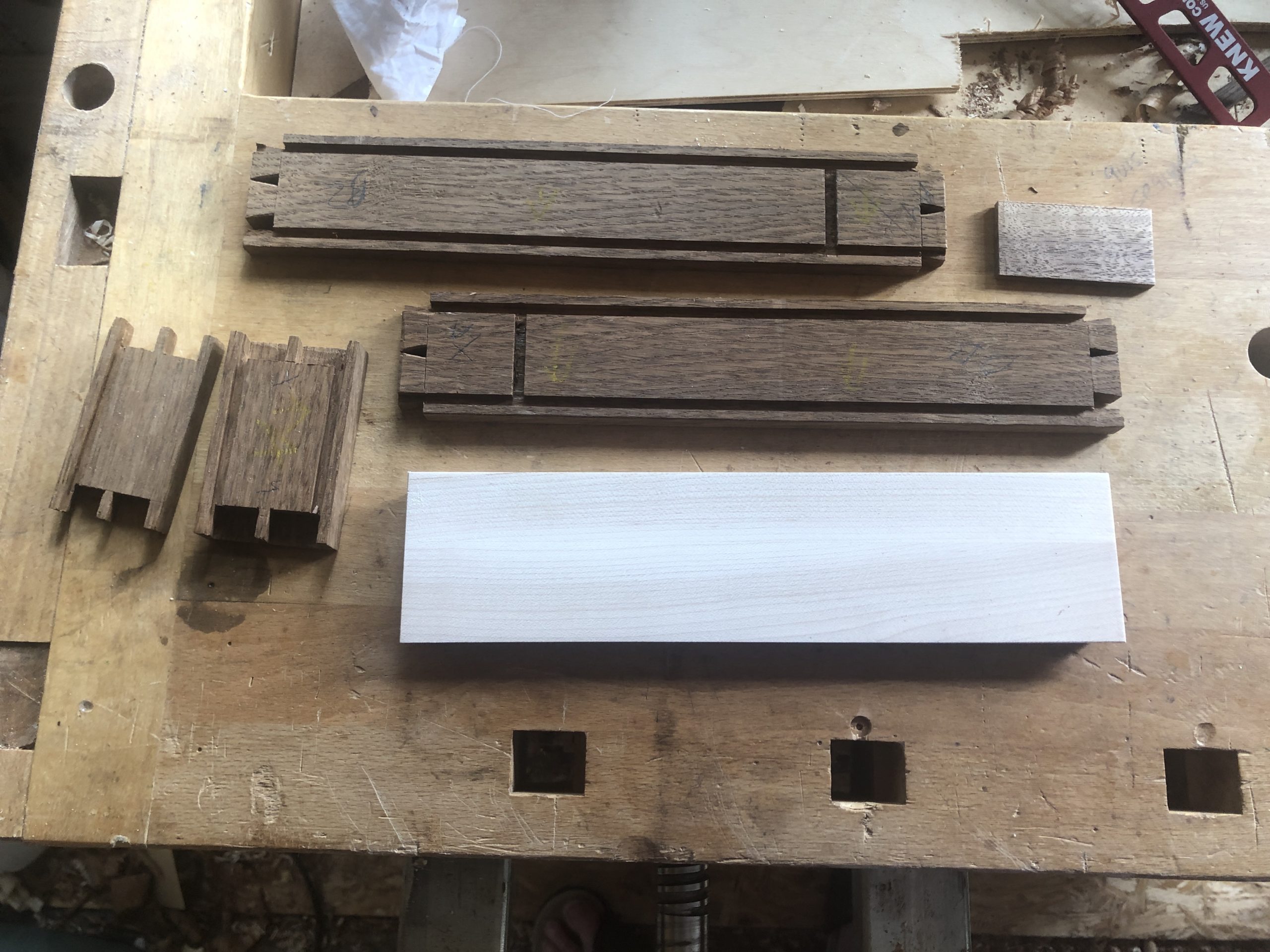
It’s just butt-jointed and glued, nothing fancy. But it gave me the dimensions, and an idea about order of operations. I made the box out of brown oak (because I have tons of it. Literally. A dead tree in our garden had to come down and I had it sawn into planks, the thinner of which are about ready to be used).I used lap dovetails at one end, and through dovetails at the other, just because. I decided to make it long enough to have a section for sharpeners and rubbers.
I chose a scrap of walnut for the divider because it had an ombre effect, light to dark, that I thought might tie the dark sides to the light base.
The base was a piece of maple I’ve had lying around for about five years, too small for most projects, but too nice to throw away. It was way too thick though, so I decided to leave it full thickness, and carve feet out of it when the box was assembled. Using such a pale wood should make the inside of the box lighter, making it easier to see what’s inside.
The sliding top came from a leftover bit of cherry that I had used for experimenting with resin. I like the idea of a translucent window into the box.
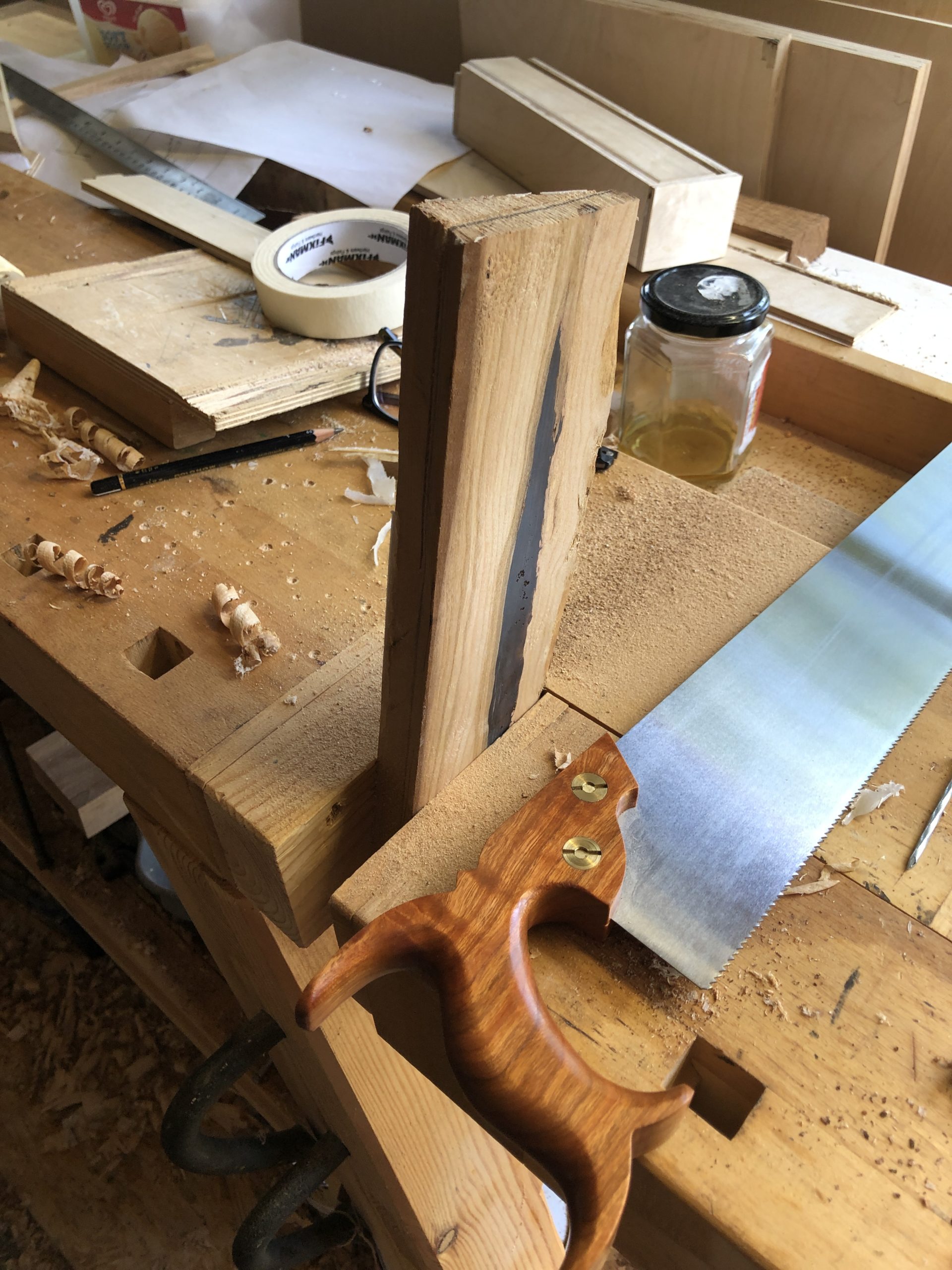
I have no idea how long it all took- I did everything by hand (including sawing to thickness, stock preparation, etc.) because that’s more fun than firing up the machines. The only exception was the grooves for the lid and the base. I didn’t have the right size blade for my plough plane, and didn’t want to grind one to fit, so I slummed it with the router. I think it turned out ok!
Pen Tray in Pine, Brown Oak, and Leather
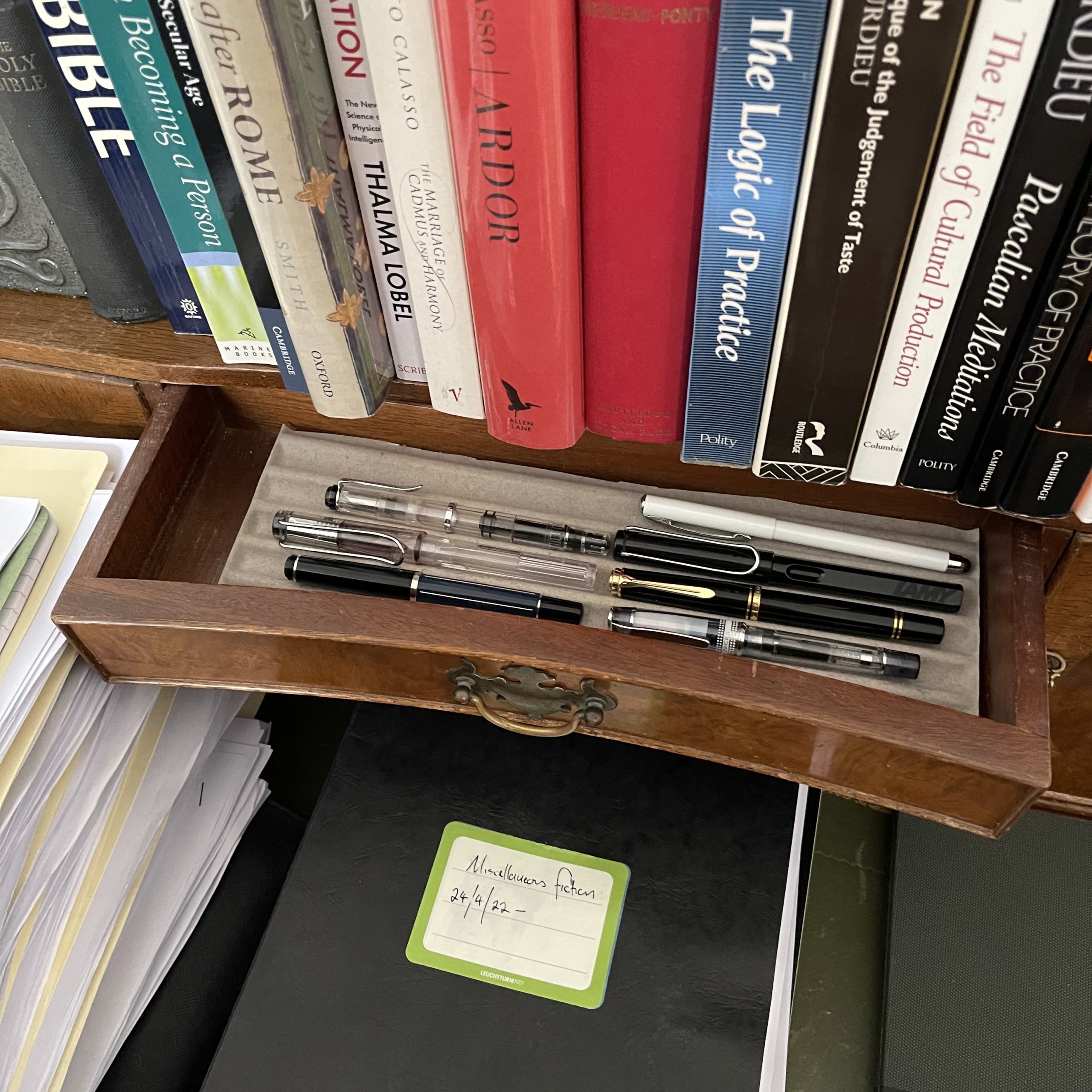
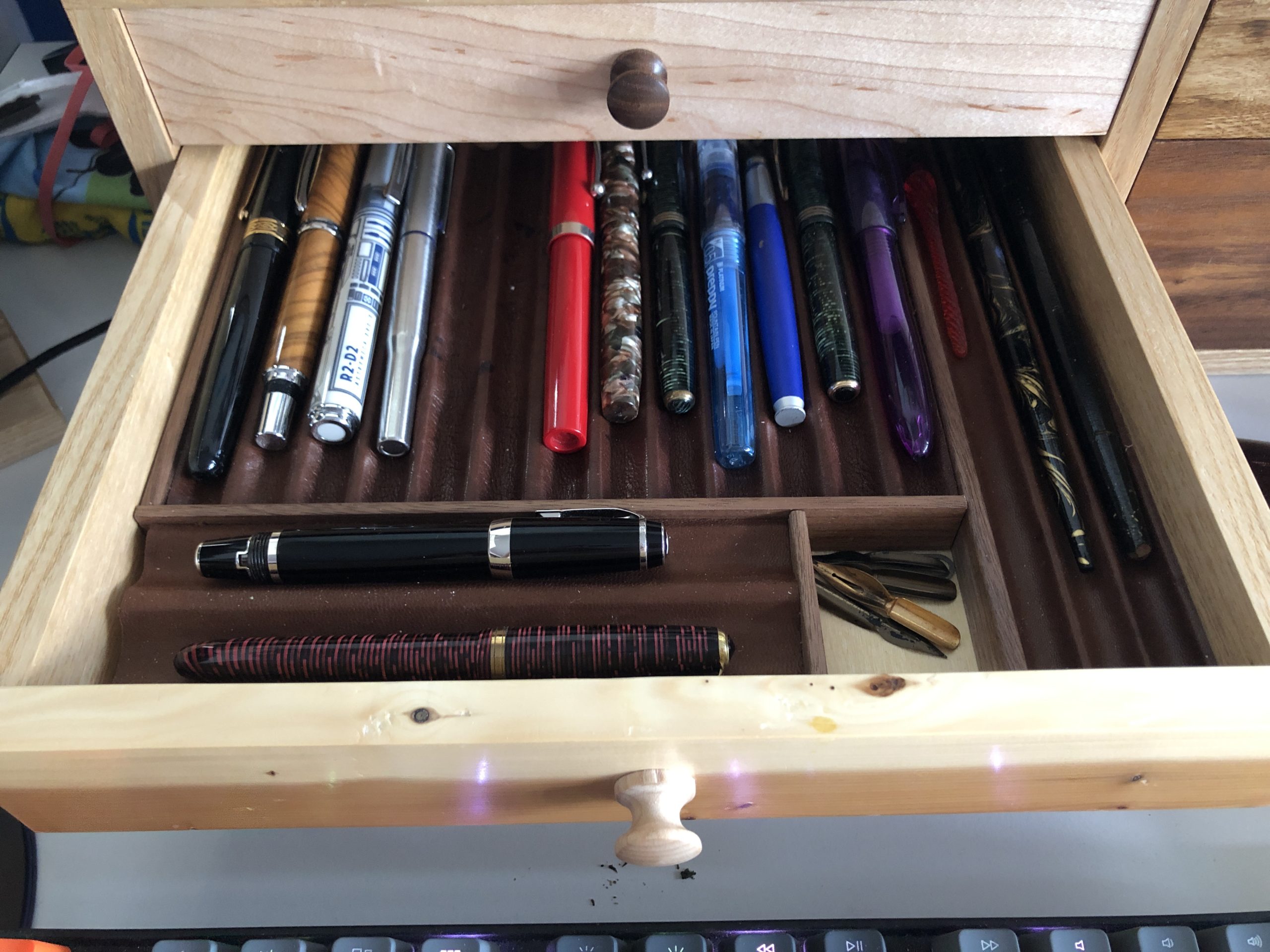
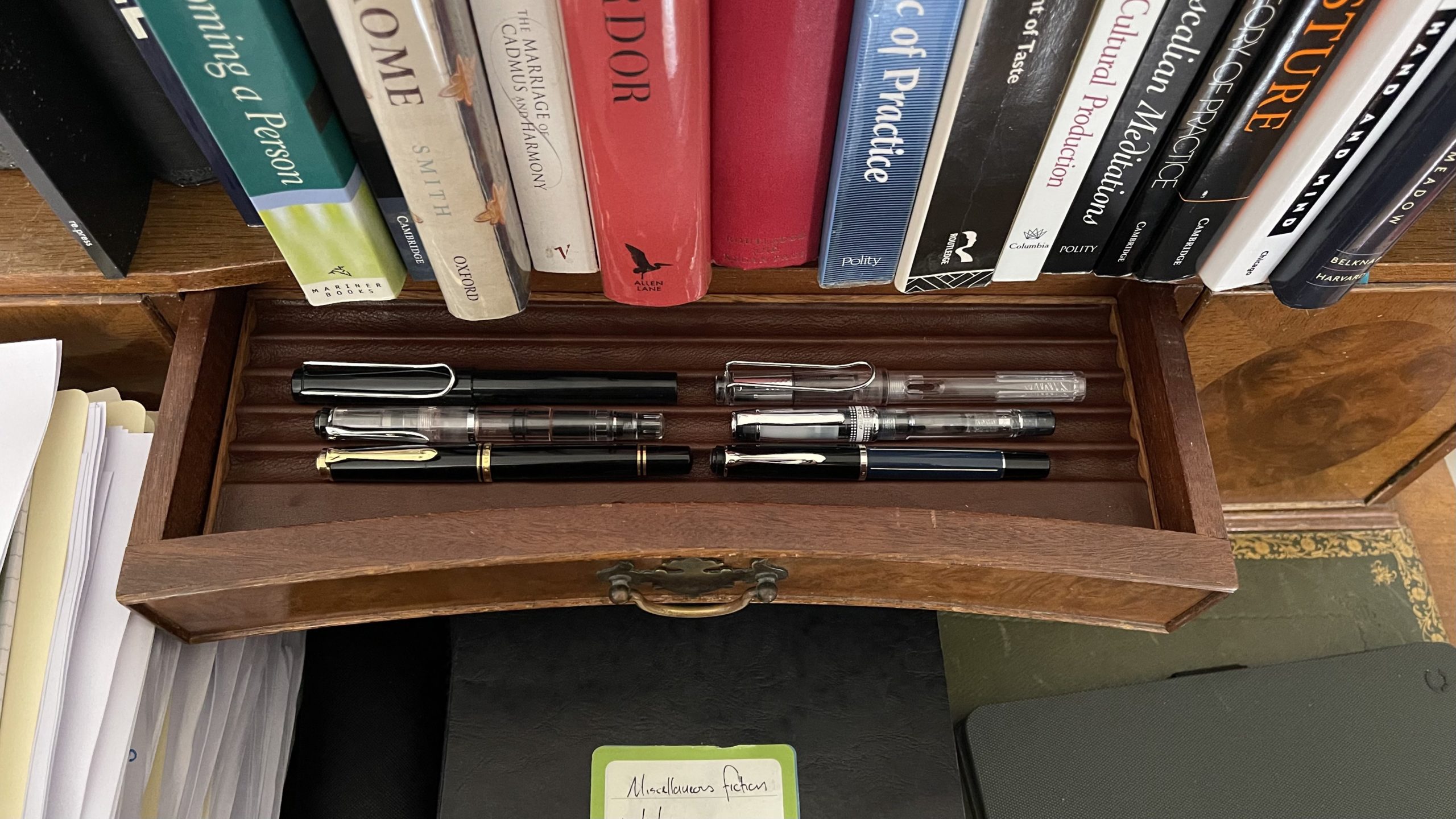
A while ago the philosopher and swordsman Damon Young (prof, dr, etc. Also guest on my podcast) posted a photo on Twitbook of his pen drawer. A small drawer in his writing desk with his pens in it:
They looked very sad in that crappy cardboard tray, and I couldn’t help but share a photo of mine:
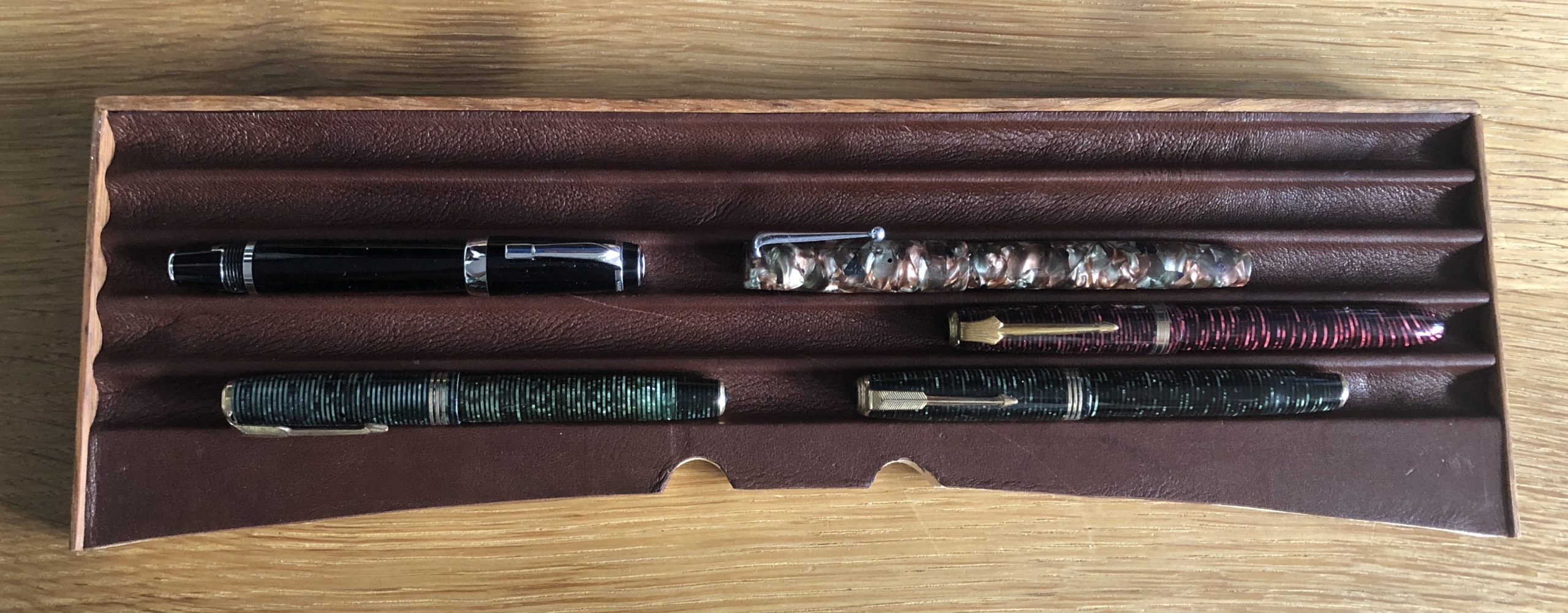
But not being a total arse, I softened the sting by offering to make Damon a proper pen tray. He’s in Tasmania, and I’m in the UK, but all I needed was an accurately cut template of the inside of the drawer, and it should slide right in. Prof. Dr. Young is an accomplished writer and philosopher, but not a craftsman, as the template rudely attested. A bit gappy sir! In fact, as gappy as the plot in most Marvel movies. But I made some educated guesses, and made this:
It’s pine, with grooves routed out, spaces for the drawer handle screws (which are in huge saucers for some reason), covered in goatskin and edged in brown oak. The edges are just pinned on so if the insert was a bit too big, they could be easily popped off. The whole thing took maybe two hours, not including waiting an hour for the glue holding the leather down to go off. I posted it off to the far side of the world, and turns out if fits ok!
Now I really should get on and make the next bookcase…
My friend Eleonora Rebecchi has designed several covers for my short ebooks, including the entire The Swordsman's Quick Guide series, and my Swords in the Time of Corona.
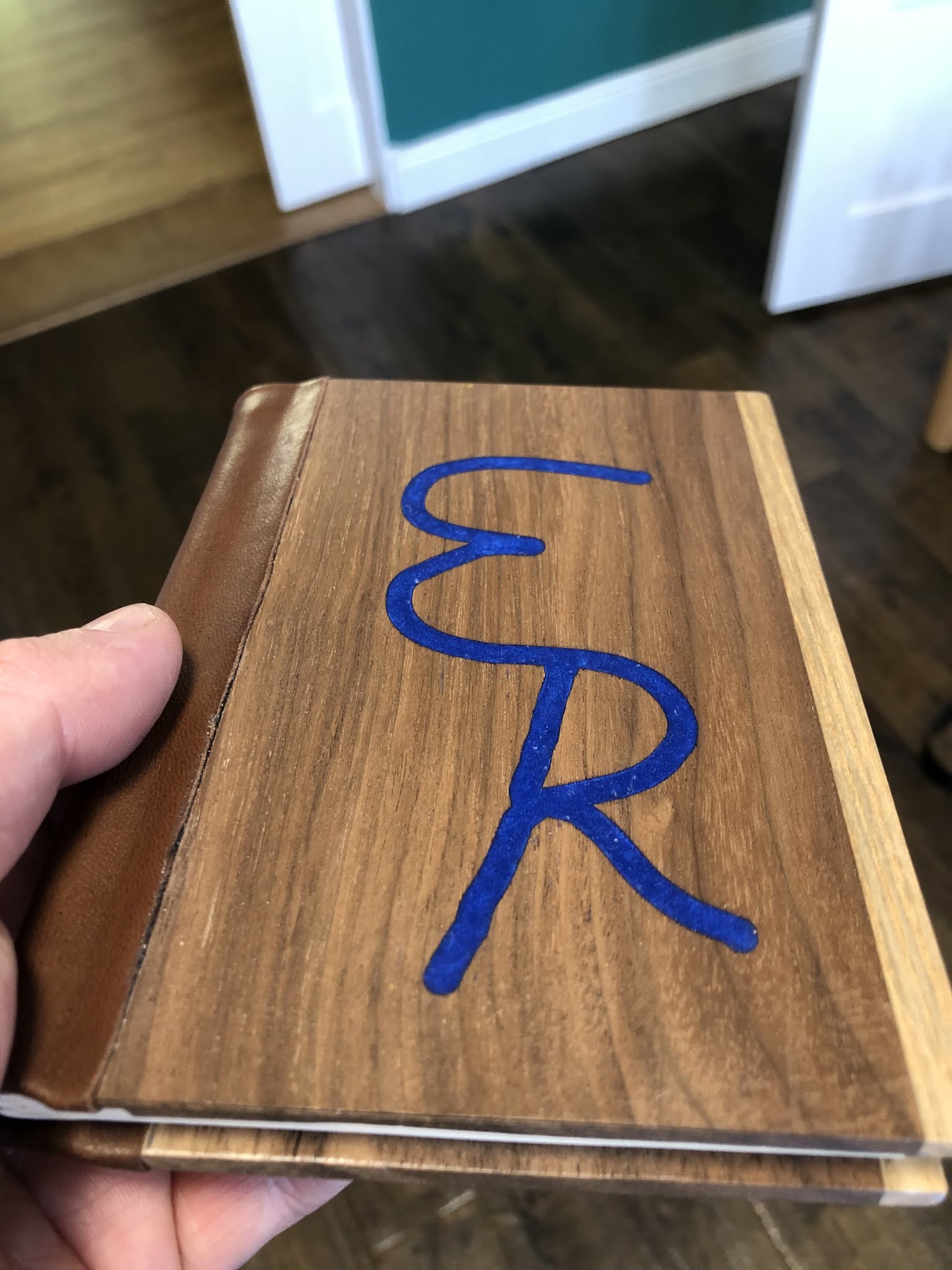
So it seemed apt to me to show her that I can make book covers too!
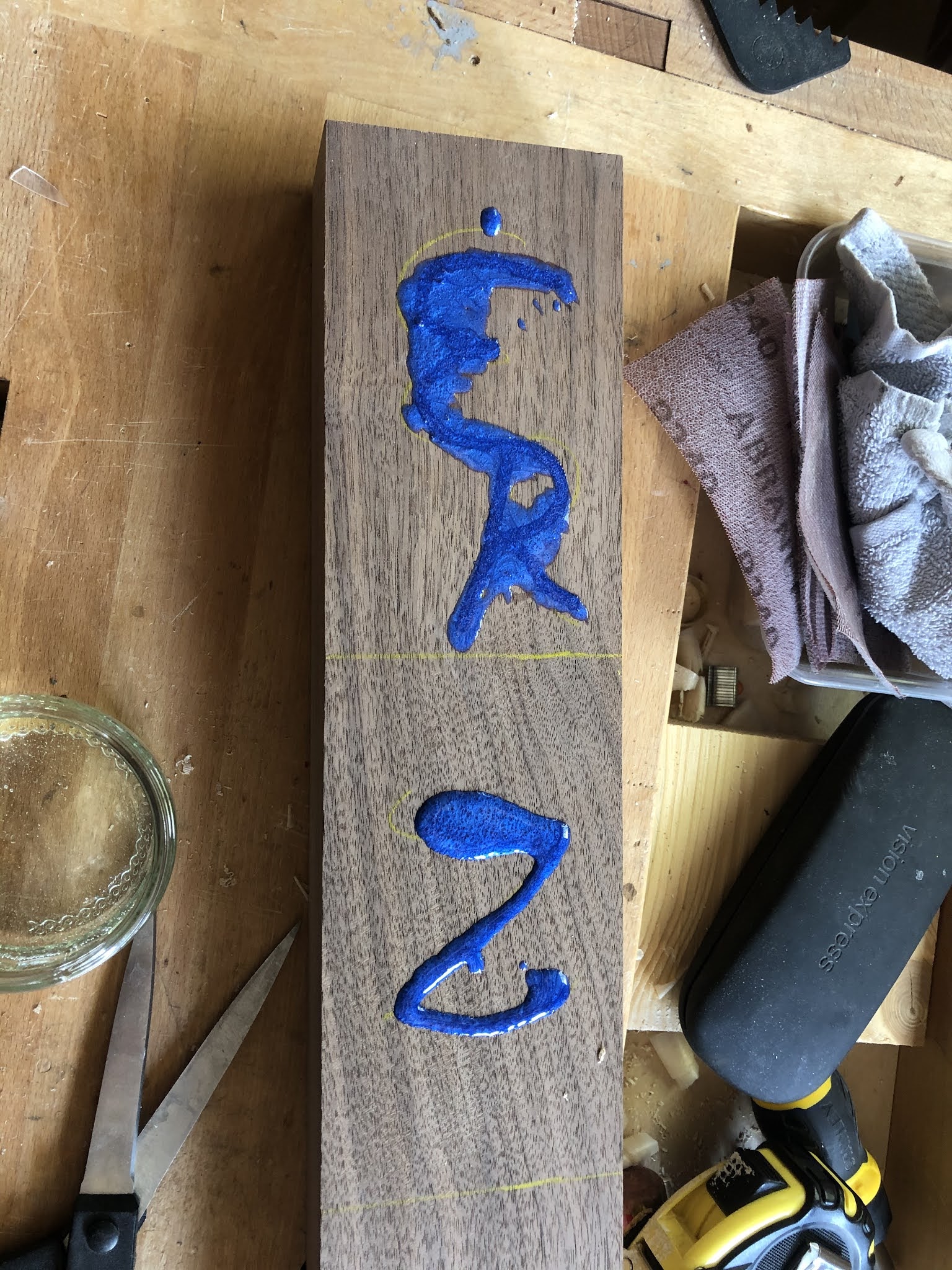
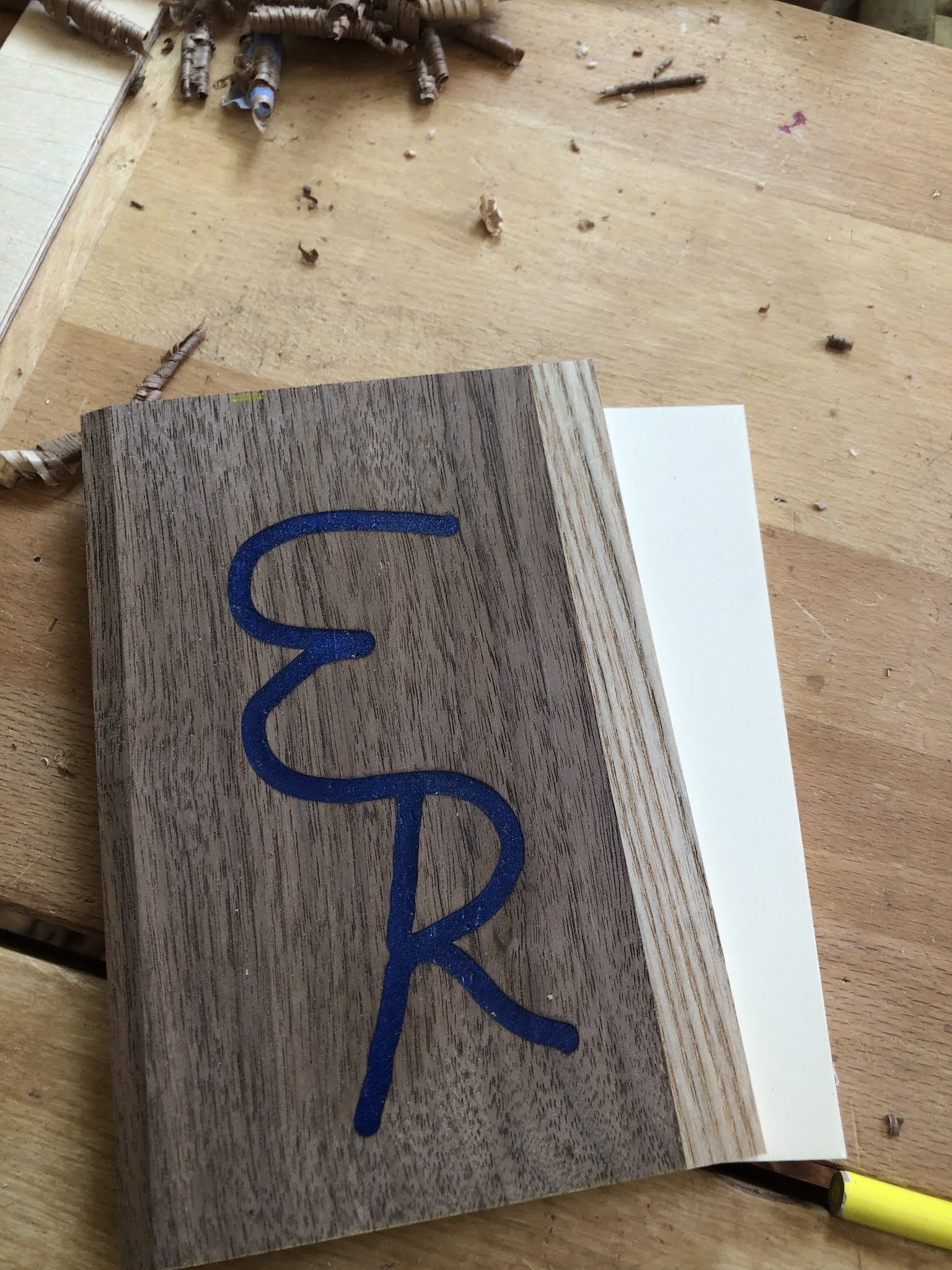
And I thought that putting her initials on the cover, in blue sparkly resin, would bring it to the next level 🙂
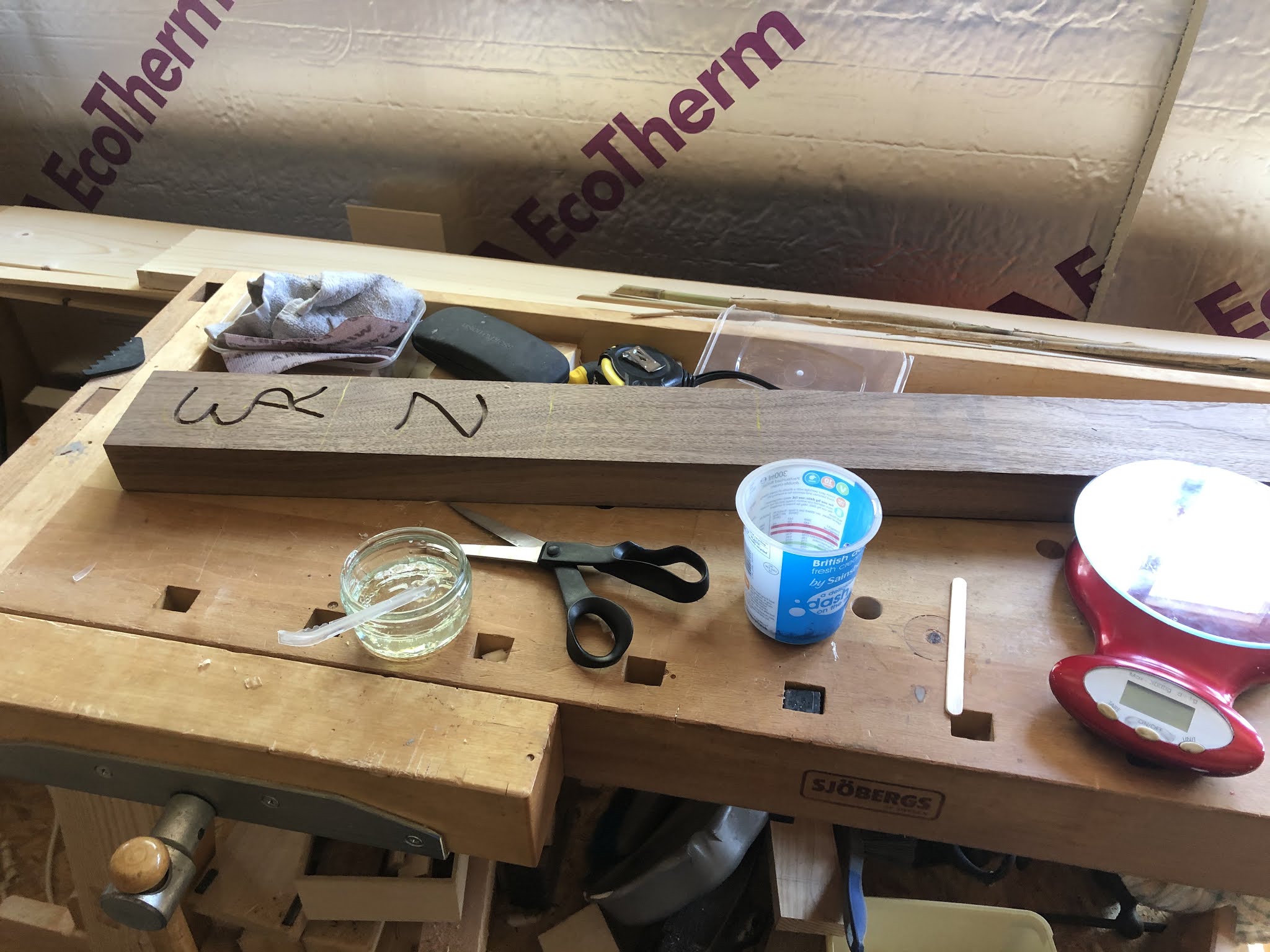
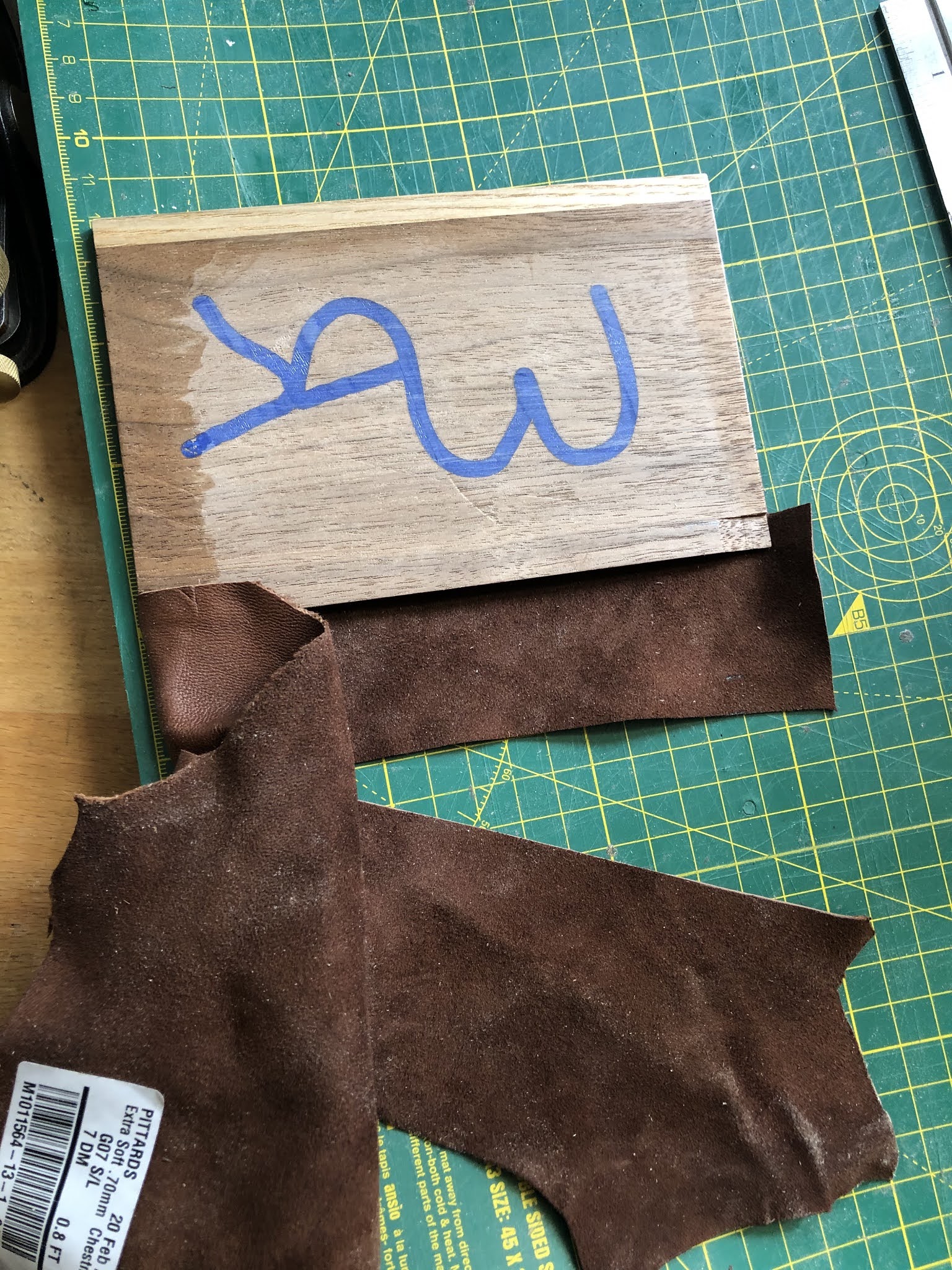
I started by routing out the initials, freehand with a router:
Then filled in the groove with the resin:
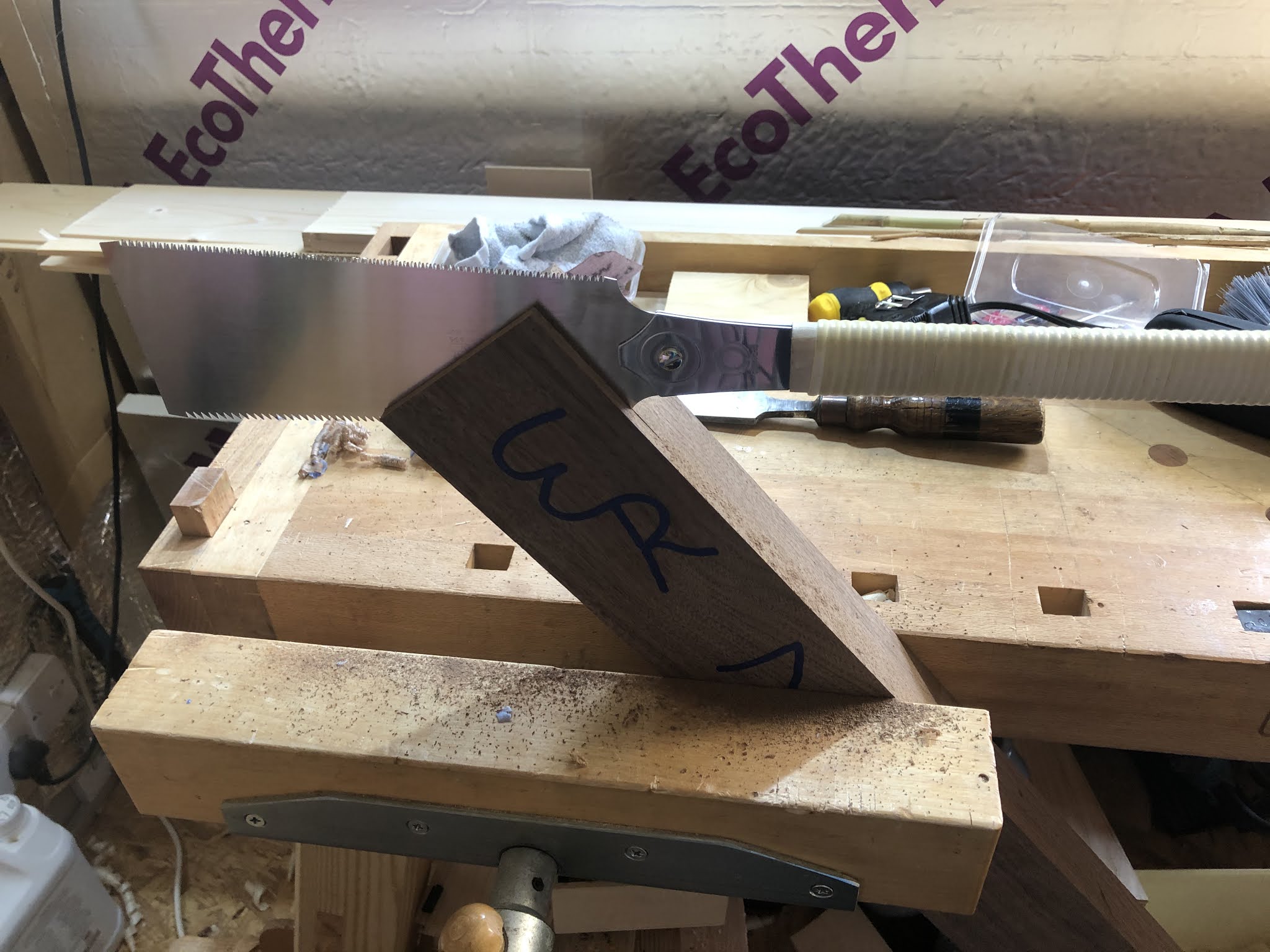
I then cut the covers off the main board. This is American Black walnut.
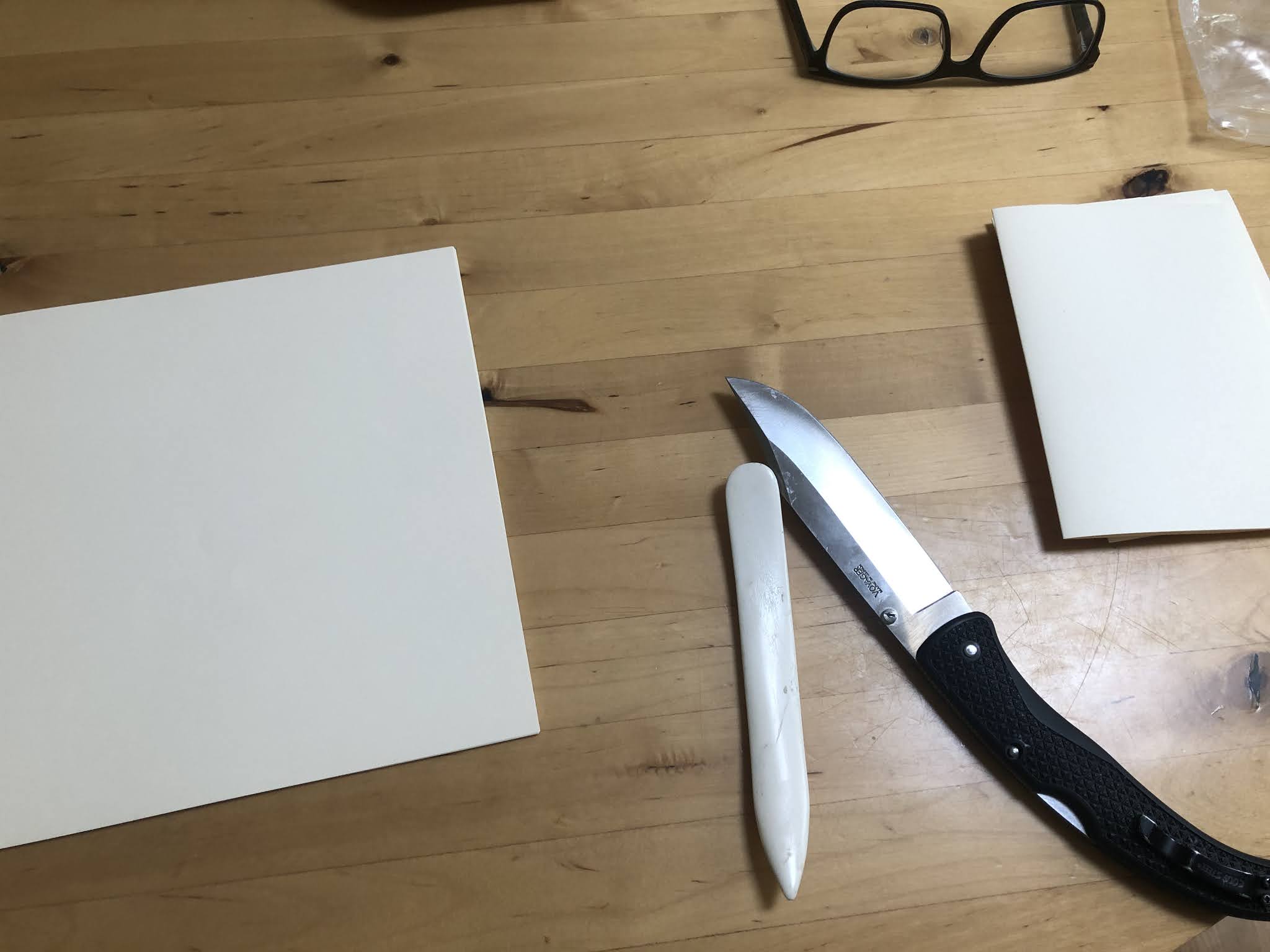
Now for the text block: very straightforward.
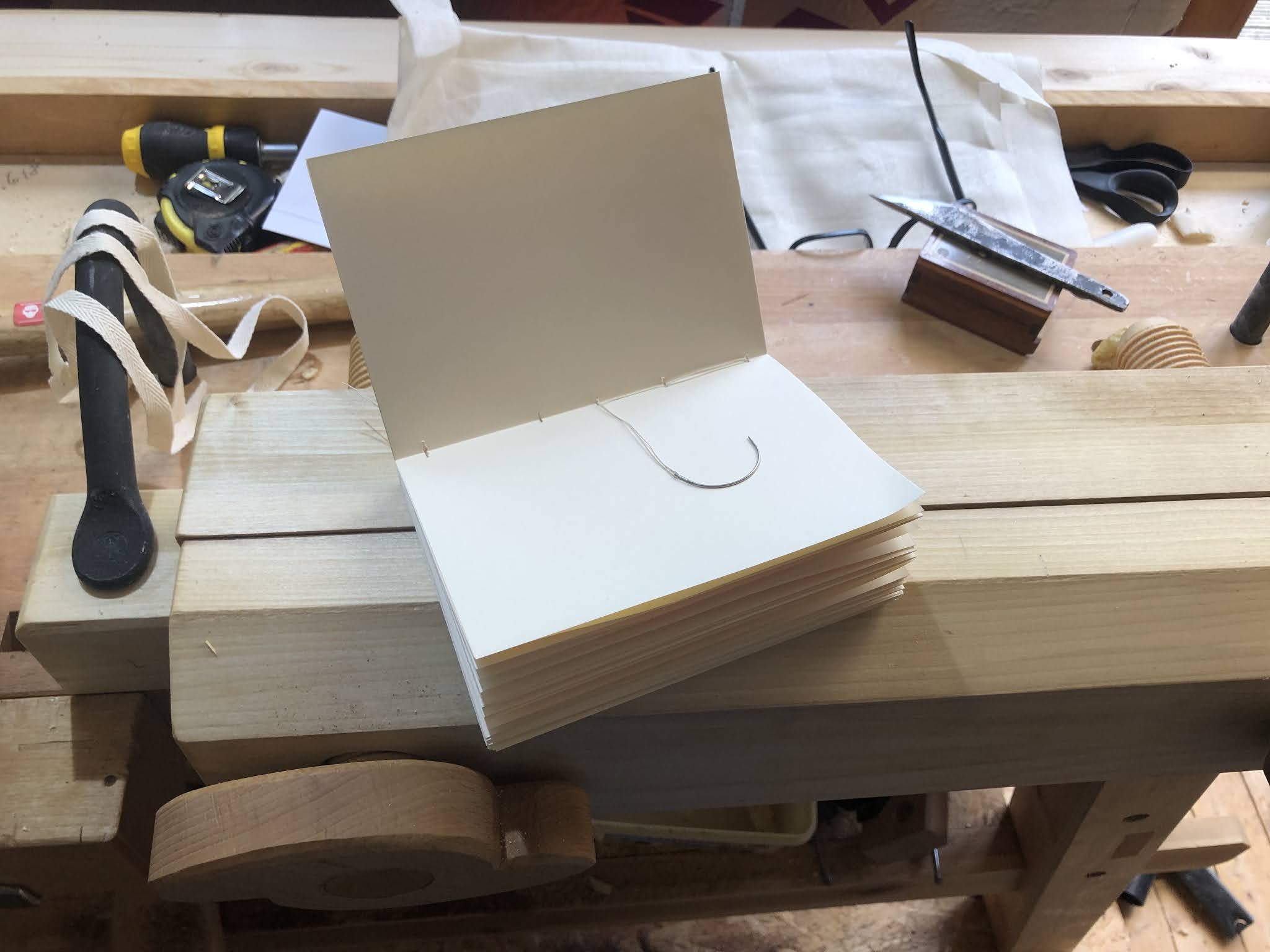
Cutting the stitching holes:
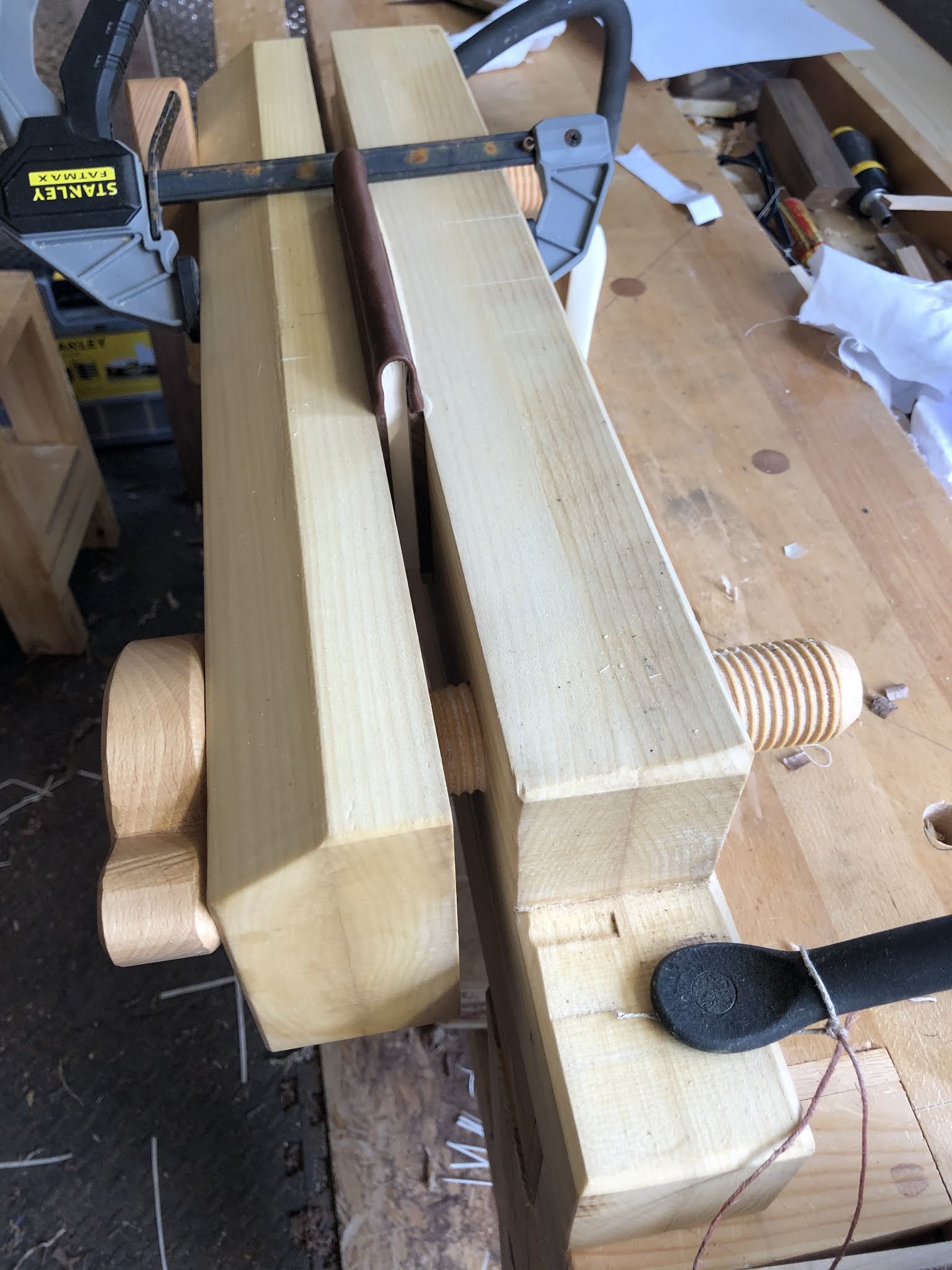
I kettle-stitched the whole thing together, then glued up the spine with some mull.
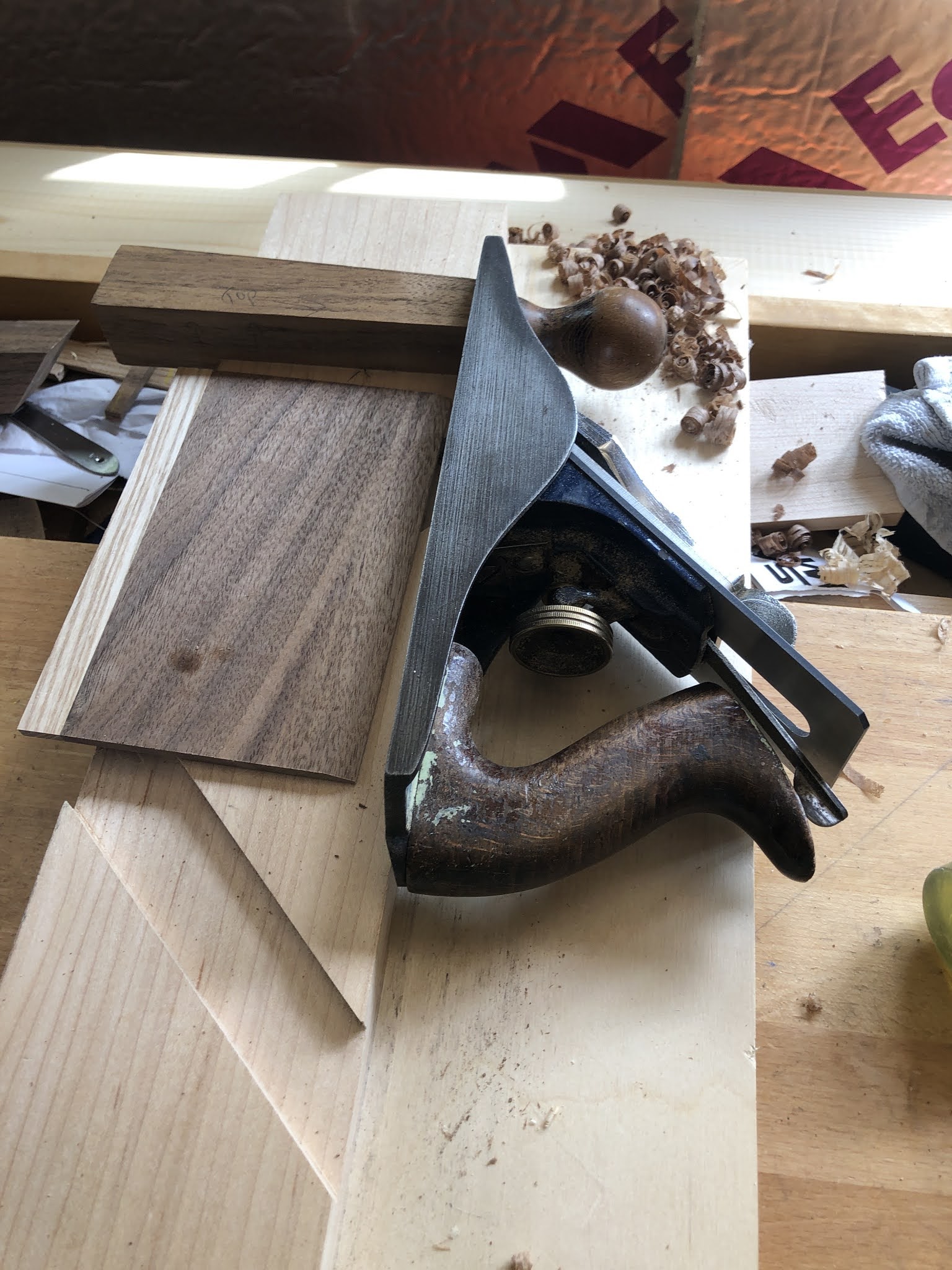
The walnut wasn't quite wide enough for what I had in mind, so I added a decorative strip of ash, and planed everything down and to size:
I did a classic assembly, gluing the covers to the leather for the spine.
Then cased in the book in one go, which fortunately worked quite well!
The finish is a few light coats of french polish, applied with a rubber (how else?).
I think it turned out ok, but I'd be the first to admit that Eleonora's covers are prettier than mine!
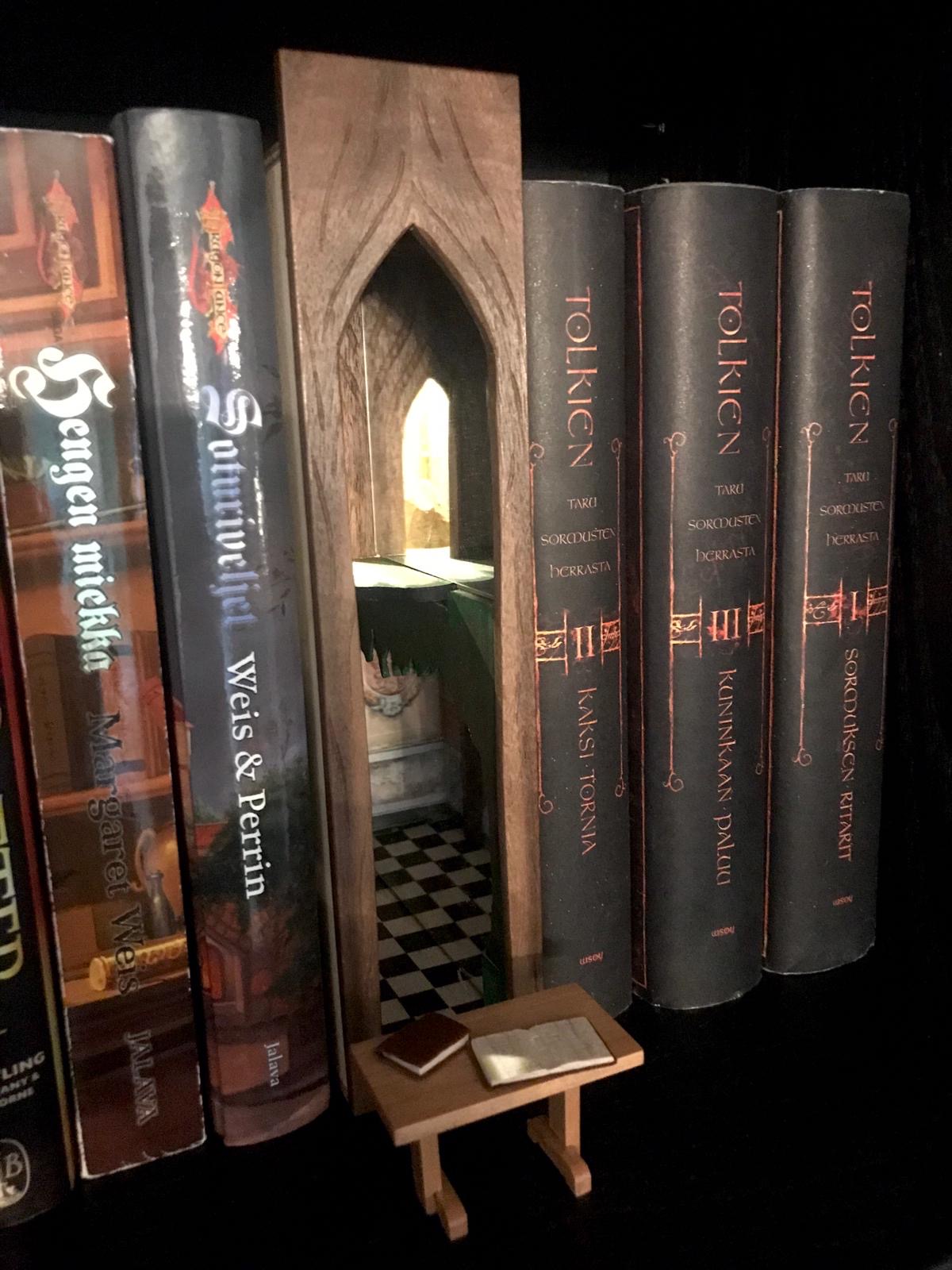
I came across the idea of a book nook quite recently; one just popped up in a search for something else (a book, I think). And I just had to have a go, as it's a perfect crossover between several of my interests. I was about half way into it when I realised it would take a simply absurd amount of time (somewhere probably over 50 hours work), because I've never done one before, and kept having to invent things from scratch. So I leaned into that, and let it take all the time it needed.
It also occurred to me about half way in that it would be a perfect wedding present for my dear friend Veera, whose wedding I couldn't go to thanks to the blasted plague. So I know it's going to a good home!
I started by making the box, and like a fool decided to dovetail it all together. I was at the ‘this won't take long' delusional phase, so I rushed it rather, and I'm not at all happy with the joinery there. No pictures for that reason. Part of the difficulty was that I had a completely free hand to do anything- it's a purely decorative piece, so there are no constraints other than size, and even that's negotiable. I had the idea at some point that one side should be mirrored, to create an illusion of depth, and then decided to make it a library. But I wanted more variation, so thought that the library should have an upper floor that's more mysterious, more fantastical. I can't paint for shit so I printed out a forest scene for the top floor, and a library scene for the bottom floor.
it wasn't in the right size for my project, so I scalped the image off their website and re-sized it. I hope they don't mind! I've sadly lost the reference and the image I used for the forest scene.
The library door needed some texture, so I made some moulding in walnut and added it round the doorway. The floor is made of birch veneer, some stained black, some bleached. I cut it in strips, taped them together, then cut them in squares. Nice to do a bit of veneer work, it's been a very long time! I was inspired by Uri Tuchman's video in which he makes (among other things), a frame for a painting.
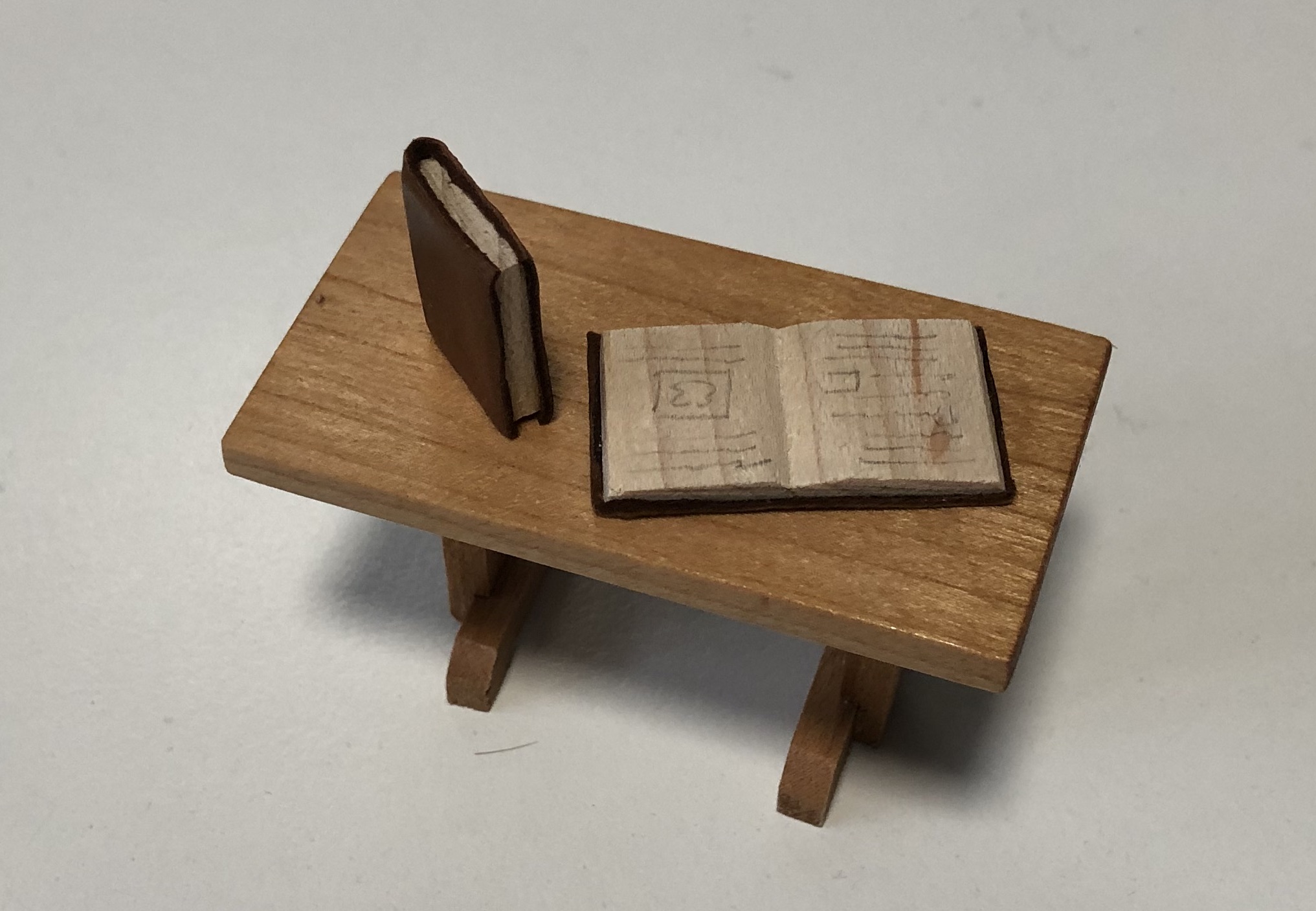
I thought the library needed some furniture, so I made a little table, and some books.
The books are super-easy: just little bits of maple wrapped in goatskin. Compared to bookbinding, they took seconds!
Then I thought to make a fake doorway upstairs, to hide the sword behind. It's glued in position, so doesn't open or close.
I've never used lighting in a project before, so figuring out how to do it took some time. There's just one light, in the space behind the door.
Now the sword… I forged the blade from a nail, then filed it to shape. Cut and filed the brass crossguard, made a little walnut handle, then added a pommel and finished shaping the handle. Sadly I forgot to photograph the finished sword before hiding it forever in its stone!
Now the doorway: I cut the basic shape from this piece of walnut, then ripped it down the middle so the arch is made of bookmatched grain.
I then carved some detail, just for fun. But, it turns out you should make the furniture after making the nook complete…
Oops!
So I made a new table, this time out of cherry, and in a more modern style. No reason, just because.
Of course the nook needed to be tested in a realistic environment, so here it is in a bookshelf:
I'm happy to report that it made its way to its new home without mishap, and here it is!
I’m in that funny limbo state between a book being finished and being published. My translation and interpretation of Fiore’s longsword plays (of which the current working title is now From Medieval Manuscript to Modern Practice: The Longsword Plays of Fiore dei Liberi. What do you think?) is back from the editor, his 2,370 comments and changes accepted, rejected, or otherwise acted on (that number is exact, not figurative. 2,370. Really. That's normal for a good editor with a 65,000 word document) and the resulting draft is now being proof-read. I expect that back in a couple of weeks, then it’ll be off to layout. Hurrah!
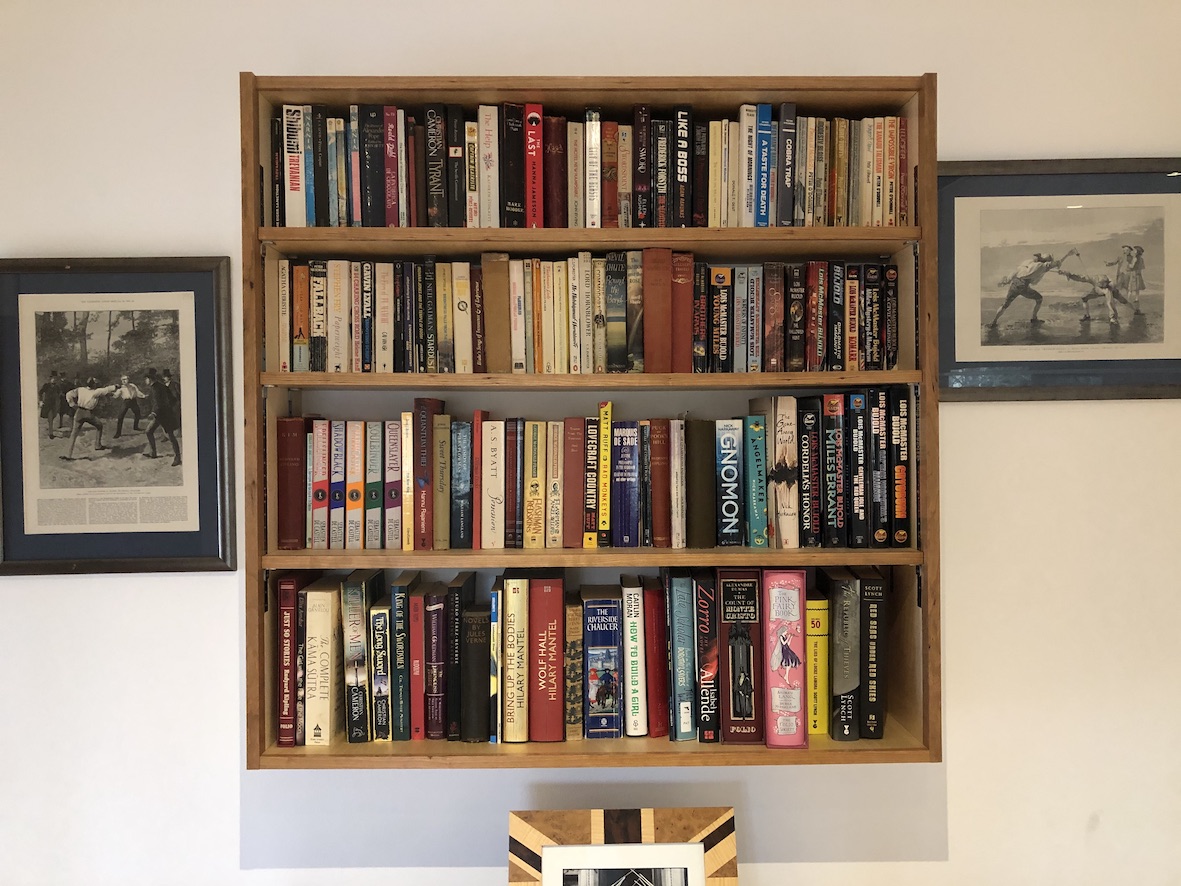
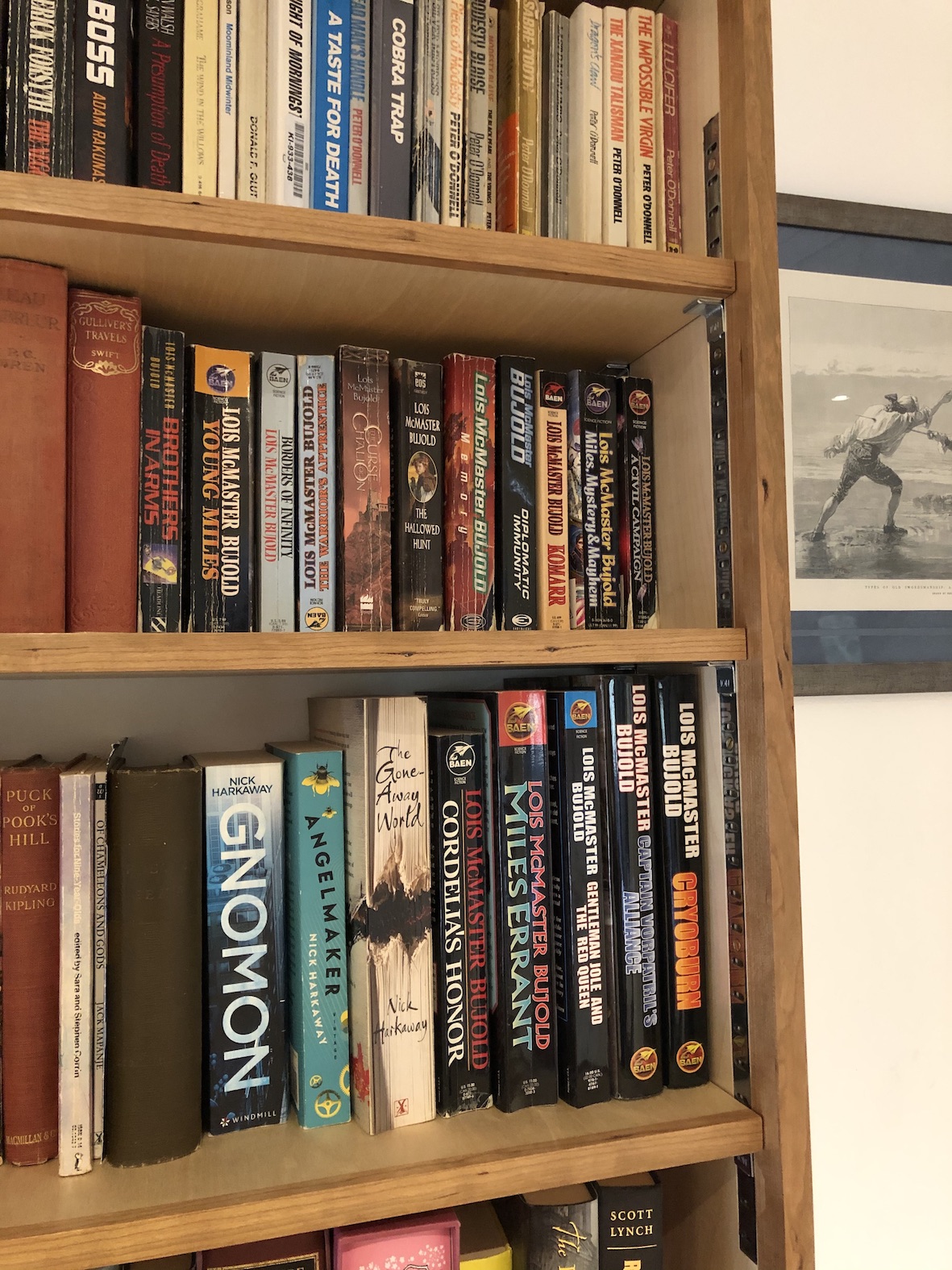
So it's a Schrödinger’s book, both finished and not finished. Done and not done. I can’t really concentrate on another sword related writing project (I think the replacement volume for The Duellist’s Companion is next up) until this one is really done. Instead I’m doing some productive procrastination, which for me is usually some craft-related activity. It’s something of a relief to get away from ideas and pixels, and back to physical materials. I’m making bookcases. This one is basically done:
That’s 18mm birch ply with solid cherry banding, and adjustable shelves, held onto the wall with a French cleat.
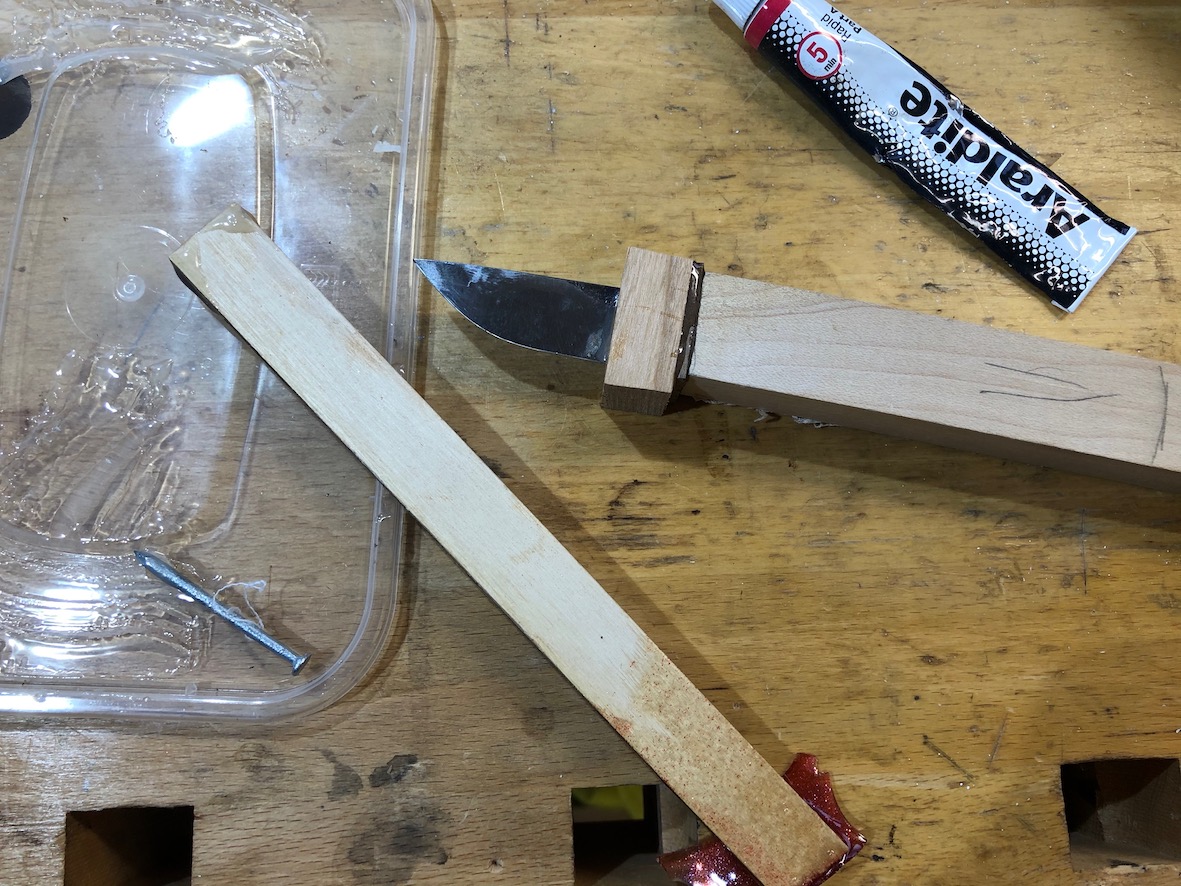
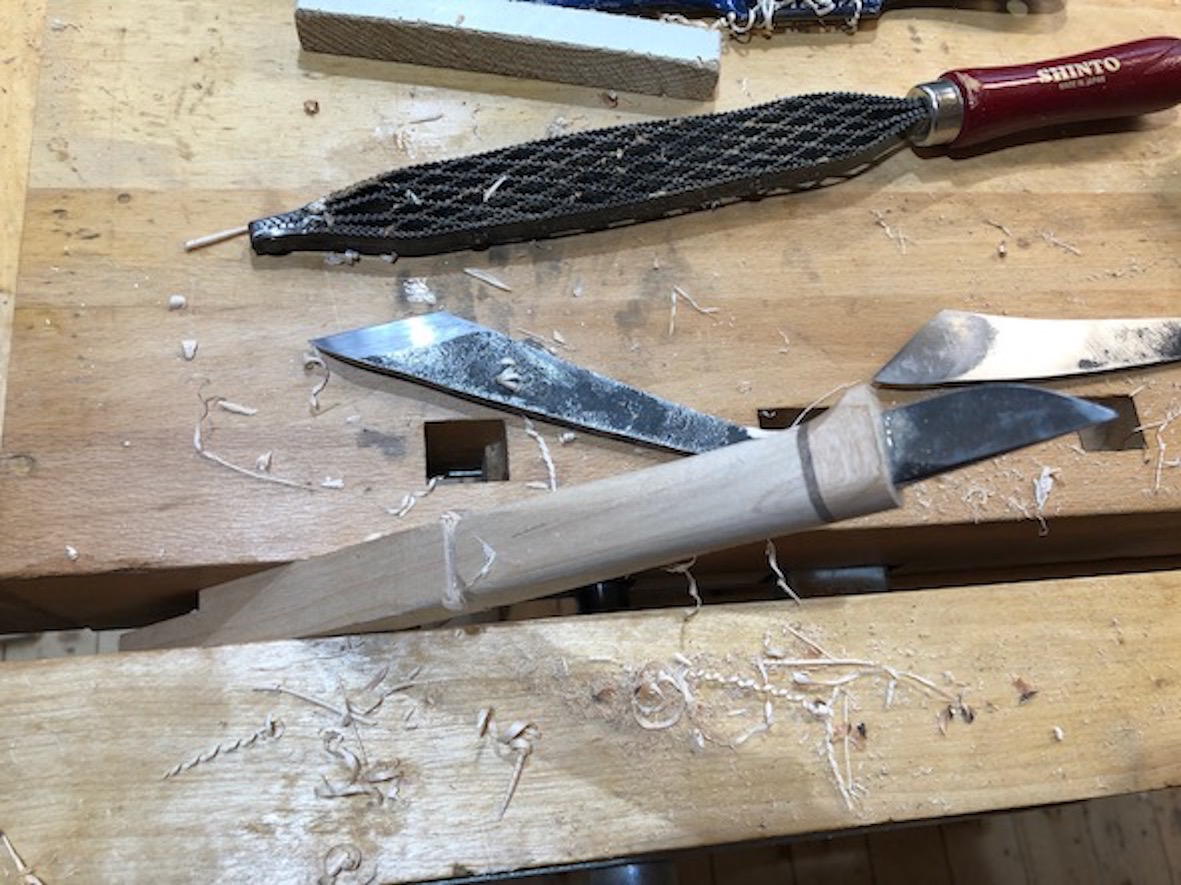
I haven’t done the cap or base yet, because I’m concentrating on getting books out of boxes. I can add the decorative but not actually necessary elements later. Bookcase 2 is basically the same, but with maple accents. I’ve been using the kiridashi knives daily since I made them– and holy cow, they are beautiful tools. They led me to dust off a chip-carving knife I’ve had knocking about the workshop for maybe 6 years. I got JT Pälikkö to make the blade for me, and I stuck a crappy birch handle on it just to get it into use asap. But I haven’t used it nearly as much as the quality of the blade deserves, which is partly because the handle just wasn’t appealing. So in some down-time between bookcases, while all my clamps were occupied with a glue-up, I started re-shaping the handle. After five minutes I thought ‘you know what? This knife deserves better’, and stripped off the old handle, and made a new one out of maple, cherry, and walnut. You can see part of the old handle in this photo.
Top tip: leave the wood long as long as possible- it's much easier to hold it still if it has a built-in handle! I epoxied the whole thing together.
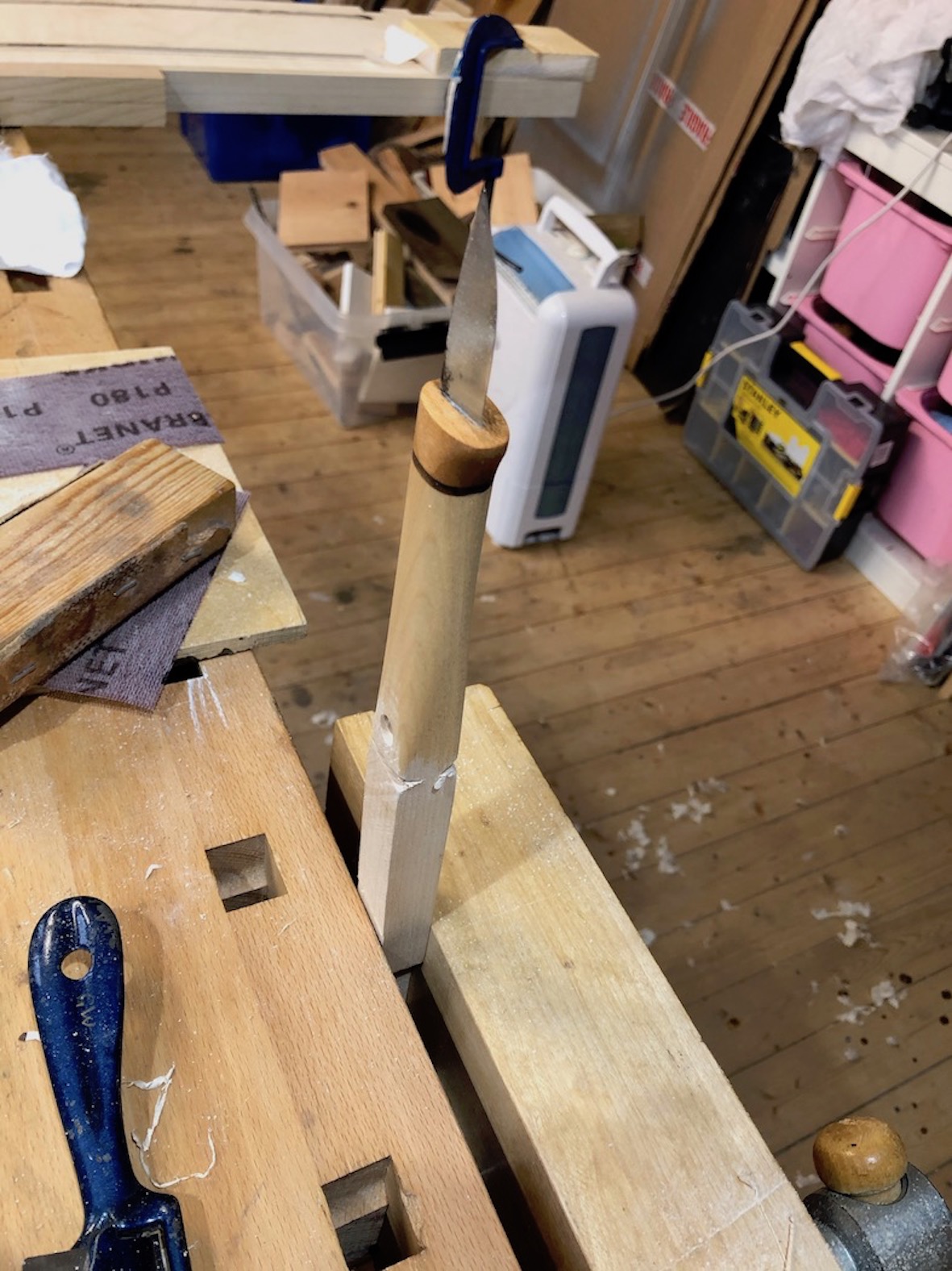
Then I did 90% of the shaping before cutting the handle to length. I went so far as to actually finish the handle at the blade end before cutting the waste away.
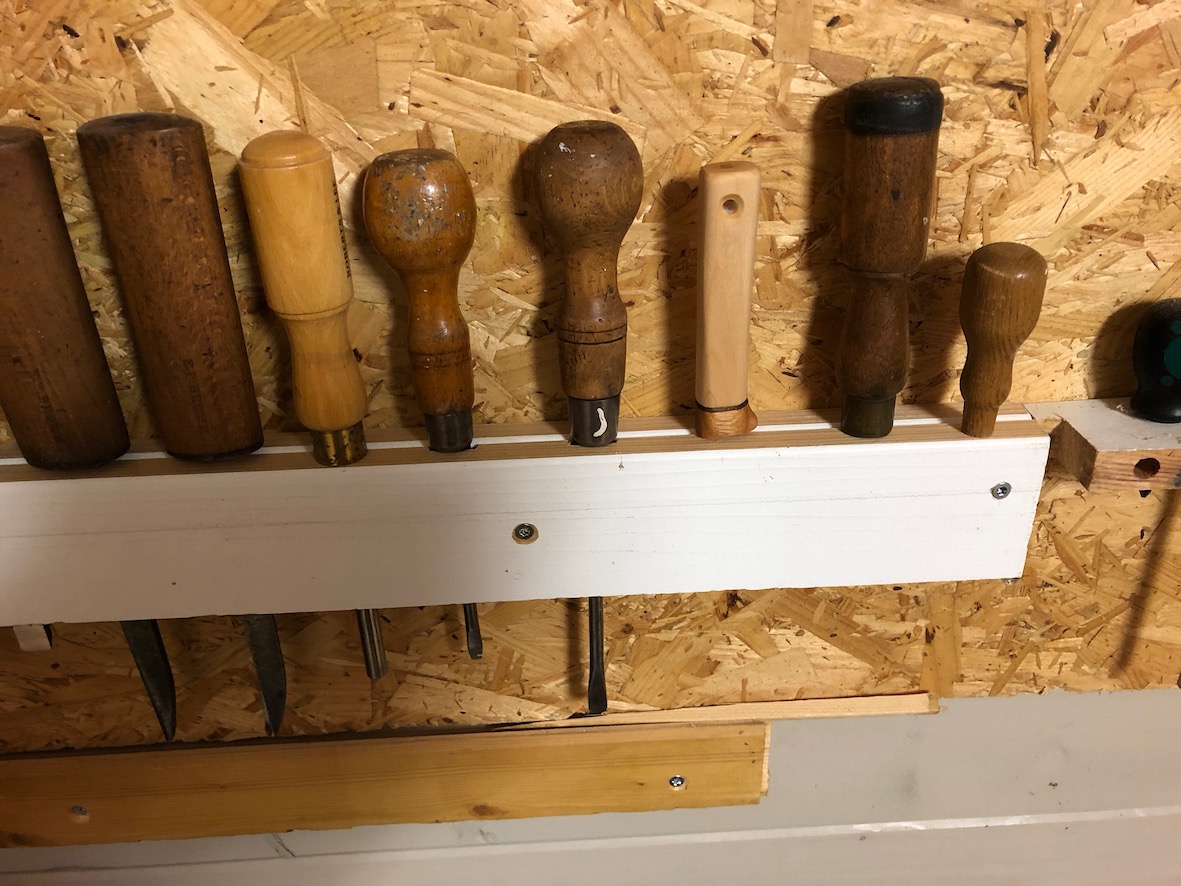
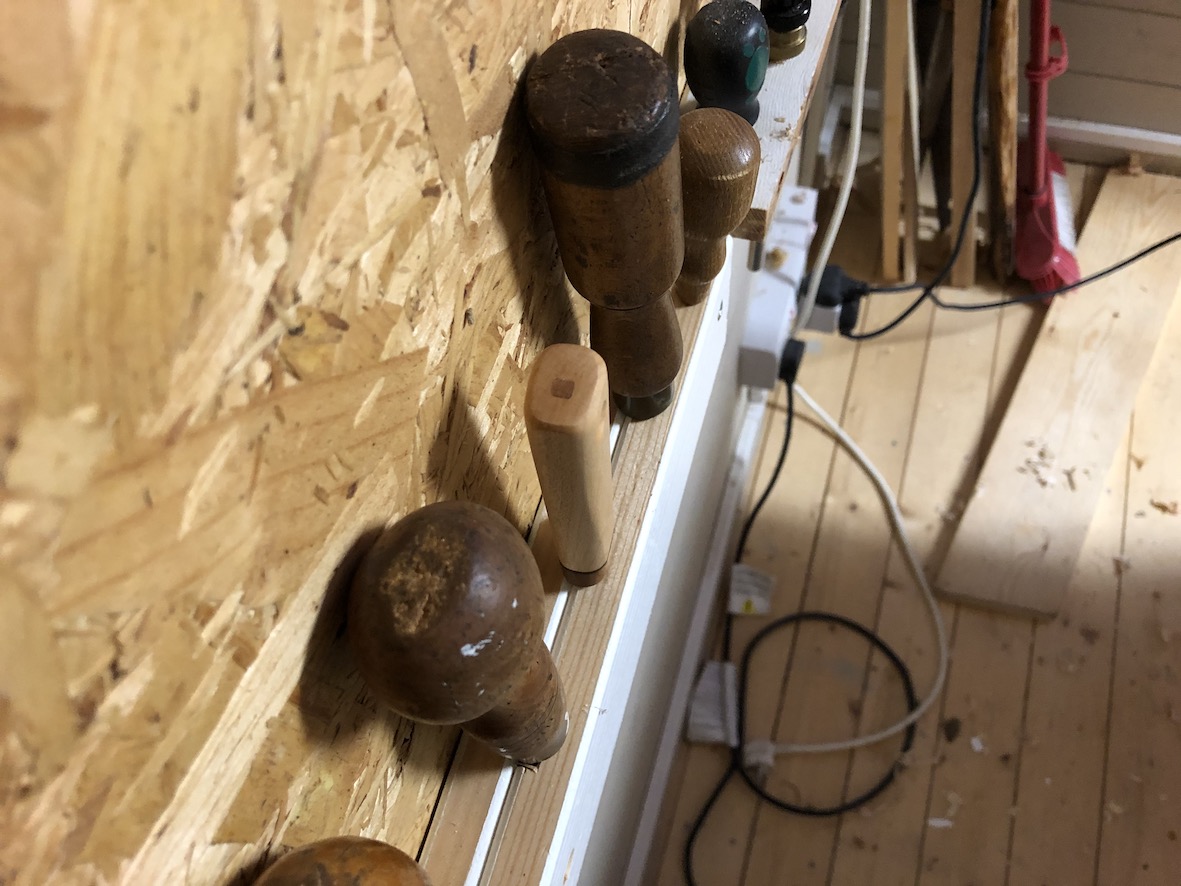
The handle is finished in boiled linseed oil, then shellac. I made a home for it on my tool board- it fits in beautifully!
Of course, in my enthusiasm, I drilled the hole for the tang too deep, and it was visible at the pommel end, so I plugged it with a square cherry plug. I could have made it disappear with some antique-restorer trickery, but decided to highlight the error with a contrasting wood.
This is in the spirit of wabi-sabi: the things that make something imperfect can also make them beautiful. This is true in many fields, but not, ever, book editing!
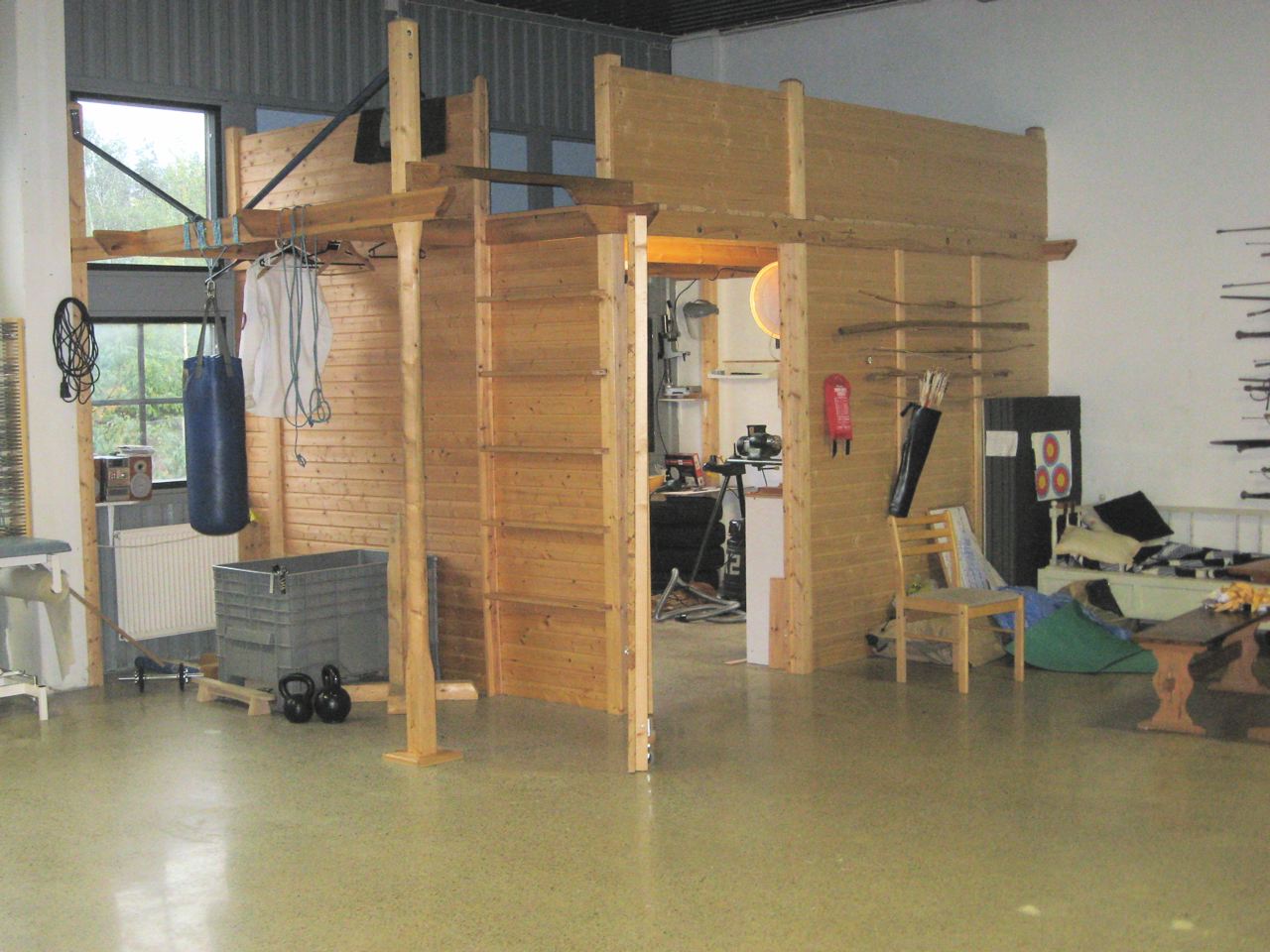
I’ve had my woodworking bench for twelve years now. It’s been a good workhorse, small enough to fit into my bijou little workshop spaces but big enough to be useful. It first lived in a corner in the old salle, then the tatami shed in the ‘new’ salle:
then my garage in Ipswich, and now my workshop at the end of the garden):
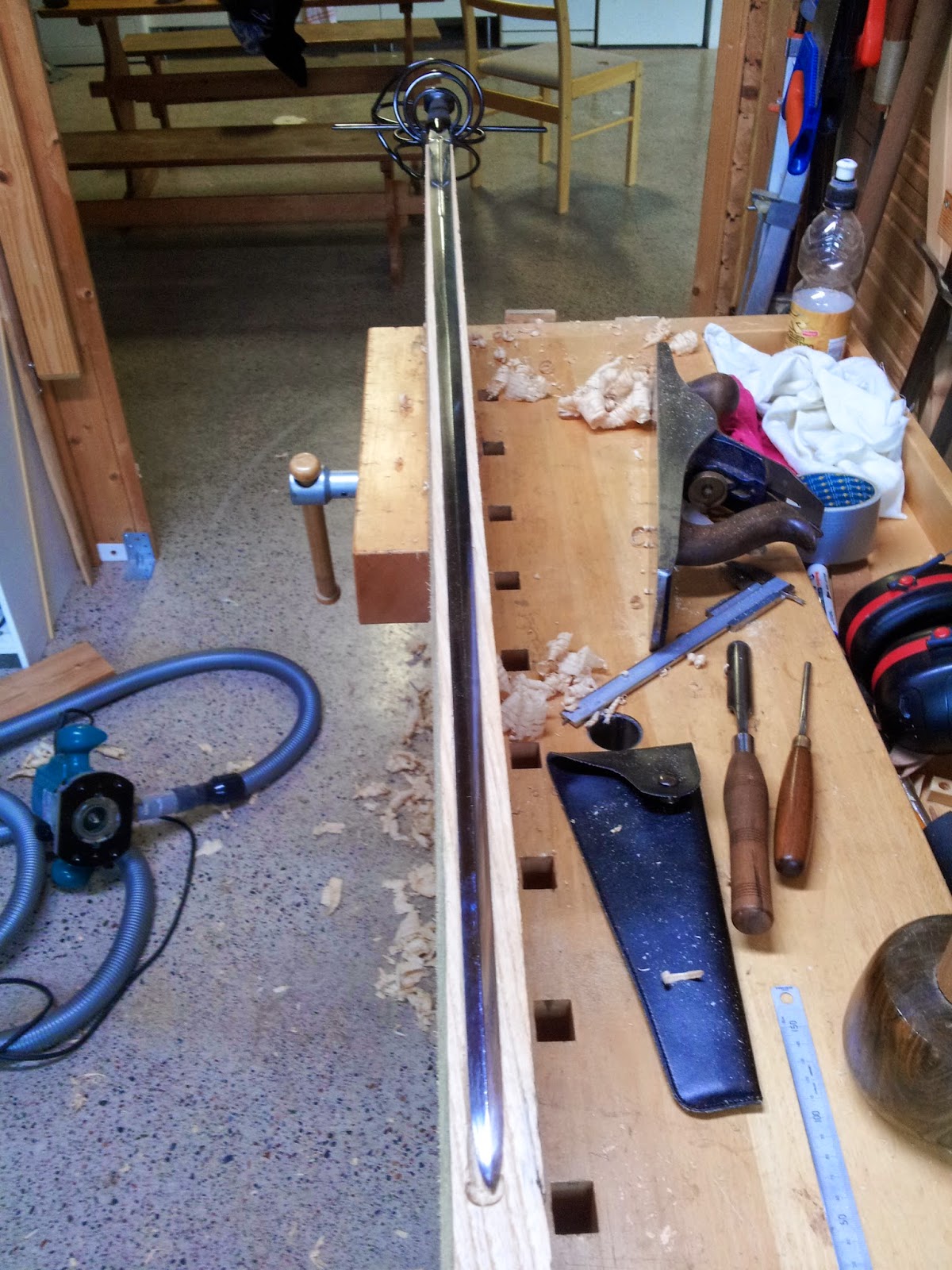
The vice has never been great though. Good enough for most things, like holding this bit of ash in place while I mark it out for a scabbard:
But it was always quite sticky, and has gotten worse over time. And with changes in atmospheric moisture, the bench top has moved a bit, so it didn’t close up all the way to the edges.
The body of the bench has also never been perfectly stable. It’s okay, but a bit light, and with the racking forces from planing on the bench top, it’s gradually become more wobbly.
Yesterday I spent about four hours disassembling the vice and getting it tuned up; planing down the vice jaw, the side of the bench, and the bench top; and adding some diagonal members to stabilise it.
Dressing the front edge of the bench so the vice will mate properly with it.
Turns out, the floor itself in my workshop isn’t very stable (it’s fundamentally just a shed) so I put down a couple of planks to spread the load a bit.
Now the vice twizzles beautifully.
At the time, I just felt like spending a day doing woodwork, and thought I’d take half an hour or so to improve the vice because I have some tricky sliding dovetails to cut. But one thing lead to another, and now the bench is performing better than it ever has before.
So here’s a thought. What other bits of maintenance am I neglecting? What other opportunities are there to put in a little bit of work now, to reap rewards for years to come?
It’s been quite a month. I’ve spent half of it in the USA, and the other half moving house. Both of those projects went splendidly, but left very little room for anything like writing- even writing a blog post like this. I really ought to do a post-seminar-review-post for my first ever Boston seminar (the short version: it went very well, with lovely students and kind hosts (the Athena School of Arms – we’re planning a return trip), plus I stumbled upon the Isabella Stewart Gardner Museum, which needs a huge post of its own, and the North Bennet Street School of craftsmanship), my first ever Providence RI seminar (a bespoke afternoon with Alexander Ripa, and two of his students, Halley and Victor- it was a delight, and we in HMA could learn a lot about running schools from sport fencing coaches like Alex), two days R+R in Madison with Heidi Zimmerman (of Draupnir Press) and Chris Vanslambrouck (the Meyer chap), then off to Seattle for lunch with Rory Miller (yes the Rory Miller), and a full weekend’s teaching.
There were many slots in that schedule where I could have stolen an hour to write, but you know what? Spending the time with friends old and new was a much better use of it.
I got home on the 16th, just in time to move house on the 24th. Yay! The new house is much better than the old one, for several reasons- not least:
1) I have a proper study.
The swords aren’t up yet because I need to build a rack for them. Something nice in oak, probably. Now, if only I had somewhere to build it…
2) The garden is long enough for archery
And 3) There’s a very nice shed at the bottom of it which is now a woodworking shop. Huzzah!
But you know the problem with a really good writing set-up?
No fucking excuses.
Normal service will resume henceforth.
Oh, but I’m off to Helsinki on Thursday for a photoshoot for a book project, so….
During all this chaotic busyness I’ve stuck to my standard operating procedure, of identifying the one thing that most needs attention, and moving that thing forward by one solid step every day. For the last couple of weeks, that’s been the move.
But now, I have these on my plate:
1) the Fiore Translation Project. I shot some more video for it in Seattle, and should carry on with the writing up and publishing.
2) part four of the Rapier Workbooks series: Rapier and Dagger. It’s coming back from the editor soon, and I should get covers, blurb, etc. sorted out for it.
3) Sean Manning has written a very interesting thorough review of The Theory and Practice of Historical Martial Arts on his blog. You can read it here. It’s clear that the book does most of what I want it to do, but the academic/research section needs expanding, because his response to it is absolutely not what I was aiming at. We’ve corresponded quite a lot about it, and I’m planning to expand that section, post the new stuff here on this blog, and re-do the book somewhat. That may be a whole second edition, or just an expansion on the first.
So I have some questions for you.
Which project would you like me to prioritise?
And regarding The Theory and Practice of Historical Martial Arts, if you’ve read it, is there anything else you’d like me to add to it? Because it costs money to get the print files laid out again, and it all uploaded to the print on demand services, so I’d rather make all the changes in one go.
Answers in the comments below, or by email please; I’m unlikely to see anything you put on social media.
Sitting will kill you. It's almost as bad as smoking. Don't believe me? Read Arsebestos, by Neal Stephenson in his compilation Some Remarks, or more fully, Deskbound by Dr Kelly Starrett.
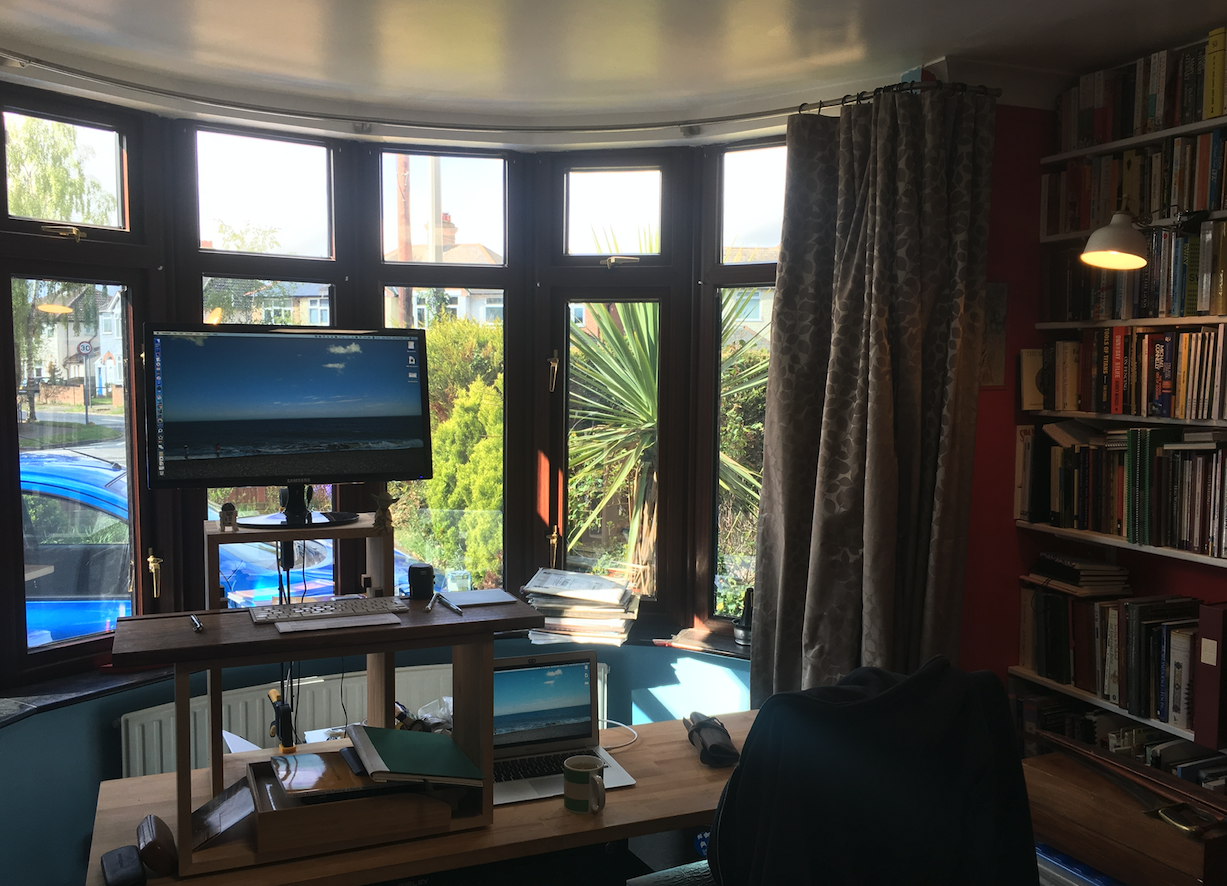
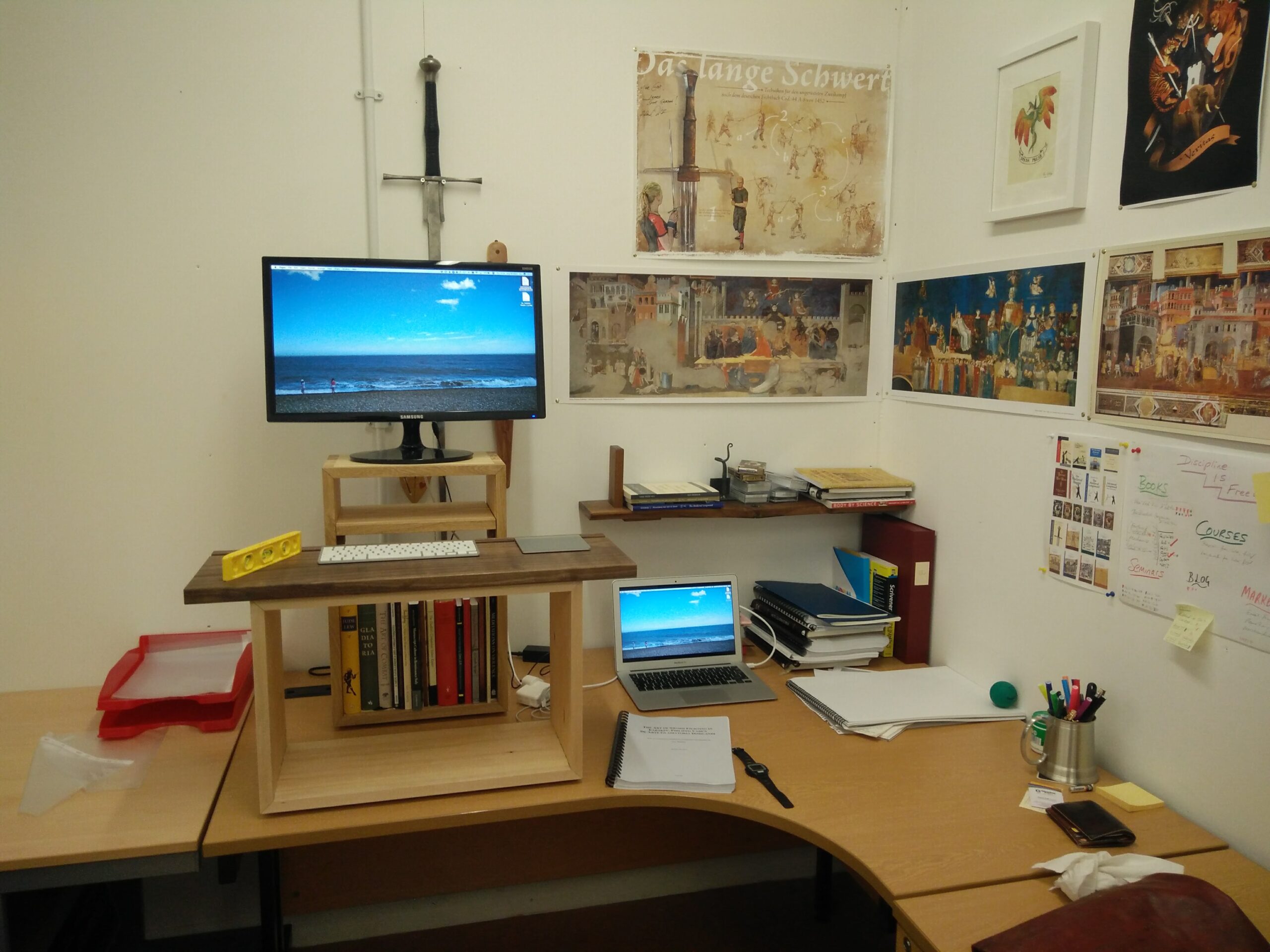
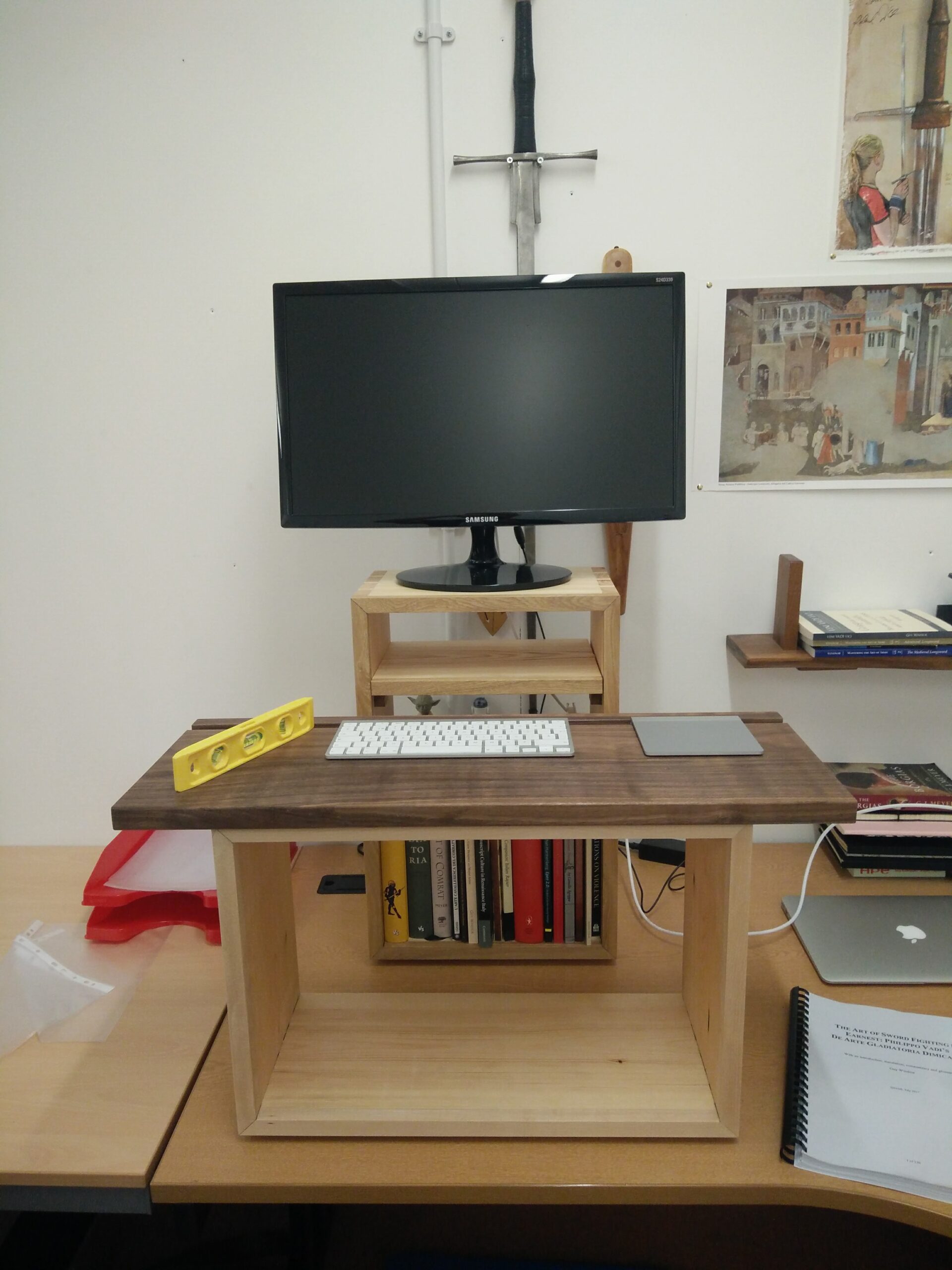
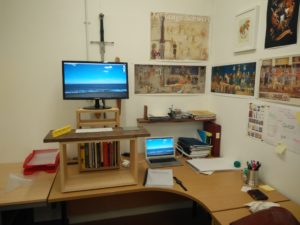
So as a matter of urgency, I created a standing desk adaptation for my work space at the Waterfront Studios.
The heart of the desk is a lovely piece of walnut, left over from both my sister's bookstand, and Heli's meditation stool. The design is just two boxes, one tall for the monitor, and one wide for the desk surface:
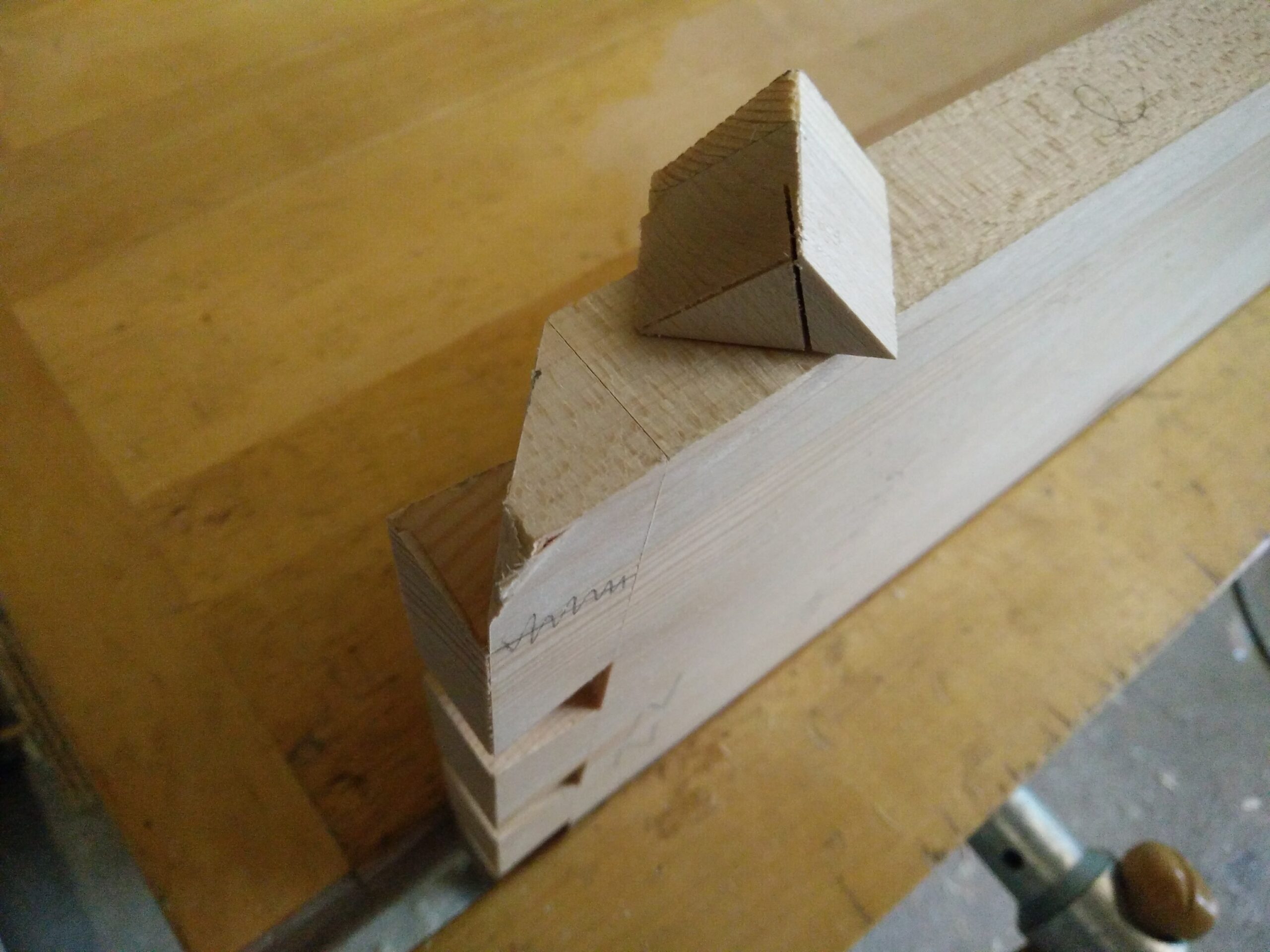
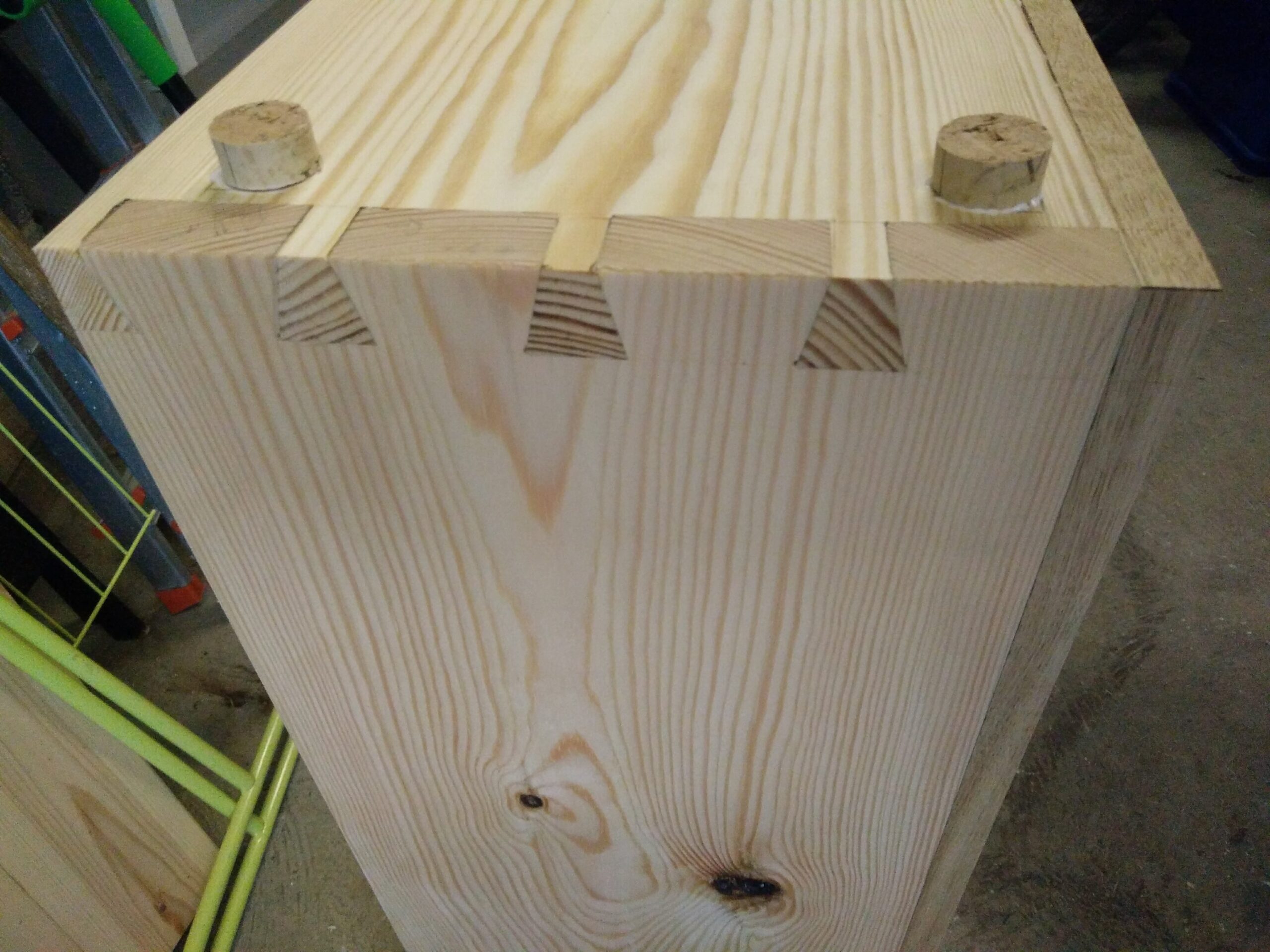
The boxes are dovetailed together out of broad pine planks which I machine cut to length at the awesome Ipswich Makerspace. At home, I added a solid wood banding on the fronts. Oak for the monitor box, and maple for the desk. I did drop the desk box at one point, amid much swearing, and had to patch the corner:
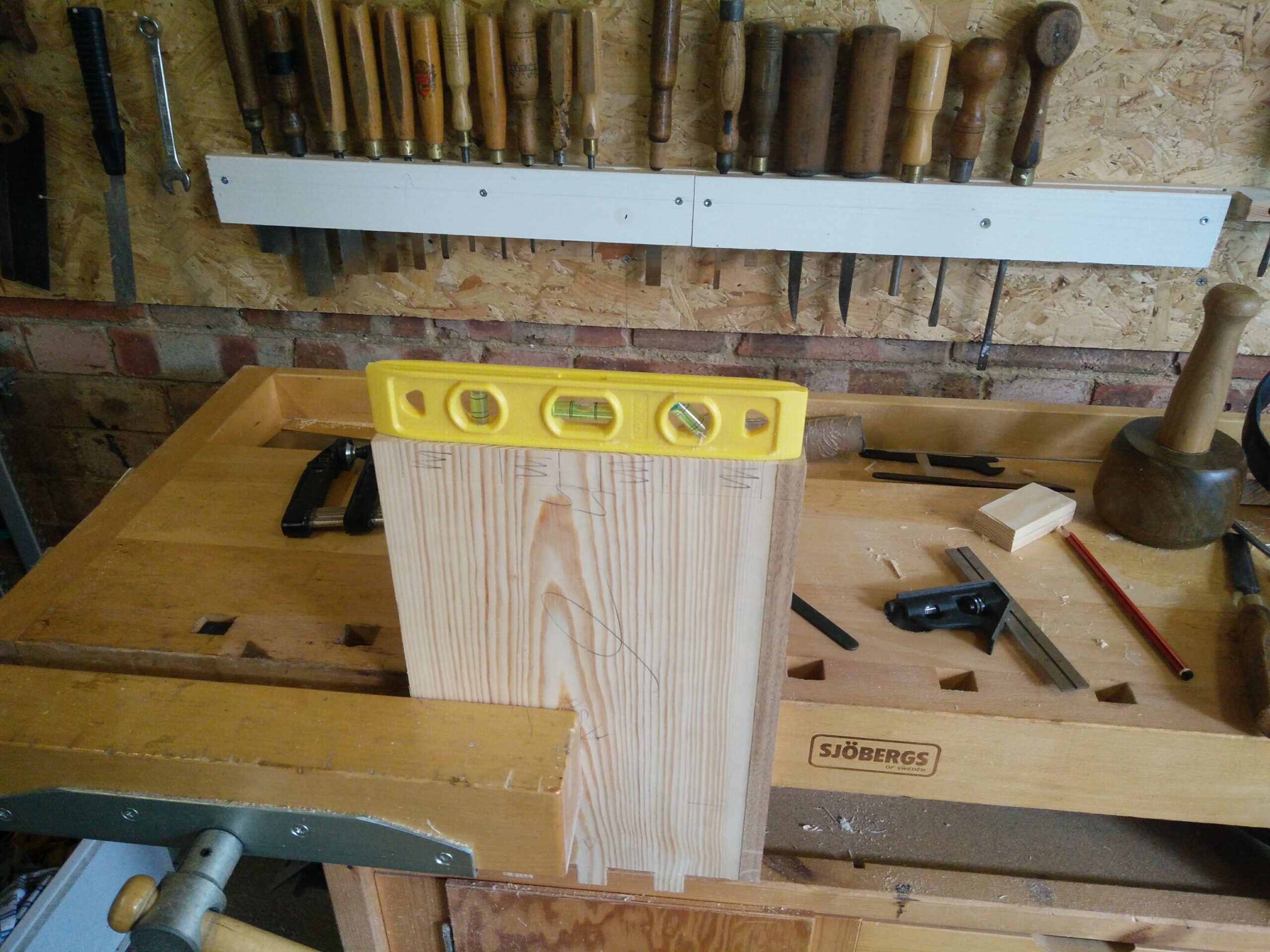
Top tip for cutting dovetails, or any joint: make every cut truly vertical. A pocket level helps. As I'm cutting pins at right angles, in this case the top surface is level. Cutting tails, I'd put the piece in the vice at an angle and use a set-square on the (level) bench to check. This way your natural sense of plumb won't drag the cut out of line.
The critical thing is the heights; they must be absolutely perfect for the ergonomic advantage to work, so both boxes have cork feet. Sorry about the shitty gappy joints. No excuses.
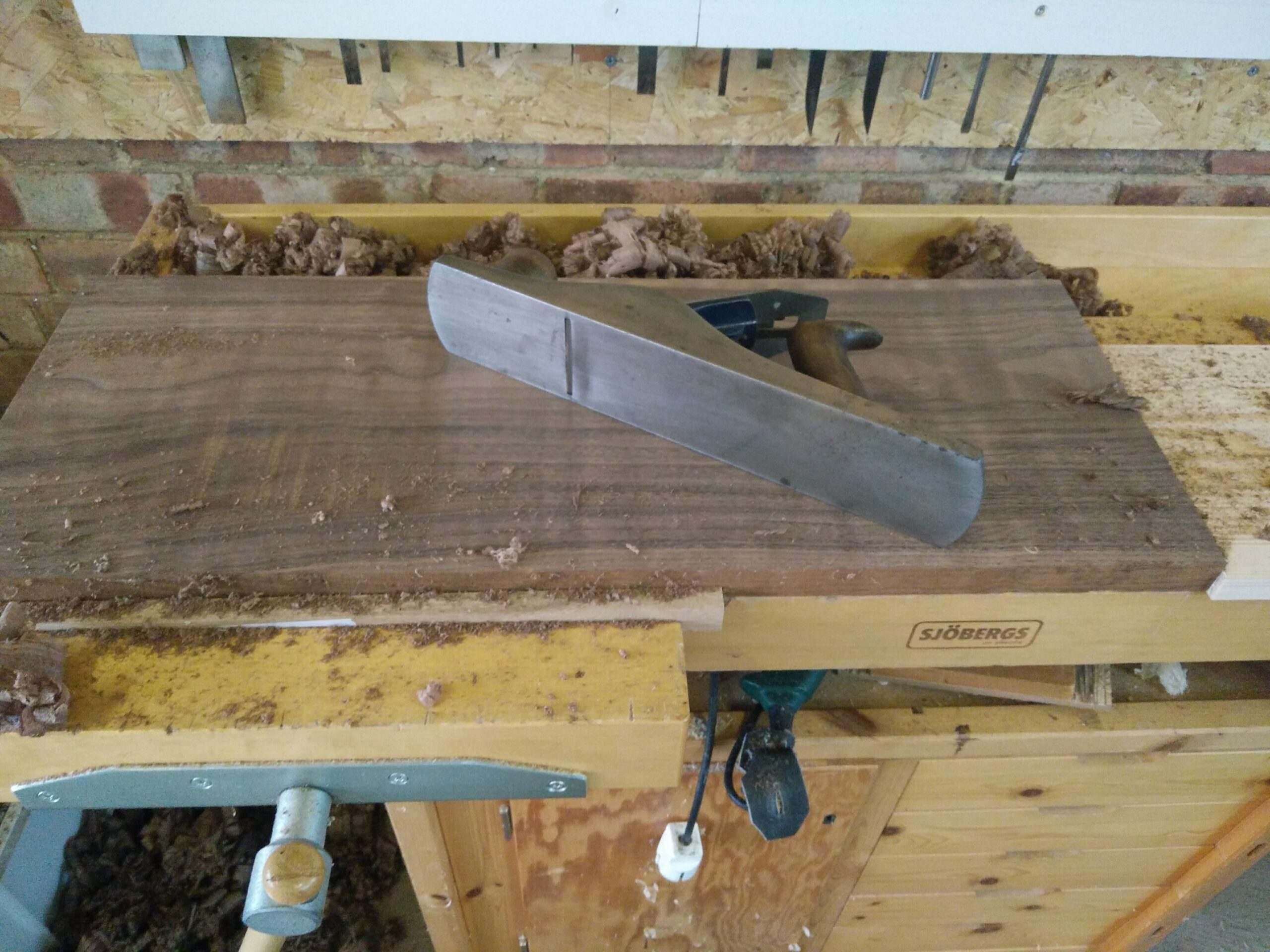
I finished it the whole thing using only hand tools, and no sandpaper; I went all James Krenov on it, and the finish is straight from the plane, with just a whisk of French Polish to bring out the colour.
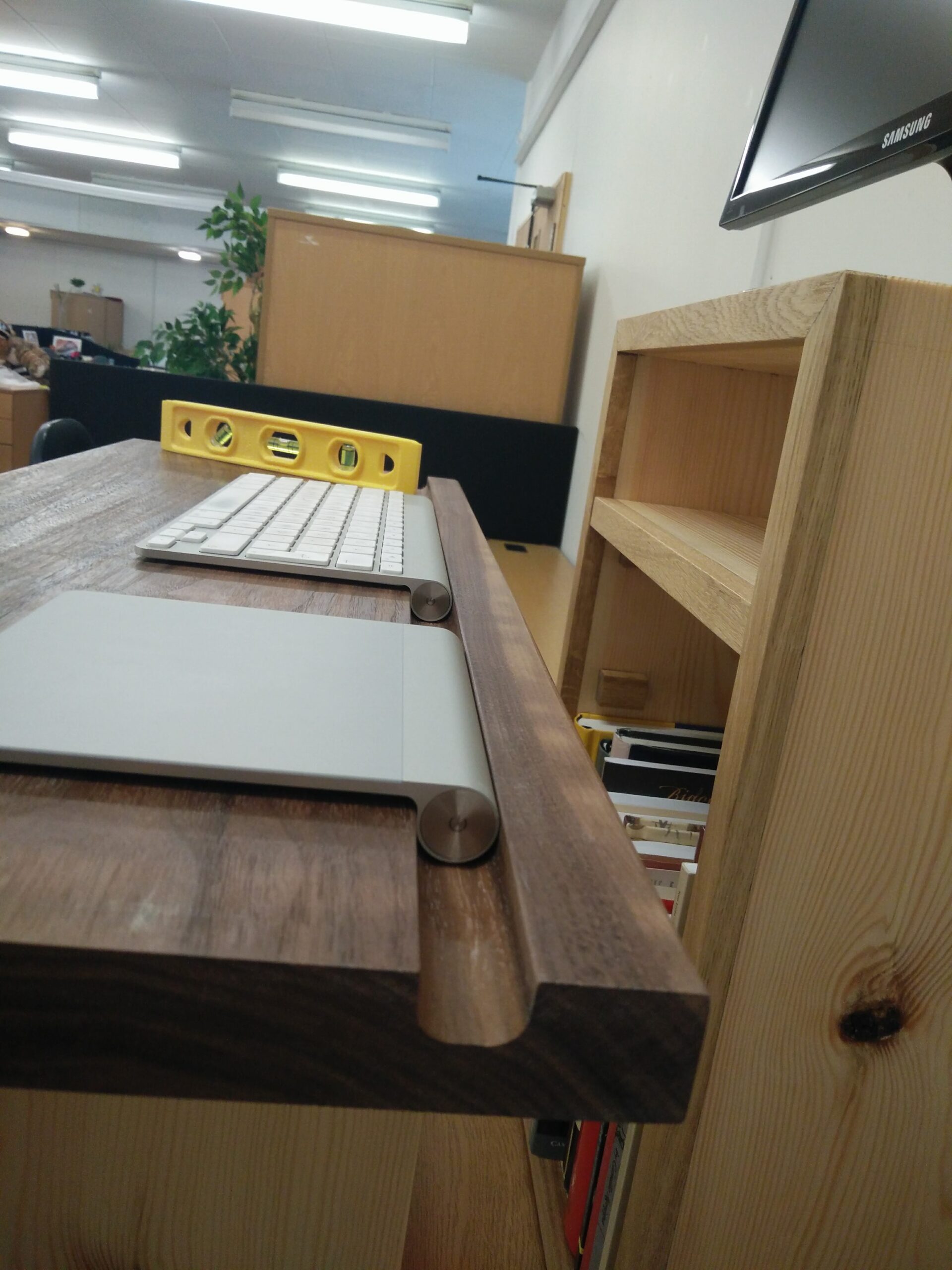
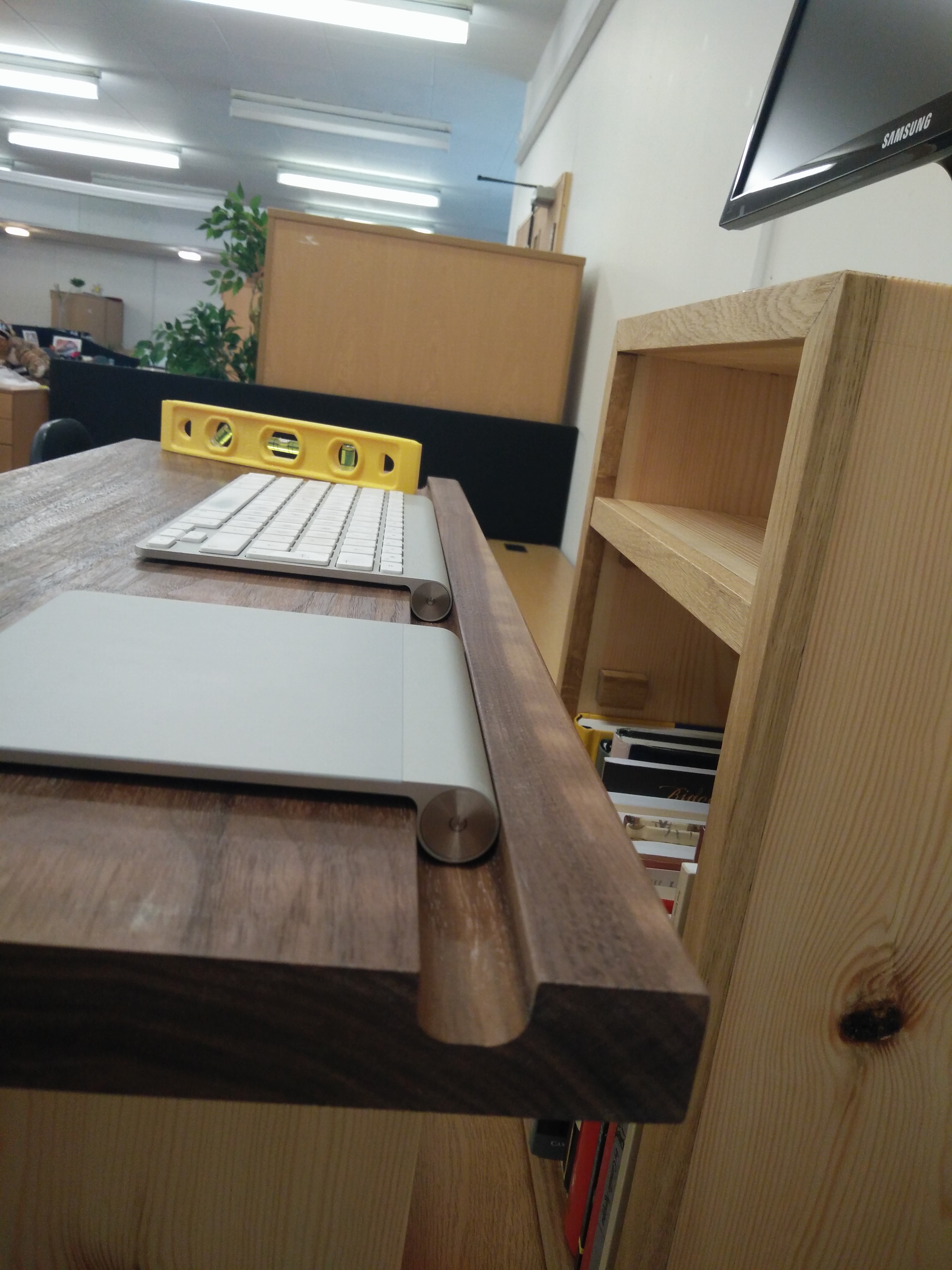
I did cheat though and use a router to cut a very deep groove in the top to fit the battery compartment on my Apple keyboard and trackpad. It puts them at a much better angle for my wrists.
Note the level; got to check that gravity is working for you, not against you!
This all took about 30 hours of my free time, so it's definitely not a commercial solution, but I don't care. I spend a lot of time at my desk (sometimes as much as four whole hours in a day!) so it's worth getting it nice.
I have been meaning to sort out a standing desk solution for my workspace for oh, about 7 months now. A couple of weeks ago I started reading Kelly Starrett’s book Deskbound.(Potted review: great information, bitty presentation. Thorough, but repetitive, and way too much referring to his super-cool fighter pilot clients. Essential reading for ergonomics at work, but I wish he’d got me to edit it for him.)
The book reminded me that sitting down to work will kill me so I was galvanized into action, and designed and built a standing desk solution that fits with my existing desk. There was no space to put a standalone desk, and that would take a lot more time anyway. I was most pleased with finding an apt use for the piece of walnut left over from my sister’s wedding present, and my friend Heli’s meditation stool.
Dovetails, with a mitred front, and the cork feet that the whole thing sits on. Of course I ended up adding edge banding to the boxes (oak and maple), and cutting some not-too-gappy-dovetails in both boxes, but that was way quicker than the heavily engineered adjustability I was originally thinking of. Don’t let the perfect be the enemy of the good!
As with my writing set up of DOOM, this set up I have now means there are no excuses left for not getting my writing done.
I set the desk up yesterday morning, and that very same day sent print-outs of the second edition of Veni Vadi Vici to the academic peer reviewers. We’ll see what they say! It’s good to have that off my plate for a bit; there’s nothing I can do with that book until I hear back from them, probably next month at the earliest.
There is a busy week coming up next week; on Tuesday, I’m flying to Helsinki with the entire family; teaching class in the Helsinki salle on Thursday, and a seminar there on Sunday, before getting home on Wednesday morning, and driving up to Glasgow to see my brother in law, and then to Dumfries for my dad’s birthday at the weekend… so if I’m a little absent and slow to respond to things, that’s why.
All of this has also meant that there has been little forward motion on The Theory and Practice of Historical European Martial Arts There is not a great deal left to do on it, but I found a couple of gaps to fill, and I want it to hit the presses as a thoroughly comprehensive set of solutions to every type of HEMA problem.
It has been a very long time since my last post; I have spent relatively little of it in the workshop, other than to make some scabbards, but a while back my friend Heli asked me to make a meditation stool for her. I jumped at it as a cast-iron excuse to potter about with chisels and planes.
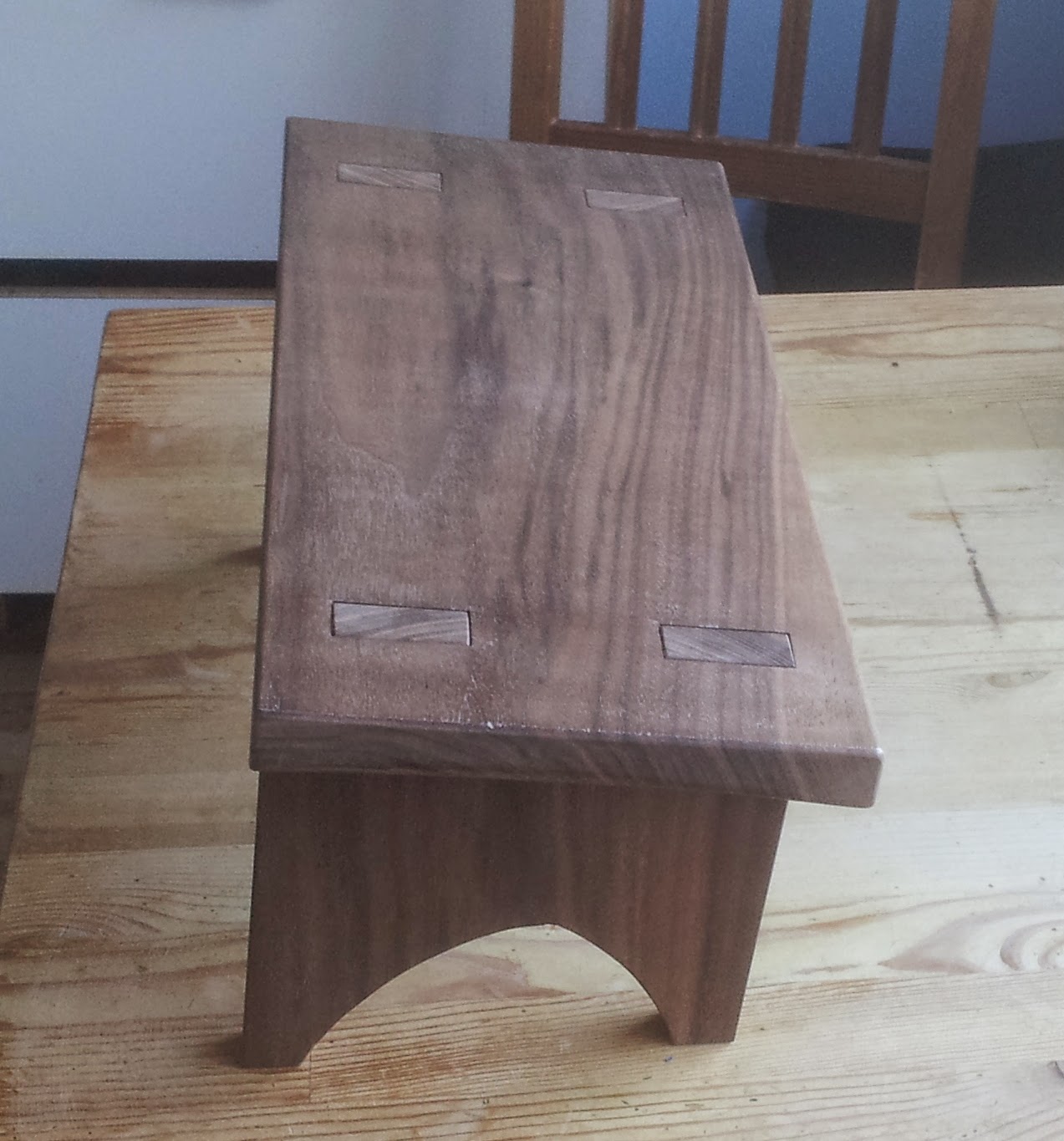
Once we had discussed the basic idea, I made a quick maquette, nailed together from bits of pine. The maquette was too ugly to photograph, but did its job; my friend made suggestions about the pitch, and dimensions, and chose walnut as her preferred wood. I set to work. This is a simple design; a top with four through-mortices, into which the tenons of the two legs will fit. But what’s the betting I’ll find ways to make it more difficult…
I started with a plank of wood, left over from my sister’s wedding present. This would have given me all the pieces I needed and left skinny little offcuts, but beautiful wide boards are not grown to be wasted, so I decided to make the top out of one single board, and the legs out of two narrower pieces glued together. This left me with about two and a half feet of full width board for future projects. Heli is a serious environmentalist, so would have no objection!
Having cut them to width, I scrubbed them to approximate thickness, using a curved blade in my Record no. 4. I then very carefully dressed the edges to be joined, as I intended to use a rubbed joint: no clamps, just glue, served hot, of course. My readers here will know that I care not a fig for nasty modern adhesives; hot animal glue is the way to go!
[I have apparently lost all of the early pics I took; I'll dig them out when I get home, if not before, and update this with them. Modern technology, huh. I doubt they so easily misplaced giant glass photo negatives back in the good old days!]
Then I dressed the top board, flat and square all round (about an hour’s work, going carefully). I left the ends uncut.
At this point my smartphone went kaput two weeks before the warranty ran out, so there are no pics of the next stage; laying out and cutting the mortices. I find through mortices, such as those on my desk, really, really hard to do well. So I went very slowly, marking out and cutting the shape out with a chisel, drilling through on my wonky drill-press attachment thing, and more chiselling. Lots and lots of chiselling.
Tenons, by comparison, are easy. So I get the mortices dead square and done, then cut the tenons to fit. This allows me more wiggle room than doing it the other way round.
Cutting the tenons was pretty straightforward; I did as much as possible with the saw, then finished with chisel, shoulder plane and apron plane. After much tweaking, the legs fit, tight enough (but not too tight; the user wants this to be a knock-down version, for easier storage and travel.
She came by the shed when I was cutting the legs to length, so we could get the height and the pitch just right. I took this photo to see how much room there is between her feet and the top, in case I decide it needs a brace to keep the legs square.
Then the cutouts in the legs; I gave her lots of options, and gauging her reaction to each one, cut the best shapes out of paper and glued them on with Pritt, so she could see what the legs would look like. She went with the asymmetrical curves, which I cut out with a coping saw.
From there it was the usual clean up: scraper, sanding up through the grits raising the grain between each, and finish with linseed oil, and wax. I did the final wax at home, with a little help from my eldest [one of the images I have misplaced is of my then-5-year-old sawing out parts of the maquette].
It came out not too badly, as you can see above. Most importantly, Heli was pleased with it!
We had agreed that this was a commission, but when push came to shove I found charging for it very hard to do. I couldn’t simply charge by the hour because I had made no attempt to be efficient; I enjoyed every leisurely minute of this project. But if I just gave it to her she would have felt guilty. Then it hit me; pay me in wine! This was a crackingly good idea, as honour was satisfied all round, and I couldn’t possibly spend the money on anything boring (like groceries or mortgage payments). And may I say, Heli’s taste in wine is confirmedly excellent!













Revolutions: Woodworking, Watches, and AI
The AI revolution has been growing behind the scenes for a very long time, and now with chat bots like Chat GPT and image bots like Midjourney, the iceberg is breaking the surface. It puts me in mind of the machine-tool revolution in woodwork that occurred in the 60s and 70s, and the quartz revolution in watchmaking around the same time. The short-term result of both of these was that a lot of old-fashioned craftspeople went out of business, and it became much easier for lower-skilled workers to make decent quality furniture and watches, and much cheaper for ordinary people to buy a functional chair or timepiece.
What we see in both cases, and indeed in just about every case I can think of where new technology comes along, was a change in the market, which became much more democratic, and much broader, with a lower low end, and a much higher high end.
Let’s start with the woodwork example, as woodwork is millenia older than horology.
Table of Contents
The Craft of Woodwork
There is nothing in woodwork that you can’t build with just hand tools. Ships? Check. Lace cravat in limewood? Check.
This is Grinling Gibbons’ cravat, hand carved in about 1690, currently held in the Victoria and Albert museum.
You can see how he (probably) did it in this astonishing video of Clunie Fretton’s partial reproduction.
Until recently, every woodworking project, including that cravat, went from tree to finished product with practically no mechanisation. All power was muscle power, human or animal. The tree was felled with axes, split with wedges, sawn by hand, planed by hand, and finished by hand. The circular saw dates back to the 18th century, when it was driven by wind or water power, and used in saw mills to cut trunks into planks, but it took a century or so to become widespread.
Mechanisation first occurred at the largest scales of woodworking: tree felling with chainsaws, ripping with giant circular saws, the planer-thicknesser (known as a jointer-planer in the US), and so on.
At one extreme, we have craftspeople making extraordinary things out of wood entirely with machines; at the other, we have craftspeople making extraordinary things out of wood with no machines at all. One great example of the latter is Tom Fidgen, author of a wonderful book The Unplugged Woodshop, who doesn’t use any machines at all! Yet he does run an online woodworking school… I wonder which makes more money?
At the level of the individual artisan working at the bench, the cataclysm of modernity didn’t really strike until the 1960s, with the development of smaller electric tools such as hand-held routers. This quickly lead to the demise of many companies making professional grade hand tools. It became very difficult to buy a decent saw or plane; all you could get was mass-produced low-grade wobbly crap. Just compare a Record plane from 1950 with one from 1975, and the cost-cutting is obvious. Plastic handles, parts made of bent mild steel rather than cast, etc. This was not the companies’ fault: the market for the high quality stuff just wasn’t big enough any more to be profitable.
But from the ashes of rubbish hand-tools, phoenixes have emerged, beginning with Lie-Nielsen Toolworks, founded in 1981. The top end of the market is now way, way, higher than it ever was before. Such as this saw from Skelton Saws:
And planes from Karl Holtey, that begin at around £1k, if you can find them. Most are much more expensive.
Which make my beautiful, immaculate, Florip saws look very cheap! I have five: their bench saw, tenon saws both rip and crosscut, and dovetail saws rip and crosscut. Oh my goddess, these are amazing, and all five together cost about the same as one Skelton. But of course, about ten times what I'd pay for the cheapest options. Likewise, you can get a really high end plane from Clifton (an old brand that was going bankrupt, and was rescued by one of the few surviving handsaw makers in the UK, Thomas Flinn), Lee-Nielsen, Veritas, etc for a tenth of the price of the equivalent Holtey, but yes, about ten times what the crap in the big box store will cost you.
You can get an idea of what it takes to make a really cheap plane work properly in this video by Rex Krueger.
Putting these tools to use, most craftspeople fall somewhere in between the high-tech and the hand tool-only. I have always had a romantic and aesthetic preference for hand tools, so avoid machines where practical. But here’s the thing: from the perspective of the end-user, it is impossible to distinguish a board that has been dimensioned by machine and finished by hand, and one from which every shaving was taken away through manual labour.
There is no difference- you only get to see the final surface. Likewise, an article written by ChatGPT will be like a rough-sawn board. Usable for some applications, but by the time a craftsperson has planed it smooth, sanded it, and applied some polish, nobody will know if she wrote it from scratch, or edited it from an AI generated draft. Most end-users, most of the time, couldn’t care less how their book was written or their furniture was made. It either meets spec, or it doesn’t.
It’s also worth noting that mastering woodworking machines is in its own way as demanding and difficult as mastering hand tools. You can’t just dump a load of wood in the machine shop, turn everything on, and hey-presto! Out comes new furniture. It’s just that it expands the lower end, and speeds up production: less-skilled workers can get useful work done, and more skilled workers can work dramatically faster, especially in getting sawn lumber dimensioned and planed all round.
The major downside of machines in woodworking (other than the noise and the dust) is that one can tend to make the furniture that the machine can handle. The machines become a limiting factor. If you can’t fit a board onto your planer, you might rip it down the middle so it will… when cutting dovetails, I usually lay out the tails so close together that it’s impossible to cut them with a router (the cutter shank won’t fit through the gap between the tails).
Anyone who knows about such things will immediately see that these were hand-cut. This has nothing to do with practicality, and everything to do with satisfaction. It’s sticking one finger up to the machine-tool revolution, and quite silly because a) it doesn’t make the joint stronger and b) I’m perfectly happy to use machines for other things. The groove for the drawer bottom in this very drawer was cut with a router, and I used a planer-thicknesser to bring the front and sides to thickness.
If you are unfamiliar with woodworking machines, you can see a state of the art modern set-up here in Matt Estlea’s overview video of the making of his Roubo-style workbench, “Bertha”.
And compare that to his traditional dovetail cutting tutorial.
Same craftsman, different jobs, so different tools.
Of course, most furniture isn’t made by any kind of craftsperson. It comes from factory assembly lines, in massive quantities at an extraordinarily low cost. It is literally cheaper to buy a table from IKEA than it is to buy the wood to make the same table yourself. The same people who are (probably rightfully) worried about how AI will steal their jobs are almost certainly wearing clothes made on machine looms, and using furniture mass-produced by industrial processes. And probably wearing quartz watches.
The Craft of Horology
Speaking of watches, here is one of the best watches in the world:
The Casio AE1500. Yours for about £30. Reliable, waterproof, multi-function, does everything you could possibly ask of a watch… Except make your craftsmanship spidey-sense tingle with glee. Which this handmade IWC perpetual calendar watch (you won’t need to adjust the date, month, or moon calendar until the year 2100) certainly does.
Get this: using only gears, springs, and levers, this watch can handle date changes, including leap years. It’s all 100% mechanical. The mind boggles. Is that worth paying about a thousand times as much for the watch? Some people certainly think so. The Casio does all that the IWC can do with ease, and more, at about a thousandth of the cost. Though, if I’m 100% honest, if money were no object, the high-end watch I’d get would be the Rolex GMT Master II, with the pepsi bezel. What can I say? The heart wants what it wants. Rolex got me with their advertising in the 80s, and I’ve never quite lost the urge. I found this genuine ex-dealer wall clock on Etsy, and I love it to bits:
Getting back on track now (please admire the deftness with which I didn’t go down the wooden timepiece rabbit hole), the quartz revolution almost destroyed the Swiss watch industry. Before those cheap, reliable, tacky watches came along, all watches were purely mechanical. The fancy ones were self-winding, and had interesting complications like GMT functionality and/or showed the date, but that was about it. And when cheaper, more reliable, tackier watches became available, there was a winnowing of watch companies that is heartbreaking to contemplate. In 1970, there were approximately 1600 Swiss watchmaking companies. By 1983, there were about 600 left.
One brand that made a tremendous success out of cheap quartz watches was Swatch. They went on to buy up some of the struggling fancy brands (Breguet, developer of the Tourbillon escapement (patented in 1801). Breitling. Even James Bond’s Omega) and made them profitable. At the same time, Patek Philippe, Audemars Piguet, Vacheron Constantin, and Rolex doubled down on the exclusive luxury end of the market and went from strength to strength, because they are not competing on price or time-keeping accuracy. They are competing on craftsmanship and artistry. It’s worth noting that Rolex and Patek Philippe particularly were actively developing their own quartz movements in the early days, so they were not in any sense Luddite about their approach to watchmaking. But they recognised a fight they'd never win, and so chose new ground to compete on.
Since the quartz apocalypse, there have been some astonishing new entrants into the field, such as Richard Mille and Kari Voutilainen (whose watches start around the 200 thousand dollar mark, about ten times what the IWC watch costs), or Finnish watchmakers S.U.F Helsinki, whose watches start at about a tenth of the IWC. These newcomers are not just filling the gap left by the older brands that failed and were bought up; the market for this kind of art/craft is much, much, larger than it ever was. In terms of price, it goes approximately like so: Casio: x 100 = S.U.F Helsinki: x 100 = Voutilainen. The gap between the bottom end and the top is almost infinite: there are new watches by new makers out there that cost millions.
People will still pay for craftsmanship
What does all this have to do with AI? Well, it’s the power-tool, quartz movement, equivalent for knowledge workers of all kinds, including programmers, graphic designers, and writers. Bill Gates reckons (in his article The Age of AI Has Begun) that this is the biggest thing since the graphical user interface, and he’s pretty well placed to make that assessment. The article is relatively fair-minded, and highlights some pros and cons. Pros include better cheaper healthcare, cons include the risks of AIs being misused by the malicious, and major disruption to the livelihoods of knowledge workers.
Here is what will happen, because it’s what always happens:
The market will split. There will be some people out of work because AI does their job better and faster than they can, and they can’t adapt fast enough. There will be some people who successfully position themselves as the hand-tool/mechanical watch artisan equivalent: poets, literary fiction writers, and so on. And there will be most people in between who learn to use the new tools, and use them to make more stuff, faster, and better.
There is space in the market for the cheap, practical, gets the job done for not much money solution. And there is space for the artisanal, bespoke, gets the job done for a lot more money solution.
On the left of my wall clock, there’s a version of my publishing imprint Spada Press’s logo, done on vellum, by the incomparable Nora Cannaday (whom I interviewed in episode 28 of The Sword Guy podcast).
It’s a one-off work of art. I also have this one, that I use in all my books:
Done precisely to spec, by the excellent Robert Simpson, using digital tools (which graphic designers were up in arms about in the 80s and 90s), and which has now been reproduced thousands of times in printed books and ebooks.
Which one is “better”? That really depends on what you want. They are both exactly what I asked for and are both excellent.
The real question is, who benefits from all this progress?
Back in the 80s, one teacher at school was banging on about how, with the new desktop publishing, you could do in a morning what used to take a week. I asked if you’d expect to get the rest of the week off, then? He said no…
And this is how it will go. If you are working for yourself, or it’s your company, then increasing productivity is usually a good thing, up to the point that it decreases the value of your product, and until your competitors become similarly more productive. If you work for someone else, this will just mean that you are expected to produce x times as much, for the same money or less.
In Gates’ article, he wrote:
“When productivity goes up, society benefits because people are freed up to do other things, at work and at home.” (Emphasis mine)
This is the most egregious rubbish. When productivity goes up, people are expected to do more work in less time. End of story. AI will mean either redundancy or more product for the same pay, for most employees affected by it.
Mark Hurst at Creative Good is a technologist who is usefully sceptical of various aspects of the modern techscape, including AI. He makes the point in his article ChatGPT’s dangers are starting to show that the companies involved in AI development are working to “privatise the gains, and socialise the losses”.
One critical area where the law has simply not been written yet is the use of copyright material to train AIs. To my mind, it’s a blatant violation of the rights of the creator to use their work (usually writing or graphic art of some kind) to train a machine to create other art in that style. Creators should have the right to decline such use, or to get paid to allow it, just as they might licence a film studio to make a movie out of their novel. I think it will be extremely difficult to prove what material the AI has used- for instance, any chatbot AI probably has access to every blog post ever written. But those posts are in most cases copyrighted to the writer. How do you prove that the AI stole your work? This is a solvable problem, I just hope that our society does the work to solve it. Making the owners of the AI liable for any infringements would go a long way towards motivating them to program the bot to behave ethically.
I think that dangerous new technology requires some kind of regulation. Cars, for instance. You need a licence and insurance to drive one. With AI, the primary worry is that ignorant people will mistake an algorithm with access to a finite (though very large) database for the arbiter of truth. And unscrupulous people will use AI to manipulate us into buying more stuff we don’t need, or voting for the wrong people. These are genuine concerns, but I am more concerned with the people who will become redundant, because they either don’t adapt, or re-brand, or their specific area is simply no longer needed by anyone. There can and should be some provision for them.
There is nothing inherently moral or immoral in AI. It’s a tool. It can and will be used to make our lives easier and better; and it can and will be used to make our lives worse. This is true for every tool ever made. Swords bring justice and defend the weak. Swords murder the innocent. It’s not the tool, it’s what we do with it. I could brain you with my #7 plane, stab you with a chisel, or use a chunky steel watch as a knuckleduster, which is how Mr. Bond broke his Rolex in On Her Majesty’s Secret Service (the book, not the movie). Though the tools you have access to will tend to guide your choices, whether you're conscious of it or not. When you're holding a hammer, you look for nails. I'm much more likely to joint an edge with my #7 that I am to hit anyone with it.
When I was thinking about getting a new (to me) car back when I lived in Finland, I considered getting a four-wheel drive, because it's that much less likely to get stuck in the snow. I asked a friend who really knows cars, and he said: “with four-wheel drive, you still get stuck, but in worse places”. Tools guide choices.
It's also true that all new technologies have unanticipated, often unanticipatable, consequences, for good or ill. I'm not a prophet, so won't make any predictions about the unanticipatable. But the obvious (to me at least) negative consequence of chatbot AI, like ChatGPT, is that we will outsource our thinking, and so become less good at it. Plato famously decried writing things down as bad for the memory. Folk are continuously ascribing all sorts of things to Plato and others (as Abe Lincoln famously tweeted: don't believe everything you read on the internet), so I'll quote him at length. He puts this story into Socrates' mouth:
He was right, but I think we'd all agree that the loss of memory skill is worth the upside of writing. I think ChatGPT threatens to create a net dumbing effect on its users. Nicholas Carr warned of a similar effect of the internet itself, and most particularly Google, in his book The Shallows: What the Internet is Doing to Our Brains. He was not wrong. I don't know how many times I've explained to my kids that googling a search term is not the same thing as researching a topic. So we should be watchful for any feeling along the lines of ‘I'm too busy/tired/stressed to do this myself so I'll just get the bot to do it'. The main red flag for this is whether something you used to do yourself becomes “too difficult” if you don't have access to the AI helper.
Banning the new technology, as some people whose livelihoods are affected by it are calling for, is never an effective solution. It has been tried over and over again, just about every time a new, revolutionary, technology comes along. Banning nuclear weapons didn’t stop North Korea from getting their hands on them. It simply doesn’t work. I bet the horse-drawn carriage makers did their damndest to get those nasty mechanised car things taken off the streets. Or restricted to the speed of a horse. And guess what? Some carriage makers went into business making bodies for cars, and some people still drive horse-powered carriages for fun. But yes, an awful lot of them just went out of business. I don’t say ‘adapt or die’. But I do say ‘regulate and adapt, or die’.
Personally, as a self-employed swordsmanship instructor and writer, I can see how using AI could help me produce better books, faster, by (for instance) creating outlines, rough first drafts of specific chapters, back-cover blurb, etc. But there is no way for ChatGPT to run a seminar for me, or to conceive of the idea of a new training manual for the Art of Arms. Also, I’m very much at the bespoke, luxury, end of the market. Absolutely nobody has an existential need for a swordsmanship lesson, so automation is not a concern. You can probably tell from the headline photo, in which I'm wearing a vintage hand-winding Roamer watch from the 50s, and using a Record #4 hand plane from the 30s that belonged to my grandfather, that I'm aesthetically always on the side of the old ways. I teach swordsmanship, not shooting.
Swords, spears, and bows used to be state-of-the-art weaponry, but were superseded by guns. Swordsmanship and archery devolved into competitive sports (throwing javelins did too), and even twenty years ago there were precious few swordmakers in the Western world. But there has been a renaissance of historical martial arts, and a consequent renaissance in the craft of swordmaking. That doesn’t help those smiths who went out of business a couple of centuries ago, but it does suggest that there will be a resurgence of appreciation for older ways of doing things in the future. It’s hard to think of a technology where this doesn’t apply.
Music? CDs and tapes killed vinyl… but vinyl came back stronger than ever. We now have streaming at the bottom end, and vinyl at the top, with CDs in the middle.
Ebooks were supposed to kill print stone dead… only for print to survive, thrive, and for high-end leather bound editions to become more popular, and more profitable, than ever. Brandon Sanderson’s latest kickstarter, for a leather bound 10th anniversary edition of his Way of Kings, raised just under seven MILLION dollars! (I could get a thousand Breitling watches for that! not to mention a thousand Holtey planes!) But print is dead, right?
Midjourney image generation does not threaten David Hockney, or Lina Iris Viktor. It does threaten folk making a living producing graphics for websites. Chat GPT does not threaten poets like Simon Armitage or Amanda Gorman. It does threaten writers making generic blog posts for other people's websites (who, incidentally, keep pitching me to write completely off-topic crap for this site!).
It’s not my place to offer advice to people in different circumstances to mine (and unsolicited advice is usually obnoxious). But as I see it, if you work in areas likely to be affected by AI, you have two options. Either master the new tool and use it to make your work even better, or brand yourself at the other end of the market. Both work, and both have value. There will always be people looking for the cheapest option, but there will also always be people looking for the hand made option, and who are willing to pay for it.
Further reading:
My brother Richard Windsor blogs about all sorts of tech stuff, including AI, from the perspective of investment advice. You can find his bearish take on GPT-4 here: https://www.radiofreemobile.com/gpt-4-the-law-of-diminishing-returns/
Joanna Penn got me thinking about AI as it affects writers, and she has written about it extensively on her blog, here: https://www.thecreativepenn.com/blog/
Wikipedia article on the “quartz crisis”: https://en.wikipedia.org/wiki/Quartz_crisis
John Harrison, winner of the Longitude prize, and maker of clocks, including all-wood clocks (you can jump down that rabbit hole yourself!): https://en.wikipedia.org/wiki/John_Harrison