Guy's Blog

Guy frequently keeps this blog updated with thoughts, challenges, interviews and more!

Tag: Philippo Vadi

Flash sale on Philippo Vadi's longsword and dagger courses bundle

Would you like a complete interpretation and training method for Vadi’s Art of Arms, as found in his De Arte Gladiatoria Dimicandi?

Well now you can have it, with the Philippo Vadi courses bundle, which includes my Philippo Vadi Longsword Course, and my Philippo Vadi Dagger Course.

The courses also include all of Vadi's other plays, such as sword in armour, pollax, and spear.

Bought individually, these courses cost $850. The Bundle is only $600. And you can get 30% off until Wednesday (October 15th).


Click here to enrol, and use the code WELOVEVADI2025 at checkout to get the discount.

The Longsword course includes over 75 video lessons, across 8 modules:

  1. Introduction & Safety
  2. Footwork and Sword Handling – Warm-ups, footwork, grips, and mechanics
  3. The Blows of the Sword– Vadi’s blows, including drills based on the guards
  4. The 12 Guards – Every position explained and drilled
  5. Basic Training and Setting up the Plays – Solo and pair training to build a solid foundation
  6. The 25 Plays of the Longsword – All 25 plays from De Arte Gladiatoria Dimicandi, step-by-step
  7. Plays from Chapters 11 and 15 – Extra drills from Vadi's theory of fencing
  8. Skill Development – Fencing games, timing, and troubleshooting

Sample video:

The Dagger course includes over 55 video lessons, across 5 modules:

  1. Introduction & Safety
  2. Basic Training: Falling and Mechanics – Warm-ups, footwork, and mechanics
  3. Dagger Grips and Strikes
  4. The Dagger Plays from De Arte Gladitoria Dimicandi – Every play explained and drilled
  5. How to Train – Solo and pair training to build a solid foundation

Sample video:


Who This Bundle Is For

  • Beginners looking for a structured, complete introduction to longsword
  • Experienced martial artists who want to explore Vadi’s unique system
  • HMA students seeking historical accuracy and practical application
  • Anyone who’s ever dreamed of mastering the knightly art of the sword

What’s Included

  • Full lifetime access to all course materials
  • Train at your own pace, anytime, anywhere
  • Mobile and desktop friendly
  • Immediate start—no prerequisites required
  • Get Started Now

You don’t need fancy gear or years of experience to begin. Just a sword (or even a stick), a mask, a friend, some space, and the willingness to train.

Sound like your sort of thing? Go here and use the code WELOVEVADI2025 at checkout to get 30% off.

Philippo Vadi holding a longsword with the text "The Philippo Vadi Longsword Course"

It’s a great week for Vadi fans. My comprehensive new course “The Philippo Vadi Longsword Course” is now live on both Teachable and Swordpeople, and my friend Michael Chidester has also just launched his new crowdfunding campaign for a very high-end and beautiful facsimile of Vadi’s treatise, De Arte Gladiatoria Dimicandi.

This was a coincidence, and not ideal from a marketing perspective, but it does open up possibilities for co-operations and collaborations. For instance: Michael is offering a $25 discount (that’s over 10% off) on his facsimile for anyone who buys my course. We’re working out the technical details, and I’ll put the discount code in the course materials as soon as I have it.

Speaking of discounts- you can get 40% off the price of the course, in one payment or spread over ten equal payments, while the launch period lasts.

You can find the course here: https://swordschool.teachable.com/p/the-longsword-of-philippo-vadi?coupon_code=VADITASTICLAUNCH&product_id=6204895

If that discount code link isn’t working, go to courses.swordschool.com and use the code VADITASTICLAUNCH at checkout.

So what is the Vadi Longsword course, and what does it cover?

This isn't just another sword course. I've meticulously reconstructed Vadi's complete system from his treatise “De Arte Gladiatoria Dimicandi,” presenting it in a logical progression that takes you from complete beginner to confident practitioner.

Every martial art is a way of moving and a set of tactical preferences. In this course I have included a lot of movement drills, and a large range of technical and tactical drills: everything you need to become proficient in Vadi’s art. (Except the equipment (swords, masks, etc.) and a training partner (because that would be illegal). But I do expect you to share your course with at least one training partner.)
​You will get over 75 video clips, organised into 8 sections:

  1. Introduction & Safety
  2. Footwork and Sword Handling – Warm-ups, footwork, grips, and mechanics
  3. The Blows of the Sword– Vadi’s blows, including drills based on the guards
  4. The 12 Guards – Every position explained and drilled
  5. Basic Training and Setting up the Plays – Solo and pair training to build a solid foundation
  6. The 25 Plays of the Longsword – All 25 plays from De Arte Gladiatoria Dimicandi, step-by-step
  7. Plays from Chapters 11 and 15 – Extra drills from Vadi's theory of fencing
  8. Skill Development – Fencing games, timing, and troubleshooting

As you can see, we cover not only all of Vadi’s longsword plays, but also basic sword training, how to get into the plays tactically, and how to become skillful in their application.

Curious? Here’s a sample video, on one of my favourite Vadi-style sword exercises:

Here’s the discount link again: https://swordschool.teachable.com/p/the-longsword-of-philippo-vadi?coupon_code=VADITASTICLAUNCH&product_id=6204895

If that discount code link isn’t working, go to courses.swordschool.com and use the code VADITASTICLAUNCH at checkout.

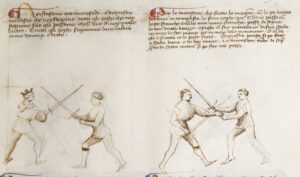
The first two plays of the zogho stretto from the Getty MS, showing the master of the zogho stretto

Ultra-geeky sword post alert: this is a lengthy and detailed discussion of some really specific terms from Fiore. Expect pedantry and nit-pickery, in the service of a definition of terms which has little bearing on how we actually fight. Read on only if that sort of thing floats your boat. I have written this because a friend and colleague asked me what I thought about ‘largo' and ‘stretto' these days. It turned out longer than I expected.

Since study began on medieval and Renaissance Italian swordsmanship, the terms giocco largo and giocco stretto have been discussed at length. The earliest reference we have to these terms is in Fiore dei Liberi’s Il Fior di Battaglia, (c.a. 1400) and they are a consistent feature of most Italian sources from then until the middle of the sixteenth century, after which they are less common.

What do the terms “largo” and “stretto” mean?

I'm going to be using the Italian terms a lot in this article, so let's take a moment to look at translating them into English. Giocco (or zogho in FdB) means ‘play’ or ‘game’. This is consistent and unremarkable, and has about the same connotations as the English word. I can’t think of an expression in either language where you might translate the term as anything else: it even works in mechanics, where slippage in a mechanism is ‘play’ in English, and ‘gioco’ in Italian. I should note that there is no connotation of measure with this term. Measure is misura.

Largo means ‘wide’, with connotations of ‘loose’, such as in the expression ‘questa giacca mi sta larga’, ‘this jacket is loose on me’, or ‘open’, such as in the expression ‘andare al largo’, ‘to go out into the open sea’. Sticking with the maritime theme for a moment, ‘off the coast of Pisa’ would be ‘al largo di Pisa’. Freedom of movement is implied, as is space to play in.

Stretto is the past participle of the verb ‘stringere’, which means ‘to constrain’, ‘to grip’, ‘to squeeze’. It has a lot of connotations, and you can see many of them at this convenient dictionary link: https://dictionary.reverso.net/italian-english/stringere There is no one perfect English equivalent. Stretto as an adjective is ‘narrow’ or ‘tight’, such as in the expression ‘questa giacca mi sta stretta’, ‘this jacket is tight on me’, with the implication of restricted movement. To return to the maritime theme: ‘una stretta di mare’ is a ‘strait’, a narrow channel of water between two pieces of land. It’s worth noting that it’s only used to indicate ‘close’ in phrases like ‘un parente stretto’, ‘a close relative’. Close would normally be translated as ‘vicino’. The single English word that best fits the set of meanings is “constrained”.

While these examples are modern, there is no reason to believe that the meanings of these words have changed over time; I’ve tried to find evidence that they may have, and failed. In modern HMA parlance, the usual translations used are ‘wide play' and ‘close play'. Neither is particularly apt; ‘loose play' and ‘constrained play' would be better, but there's little chance of changing them in the wider community after so long. But bear the connotations in mind.

For most of the time since we began studying these sources, most people have translated and interpreted them to mean ‘wide play’, as in fencing from far away, and ‘close play’ as in getting to grips; in other words, the defining feature is measure. I published this theory myself in The Swordsman’s Companion in 2004. Many of my colleagues (excellent people all) still hold that opinion, which you can read a full discussion of in Greg Mele's article here. The article is explicit: “Zogho Stretto (close or narrow play) is the measure at which dei Liberi…”

For the last decade or so I have held a more nuanced view of their meanings. I’ll confine my interpretation remarks to Fiore, as that’s where the most disagreement lies, and also where I have the most experience and expertise. And I’ll include here all my published opinions on the subject, so you can see how they have developed over time. Before I get onto this, I should be clear that the ambiguities occur only when discussing the sword; all abrazare and dagger plays are considered ‘stretto’, and the grappling plays of the sword mostly occur in the ‘stretto’ section. On this we can all agree.

Where we disagree is the notion that the term ‘giocco stretto' is effectively synonymous with ‘misura stretta' (which in Capoferro's Gran Simulacro at least is the measure at which you can strike without passing, which we might indeed call ‘close measure').

How do the terms largo and stretto apply to our practice?

As I see it, in Fiore's plays, the defining tactical consideration (and the organising principle of the longsword section of his book) is the crossing of the swords, in which the measure is approximately the same, but the blade relationship, and so tactical situation, is quite different.

This gif illustrates the point nicely:

Getty Longsword Crossings

make action GIFs like this at MakeaGif

These are the three crossings from the Getty ms, centred on the front foot of the player. The outstandingly obvious conclusion is that the measure seems pretty much the same, but the blade relationship changes hugely. (With thanks to Joeli Takala who made a gif like this in 2010, which I reproduced because the original stopped moving.) There is no question that one of the two crossings shown at the middle of the blade is ‘zogho largo', and the other is ‘zogho stretto', as they are the first images from those sections. From one, we are free to strike, from the other, our best course is to enter with a pass ‘and come to the strette'. [I know that some researchers consider the images to be unreliable, but in my experience they are almost invariably very accurate. And once you start playing the ‘but the drawings aren't photos' card, you might as well discard all the pictures altogether, because it opens the door to making the images say whatever you want them to.]

So as I see it, “zogho stretto” is a tactical condition of the play, to which our best response is to enter in. Zogho stretto in general is ‘the condition of play in which you are constrained and cannot strike directly”, and zogho largo in general is “the condition of play in which you are free to strike”. “Le strette”, “the constrained ones”, is the term for techniques in which we come to grips. Yes, they are done from closer in than the “unconstrained plays”, but to say that they are defined purely by their measure is wrong; they are defined by being grappling actions.

That's the short version. I shall now expand at considerable length…

Further depth and detail on largo and stretto

Back in 2009, I published an article that described my new understanding of largo and stretto, and includes an analysis and interpretation of all of Fiore's longsword plays out of armour. Please read it, and then we'll move on… you can download the pdf from here:

Crossing Swords 2009

Back again? Excellent.

Recall this passage:

It is my contention that zogho largo, wide play, describes the actions that are safe to do when the attacker’s point is driven wide. Zogho stretto, close play, describes the actions that we must do if the attacker’s sword is too close to us when we are crossed. The correct action then is to pass with the cover (i.e. without leaving the cross) and execute one of the close play plays.
As the defender, one should not seek out the close play; as Fiore states, from the stretto cross, either person can do the plays that follow. But by passing in, we prevent the attacker from winding the point into our face.

My interpretation of the basic form of these plays as it stood in 2009 can be seen in these videos:

Sword in One Hand:

Zogho Largo:

Zogho Stretto:

My current up to date and explained in detail interpretation of these same plays are Section 8 of my Complete Medieval Longsword Course

I should point out that introducing this interpretation of largo and stretto did more to prevent double hits in freeplay in my school than any other change to the way we conceptualise Fiore's art. Suddenly, people started paying much more attention to whether an action was appropriate in the context they found themselves, simply because they now had a way to define that context.

By 2014, my thinking had not changed particularly, despite my colleagues’ best efforts to persuade me that it was all about measure: in my book The Medieval Longsword, pages 43-45, 2014, I wrote:

Perhaps the most overt tactical distinction Fiore uses is between zogho largo, universally translated as “wide play”, and zogho stretto, which may be translated as “close”, “constrained” “narrow” or “tight” play. I find “constrained” to be the most accurate rendering, but “close” is currently the most common choice. This topic has produced perhaps the most persistent and widespread disagreement amongst Fiore scholars, so I will go into some detail regarding what I think these concepts mean, and how I use them.

Fiore’s plays of the sword in two hands are clearly divided into the 20 plays of the zogho largo and the 23 plays of the zogho stretto. There are also plays done with the sword in one hand, in armour, and on horseback. The distinction between, say, the plays of the sword in armour and those of the sword on horseback are pretty obvious. The distinction between what constitutes zogho largo and what constitutes zogho stretto has been far less clear. In my first book, I defined the terms gioco largo (wide play) and gioco stretto (close play) as functions of measure: when you are close enough to touch your opponent with your hand, you are in gioco stretto. If you can reach him with your sword using one step or fewer, you are in gioco largo. This is a useful distinction to make, especially when classifying and cataloguing techniques.

For many years, this stood as the standard interpretation of zogho largo and zogho stretto, however, this is clearly not how Fiore uses the terms. (Remember our earlier discussion of changes in interpretations? Here you can see my pressure-test system in action.) In il Fior di Battaglia, we clearly see actions done close-in but placed in the zogho largo section (such as the 14th play of the second master), and actions done from quite far away placed in the zogho stretto (such as the 12th play). So what, then, do “wide” and “close” play refer to?

Simply put, the relationship between the two swords when they cross. There is a plethora of circumstances in which you are free to leave the crossing and strike as you will—these are all considered “largo”. In other circumstances the conditions of the bind are such that if you leave the crossing you will immediately be struck. In these cases you are constrained to enter in under cover, and use one of the “close plays”.

In practice, the type of crossing that demands close play is very specific: you must be crossed at the middle of the swords, with the points in presence (i.e. threatening the target) and sufficient pressure between the swords such that if one player releases the bind, he will be immediately struck. Ideally both players have their right foot forwards, which makes it easier to enter in. This is a situation of equality, in which either player should do the close play techniques.

In all other circumstances, most commonly when the opponent’s sword has been beaten aside, it is safe to leave the crossing to strike your opponent. This is the fundamental condition of wide play. If it is necessary to maintain contact with the opponent’s sword and enter to grapple or pommel strike, you are constrained to the close play. So, the plays are ordered according to the kind of crossing that they follow. These conditions exist in a continuum. As the opponent’s sword gets closer, and the bind gets firmer, your ideal response changes. As it switches from “leave the bind and strike” (largo) to “keep in contact with the bind and enter” (stretto), so you will find your ideal response in one section of the book or the other. Identifying these conditions is perhaps the key tactical distinction to make in this system. Note that close play techniques can often be done in a wide play situation, but wide play techniques cannot be done from a close-play crossing without extreme risk. The techniques we see in the 10th, 14th, and 15th plays of the second master of the zogho largo (crossed at the middle of the swords) section are clearly “close”, and there is no practical distinction between for example the 10th play here and the 2nd play of the zogho stretto. It’s apparent then that we have a choice: either Fiore organised his book as a catalogue of techniques arranged by the measure in which they occur, with several errors, or ordered them according to the tactical circumstances in which they should be done, with no errors. Which would you choose?

As a rule of thumb, if your opponent’s sword is moving towards you, or pressing in, you must bind it to prevent it from hitting you (stretto). If it is moving away from you, you can simply strike (largo).

Wide and close play describe what happens, but can also be used to describe a set of tactical preferences, an approach to the fight. When fencing an opponent who is much more comfortable in wide play, we may engineer a situation where only close play techniques will work. We can also of course deny a close-playing opponent the context he wants, and slip away into wide play as he tries to constrain us. A good fencer will be comfortable with both contexts, though most people have a preference for one type of play or the other.

This interpretation is still my default, though I would express it differently now. In short, you are in ‘wide play’ when you are free to leave the crossing to strike, and in ‘constrained play’ when you have to maintain contact with your opponent’s sword to strike.

So where do I stand now? 

The defining features of largo and stretto

In combat, you are only likely to have your freedom of motion constrained by some threat or physical contact from your opponent. When it comes to making decisions under pressure, it’s usually unhelpful to have more options than necessary, because every choice slows you down. So I think the point of the largo-stretto distinction is to reduce the likelihood of getting hit by making it as clear as possible when it is safe to strike. It’s a tactical distinction, not a technical one. The tactical situation is determined by the following conditions:

Measure: how far apart are you? Yes, measure is a critical component of the condition of play, but not its defining feature.

Movement: where is everything going? Is your opponent pushing in, pulling back, binding strongly, yielding? And you?

Blade relationship: are the blades crossed, and if so, how?

I’ll expand on these one at a time:

Measure: 

If you are in range to strike without stepping, this distinction is crucial. Are you free, or constrained? Outside that measure, it’s irrelevant. Fiore does not explicitly discuss measure at any point- the term is used once only, on the segno page under the lynx: E acquello mette sempre a sesta e a misura. Clearly, if he had wanted to define the plays of the sword by their measure, he had the linguistic tools to do so. We can see that at the moment the swords cross, the measure is approximately the same in all three crossings, and it's at the moment of the crossing that tactical situation is defined. To be in either largo or stretto play, you must be close enough to strike.

Movement:

The measure and the blade relationship will normally be in constant flux. Sword fighters rarely stand still when this close together. The exact positioning of the players at a given moment is less important than the direction they are moving in. If your opponent’s actions are such that you have to bind their sword, you’re probably in a stretto situation. If they are moving away from you, then you are probably freer.

Blade relationship:

Is your weapon controlling your opponent’s? If not, it should be. 

Let me quote again from The Medieval Longsword  pages 159-161

Whoever masters the crossing, gets the strike. All medieval swordsmanship sources emphasise what happens when the blades cross. This crossing can be reduced to three critical factors: where on the blades the cross occurs, where the points of the swords end up, and how much pressure is being exerted. Up to now, almost every parry has been aimed middle to middle, and has worked as intended, beating the sword aside, with the exception of the “sticky” cut against the position of the sword in one hand. This was by way of introduction to the idea of binding the sword, which is a process of gaining mechanical control of your opponent’s weapon using your own.

In combat, the crossings of the sword happen so fast, and ideally last for such a short time, that it is unusual to respond to their specific conditions as they occur; more commonly, cues in our opponent’s prior movements indicate what will happen when the blades meet. It is nonetheless useful to analyse the possible crossings, to get an idea of what may occur and what you should do about it. This section is a bit like explaining traffic lights to a driving student.

Let’s start with where on the blades the cross is made. Most of the time you would be aiming for a cross at the middle of both swords, but Fiore divides the blade (as we have seen) into three parts: the tutta spada (the first section near the hilt), the mezza spada (the middle section) and the punta di spada (the last section, near the point). Mathematicians will have no difficulty working out that there are nine possible combinations of places on the sword where the crossing happens:

 We must also consider the position of your point, close enough to be a threat, or wide, and his, close or wide, so multiply 9×4 and we get 36 possible crossings. Add to that (or rather multiply) the degree of pressure between the blades (let’s be binary and say strong or weak—we could have a dozen gradations of strength) and we have 72 crossings. And lastly, which side is open—inside, outside or neither? So multiply by three and we get 216 possible meetings of the swords. That is patently absurd. Let’s carve it down a bit.

What matters most is what you can do from a given relationship of the blades. In practice, it is only possible to apply pressure when meeting at the mezza or the tutta of your sword. So where there is a punta involved, that sword (or both) are always weak in the bind.

Also, when crossed at the points, the points of the swords can’t be threatening either of you directly, as you are either too far away, or they are pointing up or to the side, so it can always be consid- ered “wide”. Likewise, when crossed at the tuttas, the points must be wide, or there would have been a strike already, you’re so close. Where one point is against another’s mezza or tutta, there should be sufficient leverage advantage that the punta is always weak in the bind, and will be driven wide. So, that same table now looks like this:

It should go without saying that you strike on the side he is open; if you aren’t sure, if neither side is clearly open, go to the other side (so if your sword is on the right of his, go to the left). This is because whatever force he is using to keep you out of the centre should open that line when you release your counter-pressure.

The only part of the table where there is any real ambiguity is the middle one, where the swords have met in the middles: the points may be wide or close, and the bind may be strong or weak. If his point is close, and the bind is strong, you must enter into the close plays. This crossing leads only to the zogho stretto. If his point has been driven wide, and/or there is little pressure in the bind, it is safe to either grab his blade and strike (if it is close) or just strike (if his point is wide). These are examples of zogho largo.

Largo and stretto in other systems.

And what about Vadi? Well, he doesn’t divide his 20 plays of the longsword this way, but he does refer to largo and stretto play, principally in his Chapter 3: Theory of the Sword, especially on folio 5v. You can download my free translation of the entire manuscript from here and make up your own mind… Or if you're feeling wealthy, you could buy the snazzy hardback of the whole book: my new The Art of Sword Fighting in Earnest!

For the perspective of a Bolognese fencer, Ilkka Hartikainen has an article on the terms here.

In conclusion

So let me sum up:

Being close enough to strike is a necessary but not sufficient condition for the term ‘zogho stretto’ to apply. If you are free to strike, and have room to do so, the play is ‘largo’. If you are constrained, the play is ‘stretto’. Fiore’s solution to the problem of being constrained is to enter in with a pass, to get to grips (he does love his wrestling); grappling plays of every kind are ‘strette'. It’s worth noting that we find different solutions to the same tactical situation (as shown in the crossing of the master) in the German medieval sources, which often recommend a winding action instead. 

Zogho stretto is a type of play, not a specific measure. All of Fiore’s stretto plays involve grappling, which requires you to get close. But that isn’t what the term means.

This interpretation makes teaching decision making at the crossing easy. A catalogue of techniques organised by measure is not useful; a distinction of when to do what is much more so. So whether you agree with my thesis or not, you can still use the idea behind it to make better tactical decisions in the moment. I think the best thing about this interpretation is that it is directly applicable to winning fights, of which I'm pretty sure Fiore would have approved.

Further reading:

From Medieval Manuscript to Modern Practice: the longsword techniques of Fiore dei Liberi

The Medieval Longsword

Many students find the (often) foreign terminology a major barrier to learning swordsmanship. I get it. I really do. In 2006 I even wrote an article explaining why I translate “meza” and “tutta” the way I do. I put a glossary in the back of most of my books, and I created a separate pdf handout for the Longsword Course that includes the essential terms for studying Fiore and Vadi. If you'd like a copy, sign up below and I'll send you one automagically.


It has been a splendid few days in Seattle so far, kicked off by a trapeze lesson with the excellent Milla Marshall at SANCA. The place was pretty empty, so there was no-one to hold the camera (Milla was busy spotting me through the tricky bits), but we did manage to catch this new trick on video:

There's no better way to get the aeroplane out of your spine! This was my third class with Milla, and I can highly recommend her. I also managed to get one go on the flying trapeze on Friday, so that's my adrenal glands thoroughly exercised.

On Thursday evening, Dan from Lonin took me shooting; it's been a while since I last shot, but I didn't disgrace myself. Dan is a fan of old British militaria (up to and including driving a 1980s military Land Rover), and he kindly let me blast away with his (semi-auto) Sterling SMG, his Browning Hi-Power (my favourite 9mm pistol), a WWII Webley revolver, and, to cap it all, a WWI era Webley .455, just like my grandfather carried in the Great War.

I spent most of Friday working on my new Vadi book (it's not all fun and games!). I'm reading around the period quite widely, and came across an interesting light history of the Medici banking empire on my brother-in-law's bookshelves. Medici Money by Tim Parks is well worth a look if you're interested. It's not a mighty and definitive scholarly work, but it explained some aspects of Italian financial history I hadn't grasped before, and it's a fun read. It's by the same Tim Parks that wrote Teach us to Sit Still, a very personal journey into meditation. As my regular readers know, I meditate a lot; if the Vipassana stuff Tim talks about is a bit heavy, you could try this instead.

While I'm on the subject of books: I'm staying at Neal Stephenson's house, and came across an advance reader's copy of his next novel (co-written with Nicole Galland), The Rise and Fall of D.O.D.O.. Let me put it this way- I meant to just scan the opening pages, but am now 400 pages in… It's classic Neal, in that you can't really categorise it, but it's a lot like Reamde in tone, with a bit of Baroque cycle in content, and it manages to fuse both classic SF elements (quantum physics stuff) with magic, in a way that's just a delight to read. Yes, we're friends so I'm biased, but I would never recommend a book just because a friend wrote it.

Friday night I was teaching in my Seattle sword home, the Lonin loft at SANCA, then all day Saturday (Fiore stuff, with a bit of Vadi), and all day yesterday (I.33 in the morning, Capoferro in the afternoon).  A big shout out to Dan Weber for organising the whole thing, Alex Hanning for running the I.33 group, and Michael Heveran for keeping the rapier flag flying amidst all this medieval stuff. Sunday's seminars were graced by Devon Boorman and three of his Duello students, one of whom, Greg Reimer, is a superb graphic designer who has taken my free Fabris photos and laid them out with Tom Leoni's 2006 translation… I have an advance reader copy of the first section, so it looks like I'll have plenty to do on my flight home next week!

But before then, I'm off to Vancouver tomorrow, to teach seminars at Valkyrie, and, while I'm there, go horse riding for the first time in about a decade… wish me luck! I'll report back in due course. If you're in or around Vancouver next weekend, come and train!


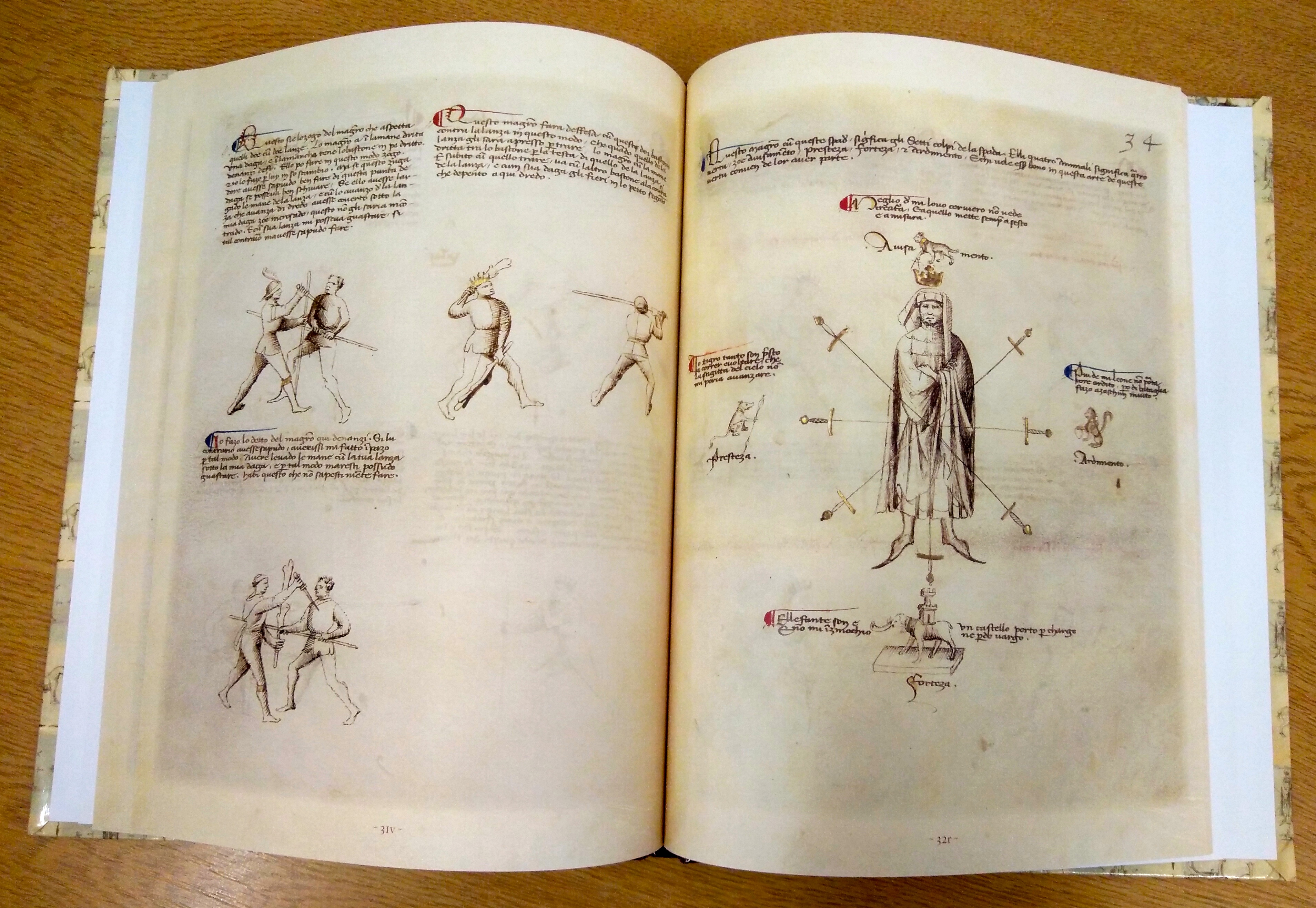
My urgent desire to snuggle up to Philippo Vadi has been gratified, and now you can do the same too. This lovely facsimile went live today, and you can get it from Amazon US, Amazon UK, or order it from any bookshop with the ISBN: 978-9527157091 Not every online store stocks it, probably because it's in Italian.

This is a pure and beautiful facsimile, with no translation, transcription, commentary or introduction; just you and the book. I’m rewriting Veni Vadi Vici at the moment, including a massively improved translation, but until that’s ready you must content yourself with this free copy of my first translation attempt.

And as if that wasn’t enough: I’m planning a reproduction of Meyer’s lovely 1560 manuscript, but am running into trouble with the print options. The trouble is caused by the format of the book- it’s landscape (wider than it is tall) rather than the more usual portrait (taller than it is wide). I’ve put together a summary of the options in this handy form— if you have an opinion, please share it with me there!

What's this? A new book? Or an old one? My recent fascination with producing affordable facsimiles of fencing manuscripts began with wanting to curl up in a chair with Vadi.

Mission accomplished.

The proof copy arrived this week, and I have released it for distribution. It will go on sale on February 28th. I set it that far ahead because it gives me some wiggle room in case I spot any errors in the print file, and because I imagine a lot of the people who bought Fiore's Il Fior di Battaglia will probably be interested in Vadi too, and it makes sense to space out these publications by a month. Fiore went out on the 28th January, so 28th February seemed auspicious.

You can preorder your full-colour hardback loveliness from Amazon US here. And from Amazon UK here.

Or use the isbn to search for it on any book store: 9789527157091

A loud shout-out to Bek Pickard of Zebedee Design who has made the book beautiful!

About a month ago I was checking through a pdf of Vadi's De Arte Gladiatoria Dimicandi, and thinking how lovely it would be to just pluck the manuscript off a shelf and curl up in an armchair with it. So I looked into getting a copy printed and bound locally. It was going to cost about £40. “Huh, that seems expensive” I thought to myself. “I wonder how much it would cost to get it printed by the company that does my print on demand publishing?” Then I thought- “you know what, I can't be the only person who wants one.” A quick email to my list triggered a deluge of “yes! do it! do it now! I want one!” responses, so I looked into the costs of getting it laid out and a cover designed.

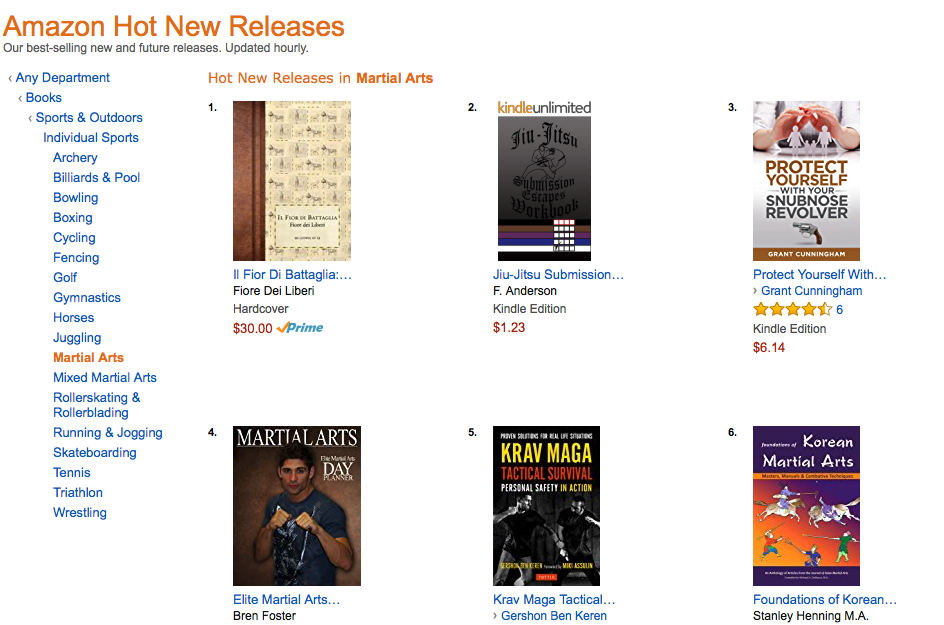
Then it hit me that I really better do Il Fior di Battaglia first. That's a way more popular manuscript, and sales of it could very well subsidize producing Vadi… four weeks later, my facsimile of Fiore dei Liberi’s magisterial Il Fior di Battaglia is #1 in fencing on Amazon (where he assuredly belongs!) as well as #1 in “hot new releases” in martial arts!

The notion of a 600 year old book being a “hot new release” is gloriously ironic, but there you have it. The only modern text in the book is a note in the back saying where the manuscript is, and some details about it. I wanted to keep myself out of these books as far as possible; I mention my Mastering the Art of Arms books, of course, but also Bob Charrette's ArmizareTom Leoni's translation of the text, and some other resources, on the grounds that most readers of the book will be interested. But this is Fiore's book, not mine. It is his manuscript, laid out, but not edited, translated or commented on. It's just its own pure gorgeous self.


Our spiffy logo

And now Vadi is laid out, uploaded to the printers, and I'm eagerly awaiting the proof copy.

The ease and sheer pleasure of producing these facsimiles has lead me to create a new imprint, Spada Press, which even has its own (very basic, don’t go there! ok, you can if you want, but I warned you) website up at www.spada.press  I expect I’ll shift all my book publishing over to that imprint, to help keep the various aspects of my work separate. Expect facsimiles of Meyer (the 1560 ms), at least one other Fiore ms, Marozzo, Fabris, and hopefully Capoferro, in the near future. I welcome requests!

On the subject of books: I have been delighted by the way my beta-readers have been responding to the first draft of The Theory and Practice of Historical European Martial Arts, which I released a 100 copies of recently. While they like the book, they have also made some really useful suggestions for improvement. I hope to get the book finished within the next four months or so. Also, the second edition of Veni Vadi Vici went to the editor at the end of last week— I have completely rewritten the book, reorganised it, and added a ton of material to the introduction. It’s probably 8 months or so from being published, but this was a major milestone in its production, and it is a much, much better book. Veni Vadi Vici was my first self-published book, and it really shows. The second edition has benefitted greatly from the constructive criticism of many readers, and the expert help of friends and colleagues. I hope it does them justice. I will be sending out ebook copies of the finished book to everyone who backed the crowdfunding campaign, and to everyone I can reach who has bought the well-meaning but flawed Veni Vadi Vici since it launched.

I would say that was a cracking start to 2017, wouldn't you?

In November 1967, De Arte Gladiatoria was sold to the Biblioteca Nazionale di Roma. It lies there still. In the process of doing research for the second edition of Veni Vadi Vici (which should be out this year), I found the auction catalogue on ebay, and bought it. As you may know, I'm not one to keep my finds secret, so I have scanned in the relevant pages, and uploaded them here. This catalogue has the only published collation of the manuscript (the description of how it is bound together), as well as some fascinating extra details. I didn't include scans of the plates reproduced in the catalogue, as much better images are available online from wiktenauer.com.

If you happen to want other pages from this catalogue, let me know and I'll scan them for you.

Sothebys Vadi 1967

I will be releasing the corrected translation for free online, as before, and all of the original backers of the campaign will get ebook copies of the second edition sent to them for free.

Rapier Length: responding to criticism from the internet

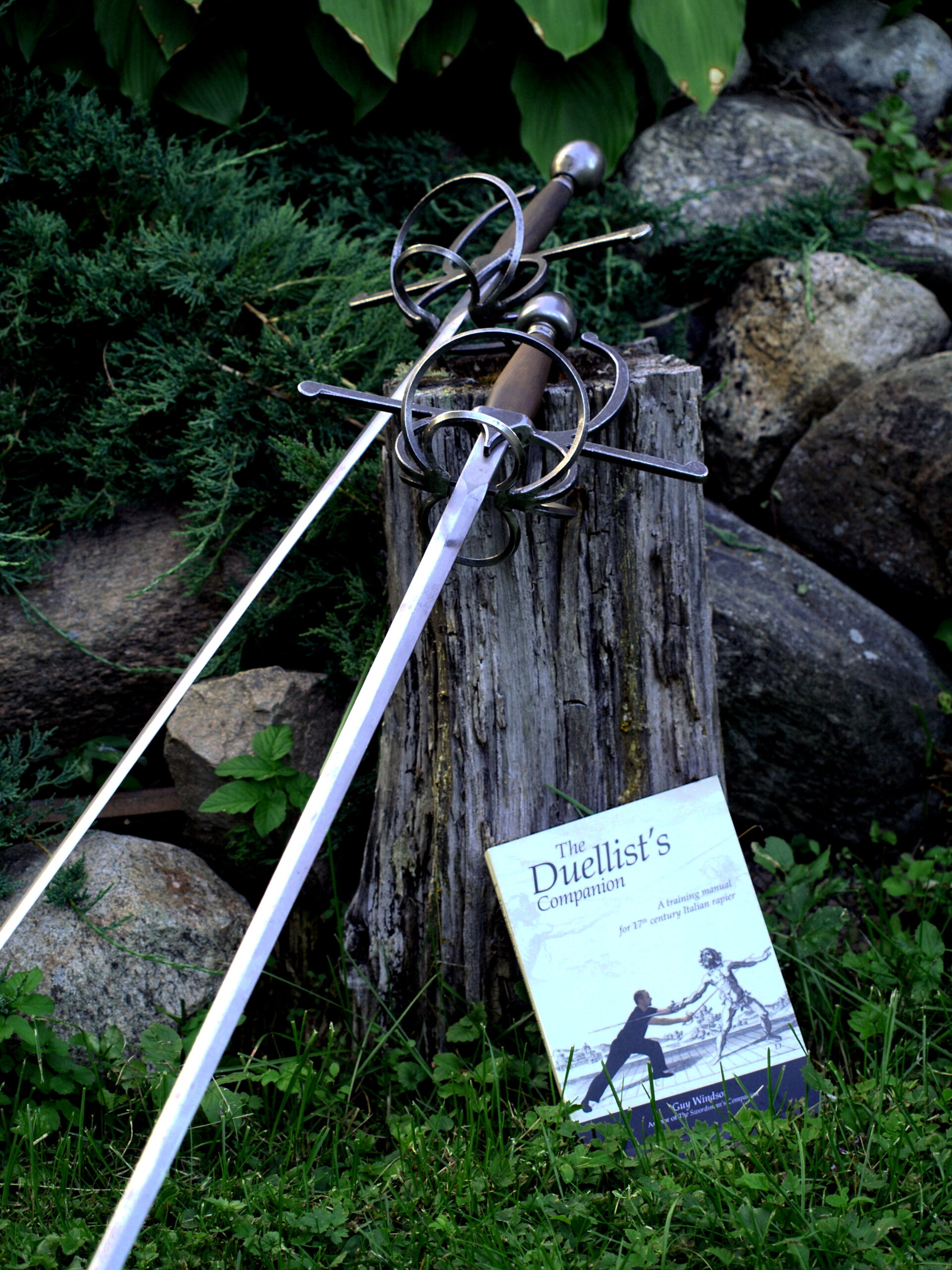
Rapier length. Guy Windsor's book The Duellist's Companion with two rapiers.
Image courtesy of Elisa Hyvärinen

As you may know, I am in the process of videoing everything we do in the salle, and putting it up online for free. This project is called the “Syllabus Wiki“. One of the many benefits of this is that informed commentators can see what we are doing and make constructive criticisms, which leads to improvement in our interpretations and methods. Not all criticism is well-meant, or well-written, but I do my best to stick to the facts, and ignore any agenda the critic may have. The truth of the Art should outweigh any other factor.

We have been putting a lot of Capoferro rapier material up lately; we have recently uploaded the last of the plays of the sword alone, shown on Plate 20. Bear in mind that these videos are intended to show a co-operative, choreographical rendition of the contents of the plate; they do not go into hard and fast applications of the lessons of the plates, or show anything against a non-compliant opponent.

One anonymous blogger, who goes by “Grauenwolf”, has recently taken issue with quite a few of our videos, and in some cases he has a point. [There is actually quite a lot of interesting material on his blog, which has been going since 2008.] I would find the criticisms more useful if they were accompanied by video examples of Grauenwolf himself doing the same actions his way, but at least he is quoting from the sources, and seems to truly care about historical accuracy.

One such critique is here, regarding rapier length, in which he states his opinion that we are using blades that are much too short. He doesn’t actually tell us how long our blades should be, but does quote from Capoferro’s passage (using Wilson and Swanger’s translation without attribution):

“Therefore the sword has to be twice as long as the arm, and as much as my extraordinary pace, which length corresponds equally to that which is from my armpit down to the sole of my foot.”

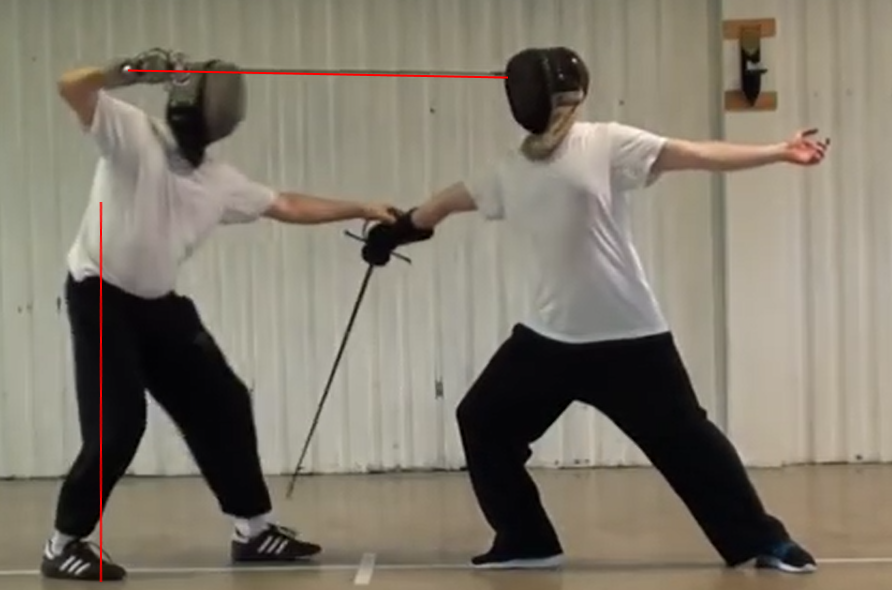
He includes this screenshot from our video (again without attribution, but at least in this case anyone who checks the video link will find out whose video it is), with lines added to indicate his point of disagreement (if only all disagreements were so clearly stated!).

Rapier length: screencap from Plate 20 showing lengths

As you can see, Henry's sword is clearly shorter than the distance from his armpit to the floor. But the passage is not quite as straightforward as all that. The arm is presumably measured from the armpit; but to the wrist, or the fingertips? The “extraordinary pace” is measured from where to where?

The only apparently simple measurement is from armpit to the sole of the foot, presumably while standing (and incidentally is the same length of sword that Vadi recommends). The problem is that it would make for a sword that is much longer than most surviving examples, and much longer than the ones that are apparently illustrated. I have addressed the problem of rapier length in print twice before, in The Duellist’s Companion, and in Choosing a Sword. To quote from the latter:

In my opinion, Capoferro’s system works best with a sword that weighs between 1kg and 1.6kg (2.0—3.5 lb), with the point of balance between 6 and 15 cm (2.5—6 inches) in front of the crossguard, a complex hilt that allows you to put your forefinger over the crossguard safely, and a blade length from crossguard to point of at least 97 cm (38”) (for short people), up to a maximum of about 114 cm (45”).
Capoferro himself tells us, in Chapter III: The Division of Fencing That is Posed in the Knowledge of the Sword, section 36:
“Therefore the sword has to be twice as long as the arm, and as much as my extraordinary pace, which length corresponds equally to that which is from my armpit down to the sole of my foot.” (Translation by William Wilson and Jherek Swanger).
I have never met anyone for whom those three measurements were the same, and in my The Duellist's Companion I worked them out like so:
“My arm is 52 cm, shoulder to wrist; my lunge about 120 cm from heel to heel, and it is about 140 cm from my foot to my armpit when standing. When standing on guard, it is about 115cm from foot to armpit. When in the lunge, it is about 104 cm from foot to armpit. Also, it is not clear whether he refers to the length of the blade, or of the whole sword.
If we resort to the unreliable practice of measuring the illustrations, in the picture of the lunge, the sword blade is 73 mm, the arm from wrist to armpit 37 mm, and the line G (front heel to front armpit) 55 mm. The distance between the feet is 67 mm.
So, the measurement most consistent with the text would appear to be the length of the arm, from wrist to armpit, as it approximately correlates to half the length of the blade.
 Given this as a guide, my blade ought to be 104 cm or about 41” long from the guard to the point.”

So there are three critical measurements:

  1. the length of the arm
  2. the length of the “extraordinary pace”
  3. the length from the armpit to the sole of the foot.

Henry, the chap in the illustration, has the following measurements:

  • Arm from armpit to wrist: 49cm. From armpit to fingertip, 66cm.
  • In guard, armpit to sole of the foot: 122cm; standing, 150cm.
  • His lunge is 100cm heel to heel, and 130cm from the back heel to the front toes.
  • His sword has a blade length of 107cm (a touch over 42”), and a total length of 122cm.

For what it's worth, modern manufacturers of rapier blades tend to offer them between 40 and 45″ (102cm- 114cm); a 150cm rapier would have a blade of about 135cm, or 53″.

So, given these measurements, I would be very interested to hear how long Henry’s sword should be, based on Grauenwolf's interpretation. I would also like to know Grauenwolf’s measurements, and the length of his sword, and see how he has solved the knotty problem of reconciling three quite different measurements.

[“Grauenwolf” goes on to criticise the way we beat the sword, apparently completely oblivious to the fact that Janne is co-operating in a way that the combatants illustrated in Gran Simulacro are not, and also oblivious to the purpose of the video. But that’s a whole other story. At least our videos are doing what they are intended to do: making it easier for people to get to grips with the source material; in this case, providing the impetus for a whole list of blog posts. Sure, I’d rather they were a bit more constructive, but anything that gets the sources talked about has to be a good thing.]

I have a strict policy on the internet: I never link to bad things. In other words, if somebody has annoyed or disgusted me, I don't reward them with traffic. So you might wonder why I am sending traffic Grauenwolf's way. Simply, it's because

a) I'm not annoyed or disgusted; if nobody ever disagreed with me, I'd never learn anything;

b) his blog has a lot of good and interesting stuff on it;

c) while I obviously don't agree with him on this point, and think he could be better at attributing his sources, I think his critique is an attempt to serve the Art, not to advance a personal agenda, and

d) I really do want to know how he solves the problem of the three incompatible measurements.

We have an entirely different issue regarding longsword length. You can find that discussion here.

How to hold the sword is another matter too. You can find that discussion here.

Search

Recent Posts

Categories

Categories

Tags