Guy's Blog

Guy frequently keeps this blog updated with thoughts, challenges, interviews and more!

Tag: Mechanics

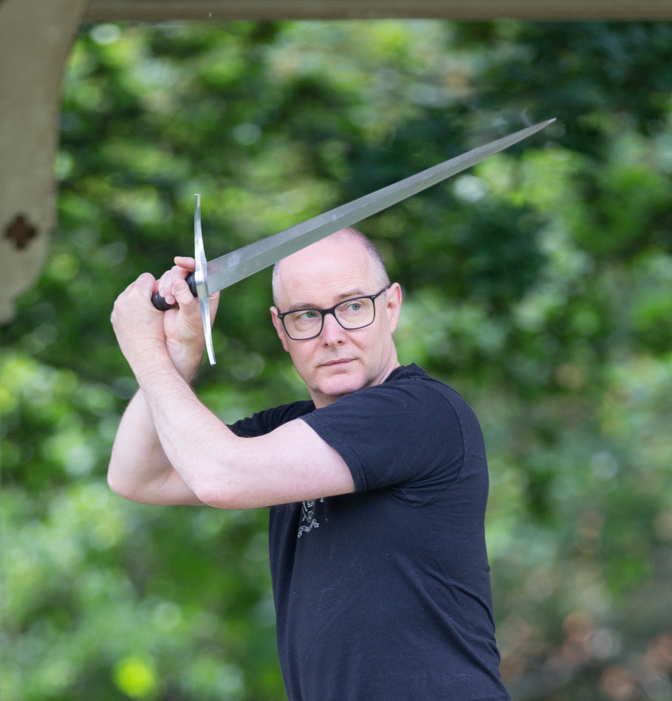
Guy holding a sharp longsword with decent mechanics

I'm teaching a seminar here in Suffolk for my friends at Suffolk HEMA on Saturday October 18th. If you'd like to learn to move better, and to analyse any guard position or movement from a structural perspective, you should come!

Move Like Fiore

Improve your structure, flow, and control in Fiore’s art of arms
Good movement is the foundation of great fencing. It keeps you safe from injury, helps you control your level of force, protects your training partners, and lets you fight harder and longer without fatigue.
In this full-day seminar, you’ll develop practical skills to make your fencing smoother, stronger, and more efficient. Together we will cover:
1. Analysing and improving the structural qualities of Fiore’s guard positions
2. Refining transitions between the guards
3. Different ways to hold the sword for specific purposes
4. Centres of rotation and how they affect different plays
5. How to strike with speed, power, and control
6. Applying these mechanics to wrestling, dagger, and longsword plays

Event Details

When: Saturday, October 18 · 11am–5pm (with a lunch break)
Where: The Coddenham Centre, Mary Day Cl, Coddenham, Ipswich IP6 9PS
Cost: £50
Bring: Longsword, fencing mask, dagger (if you have one), water, lunch. Freeplay kit is optional, but bring it if you like.
Sign up with this paypal link.
I would highly recommend having a look at my free Fundamentals: Body Mechanics course to prepare (or in case you can't make it over here from New Zealand). It will familiarise you with my approach, and the more people who know the basics of this method, the more stuff we'll be able to cover on the day.

Medieval scribes had crap posture too!

medieval scribe writing with bad posture

Image from: http://www.booktryst.com/2012/03/medieval-scribes-gripe-about-writing.html

One of the challenges of my new lifestyle is that I don’t have class three or four times a week to keep me to a fitness regime. Before I could make the switch in my head from swordsman-writer to writer-swordsman, I had to figure out how I was going to prevent myself from becoming a weak and overweight lush who was always drunk by lunchtime. Because that’s what writers are like, no?

*Guy ducks and runs away from the many, many, uber-fit sword-swinging writers he knows*

Well, maybe not all writers, but I certainly have the capacity for it.

You may have read about my morning routines for beating jet-lag. I have developed and adapted those for preventing a condition that I will christen “writer’s blimp”. The trick, the key insight, is that this is about developing the sort of habits that will lead to my desired result, rather than coming up with a prescriptive regime. This routine has four steps:

1. Meditation

When I wake up in the morning, I usually go straight into an awareness-of-breathing or mindfulness meditation (guided or otherwise). This lasts from 5-20 minutes, depending on all sorts of things, not least the time. Ideally, I wake up naturally an hour or so before my kids do, which does actually happen about once a week. But one of the greatest privileges of my self-employed (and parental) status is that I almost never have to set a morning alarm. So I don’t set an alarm to be up in time to meditate before breakfast, because if I don’t have time to do it before the kids go to school, it’s #1 on my todo list after the house has quieted down.

2. Breathing

Then I usually do three rounds of Wim Hof breathing; if I’m too late to meditate before the kids come in, then I do this anyway. In the second round, while my lungs are empty, I get up and do some squats and push-ups. Then after breathing in, I do some gentle stretches, push-ups, that sort of thing, guided by how my body feels. Or I might do some of my classic breathing exercises. You know, like the ones in this book.

3. Engage with strength

I usually then do a couple of clean-and-presses on each arm with a 16kg kettlebell, some squats with a 16kg kettlebell cleaned in each hand, followed by a couple of double overhead presses with the 16kg bells, followed by some clean and presses with a 24kg kettlebell. Maybe some Turkish Get-Ups if I’m feeling energetic. This takes about 5 minutes, and engages just about every muscle in the body. If there’s time and I feel like it, I go for longer and do more.

4. Cold Shock

Shower next; for a long time I used to have a hot shower, then finish cold. Then I went to cold-hot-cold, again for several months, maybe a year or more; I didn't really track it. Now I treat hot water as a delicious luxury for when I really feel like it, and so usually shower on full cold only. It is very invigorating.

5. Paying attention to food

I always sit down for breakfast with the kids, but I don’t usually eat anything. If I’m hungry, I’ll eat some protein and fat (such as half a tin of sardines and a tomato); I try to avoid any starches or fast carbs first thing. (But oh! Peanut butter and banana on toast with brown sugar sprinkled on! Pancakes with bacon and maple syrup! Nutella with anything! I do miss them all, so they are weekend-only fare.) I almost always have a cup of coffee, and sometimes make it “bulletproof”: a chunk of organic butter, a dash of MCT oil, and whizz it with a hand-blender. It doesn’t taste very nice, if I’m honest (if you take milk in your coffee you’d probably like it more), but it does seem to delay the need to eat lunch, and it may help a bit with mental sharpness. I'm considering changing the pattern to eating in the morning, but last-calorie-in by 6pm, to give me the necessary metabolic cleansing time. Dr Rhonda Patrick suggests 14 hours as a useful minimum in this handy podcast. Dig into that if you want the details (and yes, she's a proper scientist). I have noticed that having an earlier eating window makes jet-lag recovery much faster.

When I settle down to work, it often means doing my 20 minutes or so of meditation, and sometimes some exercise (breathing exercises, kettlebells, that sort of thing) first. My feeling is that I need to maintain a solid baseline of fitness, strength, and agility, so that my body doesn’t deteriorate, and I can still do all the things I want to do (like beat the crap out of people with a sword practice swordsmanship to a high level).

Then I start writing. If I’m working on the first draft of a new book (as I am right now), then I hit my word count, and either keep going, or stop and do something else (edit a different book; do some marketing; write a blog post; empty my inbox). I don’t usually even open my inbox before hitting my word count. I also almost always have my phone on silent*, and check it when I’ve done what I need to do. This period of maximum productivity lasts for about one to four hours from about 08.30.

Ergonomics are really important; this is why I only usually work at home in my carefully set-up study.

I’m done working by lunch, which is always very short on fast carbs of any kind, but long on vegetables. The kids get home from school between 12.30 and 2.30, depending on the day, and I try to avoid being buried in my laptop when they’re here. Of course, these days they often don’t want their old man messing up their very important games, so I might do some work or reading in the afternoons, but it’s not guaranteed.

By 6pm, right when I would have normally been starting a class, I’m free! To cook dinner for the kids, for example, have a glass of wine with my wife, for another example. The day usually ends with my wife and I watching something on TV before bed, and it’s usually sufficiently easy watching that I can get of the sofa and do twenty minutes or so of stretching while we watch it. Assuming I’ve been careful with starch and sugar all day, then I’ll usually eat whatever I want in the evening.  [I think I need to do a proper blog post on diet and weight control. Hmmm. Ok, done.]

So, in a day when I don’t set aside any real time for training, I’ve meditated, done some breathing exercises, done probably 20-50 push-ups, 10-20 pull-ups (there's a pull-up bar in my office; every time I go get a cup of tea, go to the loo, or am procrastinating, I'll do a couple), 5 minutes of kettlebells, and 20-30 minutes of stretching, and watched what I ate. Any part of this can be expanded without having to create a new habit. In other words, if I feel that my flexibility is suffering, I can extend my evening stretches, and add more range of motion stuff in the morning, without having to suddenly find time to stretch. The time is already assigned. If  I think I’m getting weaker, I can add a minute or two to the kettlebell part. For example, I went to the physiotherapist yesterday because my always-dodgy spine started acting up; I've now got some totally specific corrective exercises to do regularly throughout the day… no problem; they are slotted in in place of the pull-ups. If you are interested in the specific exercises I use to keep my arms from going into tendonitis spasm, see my free course on arm maintenance, and my free course on looking after your legs, both included in my free Human Maintenance course.

I am blessed with a metabolism that puts on weight very easily if I don’t watch what  I eat, a spine that produces agonising spasms if I don’t exercise it regularly, and pathetic little wrists that will swell up with tendonitis if I neglect my forearm maintenance for even a few days. This means that I am obliged to keep reasonably fit, or it all goes to hell very fast. It also means that I have had to learn how to do so, or I break. In this case, inherent weakness really has been a virtue.

So, that’s what I’m doing to remain a martial artist while becoming a full-time writer. What do you do?

*Here is a list of the things I might be doing that a phone-call might interrupt. In no particular order: writing something you might want to read one day if I ever get round to finishing it what with all these interruptions; editing video; training; breathing exercises; meditating; eating; playing with my kids; sleeping; bathroom stuff; thinking; writing up my notes; lying on the sofa doing nothing; watching a movie; sharpening a pencil; doing woodwork; cooking; talking to my wife; planning stuff; and that's me just getting started on this list. So, really, why would I want to answer the phone? The chances of it being either really time-critical, or something I really want to hear, are pretty small. Most of my phone calls are scheduled in advance by email, so I know not to be doing something else when the phone rings. Wife, kids, parents, siblings and very close friends get a pass. Everyone else? make an appointment 🙂

One of my favourite internet distractions is seeing how other writers (proper writers. Professional writers. Oh wait, that's me too!) set up their work space. The fallacy, of course, is the underlying idea that if I just use the same tools, I’ll get the same results. This is not so. It is well to remember that for most of recorded history, writers used feathers and bits of skin. So George R.R. Martin’s famous use of WordStar 4.0, or Iain Broome's minimal approach, or whatever, are clearly helpful but not necessary for good writing. Nice to have, sure, but not having the latest kit (or the oldest, depending on your preferences) is no excuse. There are lots of writers who seem to manage with just a laptop in a coffee shop, but I just don't find that conducive to good work myself. I like my books around me, and a very quiet environment. So what do I use?
My writing set-up is fantastic. Really, I’ve put a lot of time and effort into it, much of which should probably have gone on actually writing. The set-up is subordinate to the process, of course, so here’s the process first:
I either write directly in Scrivener (recommended to me by Neal Stephenson, whose name be praised ‘cos this program works!), or more commonly, I write up notes (after class, for instance) in a hard-back notebook, with a proper ink pen, and usually on a writing slope that I cobbled together when editing Veni Vadi Vici. Then I take a photo of the notes with my smartphone (Samsung Galaxy s2, bought in September 2012, a few months after the s3 came out, so really cheap for what it can do), which uploads the pics directly to Dropbox (which is a totally life-saving service. Automatic backing up and syncing across devices; literally everything I'm working on, and all my most commonly-used reference sources are stored there). So when I get home to my study (oh bliss, I have an actual study. A room for reading and writing only. Luxury times ten) my notes are there on the computer (a mid-2010 21.5” iMac). I can then write stuff up, with Scrivener on the right, and the notes on the left of the screen.
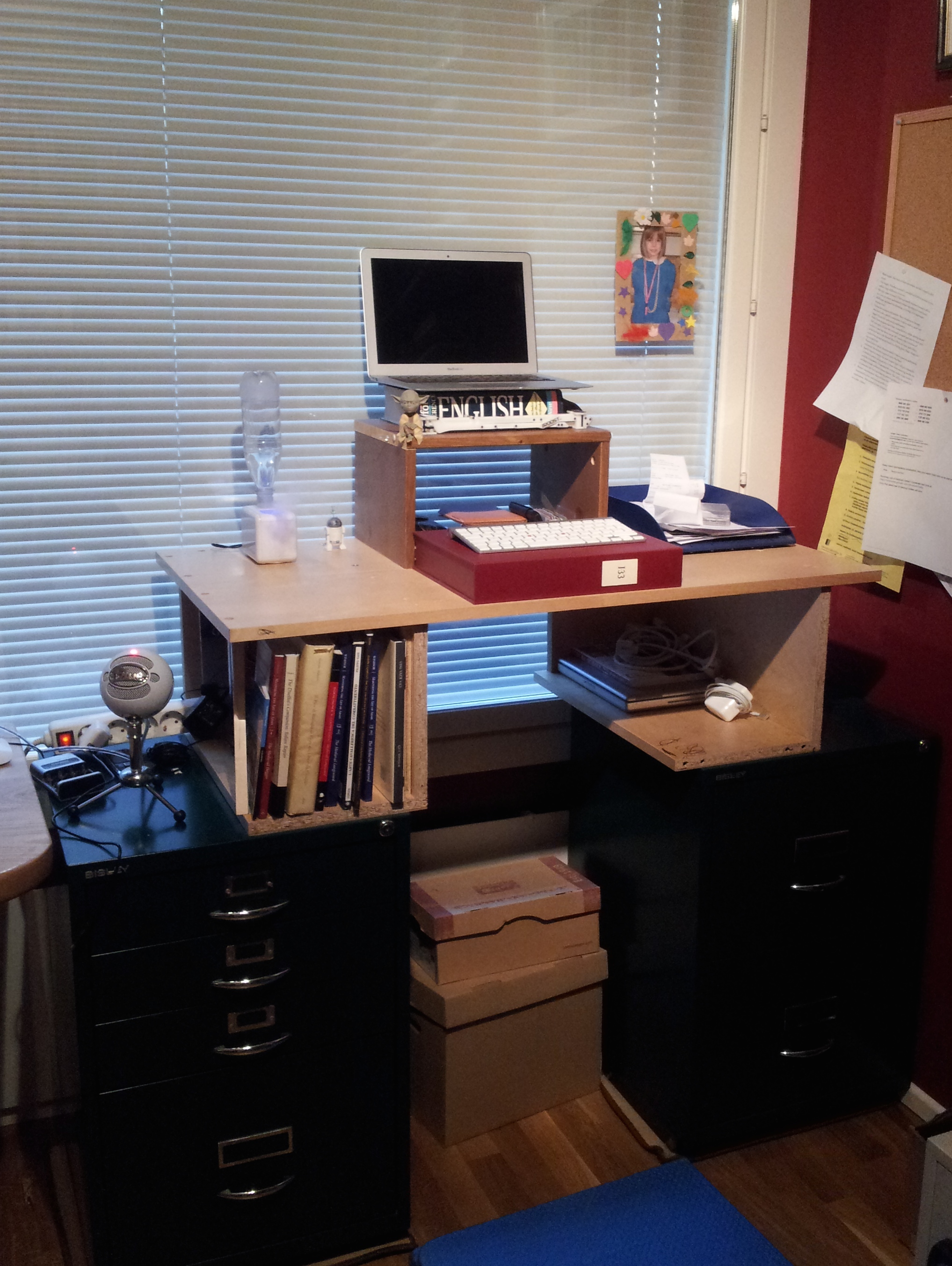
This is all made MUCH easier by being able to touch-type, which I learned thanks to a gentle teasing from M. Harold Page. This was so incredibly frustrating that I had to cobble together a standing desk (another of Neal's tips) so I could squirm from foot to foot while forcing my rebellious fingers to find the right keys. I literally disassembled and nailed together an IKEA bookshelf, and stood it on a couple of filing cabinets: yes, I really should make a prettier one; but dammit, I have books to write! During this process of learning to type, before I had much time invested in Qwerty, I switched to the Dvorak keyboard layout, and here’s why:

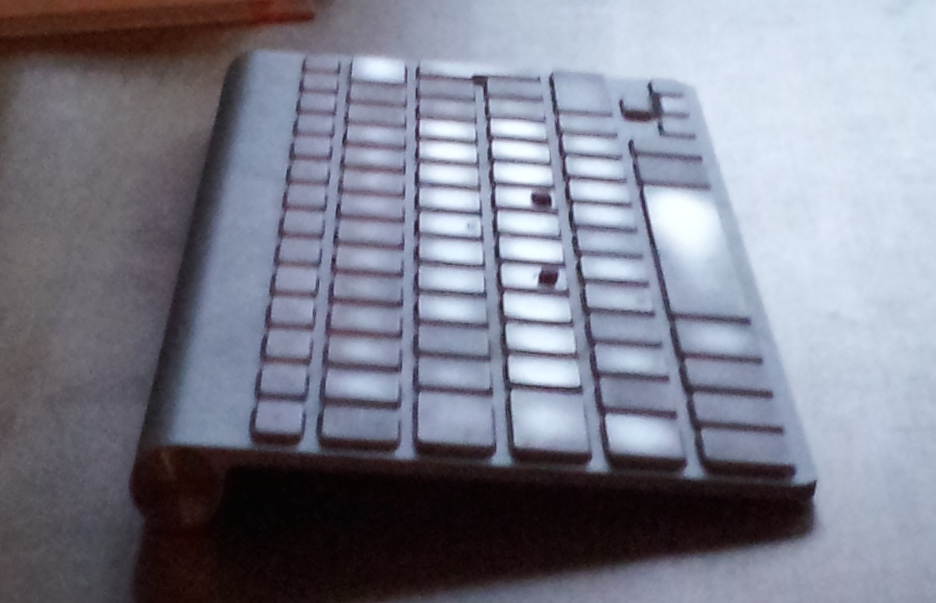
DvorakKeyboard
See the pattern of wear? Almost all on the home row, with some on the top row, and a little on the bottom? Proof if ever you needed it that Dvorak is way more efficient. (I was passing the study door one evening and noticed the light hit the keyboard, pulled out the phone at snapped a shot. Damn, having a decent camera in my pocket changes things.) I actually hacked up a Dvorak layout keyboard from a second Apple keyboard, because every now and then I need to see the keys, still. Especially for passwords and such. I hanker after but cannot yet justify one of these ergonomic beauties (in the Qwerty/Dvorak configuration, of course!).
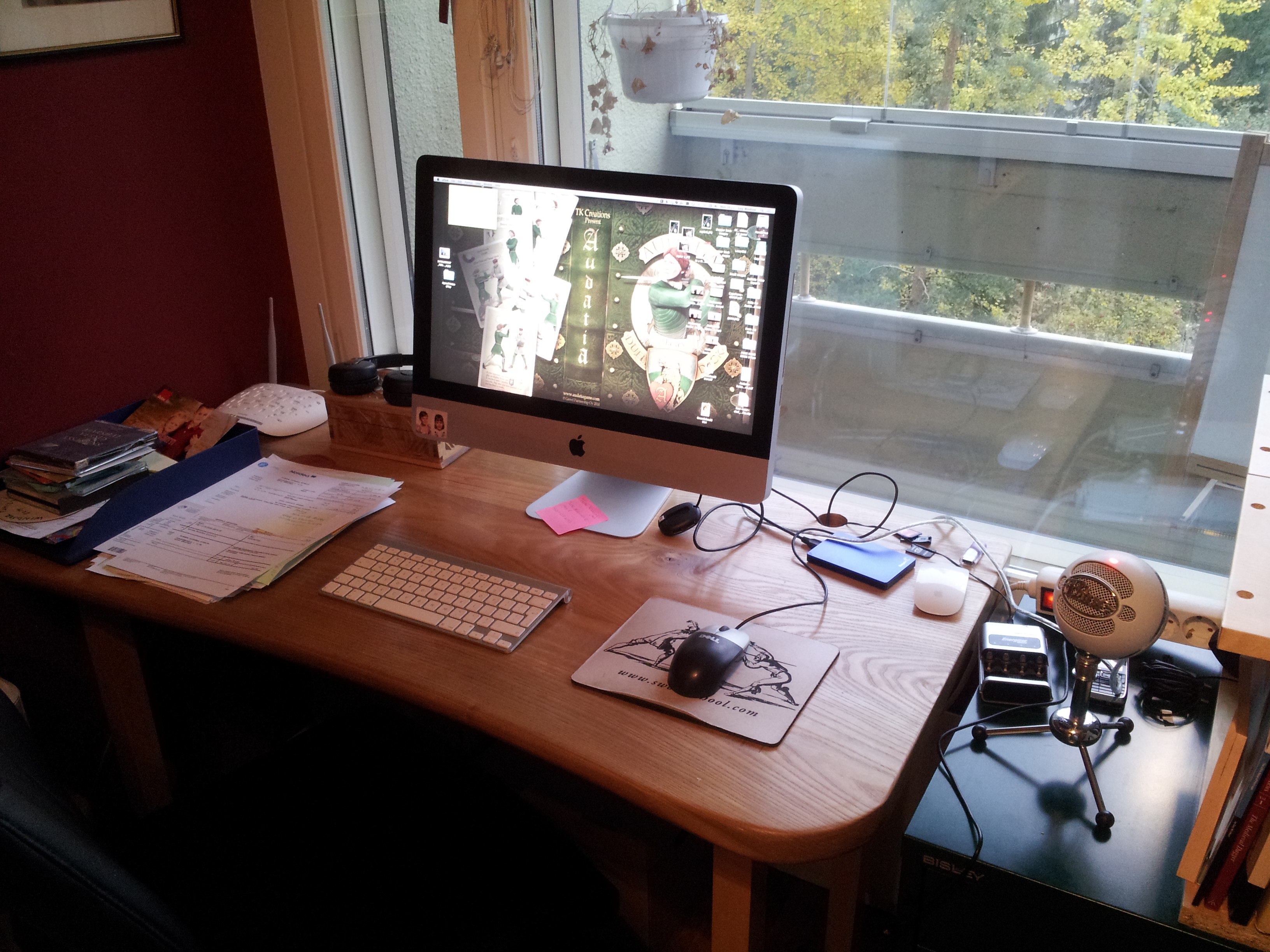
I made the normal desk back in 2008, as a way of delaying writing The Medieval Longsword; these days the iMac sits on it, for times when I don’t feel like standing, or need the bigger screen. My wife also uses the iMac, and doesn’t care to work standing up, so there it is.

desk

Now that my books are actually bringing in real income, I spent some of it on a Macbook Air, 13 inches of rocket ship. It’s fab. I can put it anywhere, such as here on the standing desk,

standingdesk

and I usually use a separate keyboard, not least for ergonomic reasons. I can support the laptop at a convenient height (this desk was made for the iMac, hence the dictionary under the laptop to bring the screen up), leaving my hands where they should be. I also stand on a pilates mat (one of my wife's), which helps a lot with lower back pain, and leg fatigue. The mat brought me up enough that I took the leftover solander box from my Extraordinary Edition of I.33 and used it to bring up the keyboard to exactly the right height. (If you're into ergonomics, you might enjoy this book on the perils of sitting: Kelly Starrett's Deskbound.)

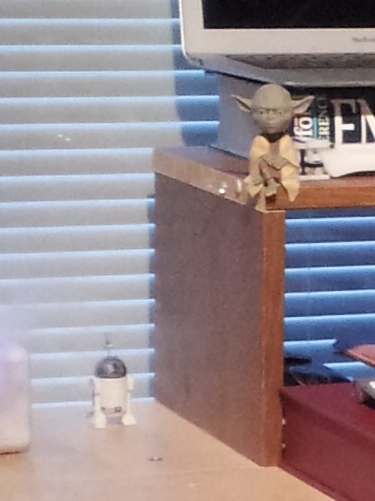
You may note that R2D2 and Yoda are both there, one for scolding, the other for sage advice, whenever I slack off or get stuck.

Yoda and R2

Note also the humidifier (the upside-down bottle on the left); it makes a big difference to long-term comfort when working, because Finnish houses are properly insulated and heated, and thus dry out during the winter. The baseball on a stick is a Blue Snowball mike for doing voiceovers on videos.
I was given a Roost stand for my birthday last year, by my friend Tina, which allows me to do this funky trick:

The Roost
This is great for writing when on the move, or in the kitchen. The kitchen has a great view, and the best light, and sometimes a change of environment can unstick the stuck. The ergonomic benefits are huge, and really capitalise on my hard-won ability to not look at my hands when I type.
I also use my writing slave (no, not a typist, I wish!); this is a specialised bookshelf, with a slope for the current tome, and canted shelves so you can read the spines from next to it (so you don’t have to move out of position to find the right book).
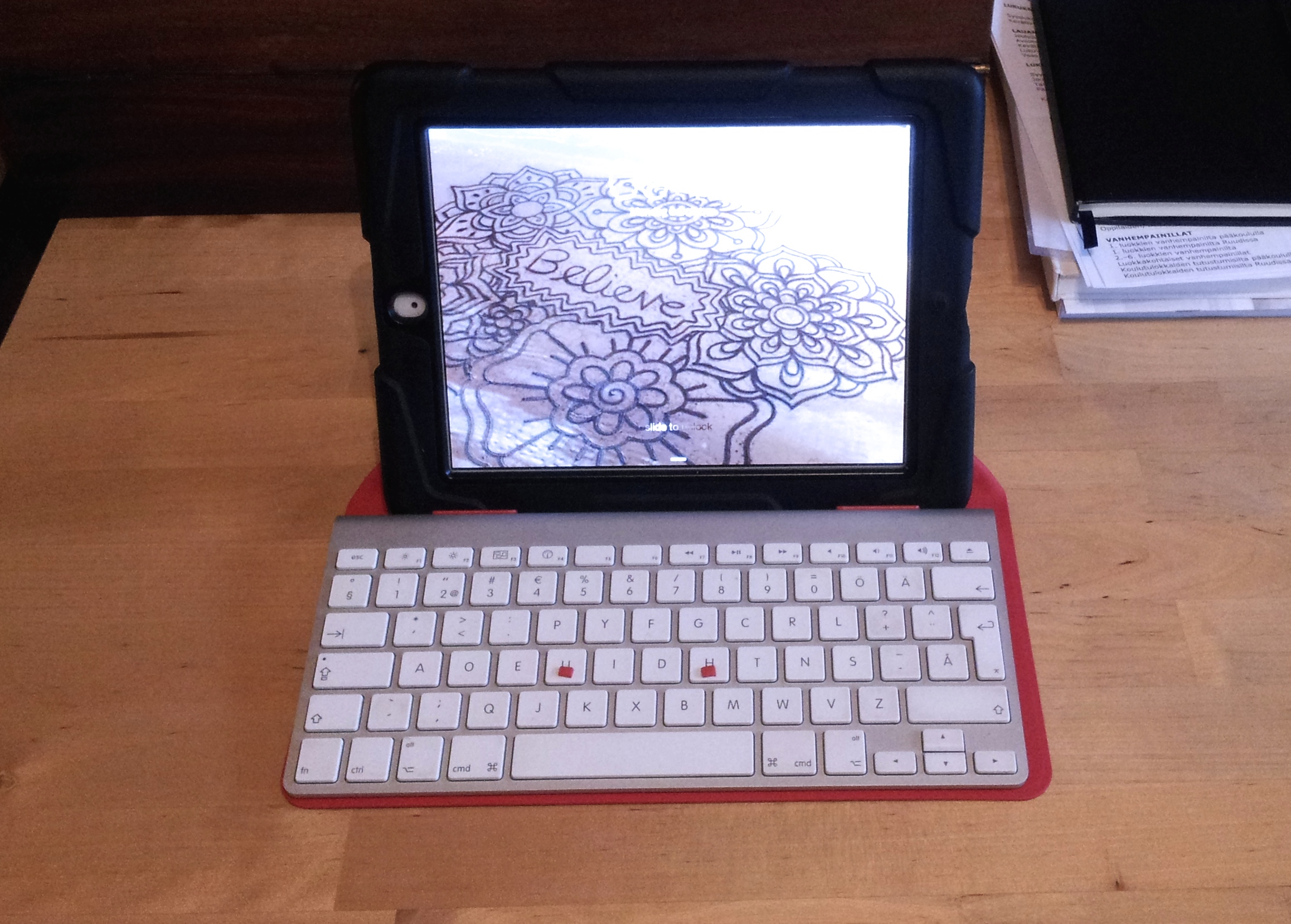
The iPad 2 (from 2011) was a birthday present from my parents, and is really, really useful. It acts as a second screen when writing, especially for a primary source that I’m referring to, but most importantly, during the dreaded editing process, I export a pdf of the current draft from Scrivener, and edit it on the iPad making notes and corrections in PDF Expert using a stylus, which I can then apply to the draft. It is an efficient way to minimise the number of printed drafts I need to do. If I’m going to write much on it, I use the Origami keyboard case and stand.

ipadandorigami

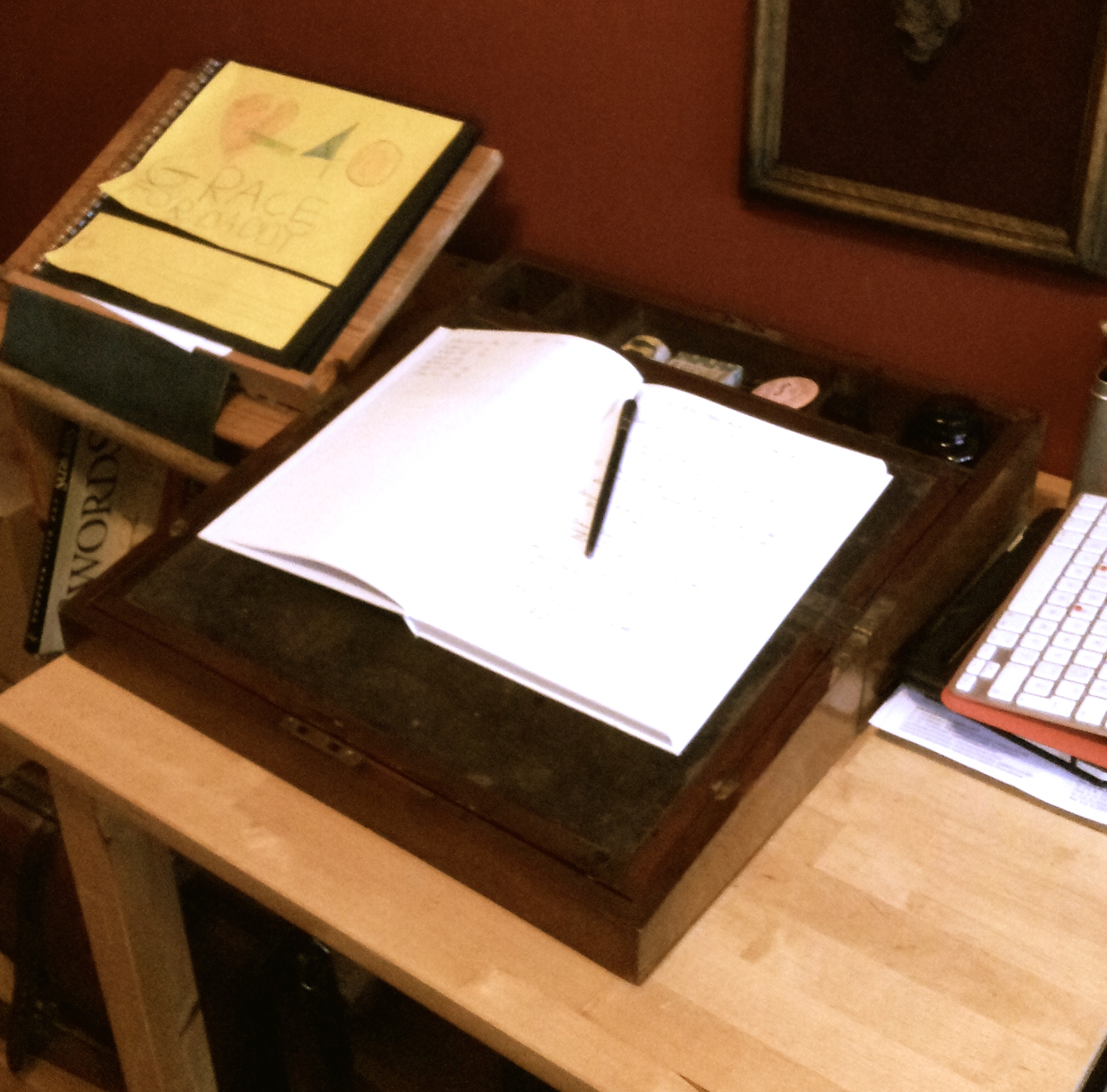
I have the iPad safely ensconced in a bulky military-grade case, from Griffin; I drop stuff way too much to risk shattering that delicate screen. When travelling, I will take the Air if I intend to do real work, or just the iPad for emails and so on. On the rare occasions I do write properly on it, I use Simplenote for syncing with Scrivener (there is no Scrivener app for the iPad; not yet at least), but more usually PlainText for writing and automatically syncing with Dropbox. We have come a long way from feathers and bits of skin; but at times when I feel like going old-school, I have a proper dip pen and an antique writing slope (bought for 25 quid on Ebay!), and a pen holder and nibs, which I use with Winsor brand (naturally!) Indian ink. And of course, I would dearly love to write with a quill on parchment. It's just better. One day…

Writing slope
Regarding layout; for writing that I am giving away free, I do it myself in Pages. For writing that I am selling, I pay my excellent designer, Bek Pickard of Zebedee Design. I trust the difference is obvious!

So, add this all together, and I think you’ll agree it’s a pretty sweet set-up, involving no less than three custom-made bits of furniture, two computers, two separate keyboards, and a tablet. The critical components are: for workflow: Pen and ink, Scrivener, Dropbox, PDF Expert, and my camera phone; for ergonomics: my standing desk, and the overall adjustability that comes from having movable screens and a separate keyboard.

Overall, I have a name for it: NO F*CKING EXCUSES.

So, what's your ideal set-up, and why?

The effects of Longsword Length

One of the mysteries surrounding German (i.e. Liechtenauer) and Italian (i.e. Fiore) unarmoured longsword combat (and I’m sure it keeps you awake at night too) is the different responses to a crossing at the middle of the sword (meza spada) in the two systems. At Fiore’s crossing of the swords in zogho stretto we see lots of entering with grips, pommel strikes and the like, whereas from the same starting point (swords crossed at the middles, some pressure in the contact, points threatening) Liechtenauer would have us wind, bind, or cut around (such as the twitch, zucken).

My theory (and is it only a theory) is that the systems are optimised for slightly different weapons. Longsword length matters. Fiore’s longsword appears to be a little shorter than that used in the German manuscripts. (If you don't have examples to hand, you can find them at the  excellent Wiktenauer.)

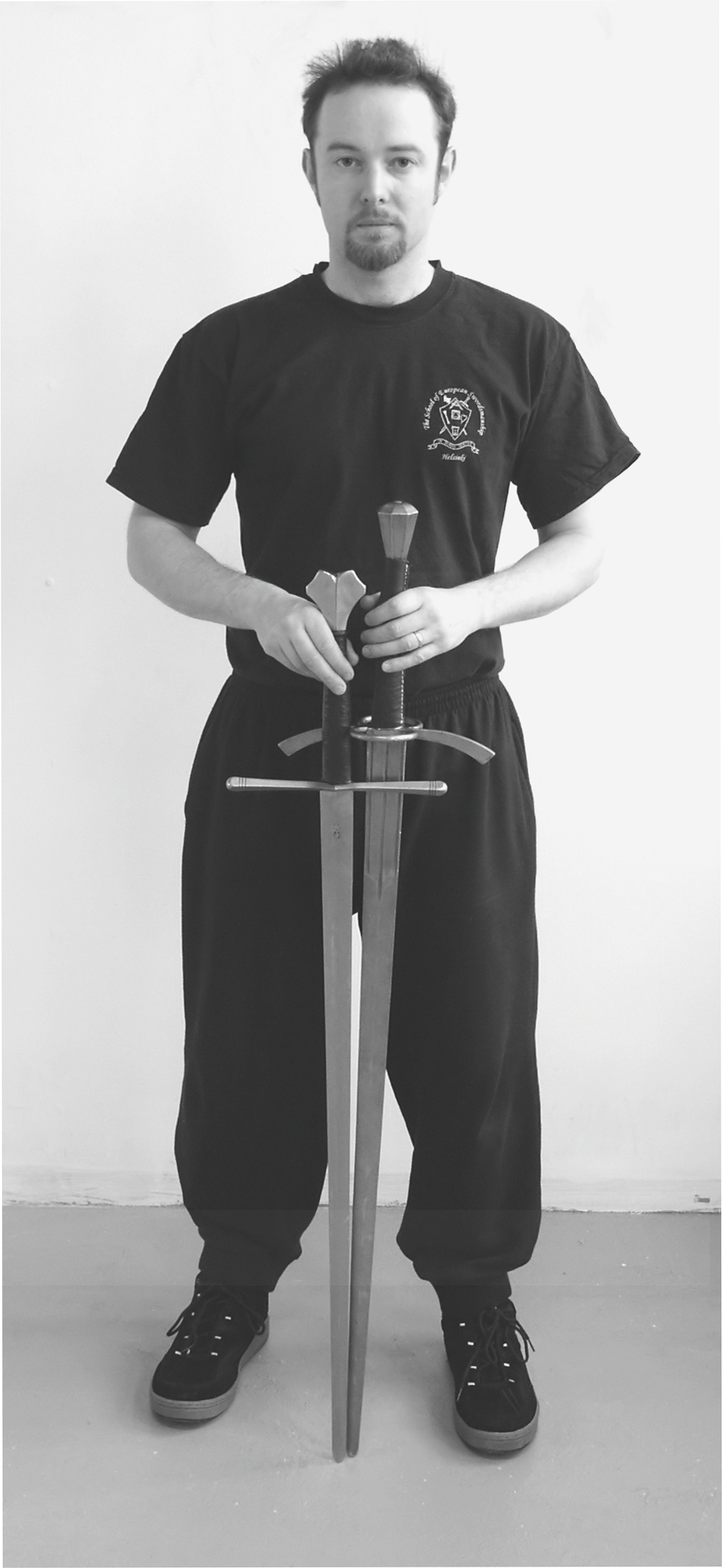
Guy Windsor with two longswords, showing different longsword length
This photo by Jari Pallari, from The Swordsman's Companion (2004) shows two common longsword lengths

It is is difficult to establish the size of the weapons from the illustrations in the manuals, but fortunately one Italian master, Filippo Vadi, explicitly determines the proportions of the sword in Chapter 2 of his De Arte Gladiatoria Dimicandi (Folio 4)

La spada vole avere iusta misura
Vole arivare el pomo sotto el brazio
Come qui apare nella mia scriptura.

The sword should be of the correct size,
The pommel should come under the arm
As it appears here in my writing.

(Translation here and below mine, from my The Art of Sword Fighting in Earnest)

Using Vadi's stated proportions, my sword should be 133cm (my floor-armpit measurement). If we measure the illustrations, we find that the longest sword (relative to the man holding it) is 1.31:1. I am 175cm tall: keeping this ratio, my sword should be 133.6cm long, and my floor-armpit measurement is 133cm. Pretty close: but this is the longest sword in the sample. In contrast, the swords in Fiore appear to be a bit shorter. (There is no hard evidence for this.)

In Vadi’s explanatory chapters on the art of the sword, he makes several references to techniques that re clearly Fiorean, but also many to techniques that appear to be very similar to Liechtenauer. For instance, he describes at length the way to play at the meza spada, and includes the following:

On folio 11V
Ragion de giocho de spada. Capitolo XI
Theory of Swordplay chapter XI

Qvando tu sei amezza spada gionto.
Facendo tu el diritto o voi el riverso.
Farai che piglie el verso.
Di quel chio dico poi che sei al ponto.

When you have arrived at the half sword,
Making a mandritto or roverso,
Be sure to grasp the sense
Of what I say, because it is to the point.

Si tuui steggie tien pur lochio pronto
Et fa la uista brive con coverta.
Et tien la spada erta.
Che sopra el capo tuo le braccie gioche.

When you feint keep a sharp eye out,
And make the feint short, with the cover,
And hold the sword up,
So your arms play above your head.

So when crossed at the meza spada, we leave the crossing to strike. Lifting your hands up at this point seems to indicate exactly the kind of winding action we see in the Liechtenauer material.
We can even feint on one side and strike on the other:

On folio 12V

Ragion de mezza spada.. C. XIII
Theory of the half-sword.

Essendo tu pur gionto ameza spada
Tu po bem piu et piu volte martelare
Da un sol lato trare
Da laltra parte le tue viste vada.

Having then arrived at the half sword,
You can well hammer more and more times,
Striking on only one side,
Your feints go on the other side.

The problem is of course that all this is being done in circumstances where as Fioreans, we would only enter because the leave the crossing would mean being immediately struck (the defining feature of zogho stretto). But here’s the thing: with the longer swords, the situation is different. The extra length, only a few inches at most, nonetheless changes the game completely.

To illustrate this I shot a short video with my student Ilpo Luhtala. The swords we used for the Fiorean crossing were an Arms and Armor Fechterspiele, at 123cm (48 1/2”) and a 117cm (46”) Pavel Moc Embleton (old version, the new ones are longer). We then switched to longer swords, about the right length for Vadi: a Peter Regenyi fechterspiele at 135cm (53”) and an Angus Trim sharp at 130cm (51”).

As you can see in the video, with the shorter swords, crossed at the meza spada in measure to strike without stepping, it is easy to enter in, and very dangerous to leave the crossing, even for an instant. The points are very close to our faces. With the slightly longer swords (about 10-12% longer), the game changes completely, and there is time to safely cut around, provided you make a small motion, a “turn of the wrist”:

El mzzo tempo est solo uno suoltare
De nodo: presto et subito alferrire
E raro po falire
Quando le fatto con bona mesura

The half tempo is just one turn
Of the wrist: quick and immediately striking,
It can rarely fail
When it is done in good measure.

And we must close the line and strike with a single motion, as Vadi demands:

De tucta larte questo sie el givello
Perche inun tracto el ferrissi et para
O quanto e coxa cara
A praticarlo con bona ragione
E facte portar de larte el gonfalone.

Of all the art this is the jewel,
Because in one go it strikes and parries.
Oh what a valuable thing,
To practice it according to the good principles,
It will let you carry the banner of the Art.

You can find the rest of the translation of Vadi, and a load of commentary etc. here.

Unfortunately Fiore doesn't say a word about the length of the sword, and neither does Liechtenauer. It's interesting to me that Vadi, an Italian writing about 80 years after Fiore, seems to be closer to the Liechtenauerian length.

Search

Recent Posts

Categories

Categories

Tags