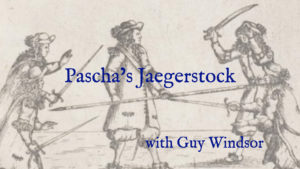
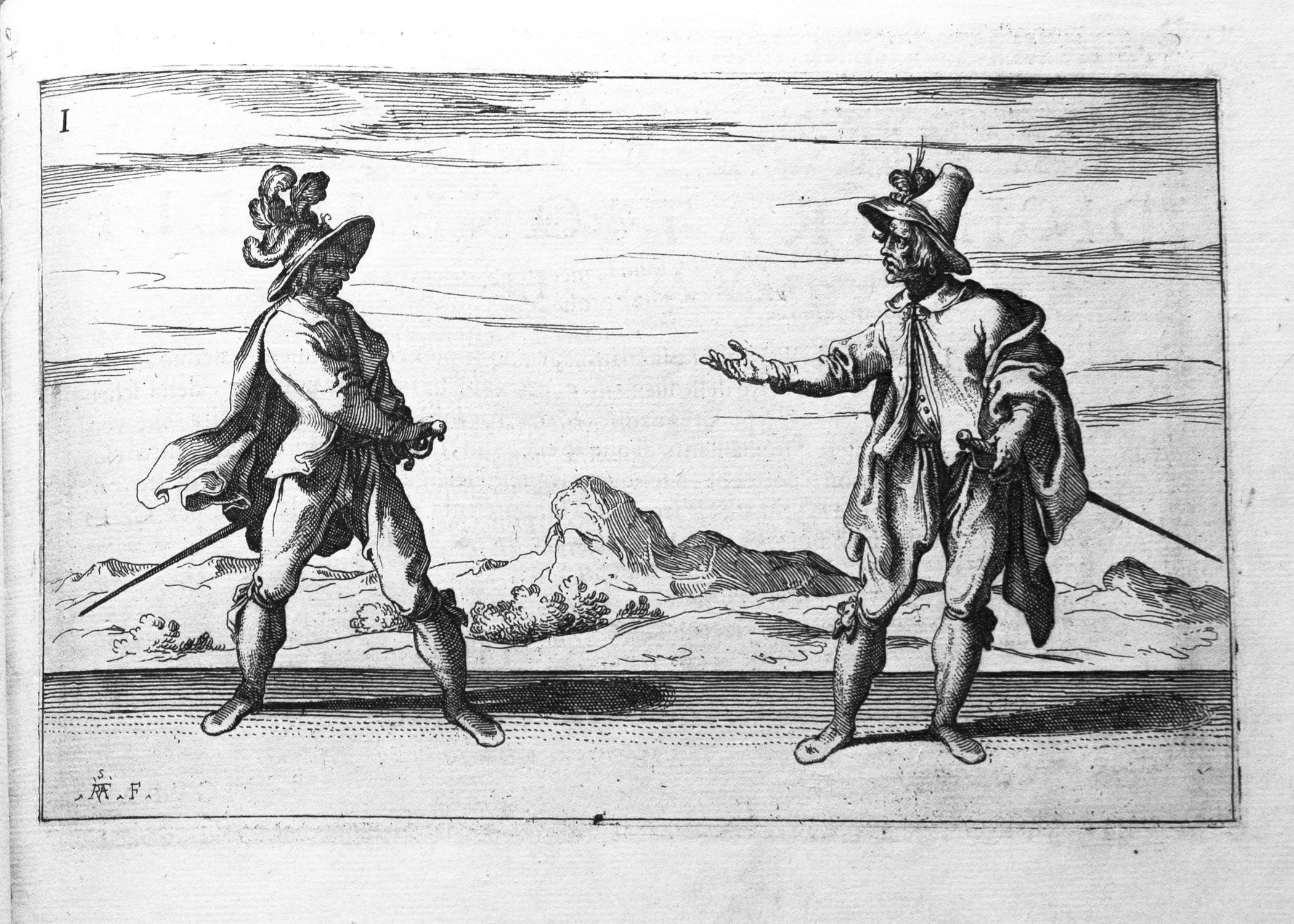
I recently interviewed Reinier van Noort for my podcast, and while we were talking he mentioned a documented set of solo forms for the Jaegerstock, a nine-foot long spear with a point at both ends. The source is Johann Georg Pascha’s book Kurtze ANLEIDUNG Wie der BASTON A DEUX BOUS, Das ist JAEGERSTOCK/ Halbe Pique oder Springe-stock Eigentlich zu gebrauchen und was vor Lectiones darauff seyn. This was originally printed in 1669, and is a translation of a French work. Reinier has published his translation (along with many more of Pascha’s works) in his book The Martial Arts of Johann Georg Pasha. I love solo training, and so promised in the show to figure out those solo forms and video them.
This turned into something of a project, including doing the research, making the weapon, figuring out the forms themselves, and so on. It struck me when I was starting out that it has been a long time since I approached a new source from scratch, and that it may be helpful to other scholars of historical martial arts to see how I get from the page to the physical action. It’s never just a question of read the whole book and then do all the actions- I always start with a small chunk of text and try it out. The process is iterative and cumulative, not linear.
I don’t intend to write this up in a formal way, but instead create a video log of the process, which will include asides, digressions, mistakes, ruminations, plenty of expletives, and eventually lead us to a working interpretation.
One note before we begin- there are several existing interpretations already out there, including Reinier’s own. In the normal run of things, if I was just trying to come up a working interpretation I would study those at the same time as creating my own- there is no sense in re-inventing the wheel. But because I want to illuminate my process of ab initio interpretation, I’m wilfully ignoring the existing ones. This is not best practice if other interpretations exist, but I’m doing it here to simulate the situation of being the first or only person working on a given text.
I’ve got half a dozen videos shot and edited already, so am planning to release them here on a weekly schedule. This gives you a chance to train along in real time, if you’d like to.
So, without further ado, here’s the first video:
This is part one of the Jaegerstock series. You can find the rest here as they are produced:
I have been beavering away on the Fiore Translation Project, and have completed the work on the Stretto plays. Hurrah! You can find them here: https://gumroad.com/l/ftp4
I am now working on bringing the four parts of this series together into a coherent whole, starting with the defences of the dagger against the sword, and ending with the conclusion to the Stretto plays. This covers the entirety of the longsword on foot out of armour. I hope to have that complete book in your hands before Christmas, but dashing off to Australia next week makes it something I'm not willing to promise!
It's true I'm a Fiore man through and through, at least when it comes to Longsword. But, I do hear good things about that Meyer chap, though he was born a full century after Fiore must have died, and tended to wear outrageous trousers when fencing. So I have teamed up with the excellent Alex Beaudet who has compiled the MS A.4º.2 version of Gründtliche Beschreibung der Kunst des Fechtens into comic-book format (CBZ). You can get that for free (or pay what you want) here: https://gumroad.com/l/meyerThat all should keep you busy while I'm cracking on with the compilation!
I've been working on The Fiore Translation Project for about a year now, working through all of Fiore's longsword plays out of armour on foot. The work so far has been published here on this blog in 24 instalments, taking us all the way from sword against dagger to the end of the zogho largo section, and which have also been published as three ebooks:
I have just completed the work on all the stretto plays. I made the decision not to publish them bit-by-bit on the blog because I am going to compile the entire work into a proper book, and I want to keep something back from the public domain to encourage readers to go buy the book!
However, I will be making the Stretto Plays available to buy on its own on my Gumroad account in due course, so that people who have already got the first three can complete the set.
You There is a critical feedback system between transcription, translation, and interpretation. Getting the words in the original language right is a good first step, which allows for better translation, which enables better interpretation, which in turn may resolve issues of translation or transcription. It would be foolish to begin with interpretation and try to make your translation work from there, but when there is some doubt regarding the transcription or translation, sometimes one version works in reality, and the other doesn’t. For this reason I’ve been hesitant to translate the mounted combat section. Sure, the language is quite clear and straightforward, but still, it seems odd to me to publish a translation of descriptions of actions that I haven’t tested in reality. This is a common problem for historical martial arts translators, but doesn’t seem to bother those translating fiction so much. Though I reckon Sir Richard Burton was careful to test every translation in practice when working on the Kama Sutra.
I had the opportunity recently to work on the plays on foot against attackers on horseback, from folio 46r. I went to visit Jason Kingsley (of the Modern History youtube channel), who has a superb riding facility, and is an expert jouster and horseman. I am neither, so we had a go at recreating the plays of the ghiaverina on foot, which meant that Jason did the riding, and I got to stay on the ground, which was much safer all round.
Now that I’ve worked through them, here’s my transcription and translation. I’ll comment as I go.
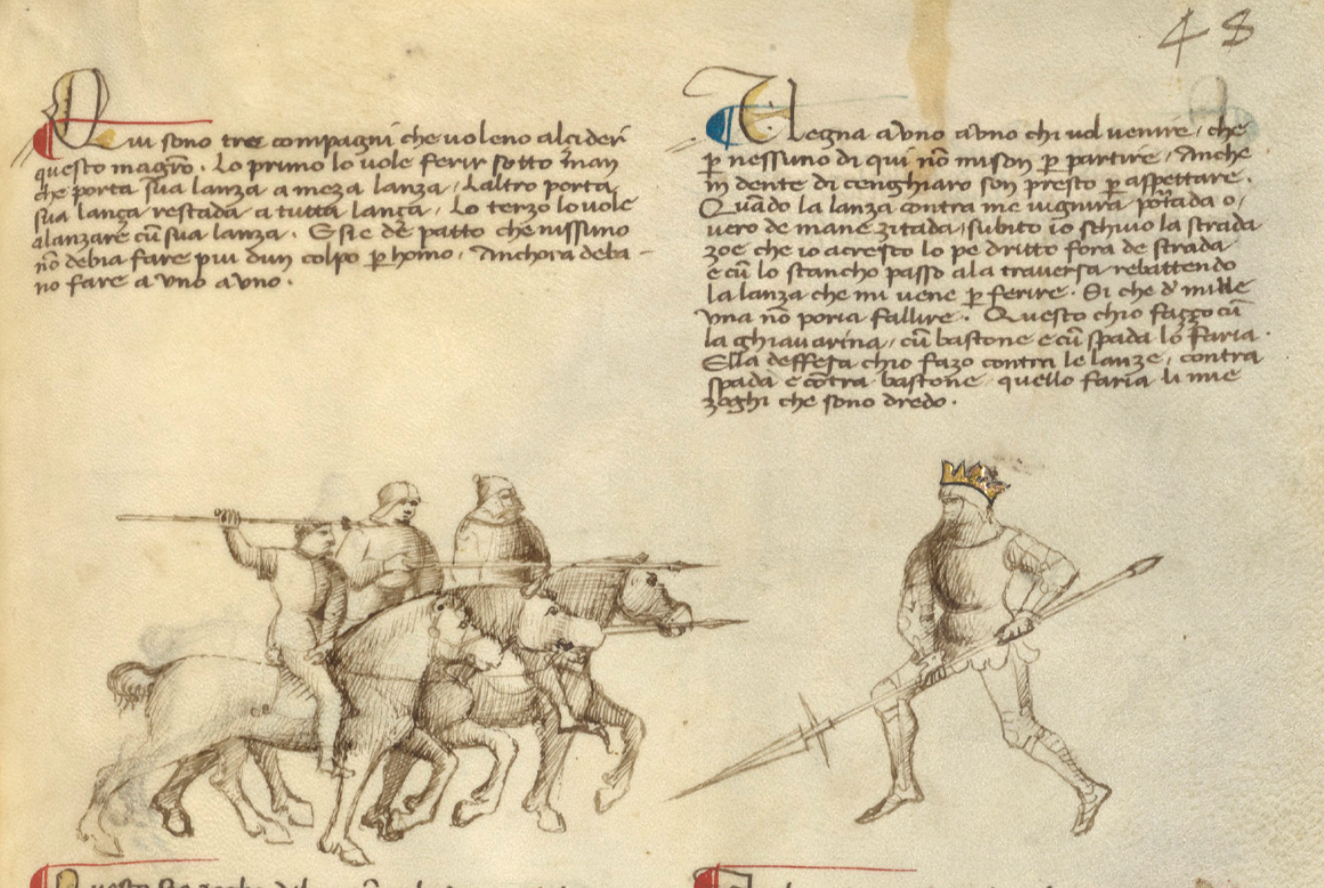
Qui sono tre compagni che voleno alcider questo magistro. Lo primo lo vole ferir sotto man che porta sua lanza a meza lanza. L’altro porta sua lanza restada a tutta lanza. Lo terzo lo vole alanzare cum sua lanza. E sie de patto che nissuno non debia fare piu d’un colpo per homo. Anchora debano fare a uno a uno.
Here are three companions who want to kill this master. The first wants to strike under-arm so carries his lance by the middle. The other carries his lance couched by the end. The third wants to throw with his lance. And it is agreed that none of them may make more than one blow per person. Also they must do it one by one.
This is an interesting set-up. As we have seen elsewhere, there are three different kinds of blows each represented by a different companion. Though they want to “kill” the master, there is an agreement in place that they will only make one blow each, and will come one at a time. Fiore uses the expression ‘a meza lanza’ and ‘a tutta lanza’ in the same way that he has used ‘a meza spada’ and ‘a tutta spada’ (see the discussion of the crossings of the sword for more information). I’ve translated them as ‘by the middle’ and ‘by the end’; ‘a tutta lanza’ means that the whole lance is extended, as you can see from the image. So how does the master handle them? Effortlessly, it seems:
Vegna a uno a uno chi vol venire, che per nessuno di qui non mi son per partire. Anche in dente di cenghiaro son presto per aspettare. Quando la lanza contra me vignira portada o vero de mane zitada, subito io schivo la strada zoe che io acresco lo pe dritto fora de strada e cum lo stancho passo ala traversa rebattendo la lanza che mi vene per ferire. Si che d’ mille una non poria fallire. Questo ch’io fazzo cum la ghiaverina, cum bastone e cum spada lo faria. E’lla deffesa ch’io fazo contra le lanze, contra spada e contra bastone quello faria li mie zoghi che sono dredo.
Come one by one who wants to come, I’m not for leaving here for any of them. Also in the boar’s tooch I am ready to wait. When the lance will come against me, carried or thrown from the hand, immediately I avoid the way, thus, I advance my right foot out of the way and with the left I pass across, beating away the lance that comes to strike me. If there were a thousand, not even one would fail. This that I do with the ghiaverina, I do with a stick or a sword. And the defence that I make against the lance, against the sword and against the stick I will make my plays that follow.
The first line of this reminds me of Margaret Thatcher’s famous remark “the lady’s not for turning”. It’s the same construction: ‘non mi son per partire’: ‘I’m not for leaving’. The ‘fuck you’ is clear in the subtext. He re- iterates that this action is done against the lance whether it is held or thrown, though he uses a new locution: ‘schiva la strada’, which literally means ‘avoid the way’, and of course means ‘get out of the way’. This is perhaps the sixth or seventh time we’ve seen the instruction to step the front foot out of the way and pass across.
I always assumed that this would be quite hard to do, and so the next line about being able to do it a thousand times was hyperbole. Well, you’d get tired after about a hundred, but otherwise, this is way easier to do against a mounted lancer than it is to do against one on foot. Jason is a superb mounted combatant, as one would expect the companions to be (at least by our modern standards). As his lance approached me, the point was rock-steady, and because he was on a horse, he didn’t come straight at me- his lance was angled off to his right by perhaps 30 degrees. This gave me plenty of space and time to do the action, and the steadiness of the lance made this absurdly easy to do. The only real challenge was being careful not to hit him or the horse, which of course would not be an issue if we were doing this in earnest.
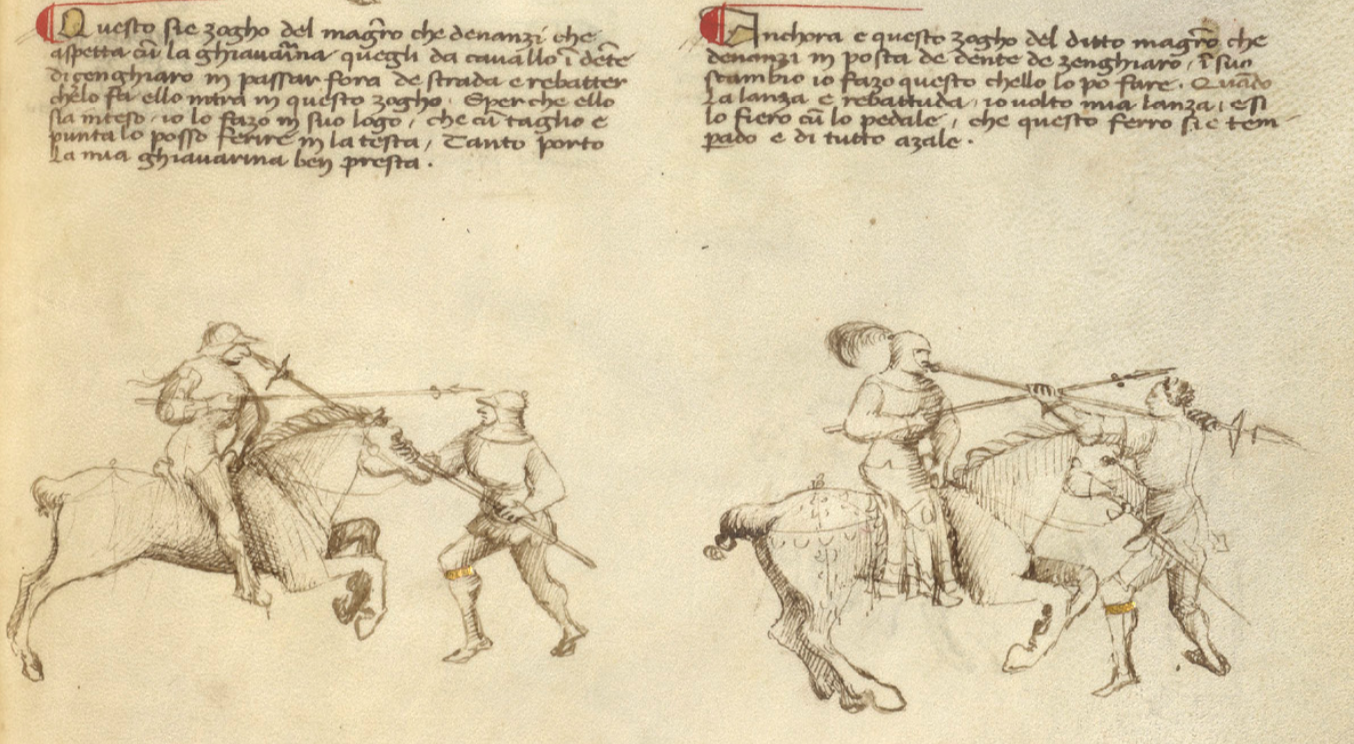
The plays that follow are these two:
Questo si’e zogho del magistro ch’e denanzi che aspetta cum la ghiaverina quegli da cavallo in dente di zenghiaro in passar fora de strada e rebatter chelo fa elo intra in questo zogho. E per che ello sia inteso, io lo fazo in suo logo, che cum taglio e punta lo posso ferire in la testa. Tanto porto la mia ghiavarina ben presta.
This is the play of the master that is before, that waits with the ghiaverina, for the one on horseback, in boar’s tooth, passing out of the way and beating and then enters into this play. And because he understood it, I do it in its place, that with cut and thrust I can strike to the head. Thus I carry my very quick ghiaverina.
In terms of interpretation, this is easy enough. Having stepped out of the way and beaten the incoming lance aside, you can strike with cut or thrust. The language is a little awkward, with some apparently redundant phrasing, such as ‘and because he understood it’. Likewise at the end, ‘tanto’ usually means ‘a lot of’, but it’s one of those words that has a range of uses (such as in ‘ogni tanto’, every now and then). I take this last line to mean essentially ‘this is why I’m carrying a ghiaverina. It’s very quick and takes care of those pesky horsemen’.
If you’re familiar with the plays of the spear on foot, then this last play of the ghiaverina will come as no surprise.
Anchora e questo zogho del ditto magistro ch’e denanzi in posta de dente de zenghiaro, in suo scambio io fazo questo ch’ello lo po fare. Quando la lanza e rebattuda, io volto mia lanza, esi lo fiero cum lo pedale, che questo ferro sie temperado e di tutto azale.
This is also a play of the aforesaid master that is before me in the guard of the boar’s tooth, in his exchange I do this which he could do. When the lance is beaten aside, I turn my lance and then strike him with the butt, the which iron is tempered and completely of steel.
As before, in terms of interpretation this is perfectly straightforward. Because the butt of your ghiaverina is shod with steel, you can turn the weapon and hit him with the butt instead of the head. We’ve seen this before in the counter-remedy of the spear, on f39v, where he also mentions that the butt (pedale) is shod.
The language is a bit less straightforward though. I read ‘in suo scambio’ to mean ‘in his exchange’, in other words, in his technique. Others (Hatcher and Leoni, for instance) both read it to mean essentially ’in his stead’, in other words ‘I can do this instead of that’. From a practical perspective, it makes no difference, of course. Likewise though there is no doubt about the sense of it (hit him with the butt because it’s shod with steel), the specific locution is tricky. “Ferro” is iron, of course. And it also has the connotation of ‘the metal bit attached to a stick’, as in the English word ‘ferrule’. Temperado is ‘tempered’, as steel may be, and as iron cannot be, a fact Fiore would certainly have known. The last word, ‘azale’, is probably a version of acciaio, steel as Florio’s dictionary has azzale for steel. (See here: https://www.pbm.com/lindahl/florio/065.html)
I may be making a meal of this, but I think it’s useful to show my working (as my maths teacher used to insist on).
So, what do these plays look like in real life? Here are Jason and I (and the inestimable Warlord) working through them, in the latest instalment of his excellent Modern History TV:
One of the most stylish techniques in the system is the punta falsa, literally “false thrust”. Fiore’s instructions are very detailed:
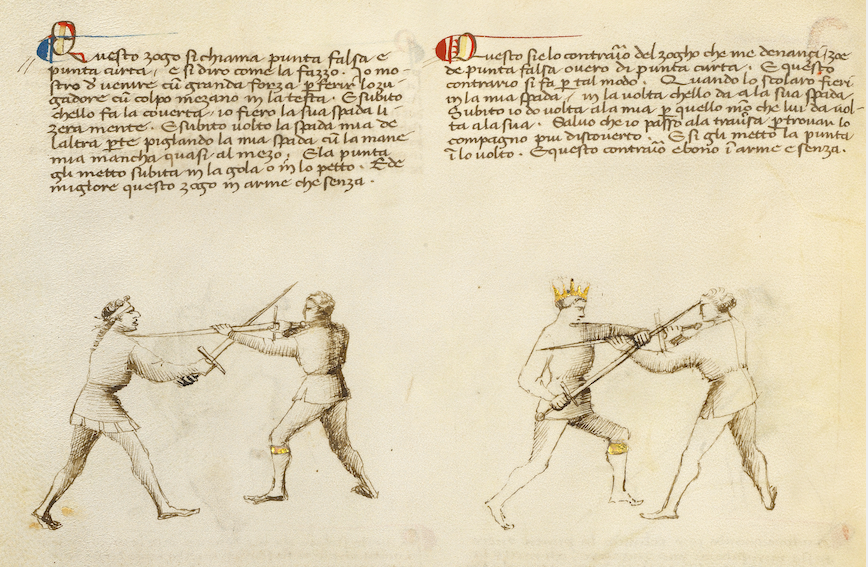
Questo zogo si chiama punta falsa o punta curta, e si diro come la fazzo. Io mostro d’venire cum granda forza per ferir lo zugadore cum colpo mezano in la testa. E subito ch’ello fa la coverta, io fiero la sua spada lizeramente. E subito volto la spada mia de l’altra parte piglando la mia spada cum la mane mia mancha quasi al mezo. E la punta gli metto subita in la gola o in lo petto. E de miglore questo zogo in arme che senza.
This play is called the false thrust or the short thrust, and I’ll tell you how I do it. I show that I am coming with great force to strike the player with a middle blow in the head. And immediately that he makes the cover I strike his sword lightly. And immediately turn my sword to the other side, grabbing my sword with my left hand about at the middle. And I place the thrust immediately in the throat or in the chest. And this play is better in armour than without.
This is the 17th play of the second master of the zogho largo, and so in its basic form is done as a riposte after a successful parry of the first attack (as shown by said master). It can of course be done any time there is an opening to throw the mezano feint, but let’s start out being strictly canonical. We bring this to life like so:
https://youtu.be/BkhdctzyE2g
When practising the punta falsa, there are some things to bear in mind.
Make sure you leave enough space to turn your sword when feinting. A small step offline with the back foot can help, when making the feint.
Keep the turn of the sword tight, by rotating it around the midpoint of the blade, then let the point lead you in.
Cross-handed pairs will find that the punta falsaonly works when there is a forehand (mandritto) mezano being met by a parry on the inside of the attack. This allows the turn to half-sword, which is only mechanically possible from this situation. A left-hander will therefore need to strike the mezano to generate a parry from their opponent’s left side; right-handers need to draw a parry from the opponent’s right side.
Incidentally, in Italian, punta can mean ‘point’ (as in the point of the sword), or ‘thrust’, depending on context. So you may find the term punta falsa translated as ‘false point’, and punta curta as ‘short point’. (or indeed, references to ‘exchanging the point’ or ‘breaking the point’). It doesn’t actually matter from an interpretation standpoint, but as a fencer, I would be more inclined to think about actions rather than parts of the sword. Where it matters are when Fiore is telling us which bit of the swords are crossed (such as in the first master of the zogho largo, crossed at the points of the swords), or where to grab the blade (see for instance the 14th play, where we should grab it ‘near the point’). This has changed over time: in modern Italian ‘a thrust’ is ‘una spinta’, while ‘point of the sword’ remains ‘la punta della spada’.
We should also think a moment about the ‘better in armour’ injunction. Why would Fiore put a play here that apparently belongs in the armoured section? As I see it, it is because firstly it can be done out of armour – it’s quite safe to do if you get it right. And secondly, this play is something that a person wearing armour when you are not might do, and as we shall shortly see, the counter works just fine out of armour.
The next play is the last play of the zogho largo; the instruction is simplicity itself, but the action is very counterintuitive for most people.
Questo sie lo contrario del zogho ch’e me denanzi, zoe de punta falsa overo di punta curta. E questo contrario si fa per tal modo. Quando lo scolaro fieri in la mia spada, in la volta ch’ello da a la sua spada, subito io do volta a la mia per quello modo che lui da volta a la sua. Salvo che io passo ala traversa per trovar lo compagno pui discoverto. E si gli metto la punta in lo volto. E questo contrario e bono in arme e senza.
This is the counter to the play that is before me, so, the false thrust or short thrust. And this counter is done in this way. When the scholar strikes on my sword, in the turn that he makes with his sword, I immediately make a turn to mine, in the same way that he makes a turn to his. Only I also pass across to find the companion more uncovered. And I place the thrust in his face. And this counter is good in armour and without.
The exact nature of the blade action and the relationship between the weapons was first figured out, as far as I know, by Sean Hayes at WMAW 2006. We had just attended a lecture on the manuscript given by Brian Stokes, and seen really high resolution scans for the first time- so clear that places where the manuscript had been corrected (by scraping off the original ink and redrawing a line) could be seen. The counter-remedy master’s sword was suddenly, clearly, on the inside of the player’s (the one trying to do the punta falsa). I will never forget the time about half an hour later when Sean tried out this interpretation on me, and sold it in one go as my attack collapsed as his point magically appeared in my mask.
Here’s how it looks in practice:
https://youtu.be/E4Y0AAZ9Z_0
Perhaps the most common problem when attempting this counter is ending up outside your opponent’s sword. Don’t worry, that’s how everybody did this play for years. It works, it just takes longer. It can also be documented in other sources, so it’s even historically accurate. But if your partner does it, yield immediately to pommel strike on the other side.
The text continues on this page with two paragraphs side by side, with no illustrations:
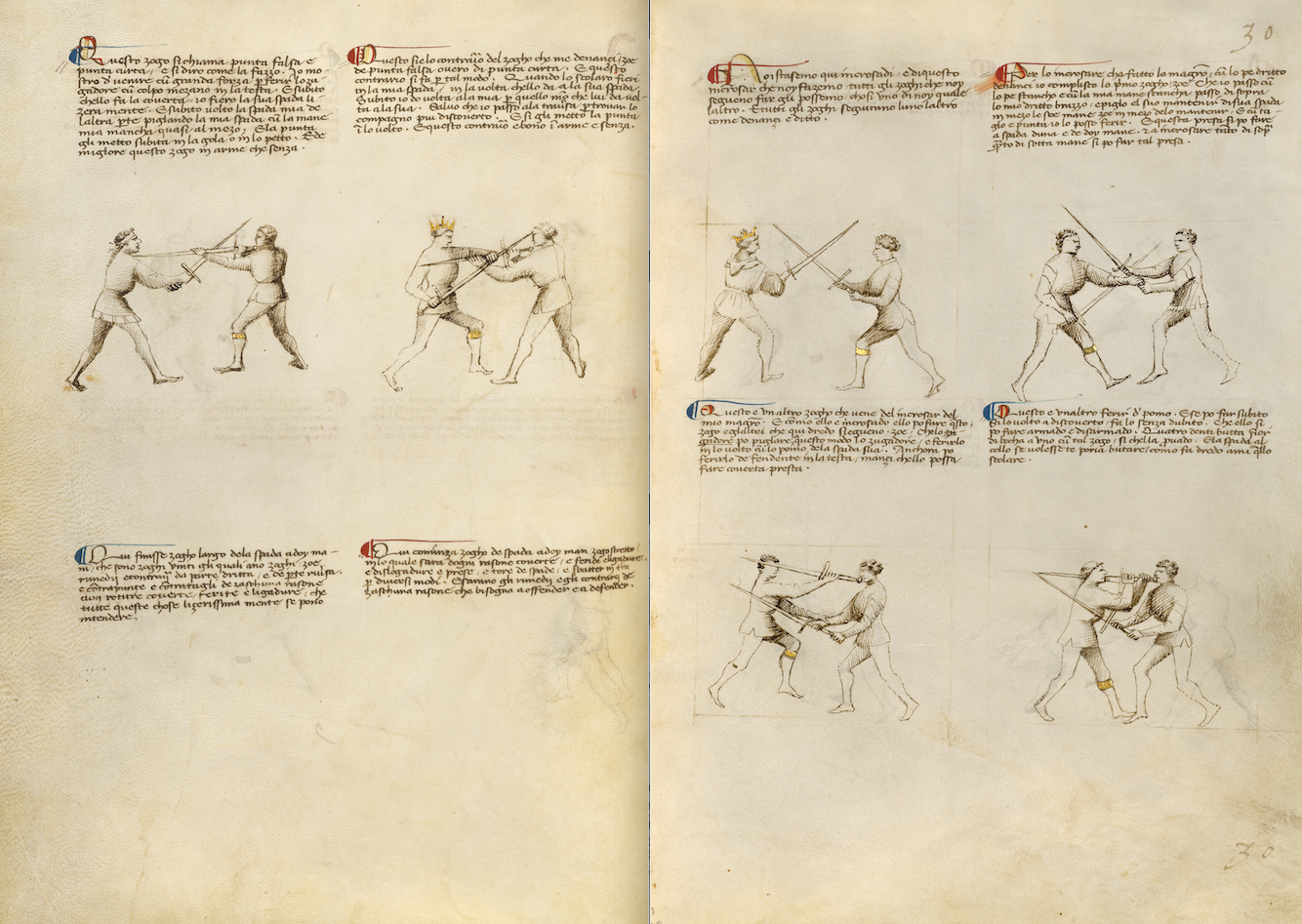
Qui finisse zogho largo dela spada a doy mani, che sono zoghi uniti gli quali ano zoghi, zoe rimedii e contrarie da parte dritta e de parte riversa. E contrapunte e contratagli de zaschuna rasone cum roture coverte ferire e ligadure, che tutte queste chose lizerissimamente se porio intendere.
Here ends the wide play of the sword in two hands, that are joined together plays, which plays are: remedies, and counters from the forehand and the backhand side, and counterthrusts and countercuts of ever type, with breaks, covers, strikes and binds, that all these things can be very easily understood.
This passage is actually quite tricky to translate, as the second line is unclear: ‘che sono zoghi uniti gli quali ano zoghi, zoe…’
I am translating ‘zoghi uniti’ as ‘joined together plays’, in the sense of they are joined (united) in some way. It’s a clunky sentence, I think. Though the meaning of it is reasonably straightforward to tease out, the exact grammar makes no sense to me. Then Fiore continues with what appears to be a bare-faced lie: these ‘joined together plays’ are apparently “remedies, and counters from the forehand and the backhand side, and counterthrusts and countercuts of ever type, with breaks, covers, strikes and binds.” We have seen nothing, zip, nada, from the backhand side, and while we have arguably seen a counterthrust, countercuts have there been none. Plus, there has been exactly one counter-remedy (the last play of the section), so not ‘contrarie’, counters plural. Unless we count the 14th play, which kind of counters the break and is then countered.
So what do we do with this statement?
I think we go back and play. And sure enough if we take this material and play with it, pretty soon we do end up doing all these different things. Applying the exchange of thrusts idea to cuts gives us something astonishingly like a zornhau ort, for instance.
What’s a zornhau ort? Don’t you read the German stuff too? It’s really interesting… basically, it’s when a mandritto fendente (sorry, forehand oberhau) is met with the same blow, leaving the defender’s point in the attacker’s face. We’ll need something like that for the next section, so I’ll go into it then.
The plays of the zogho stretto are coming up. Take a look at this two-page spread:
The master of the zogho stretto is the first play on the recto page. The text introducing the stretto plays is at the bottom of the verso page. This makes perfect sense when you see the pages as they are bound in the manuscript, but the sense is lost when you look at individual pages. Or worse, when the pages are bound such that the verso pages are printed on the recto side, and vice versa.
The text reads:
Qui cominza zogho de spada a doy man zogo stretto, in lo quale sara d’ogni rasone coverte, e feride e ligadure e dislogadure e prese e tore de spade, e sbatter in terra per diversi modi. E sarano gli remedij e gli contrarij de zaschuna rasone ch’e bisogna a offender e a defender.
Here begins the play of the sword in two hands zogo stretto, in which will be, of every type, covers, and strikes, and locks, and dislocations, and grips, and disarms, and throwings to the ground in various ways. And there will be remedies and counters of every type necessary to offend and defend.
Well, that sorts us out then. It reads like a trailer for a movie: there’ll be drama! And excitement! And explosions! And sticky situations over a pound note! Don’t miss it!
(Full marks if you spotted the Blackadder reference. If you don’t know what Blackadder is, start here. The reference is from Season Three episode Ink and Incapability).
I am now working on the next section, the stretto plays. I’ve been thinking though of not publishing them here, just making them available as part of the book I’m compiling from this series (provisionally titled “Fiore dei Liberi’s Longsword Plays on Foot Out of Armour”). What do you think?
And in the meantime, you can get parts one to three as snazzy ebooks here for reading on your phone, kindle, kobo, or other device.
You can get part one, The Sword in One Hand, as a free PDF by subscribing to my mailing list below, or buy it in ebook format from Amazon or Gumroad.
You can get Part two, Longsword Mechanics, from Amazon or Gumroad
And you can get Part three, the Plays of the Zogho Largo, from Amazon or Gumroad.
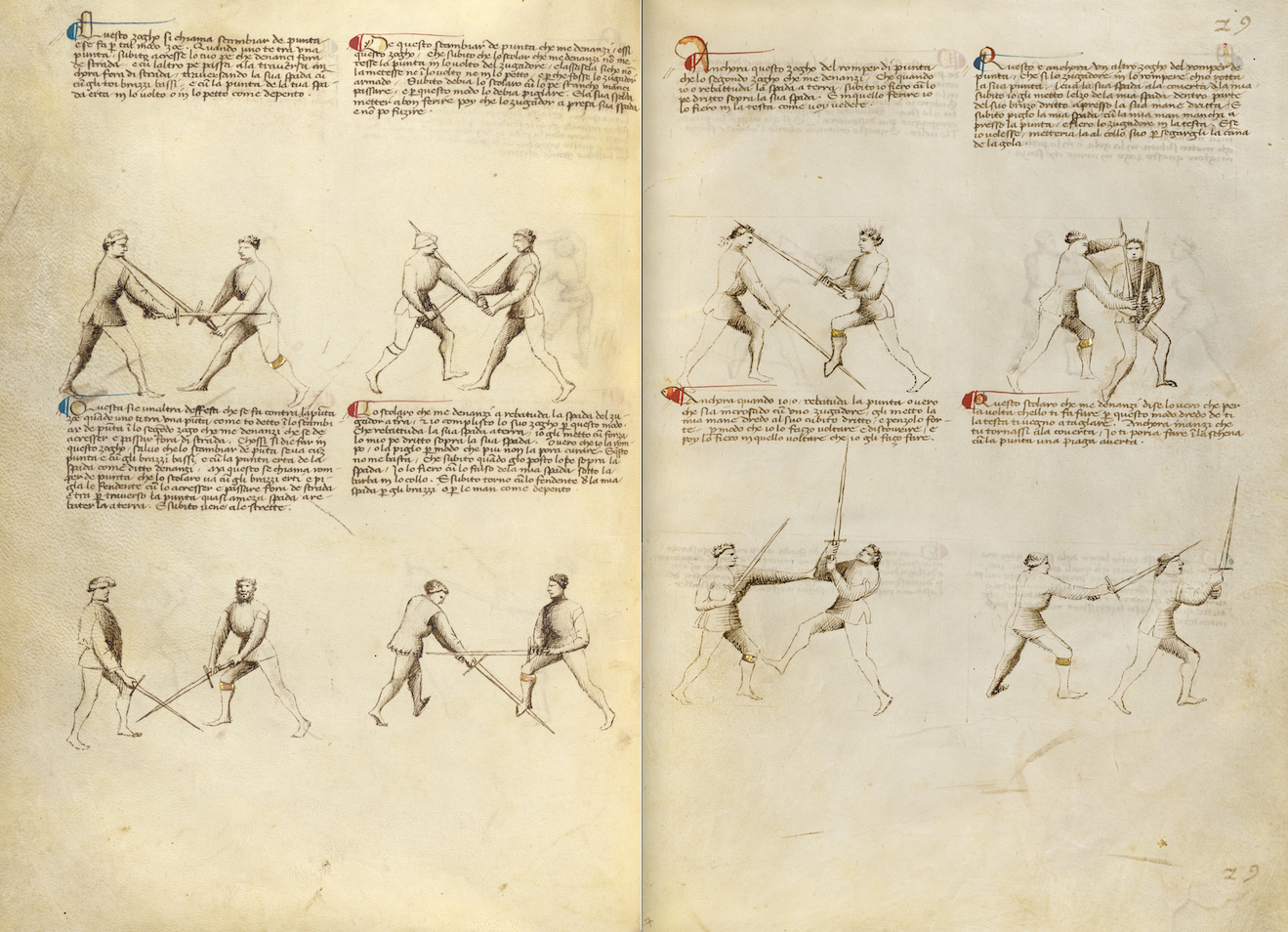
The two-page spread of plays against the thrust continues with the six plays relating to breaking the thrust. I’ll cover them all in order, starting with the 11th play of the master of the zogho largo crossed at the middle of the swords, shown on f26v.
The text reads:
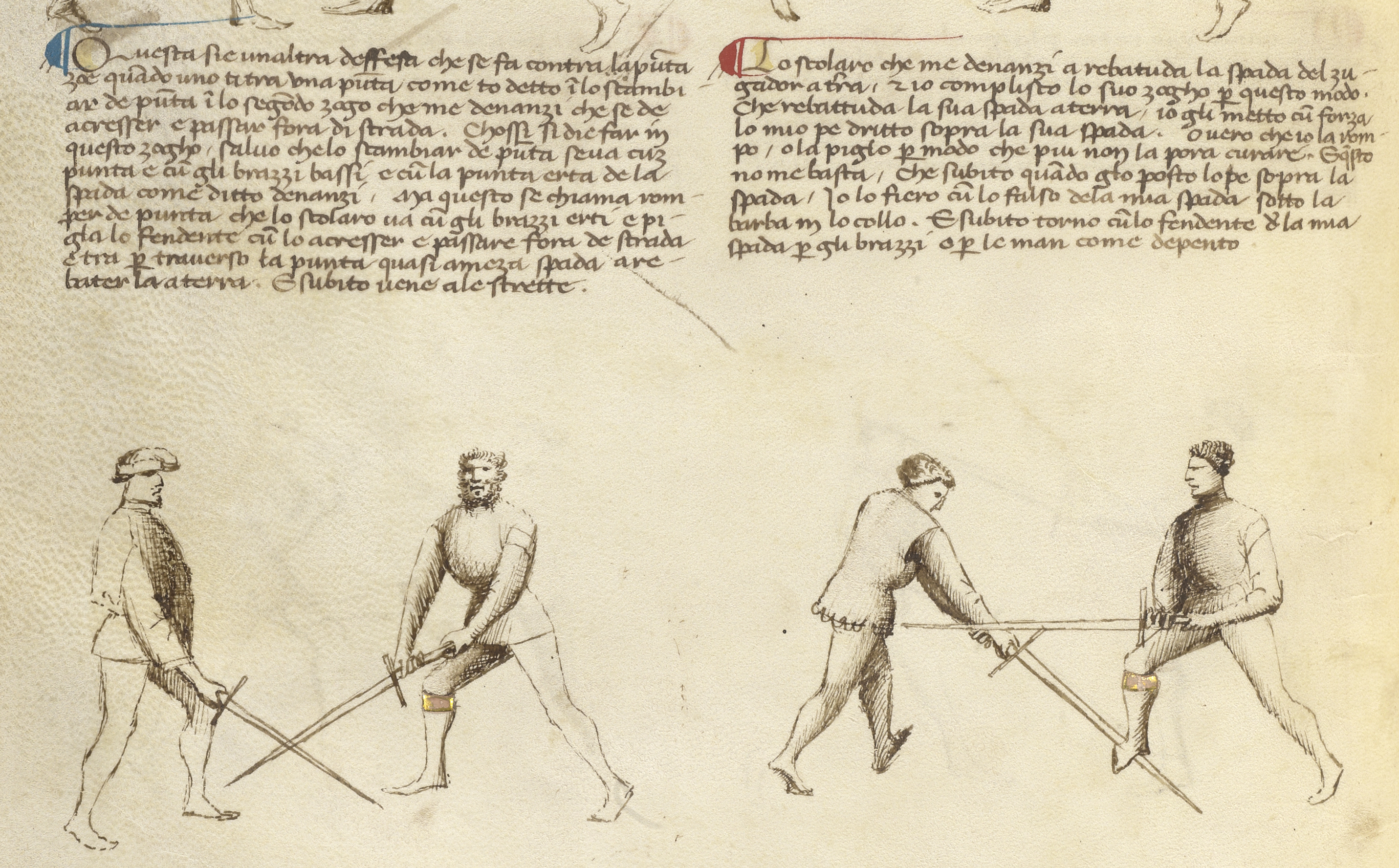
Questa sie unaltra deffesa che se fa contra la punta, zoe, quando uno ti tra una punta come to detto in lo scambiar de punta in lo secondo zogo che me denanzi che se de acresser e passar fora di strada. Chossi si die far in questo zogho salvo che lo scambiar de punta se va cuz punta e cum gli brazzi bassi, e cum la punta erta de la spada come ditto denanzi. Ma questa se chiama romper de punta che lo scolaro va cum gli brazzi erti e pigla lo fendente cum lo acresser e passare fora de strada e tra per traverso la punta quasi a meza spada a rebater la a terra. E subito vene ale strette.
This is another defence that is done against the thrust, so, when one thrusts at you as I said in the exchange of thrust, in the second play that is before me, one advances and passes out of the way. So you must do in this play except that in the exchange of thrust you go with the thrust, and with the arms low, and with the point of the sword high, as I said before. But this is called the breaking of the thrust, that the scholar goes with his arms high and catches the fendente with the advance and pass out of the way, and strikes across the thrust about at the middle of the sword to beat it to the ground. And immediately goes to the close plays.
The next play shows the scholar stepping on the player’s sword, like so:
Lo scolaro che me denanzi a rebatuda la spada del zugador a terra, et io complisto lo suo zogho per questo modo. Che rebattuda la sua spada a terra, io gli metto cum forza lo mio pe dritto sopra la sua spada. Overo che io la rompo o la piglo per modo che piu non la pora curare. E questo no me basta. Che subito quando glo posto lo pe sopra la spada, io lo fiero cum lo falso de la mia spada sotto la barba in lo collo. E subito torno cum lo fendente de la mia spada per gli brazzi o per le man com’e depento.
The scholar that is before me has beaten the player’s sword to the ground, and I complete his play in this way. Having beaten his sword to the ground I put my right foot forcefully on his sword. Either I break it or I grab it in such a way that he can no longer fix it [I.e. Recover from it]. And this is not enough for me. Immediately that I have put my foot on the sword, I strike with the false [edge] of my sword under the beard in the throat. And immediately return with the fendente with my sword to the arms or hands as is shown.
Here’s how I do the play in its most basic form:
https://youtu.be/gGD4KAz3JJQ
I just love the instruction to ‘strike with the false edge of your sword under the beard in the throat’. In case you weren’t certain where the throat was. This also reaffirms the general practice in this system of using multiple strikes. We aren’t playing tag, first to touch wins. A single blow may well not incapacitate the opponent. Once you have them where you want them, hit them until there’s no point continuing to do so.
The next play, on the top left of the facing page (f27r) is also a continuation of the breaking of the thrust:
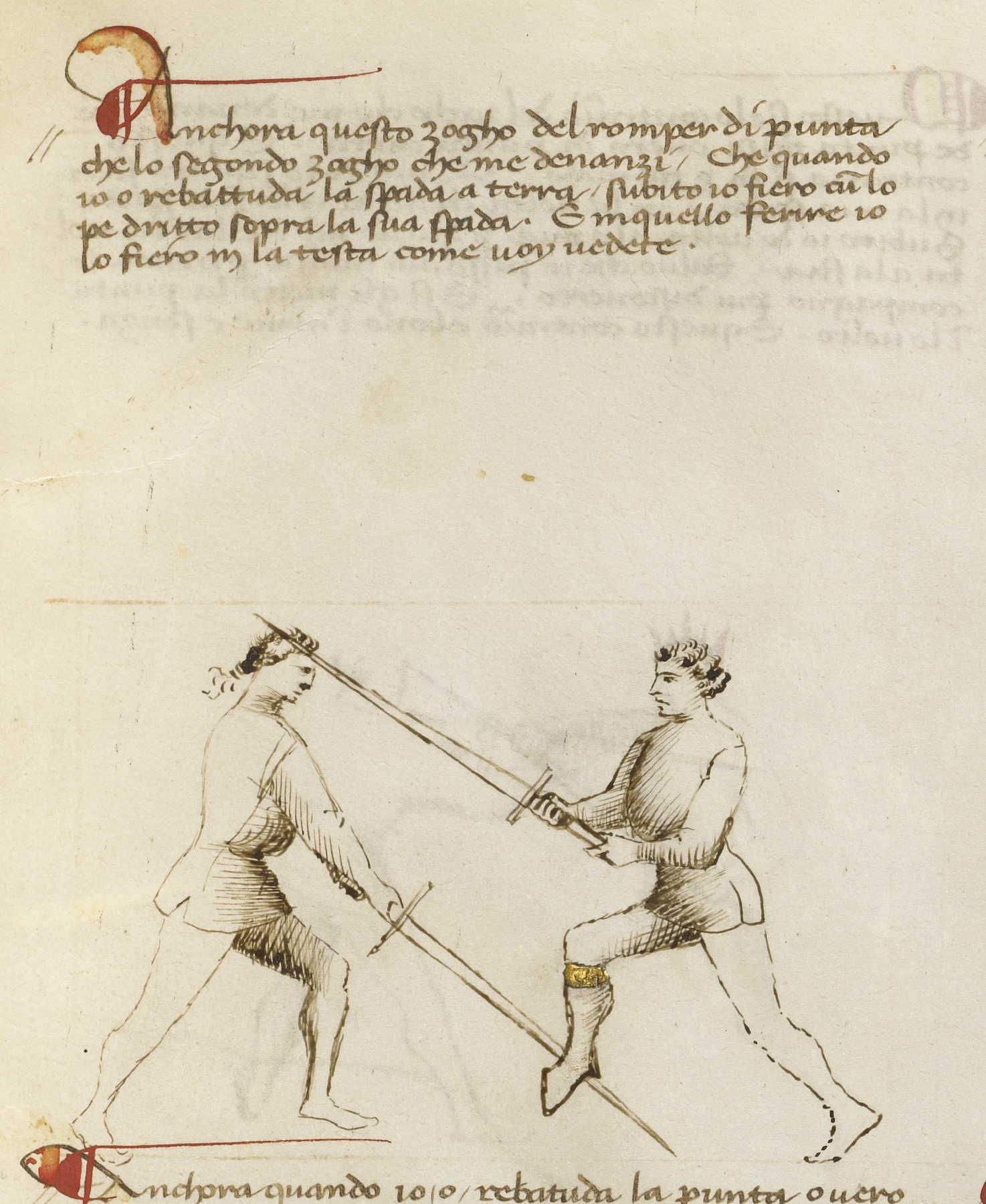
Anchora questo zogho del romper di punta ch’e lo segondo zogho ch’e me denanzi. Che quando io o rebattuda la spada a terra, subito io fiero cum lo pe dritto sopra la sua spada. E inquello ferire io lo fiero in la testa come voy vedete.
Also this play of the breaking of the thrust that is the second play that is before me. When I have beaten the sword to the ground, I immediately strike with the right foot over his sword. And in that strike I will strike him in the head as you can see.
So this is the same play as the one before it, except the strike is to a different target- directly to the head as you step on the player’s sword, rather than cutting the throat first. What follows is a way to deal with the player parrying the strike (which can only happen if you have failed to step on the sword, as indeed the first of these breaking the thrust plays shows). In practice we tend not to step on our training partners’ swords – they are likely to get damaged.
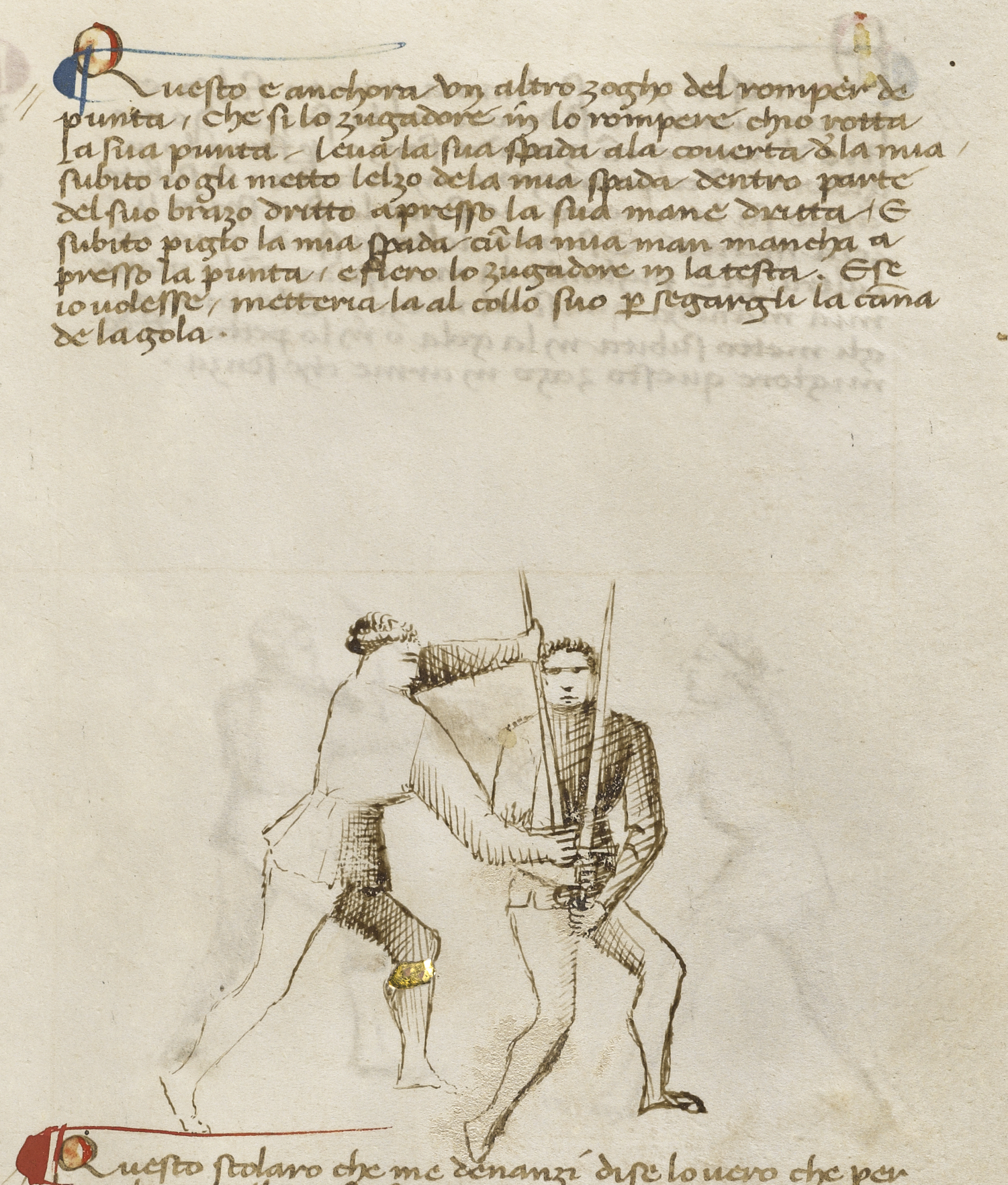
Questo e anchora un altro zogho del romper de punta, che si lo zugadore in lo rompere ch’i’o rotta la sua punta, leva la sua spada ala coverta de la mia, subito io gli metto l’elzo de la mia spada dentro parte del suo brazo dritto apresso la sua mane dritta, e subito piglo la mia spada cum la mia man mancha apresso la punta, e fiero lo zugadore in la testa. Ese io volesse, metteria la al collo suo per segargli la canna de la gola.
This is also another play of the breaking of the thrust, in which if the player, in the breaking that I have broken his thrust, lifts his sword to cover mine, I immediately put the hilt of my sword on the inside part of his right arm close to his right hand, and immediately grab my sword with my left hand close to the point, and strike the player in the head. And if I wish, I could put it to his neck to slice his windpipe.
There are a few things to note here. Firstly, though the player parries the initial riposte, his action does not count as a counter-remedy, and this scholar is not, therefore, a counter-counter-remedy master (as his lack of a crown confirms). Why not? It’s my view that because his action is not shown as a successful counter to the break, it doesn’t merit the term. As Fiore wrote in text above the first master of the dagger (f10v):
Io son primo magistro e chiamado remedio per che rimedio tanto e a dire savere rimediare che non ti sia dado e che possi dare e ferire lo tuo contrario inimigho. Per questa che meglo non si po fare la tua daga faro andar in terra. Voltando la mia mane aparte sinestra.
I am the first master and am called remedy, because remedy is as much as to say to know how to remedy, that you are not given [a blow] and can give [a blow] and strike your own counter [against] the enemy. For this it is better to make your dagger go to the ground. Turning my hand to the left side.
The definition of ‘remedy’ is quite clear- you must be able to prevent the attack from hitting you, and strike afterwards. It’s not enough just to stop the attack. You should also note the change of point of view in this passage. It begins with Fiore addressing us, the reader: ‘so that you are not given a blow’. Then it shifts to address the player so that ‘your dagger goes to the ground’ describes the play, not an instruction to us to drop our weapons! It’s worth remembering that this kind of conversational tone pervades this text.
Returning to the play in question, the player’s attempt to parry ends up with him getting his throat cut. As a matter of good training, I don’t recreate the play this way- there is really no point teaching students to parry in a way that just fails. So in this drill, I have the player countering the break with a pommel strike, closing the line of the blow to the throat or the head (or as Fiore would say, ‘passing with the cover’), which is then countered by the scholar putting their hilt over the player’s arm and following the instructions. I also tend to swap out cutting the throat with a take-down, as you can see in this video:
https://youtu.be/ttFY_EQqvU8
The last pair of plays on this page, the fifteenth and sixteenth of the second master of the zogho largo, can be done as a follow on from the breaking of the thrust, or not, as we will see:
Anchora quando io o rebatuda la punta o vero che sia incrosado cum uno zugadore, gli metto la mia mane dredo al suo cubito dritto, e penzolo forte, per modo che io lo fazzo voltare e discovrire, e poy lo fiero in quello voltare che io gli fazo fare.
Also when I have beaten aside the thrust, or when I am crossed with a player, I put my hand behind his right elbow, and push it hard, in such a way that I make him turn and be uncovered, and can strike him in that turn that I have made him do.
The next play completes this action:
Questo scolaro ch’e me denanzi dise lo vero che per la volta ch’ello ti fa fare per questo modo dredo de ti la testa ti vegno a taglare. Anchora inanzi che tu tornassi ala coverta, io ti poria fare in la schena cum la punta una piaga averta.
This scholar before me tells the truth, that by the turn that he has done to you, in that way I come to cut you from behind in the head. Also before that you would turn to parry, I could give you an open wound in the back with the point.
So, when we can reach the elbow, we can push it and strike from behind, just as we saw in the sixth play of the sword in one hand. This can be done after breaking the thrust, but also whenever we are crossed with the player (at the middle of the swords in zogho largo, at least, given the section that we are in). Notice how specific Fiore is about which elbow to push- as we saw in the 6th abrazare play, where you push ‘the elbow of the hand offending your face’, here you push the elbow of the sword arm. Pushing the other elbow may well not give you full control of the sword. And the window of opportunity is small – you must strike immediately, before they can turn back round to parry.
You can see my interpretation here:
https://youtu.be/96LDqDG9cRU
The theme of thrusting will conclude in the next post, with the punta falsa, and its counter. See you then!
This project is being published in stages. You can get part one, The Sword in One Hand, as a free PDF by subscribing to my mailing list below, or buy it in ebook format from Amazon or Gumroad. You can get Part two, Longsword Mechanics, from Amazon or Gumroad too!
Having kicked our opponent in the groin, we turn the page to see this spread:
[Note, this image is not a photograph of the manuscript opened up; I have just put the scan of each page next to each other.]The story is the same though; having dealt with a whole lot of cuts, including (if you’ll indulge me a moment) too hard, too low, and the regular kind, we now deal with thrusts. The first, and probably ideal, response is to exchange the thrust. We have seen this play before in my discussion of the eighth play of the sword in one hand.
Questo zogho si chiama scambiar de punta e se fa per tal modo zoe. Quando uno te tra una punta subito acresse lo tuo pe ch’e denanci fora de strada e cum l’altro pe passa ala traversa anchora fora di strada traversando la sua spada cum cum gli toi brazzi bassi e cum la punta de la tua spada erta in lo volto o in lo petto com’e depento.
This play is called the exchange of thrust, and it is done like this, thus. When one strikes a thrust at you immediately advance your foot that is in front out of the way and with the other foot pass also out of the way, crossing his sword with with your arms low and with the point of your sword up in the face or in the chest as is pictured.
Note the repeated ‘cum’, ‘with’. A common scribal error. Not secret messages from beyond the grave, ok? The instructions couldn’t be clearer, could they?
Rapier fencers will of course be delighted to see the classic thrust in opposition done with longswords, though one should take care to make the crossing thoroughly, and not race to get the point in. At the end of the zogho largo section, on folio 27v, Fiore wrote:
Qui finisse zogho largo dela spada a doy mani, che sono zoghi uniti gli quali ano zoghi, zoe rimedii e contrarie da parte dritta e de parte riversa. E contrapunte e contratagli de zaschuna rasone cum roture coverte ferire e ligadure, che tutte queste chose lizerissimamente se porio intendere.
Here ends the wide play of the sword in two hands, that are plays together, which plays are: remedies, and counters from the forehand and the backhand side, and counterthrusts and countercuts of ever type, with breaks, covers, strikes and binds, that all these things can be very easily understood.
I’ll discuss this translation in more depth in the post after next (there is a lot to discuss), but for now, just notice the ‘contrapunte’, counterthrust. As I see it, this refers to the exchange of thrusts. That Fiore also mentions (but as far as I can see does not show) countercuts, suggests that the lesson of this play can legitimately be applied to countering a cut with a cut.
At this stage we should remember that Fiore loves us and wants us to be happy. He understands that sometimes one might miss a stroke, and that’s okay. Because this action continues in the tenth play:
De questo scambiar de punta ch’e me denanzi, essi questo zogho, che subito che lo scholar ch’e me denanzi non mettesse la punta in lo volto del zugadore, e lassasela si che non la metesse ne in lo volto ne in lo petto, e per che fosse lo zugadore armado, subito debia lo scolaro cum lo pe stancho inanci passare, e per questo modo lo debia piglare. E la sua spada metter a bon ferire poy che lo zugador apresa sua spada e non po fuzire.
From this exchange of thrust that is before me, comes this play, that immediately that the scholar that is before me does not place the thrust in the player’s face, and leaves it such that he doesn’t place it neither in the face nor the chest, and because perhaps the player was in armour, the scholar must immediately pass forwards with the left foot, and in this way must grab. And put his sword to work with good strikes, because the player’s sword has been grabbed and he cannot get away.
So having missed our thrust, perhaps because the opponent is in armour, we pass again, grabbing the sword and striking. In practice I always teach these plays together, and you should continue with the grab whether you hit the face with the exchange or not. That way if you do miss, you’ll continue without pause.
Here are the plays in action:
https://youtu.be/JEsKnhBm_PU
Next week: breaking the thrust!
This project is being published in stages. You can get part one, The Sword in One Hand, as a free PDF by subscribing to my mailing list below, or buy it in ebook format from Amazon or Gumroad. You can get Part two, Longsword Mechanics, from Amazon or Gumroad too!
We in the historical swordsmanship community are often asked about drawing the sword. I wrote a short chapter on it in my bookSwordfighting. The chapter was short because there isn’t much information in the sources! I think this is because most sources are concerned with swordsmanship for the duel in a European culture, which for some unknown reason has always begun with the swords already drawn. There’s no tradition of the quick-draw (unlike in Japan, for instance, or the Wild West, for another instance).
Let us begin with Fiore’s sword drawing plays, and then have a look at what other masters have to say on the subject. Fiore gives us five plays of the sword in the scabbard against the dagger, but in each of them, the scabbarded sword is being carried in the hands, either point up or point down. This was actually a quite common way to carry your sword, much as we might carry an umbrella today. This is from folio 19v:
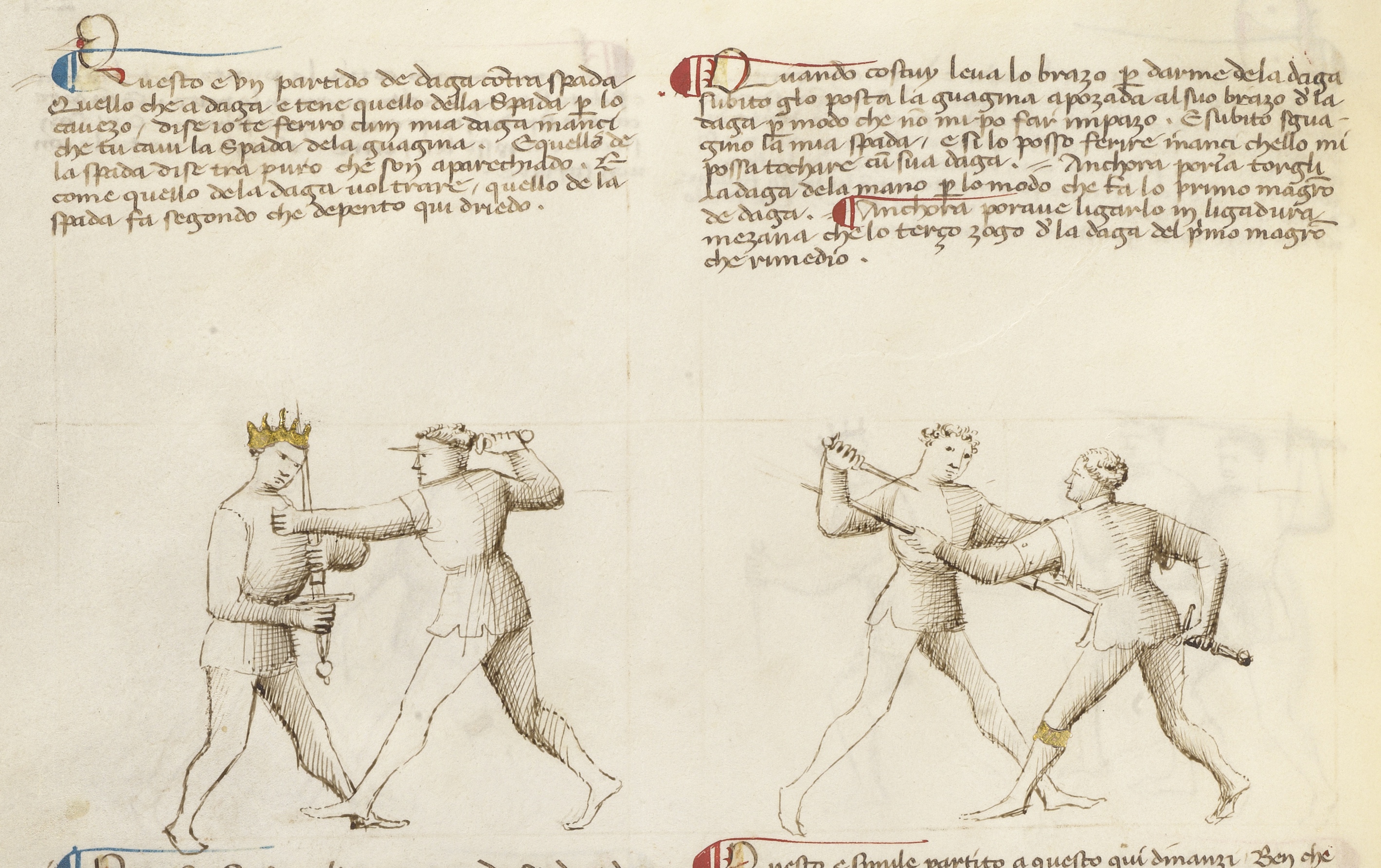
Questo e un partido de daga contra spada. Quello che a daga e tene quello della Spada per lo cavezo dise io te feriro cum mia daga inanci che tu cavi la spada dela guagina. E quello de la spada dise tra puro che son aparechiado. E come quello dela daga vol trare, quello de la spada fa segondo che depento qui dredo.
This is a situation of the dagger against the sword. The one with the dagger has the one with the sword by the collar [and] says: “I will strike you with my dagger before you can draw the sword from its scabbard”. And the one with the sword says “strike as you will for I am prepared”. And as the one with the dagger wants to strike, the one with the sword does the action as it is shown after this.
Note: I translate partido here as “situation” rather than “technique” as it fits better, because a ‘technique of the dagger against the sword’ would imply that the dagger is doing the technique (and will therefore win), which is not the case here. You’ve got to love the smack-talk, which is actually rendered as dialogue. Also note how careful Fiore is to let us know who is doing what: ‘the one with the sword’ or ‘the one with the dagger’.
Also note: Alberto Dainese spotted an error and kindly emailed me to correct it. Thanks Alberto!
The action that follows is lovely: drop the point of the scabbarded sword onto the attacker’s elbow, controlling their weapon; then draw the sword and run them through. Like so:
Quando costuy leva lo brazo per darme de la daga subito glo posta la guagina apozada al suo brazo de la daga per modo che non mi po far impazo. E subito sguagino la mia spada e si lo posso ferire inanci che’ello mi possa tochare cum sua daga. Anchora poria torgli la daga dela mano per lo modo che fa lo primo magistro de daga. Anchora porave ligarlo in ligadura mezana ch’e lo terzo zogo d’la daga del primo magistro ch’e rimedio.
When this man lifts his arm to give me [a strike] of the dagger, I immediately put the scabbard on his dagger arm in such a way that he cannot cause me any trouble. And immediately I unsheathe my sword and can strike him before he can touch me with his dagger. Also I could take the dagger out of his hand in the way that the first master of the dagger does. Also I could have bound him in the middle lock, that is the third play of the dagger, of the first master that is a remedy [master].
This is quite straightforward, and you can see how I do it here:
https://youtu.be/yWp9dx9cdgI
Yes, I include the trash-talking dialogue!
There are some interesting depths to this. Firstly, you have to love the idea of using your scabbarded sword to constrain the opponent. We tend to think of the scabbard being always attached to a belt, but in fact it was quite common for swords to be carried, especially in town. They would often be handed over to the servants with your cloak and hat when you entered a home. It’s interesting to note that Fiore specifies that you constrain ‘the dagger arm’, rather than ‘his right arm’. This allows for the possibility of left-handed attackers (as are explicitly mentioned on f43v in the context of mounted combat), and echoes the sixth play of abrazare.
Okay, I’ll briefly digress into the abrazare…
The abrazare section begins with the master, shown controlling the player’s arms. The next play shows his scholar breaking the player’s left arm, the one that was extended to the master’s collar. The third play shows what you should do if the player removes their arm from your collar while or before you are trying to break it. The fourth play shows what to do if the original grip is the same, but the player has the right foot forwards. This foot placement prevents both the arm break, and the throw, and requires you to throw them in the other diagonal. The fifth play shows the counter to a situation where the player has grabbed you round the waist (but their feet are as they were in the first-third plays). The sixth play is the first counter-remedy master shown in the entire book, so pay attention:
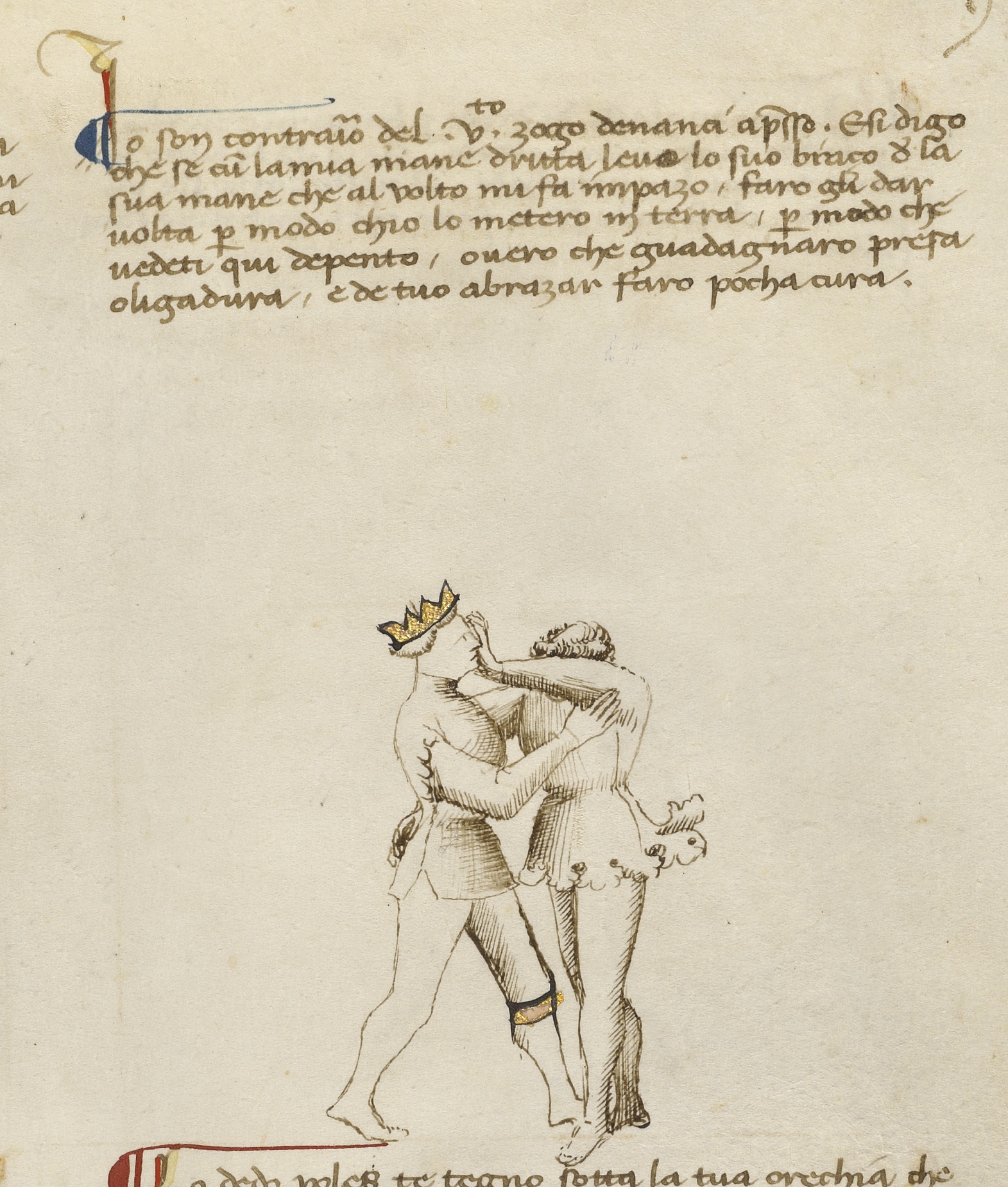
Io son contrario del Vto zogo denanci apresso. Esi digo che se cum la mia mane dritta levo lo suo brazo de la sua mane che al volto mi fa impazo, faro gli dar volta per modo ch’io lo metero in terra, per modo che vedeti qui depento, overo che guadagnaro presa o ligadura, e de tuo abrazar faro pocha cura.
I am the counter of the fifth play immediately before me. And so I say that with my right hand I lift his arm, of the hand that offends my face, I make him turn in such a way that I put him on the ground, in the way that you see shown here, or I can gain a grip or a lock, and I’ll make your wrestling [skills] useless.
The point I’m interested in here is this: he specifies that you should push the arm that belongs to the hand that is at your face. And you can see that while doing the fifth play exactly as shown has the scholar’s right arm at the face, in the sixth play the counter-remedy master is pushing his opponent’s left arm. This is not a mistake, as such. It’s a general principle, showing what it would look like if the scholar used the other hand.
This is a handy illustration of a) the need to read the text- just following the pictures exactly would be impossible, and b) the fact that these are plays not just techniques. The play will often embody a principle that can be applied in other situations. Returning to the sword against the dagger: it may be obvious that you should constrain the dagger arm, not the other…. Except, in the fifth master of the dagger, you can do either. The master himself, on f38r (which has been bound in the middle of the mounted combat section; this folio belongs between f14 and f15), shows how to deal with an attacker who grabs you by the collar with one hand, and has a dagger in the other.
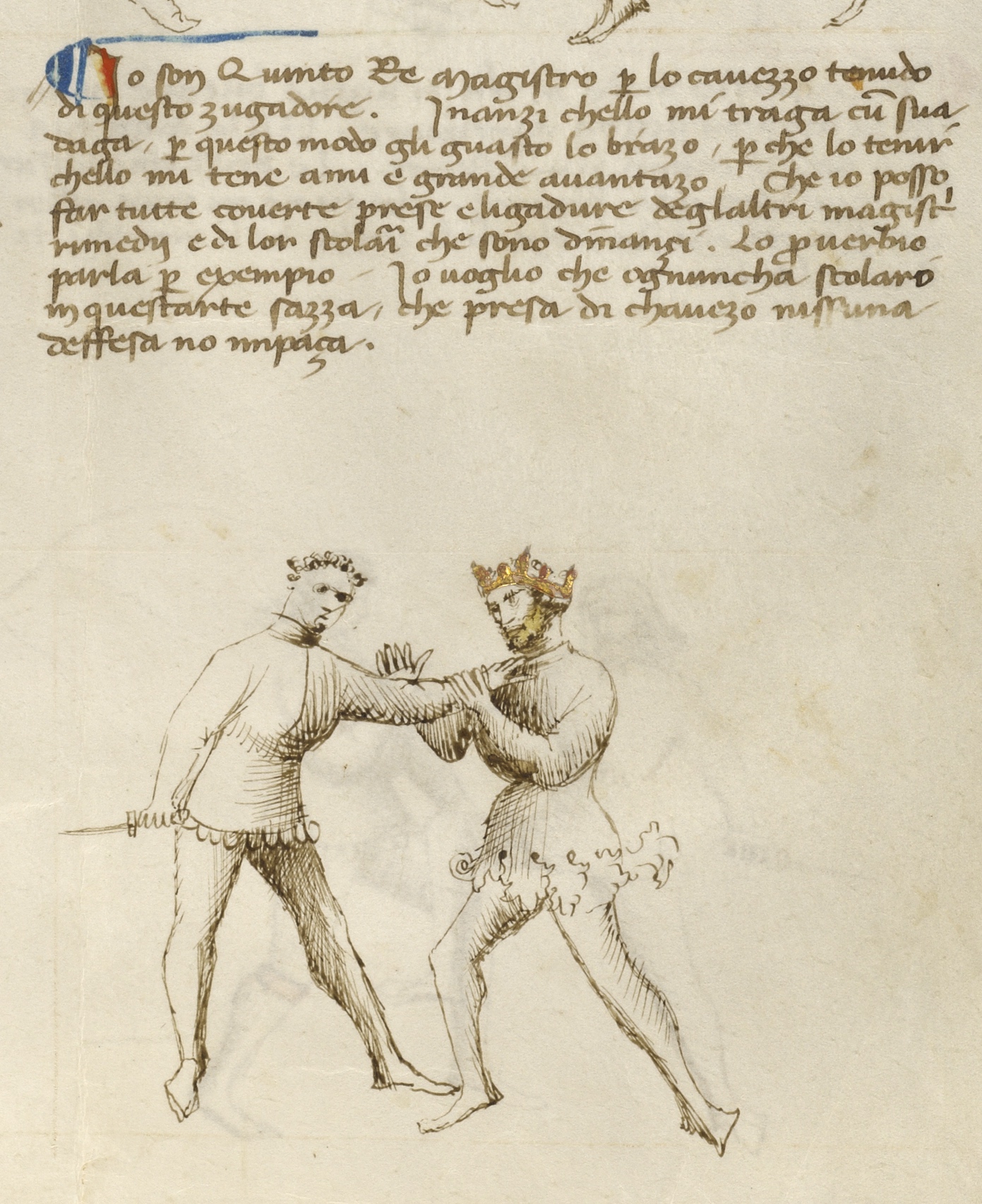
Io son Quinto Re Magistro per lo cavezzo tenudo di questo zugadore. Inanzi ch’ello mi traga cum sua daga, per questo modo gli guasto lo brazo, per che lo tenir ch’ello mi tene a mi e grande avantazo. Che io posso far tutte coverte, prese e ligadure degl’altri magistri rimedii, e di lor scolari che sono dinanzi. Lo proverbio parla per exempio. Io voglio che ognun ch’ascolaro in quest’arte sazza, che presa di chavezo nissuna deffesa no impaza.
I am the fifth king master held by the collar by this player. Before he strikes me with his dagger, in this way I destroy his arm, because the hold he has on me is a great advantage to me, so I can make all the covers, grips, and locks of the other remedy masters, and of their scholar that are before [me]. The proverb speaks by example. I want that everyone who is a scholar in this art to know that the grip on the collar does not hinder any defence.
The master and his first five scholars all deal with the extended arm, as do scholars eight and nine; the others (six, seven, ten and eleven) deal with the dagger arm. I interpret this as a matter of threat assessment: if the dagger is within reach, or coming towards you, deal with it; otherwise, destroy the extended arm. This clearly relates to the second and third plays of wrestling: if the extended arm is available, break it; if not, then throw. Here in the play of the sword against the dagger, Fiore is explicitly telling us to deal with the dagger arm- perhaps because even if it is held back as a threat, we can reach it with the scabbarded sword, when we couldn’t with just a hand.
This is quite straightforward, and you can see how I do it here:
https://youtu.be/yWp9dx9cdgI
Yes, I include the trash-talking dialogue!
This page continues with two other ways to do the same defence, starting with the sword held point down.
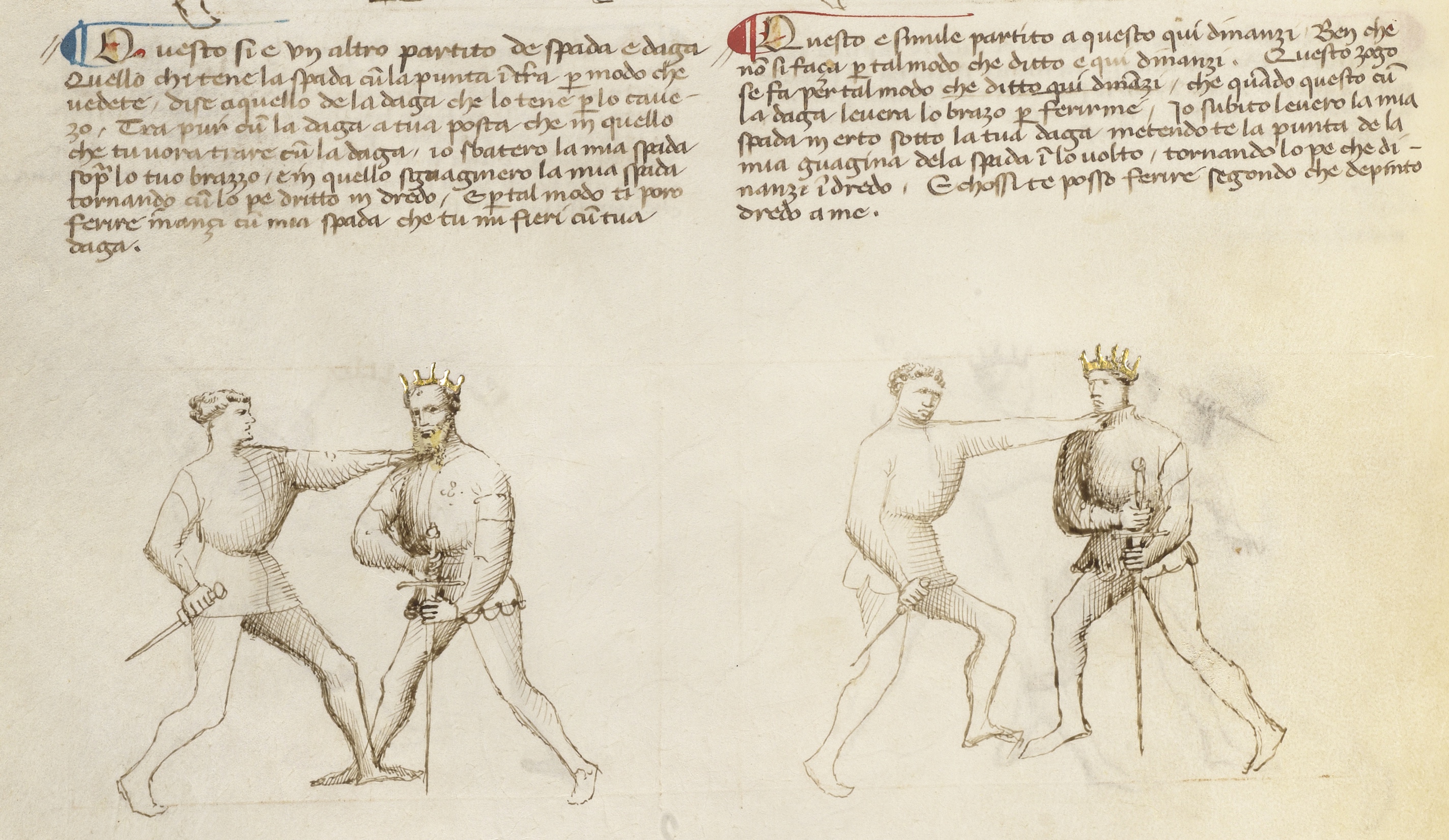
Questo sie un altro partito de spada e daga. Quello chi tene la spada cum la punta in terra per modo che vedete, dise aquello de la daga che lo tene per lo cavezo, Tra pur cum la daga a tua posta che in quello che tu vora trare cum la daga, io sbatero la mia spada soprano lo tuo brazzo, e in quello sguaginero la mia spada tornando cum lo pe dritto in dredo, e per tal modo ti poro ferire inanci cum mia spada che tu mi fieri cum tua daga.
This is another technique of the sword and the dagger. The one that has the sword with the point down in the way that you see, says to the one with the dagger that has him by the collar “Just strike with the dagger, with your guard in which you want to strike with the dagger, I will beat my sword over your arm, and in that [motion] draw my sword, passing the right foot back, in such a way that I can strike you with my sword before you strike me with your dagger.”
This is basically the same play, just done from a different starting point. You can see how I do it here:
https://youtu.be/o3Qfo3KGXAY
Finally we have the scabbarded sword being swung up to defend against the dagger attack (a presaging of the plays of the sword in one hand, do you think?). Looking closely at the images, we see that the sword is being held differently: in the first image, where we whip the sword down onto the arm, the sword hand is thumb down; in the second, where we swing it up, it’s thumb up.
first image: thumb up.second image: thumb down.
Does it make a difference? He doesn’t mention it in the text, but try it both ways and you tell me…
Questo e simile partito a questo qui dinanzi. Ben che non si faca per tal modo ch’e ditto e qui dinanzi. Questo zogo se fa per tal modo ch’e ditto qui dinanzi, che quando questo cum la daga levera lo brazo per ferirme, io subito levero la mia spada in erto sotto la tua daga, metendote la punta de la mia guagina dela spada in lo volto, tornando lo pe ch’e dinanzi in dredo. E chossi te posso ferire segondo ch’e depinto dredo a me.
This is a similar technique to the one that’s here before. But it isn’t done in the same way as is said in the one before. This play is done in in the way that is said here before, that when the one with the dagger raises his arm to strike me, I immediately raise my sword up under your dagger, putting the point of my sword’s scabbard in your face, passing back with the front foot. And so I can strike you in the way that is shown after me.
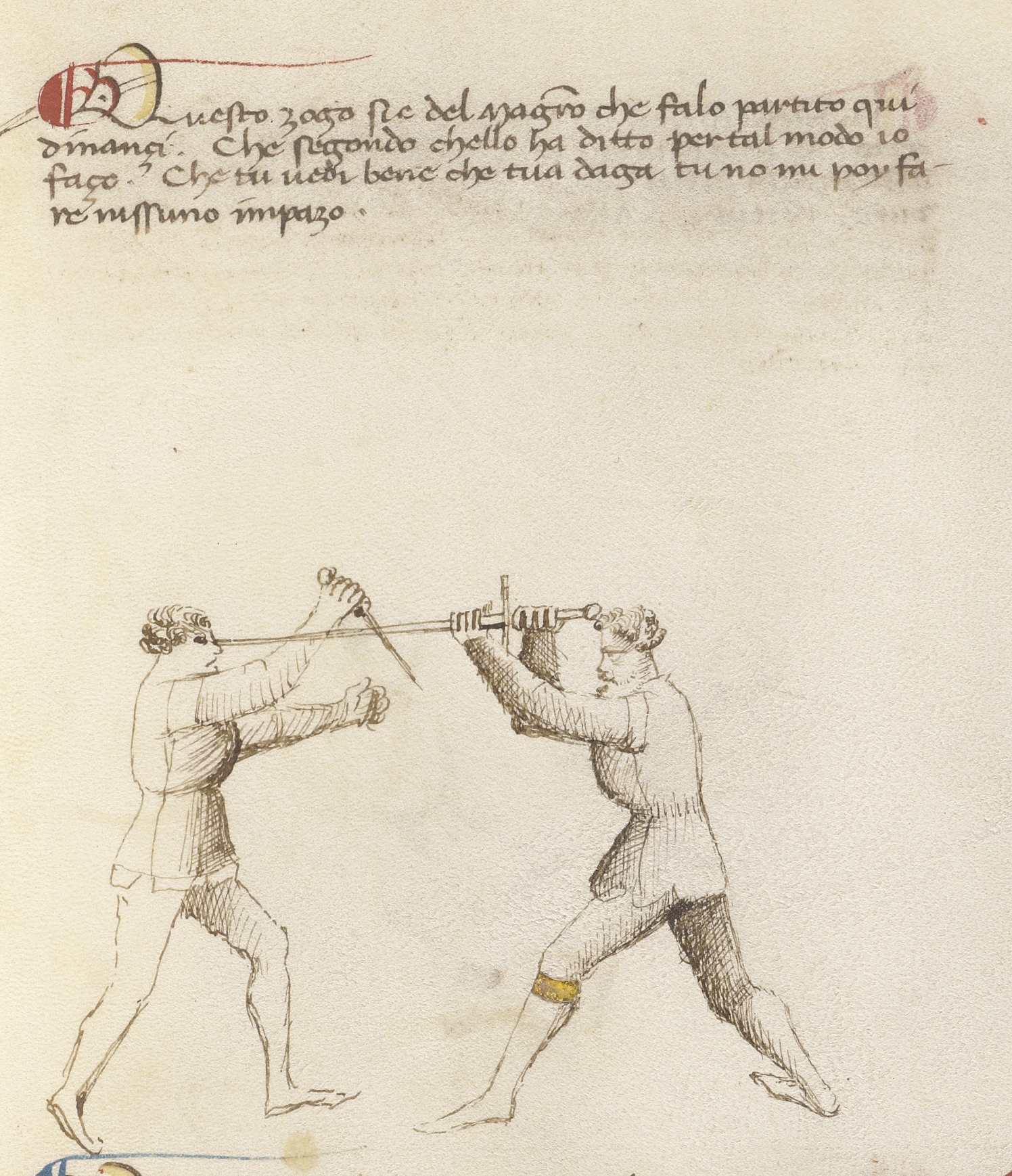
Then on the next page, f20r, we have the conclusion to this play. Note the way the sword is held like a very long dagger, which accords with the grip illustrated.
Questo zogo sie del magistro che fa lo partito qui dinanzi. Che segondo chello ha ditto per tal modo io fazo. Che tu vedi bene che tua daga tu no mi poy fare nissuno impazo.
This play is of the master that does the technique before this one. I do it in the way that he has said. You can well see that your dagger cannot cause me any trouble.
The text is a little confusing here- is it the same as the play before it, or not? As I read it, it’s similar, but not the same. The action is quite clear though. Here’s how I do it:
https://youtu.be/7TiHYphEbsM
You can also see my take on how to do these plays in The Medieval Dagger, pp. 148-154.
Note that when the sword is high, you strike down, but when the sword is down, you can strike both downwards, and upwards. I find that the same general rule applies with the longsword guards; I don’t usually strike upwards from a high guard (though of course Fiore says that donna does all seven blows of the sword, so there are exceptions).
When not carried in the hand, swords were generally suspended from a waist belt in a scabbard, on the non-dominant side (so, on the left for right handers). Daggers, and very short swords, are usually worn the same side as the hand that will use them. The reason for this is blade length. If you snag a tape measure by your right hip and see how far you can pull it out with your right hand, then snag it by your left hip and try the same thing (with your right hand), you will find that drawing across your body allows you to draw a much longer weapon. On me the difference is 90cm (35”) to 130cm (51”).
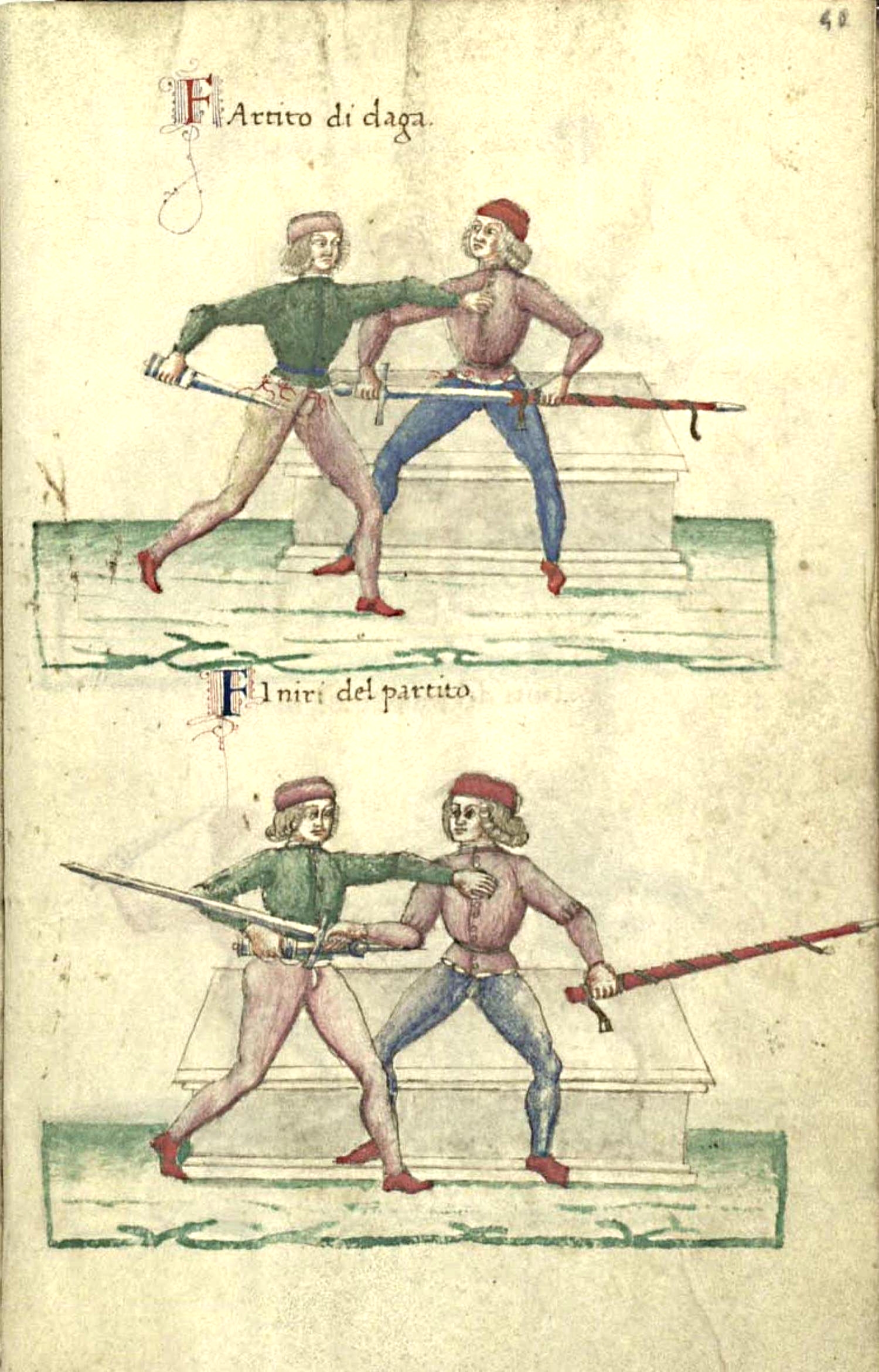
Some seventy years after Fiore, Vadi shows this play (in his De Arte Gladiatoria Dimicandi, folio 40r, from about 1485. See my The Art of Sword Fighting in Earnest for a complete translation and commentary):
Unlike Fiore’s actions, this can be done with the scabbard attached to the belt, as one would expect, but is not shown that way here. The text reads only “Dagger technique” and “Finish of the technique”.
Capoferro
In his Gran Simulacro (from 1610), Capoferro does include a brief mention of drawing the sword, in the text regarding this plate:
Under the title “Way to Place the Hand on the Sword” (as I would translate it) he simply tells us to step back with the right foot, and extend your arm (presumably with the sword attached) in prima (above the shoulder), unless you have your left foot forwards, in which case you can unsheathe the sword without moving your feet. And if you have other weapons (cape or dagger), then draw your left foot back while presenting the sword in quarta (on your left) to keep the opponent away while you sort out your weapons.
That’s it. Nothing at all on how exactly to pull it out of the scabbard, to hold it, or anything like that.
Thibault
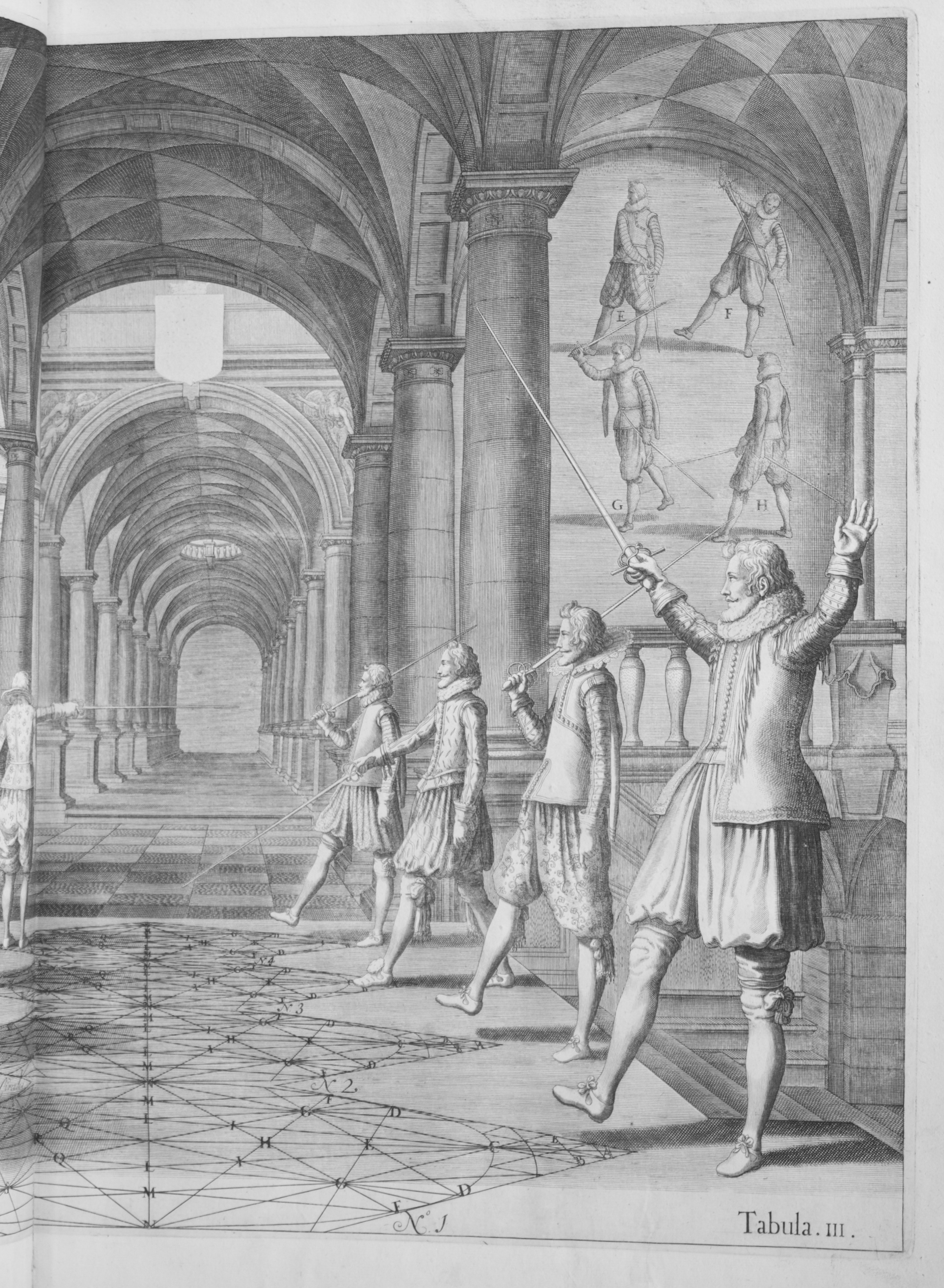
The most detailed discussion of drawing the sword that I can find is in Girard Thibault’s glorious Academie de l’espee (1630, translated by John Michael Greer in 2006, published by Chivalry Bookshelf) He devotes chapter 3 to “The Correct Way of Drawing the Sword and Entering Into Measure”. Most interesting to me is his instruction to advance on the enemy while drawing, “meeting him with a spirited resolve”.
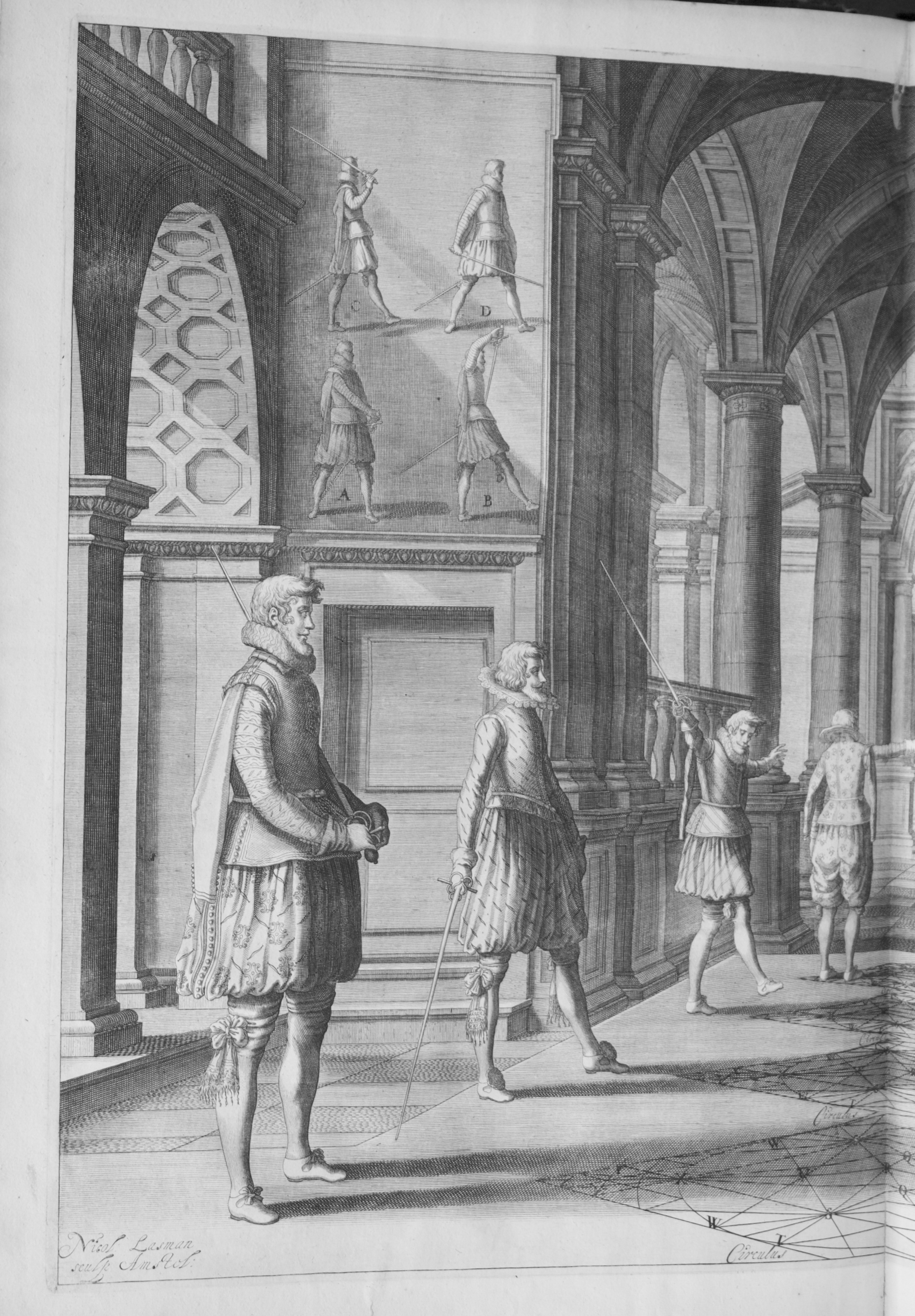
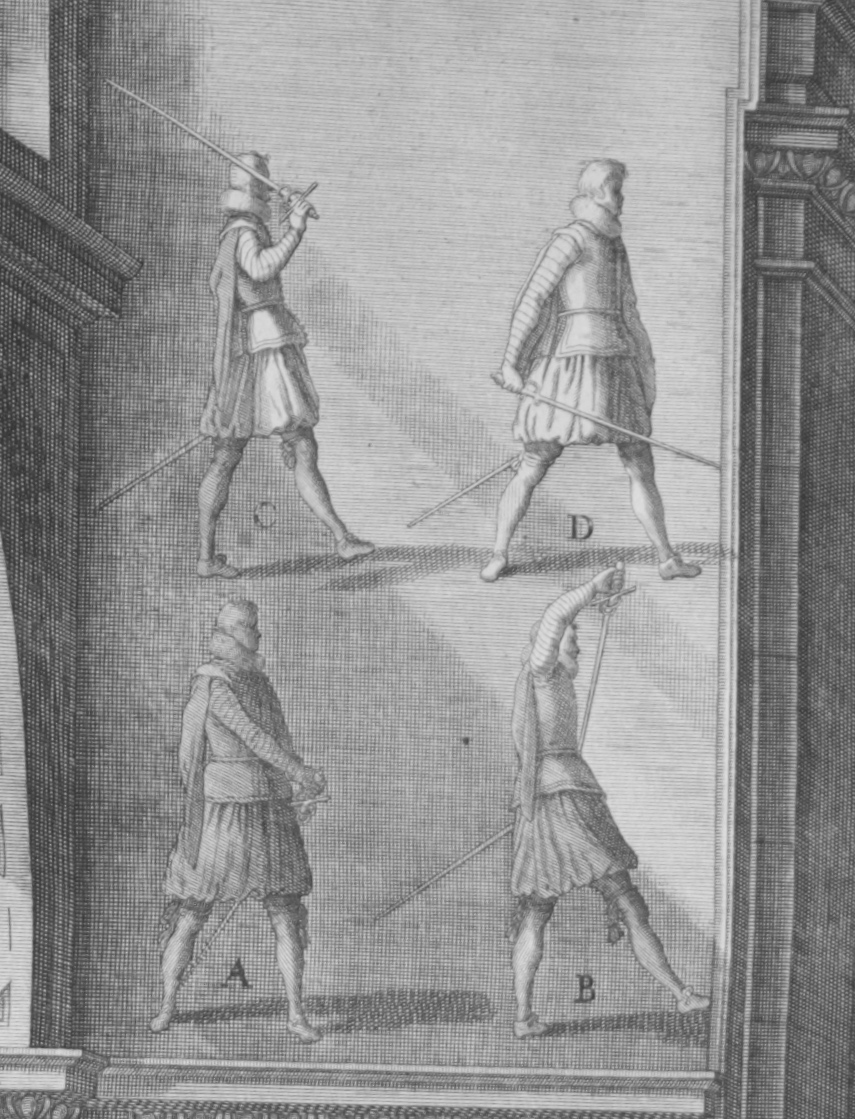
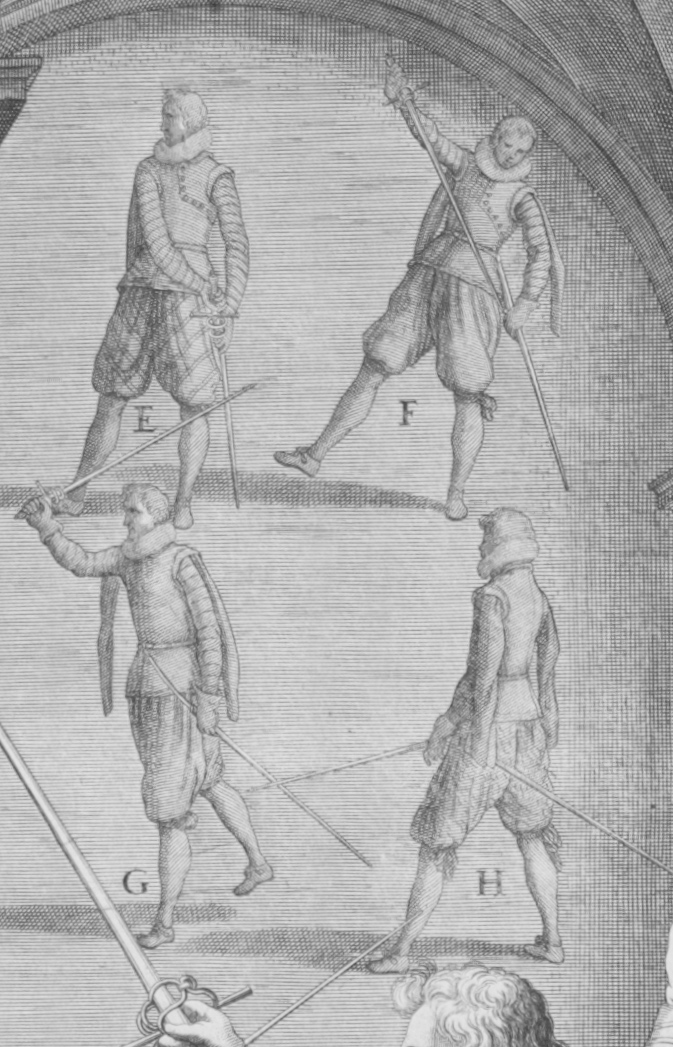
In Tabula III, up in the top left, you see four images, labelled A to D.
I will paraphrase the instructions for the sake of brevity:
A: After a few paces forwards, grab your hanger and scabbard with your left hand; step with your left foot, and as it lands, grip your sword with your right hand, with your forefinger over the outside arm of the hilt.
B: Keep stepping forwards; as your right foot lifts, grip the scabbard hard; lift your right foot higher than usual, draw the sword while opening your right hand [yes, he really says that]; pause your right foot in the air.
C: Close your right hand; turn the wrist; pick up your point in a half-circle until level with your shoulder, with your point back. Keep your arm slightly bent.
D: Bring the sword down in an overhand blow as you place your right foot; step with your left foot, and while it is moving, let the sword carry on down to your hip, while you turn the sword in your hand and put your thumb on the inside arm of the hilt. [Thibault has a very non-standard way to hold a sword.]
This goes on for another paragraph, and even with all these steps, you are still not yet in measure!
He also includes instruction on drawing while retreating, captured in images E, F, G and H, also on Tabula III.
Angelo
Domenico Angelo covers the draw briefly, in his definitive l’Ecole des Armes (1763). I use “definitive” advisedly: in Diderot’s Encyclopedie, the first true Encyclopedia ever compiled (between 1750 and 1772), the entry on fencing is simply a complete reproduction of Angelo’s book. Malcolm Fare (owner of the copy of Thibault photographed above, and proprietor of the National Fencing Museum) notes that “Diderot’s Escrime section, although undated, is believed to have been published in 1765 (see the University of Michigan’s translation project, which identifies the section as being included in vol. 4, 1765), 2 years after the first appearance of L’Ecole des Armes.” (Private correspondence, June 7th 2016.)
This is from the English translation, The School of Fencing, produced by his son Harry in 1787, pages 4-5.
The First Position to Draw a Sword
You must stand straight on you legs, with your body sideways; keep your head upright and easy, look your adversary in the face, let your riht arm hang down your right thigh, and your left arm bend towards your left hip; your left heel should be near the point of your right foot, the point of your right foot in a line with your knee, and directed towards your adversary; and, holding your sword towards the dook of your scabbard, you must present yourself in order to draw.
In this position, fixing your eyes on your adversary, bend your right arm and raise it to the height of your shoulder, and carrying your hand the to the grip of your sword, which hold tight and firm, turning your nails toward the belt, draw your sword, raising your hand in a line with your left shoulder, and make a half circle, with vivacity, over your head, presenting the point in a line to your adversary, but no higher than his face, nor lower than the last rib, holding your arm straight, without stiffness in the elbow, or the wrist; in presenting thus the point, you must raise the left arm in a semi -circle, to the height of your ear, and single your left shoulder well, that the whole body may be in a profile; which instruction cannot be too closely attended to.
This is clearly not a quick-draw method! He is describing the formal draw at the beginning of an academy bout, perhaps, or a real duel, in which all the punctilios are being observed.
Note that in all these examples the draw is always done while out of measure; there are no sources I can find to tell us how to draw quickly when surprised. Perhaps because there is nothing to it; you just pull the damn thing out as fast as you can. As I said before, I think this is also because fast-draw techniques were not traditionally part of the fight; you draw out of measure, and then the duel begins. It was thought cowardly to strike while your opponent’s weapon is still in its scabbard.
Returning to Fiore (as ever), the plays of the sword in one hand begin (as we saw) with the sword held in the same position that it would be if it were in a scabbard attached to the waist. You certainly can do these plays incorporating a draw, and it's no coincidence that the sword in one hand plays follow on from this section on drawing the sword against the dagger. But, I am enough of a purist that because Fiore chose not to show the sword in a scabbard at the beginning of the sword in one hand section, I cannot see these plays as sword draws. If they were intended as such, it would be mentioned in the text (it isn't), or shown in the pictures (it isn't). You are of course entitled to your own opinion, which you're welcome to share in the comments!
This project is being published in stages. You can get part one, The Sword in One Hand, as a free PDF by subscribing to my mailing list below, or buy it in ebook format from Amazon or Gumroad. You can get Part two, Longsword Mechanics, from Amazon or Gumroad too! This post will be edited into part one when I put the four sections (Sword in One Hand, Mechanics, Largo, and Stretto) together into one volume for print.
If you have been following The Fiore Translation Project from the beginning, you may recall that I gave myself permission to skip about in the treatise as the whimsy takes me. I had a nagging feeling that I ought to include the plays of the dagger against the sword, and the sword in the scabbard against the dagger, and so here we are.
One of the things that was stopping me getting to these plays earlier was that I realised I didn’t have them on video anywhere, so on my last trip to Seattle, when the topic came up in class, I asked the students present if they’d be happy with my videoing the demonstrations. It’s a firm principle with me that the students who show up to my classes get priority over those that don’t (for whatever reason- this is not a value judgement on those who can’t afford to fly from Thailand to America every time I teach a class there. Or are even in Seattle but have other commitments). This means that though I’m always happy having my classes videoed, I’m never going to inconvenience my class for the sake of people not present.
But they’re a nice bunch of people at Lonin, so the videos were shot and you get to watch them. Try to contain your excitement.
This section begins on folio 19r, and it immediately follows the final plays of the ninth master of the dagger. As such, it forms a beautiful segue between the dagger plays and the sword plays. First the dagger beats the sword, then the sword beats the dagger, and then we’re into the plays of the sword in one hand.
So, without further ado:
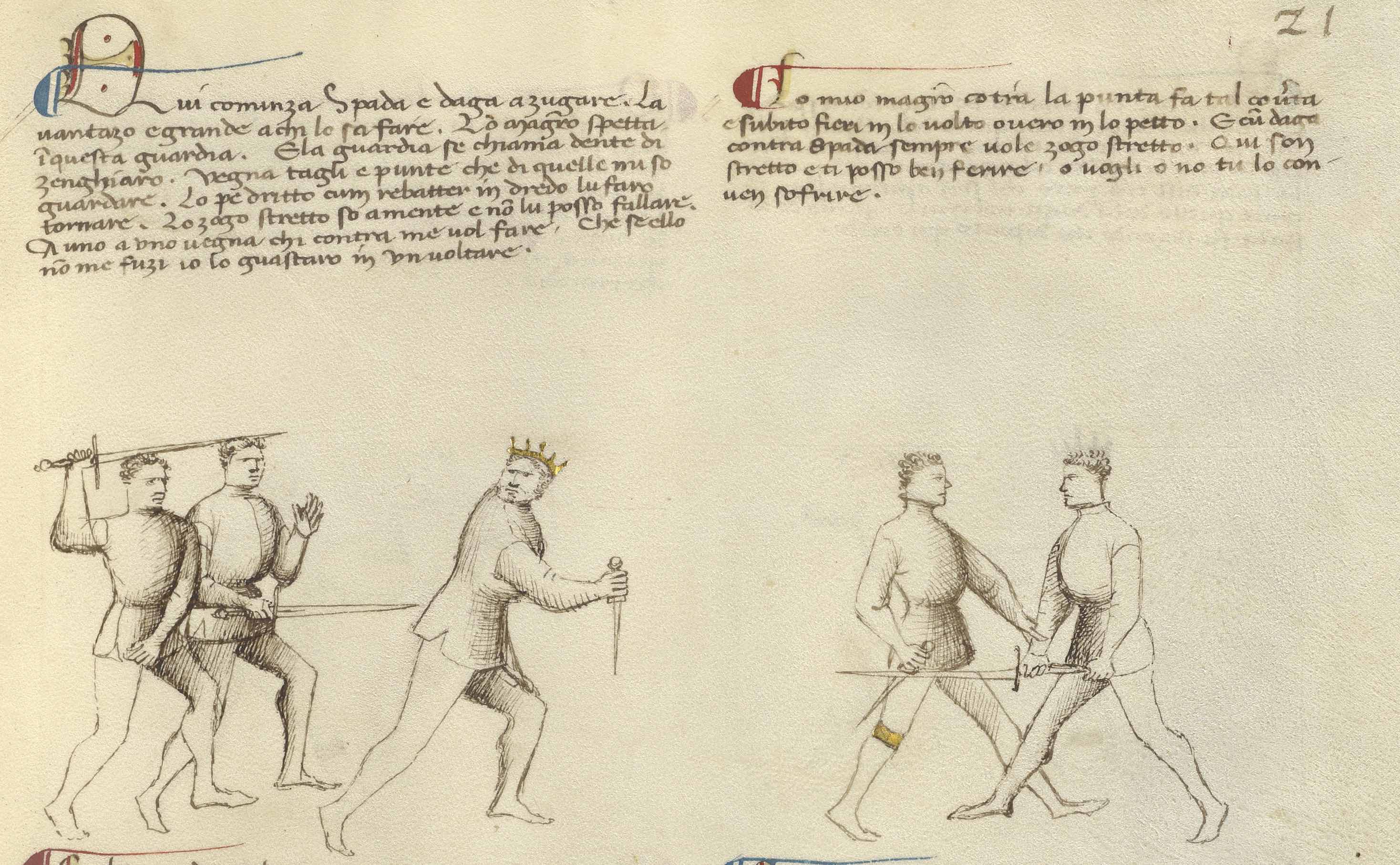
Qui cominza Spada e daga a zugare. La vantazo e grande a chi lo sa fare. Lo magistro spetta in questa guardia. E la guardia se chiama dente di zenghiaro. Vegna tagli e punte che di quelle mi so guardare. Lo pe dritto cum rebatter in dredo lu faro tornare. Lo zogo stretto so a mente e non lu posso fallare. A uno a uno vegna chi contra me vol fare. Che se ello non me fuzi io lo guastaro in un voltare.
Here begin the sword and dagger to play. The advantage is great to the one who knows how to do it. The master waits in this guard. And the guard is called the Boar’s Tooth. Come cut and thrust, I am ready for them. The right foot with the parry I will pass back. The close play I have in mind, and it cannot fail. One by one come those who wish to act against me. If they do not get away from me, I will destroy them in one turn.
Lo mio magistro contra la punta fa tal coverta e subito fieri in lo volto overo in lo petto. E cum daga contra spada sempre vole zogo stretto. Qui son stretto e ti posso ben ferire, o vogli o non tu lo conven sofrire.
My master makes this cover against the thrust, and immediately strikes in the face or in the chest. And with the dagger against the sword [you] always want close play. Here I am close and I can well strike you. Whether you want it or not, I’ll make you suffer.
The next play is the counter to the dagger’s defence:
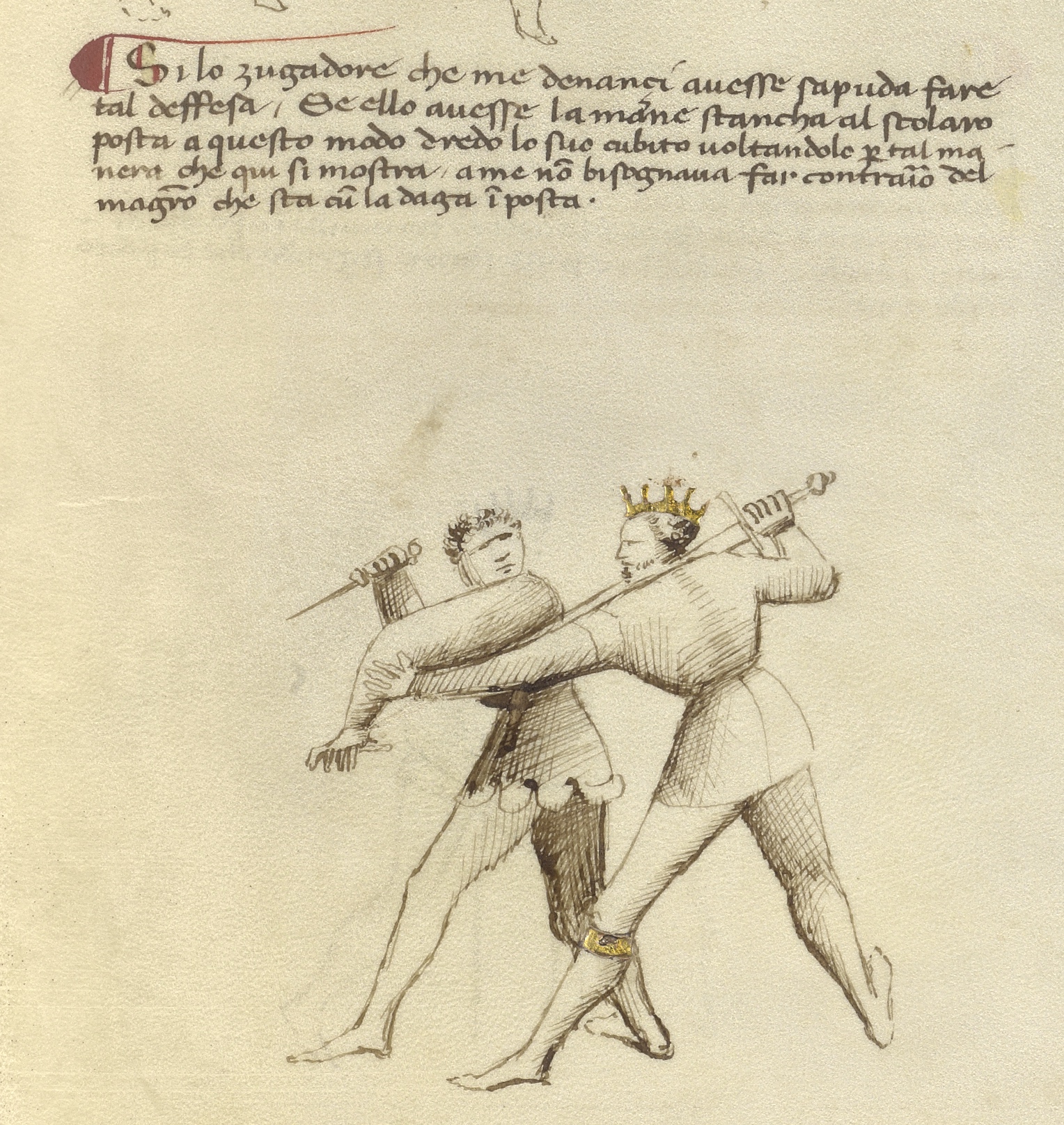
Si lo zugadore ch’e denanzi avesse sapuda fare tal deffesa, se ello avesse la mane stancha al scolaro posta a questo modo dredo lo suo cubito voltando per tal manera che qui si mostra, a me non bisognava far contrario del magistro che sta cum la daga in posta.
If the player that is before me had known to make this defence, he would have put his left hand on the scholar in this way behind his elbow, turning [him] in the way that is shown here. To me it would not have been necessary to make the counter of the master that stands with the dagger in guard.
This play and its counter are quite straightforward: here’s how I do them.
https://youtu.be/Oq4FtCBSSFM
The phrasing of the counter-remedy master’s explanation is interesting though. It reads like “if I’d known the counter to the remedy, there would have been simply no point in you doing the remedy. What a great big waste of my time.”
I should point out here that if you are starting out of measure, weapons drawn, the sword has a huge advantage over the dagger. In close, not so much. So the general advice here is sound (of course! It’s Fiore!) but I think he overstates the case regarding how easy it is to defend against the sword armed only with a dagger.
The next play is the defence against a sword cut.
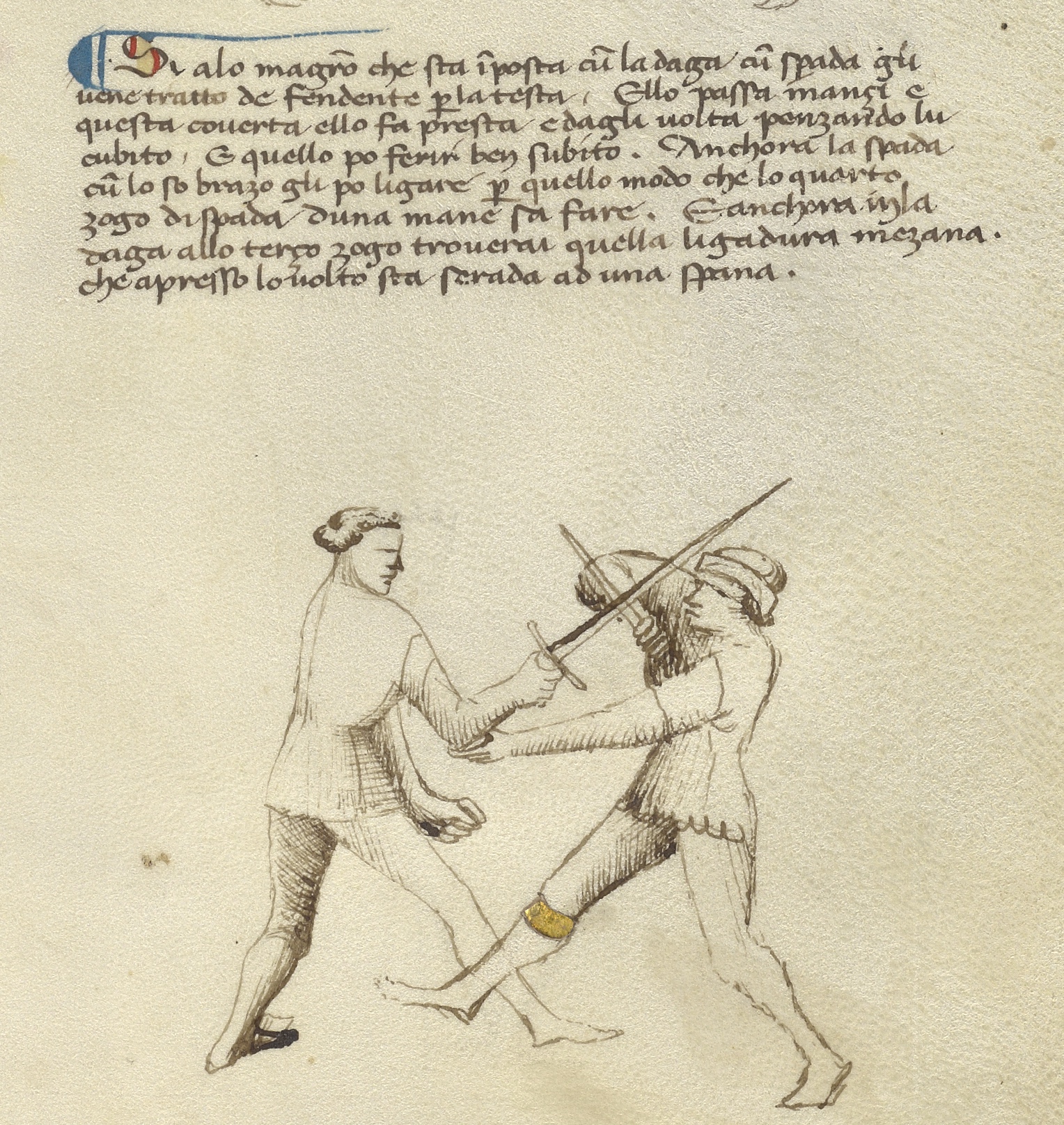
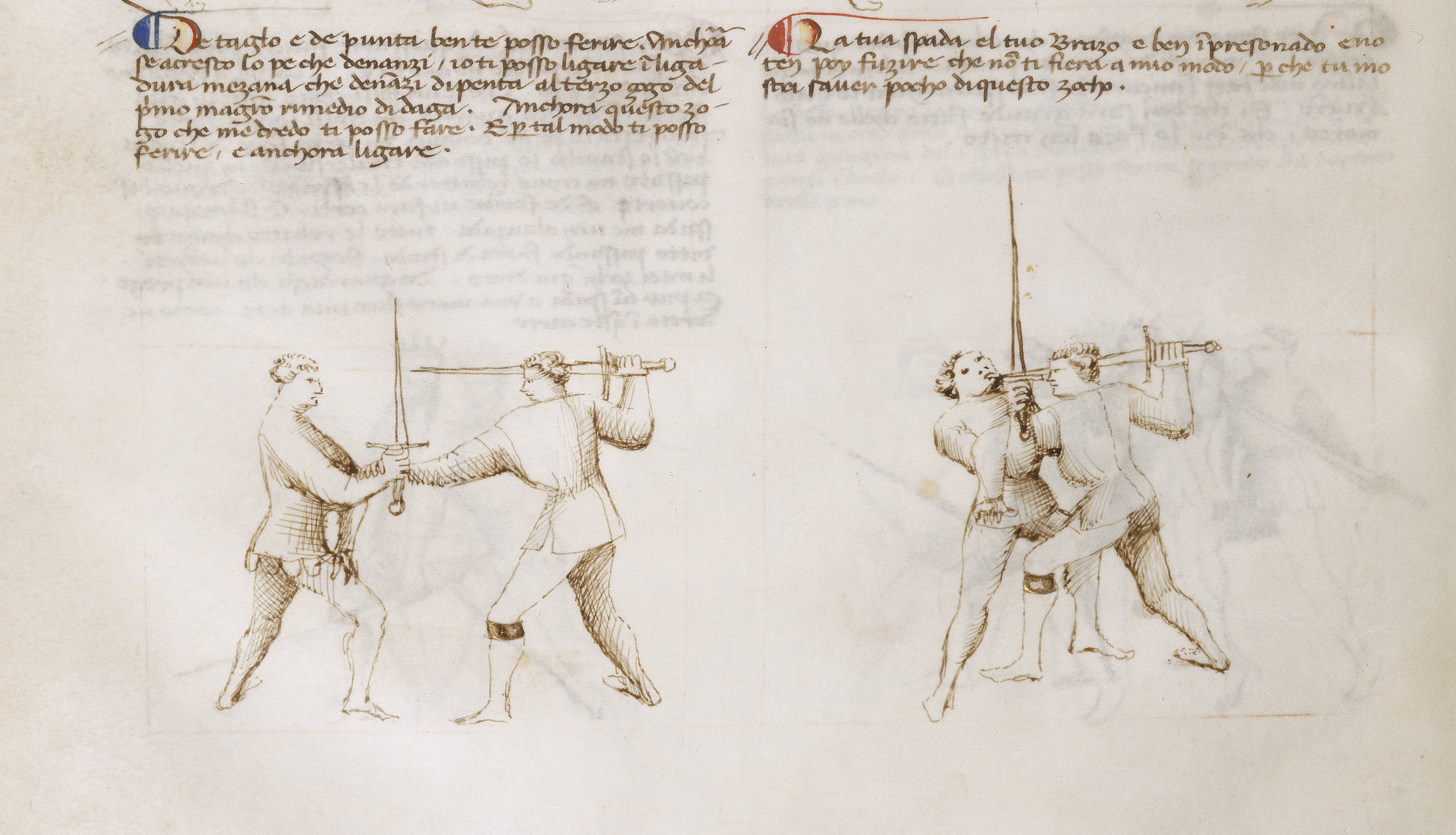
Si a lo magistro che sta in posta cum la daga contra spada gli vene tratto de fendente per la testa, ello passa inanci e questa coverta ello fa presta, e dagli volta penzando lu cubito. E quello po ferir ben subito. Anchora la spada cum lo so brazo gli po ligare per quello modo che lo quarto zogo di spada d’una mane sa fare. E anchora in la daga allo terzo zogo troverai quella ligadura mezana che apresso lo volto sta serada ad una spana.
If one had come with a fendente to the head against the master that stands in guard with the dagger against the sword, he [the master] would pass forwards and make this cover quickly, and give him [the attacker] a turn, pushing his elbow. And this must be done absolutely immediately. Also, the sword with the [attacker’s] arm can be bound in that way that the fourth play of the sword in one hand does. And also in the dagger [section] at the third play you will find that middle lock, that stands closed up within a span of the face.
This is the defence against a cut to the head. You pass in with the cover, and either push the elbow, turning the attacker so you can strike them in the back, or you wrap the sword arm with a ligadura mezana. Fiore helpfully tells us that we can find that lock shown in the fourth play of the sword in one hand, shown here on the right:
The text reads (on f20v):
La tua spada el tuo brazo e ben impresonado e no ten poy fuzare che non ti fiera a mio modo, per che tu mostra saver pocho di questo zogho.
Your sword is well imprisoned and you cannot escape without being struck in the way that I do (lit. my way), because you show that you know little of this play.
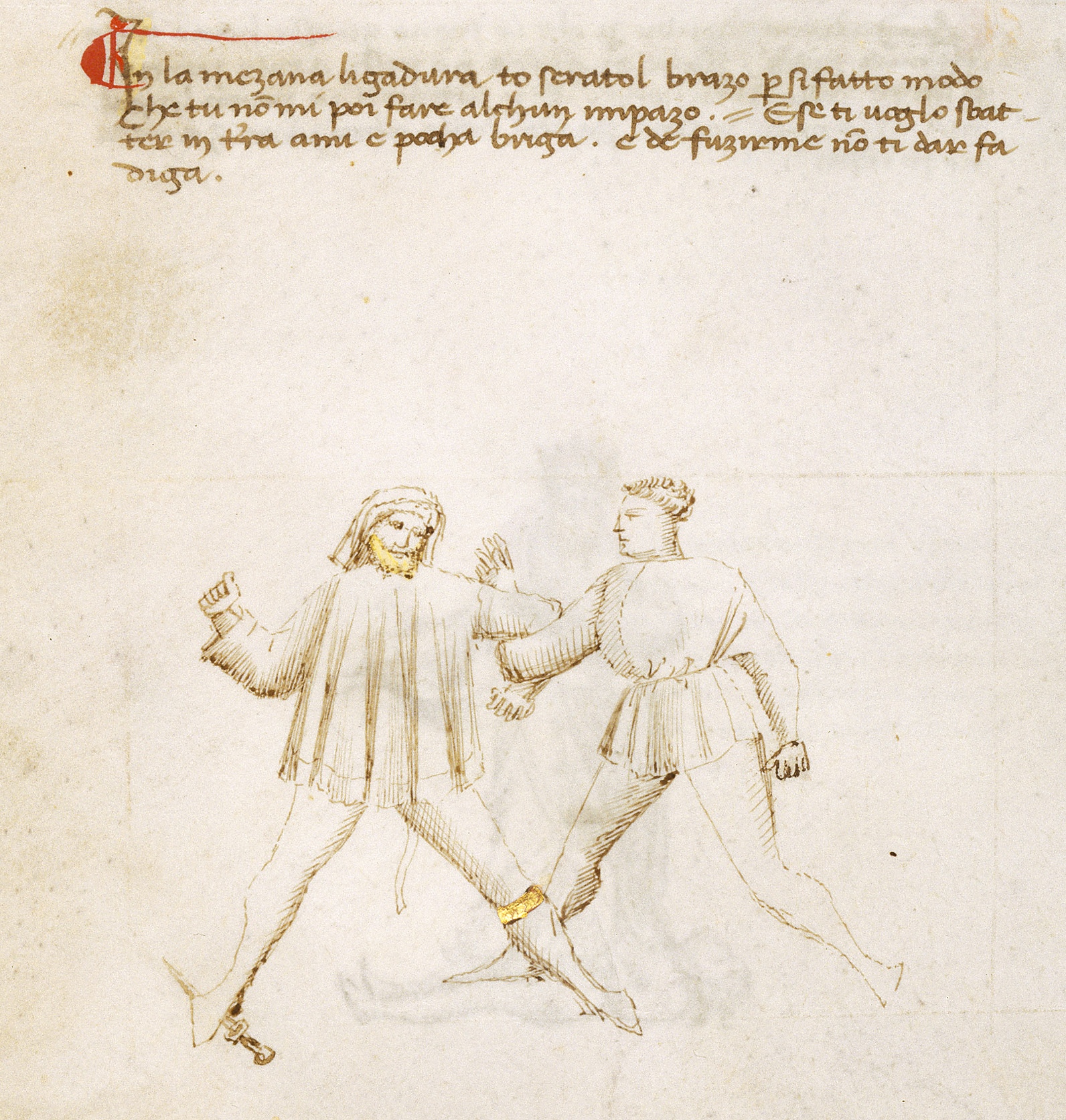
And also in the third play of the dagger (he doesn’t specify which master, but it’s clearly the first). This is from f10v:
In la mezana ligadura t’o serato ‘l brazo, per si fatto modo che tu non mi poi fare alchun impazo. E se ti voglo sbatter in terra a mi e pocha briga. E de fuzirme non ti daro fadiga.
I have locked your arm in the middle lock, in such a way that you can’t be of any inconvenience. And if I want to smash you to the ground, that’s no trouble. And don’t bother escaping from me.
He reminds us that when doing the lock, your hand should come within a span (the measurement from the tip of your thumb to the tip of your little finger when your hand is completely open) of your face. Comparing that to the image, clearly the lock isn't fully on yet.
Here's how I do these in practice:
https://youtu.be/54nkWXyJMGQ
Looking at this page as a whole, it’s clear that one of the foundational skills when dealing with the sword is to distinguish between cut and thrust. They are dealt with completely differently. The dagger only thrusts: it’s a murder spike for getting through medieval clothing and even armour. There are no cuts or slashes shown or mentioned in the entirety of the dagger section. So working through the treatise from the beginning, the sword cut on this page is the very first cut we have seen.
Against the thrust, you pass back, clear the weapon out of your way, and move in.
Against the cut, you move in, parrying closer to the centre of rotation, and so are able to actually control the blow. You then must be able to distinguish between inside and outside, which is determined by the mechanics of the sword blow you are facing, and how that interacts with your parry.
These skills will be vitally important in the rest of the sword plays.
So that’s how the dagger defeats the sword (in theory anyway). Next week we’ll have a look at how the sword in the scabbard defeats the dagger. Drawing the sword is very rarely covered in medieval sources (or indeed later ones), so it’s a special treat to be able to see some techniques that are based entirely on the draw. See you then!
This project is being published in stages. You can get part one, The Sword in One Hand, as a free PDF by subscribing to my mailing list below, or buy it in ebook format from Amazon or Gumroad. You can get Part two, Longsword Mechanics, from Amazon or Gumroad too! This post will be edited into part one when I put the four sections (Sword in One Hand, Mechanics, Largo, and Stretto) together into one volume for print.