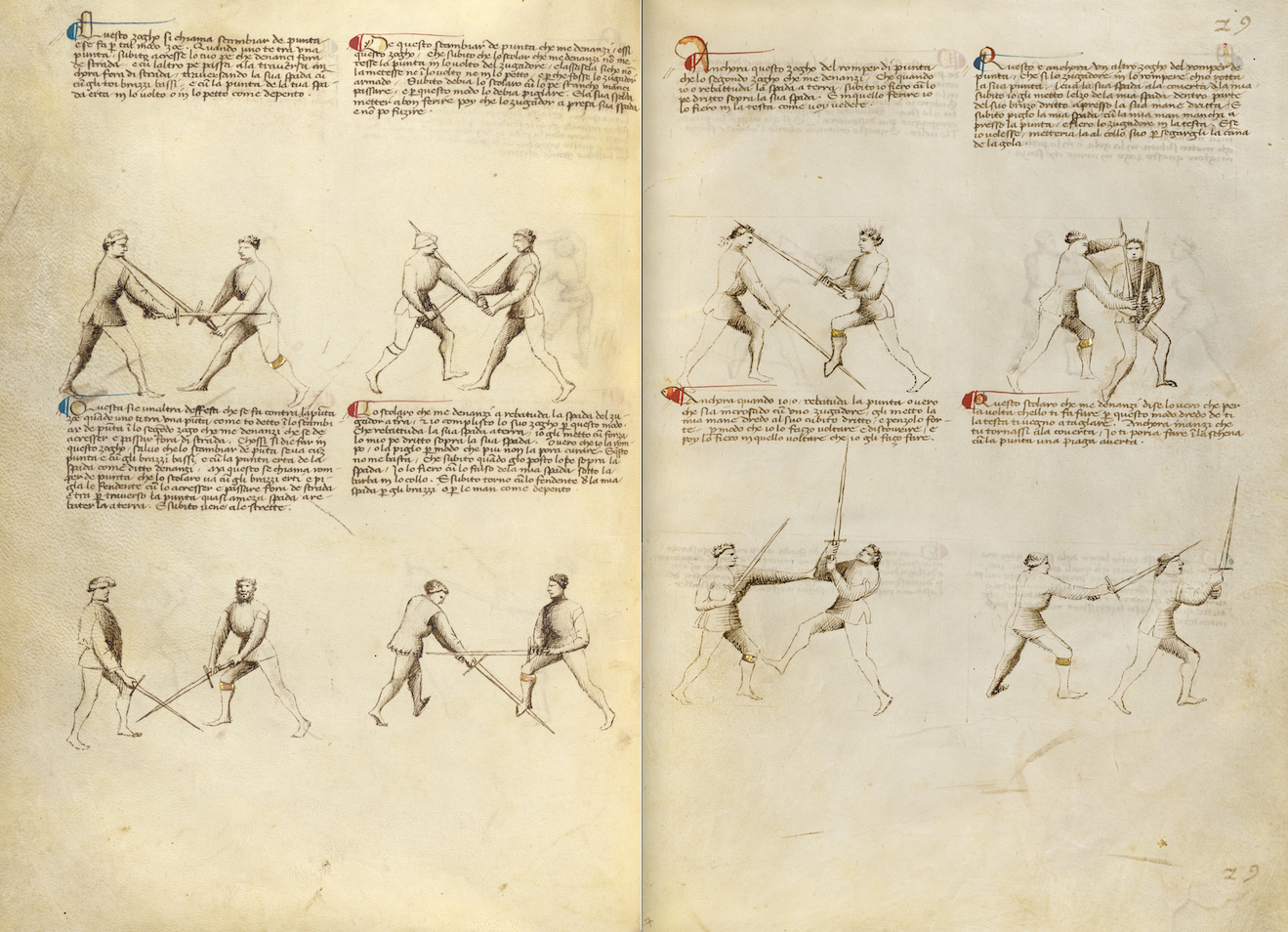
The two-page spread of plays against the thrust continues with the six plays relating to breaking the thrust. I’ll cover them all in order, starting with the 11th play of the master of the zogho largo crossed at the middle of the swords, shown on f26v.
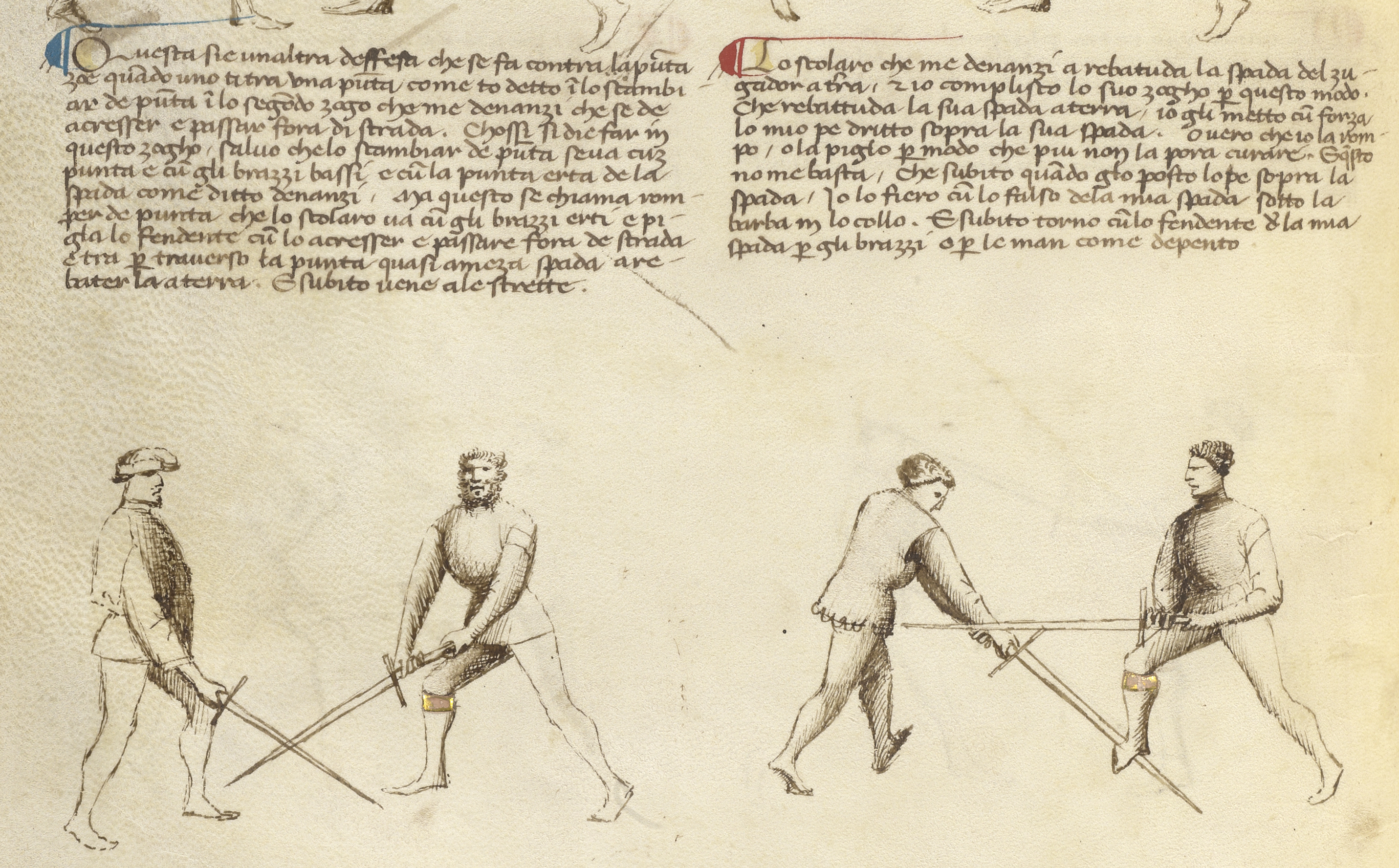
The text reads:
Questa sie unaltra deffesa che se fa contra la punta, zoe, quando uno ti tra una punta come to detto in lo scambiar de punta in lo secondo zogo che me denanzi che se de acresser e passar fora di strada. Chossi si die far in questo zogho salvo che lo scambiar de punta se va cuz punta e cum gli brazzi bassi, e cum la punta erta de la spada come ditto denanzi. Ma questa se chiama romper de punta che lo scolaro va cum gli brazzi erti e pigla lo fendente cum lo acresser e passare fora de strada e tra per traverso la punta quasi a meza spada a rebater la a terra. E subito vene ale strette.
This is another defence that is done against the thrust, so, when one thrusts at you as I said in the exchange of thrust, in the second play that is before me, one advances and passes out of the way. So you must do in this play except that in the exchange of thrust you go with the thrust, and with the arms low, and with the point of the sword high, as I said before. But this is called the breaking of the thrust, that the scholar goes with his arms high and catches the fendente with the advance and pass out of the way, and strikes across the thrust about at the middle of the sword to beat it to the ground. And immediately goes to the close plays.
The next play shows the scholar stepping on the player’s sword, like so:
Lo scolaro che me denanzi a rebatuda la spada del zugador a terra, et io complisto lo suo zogho per questo modo. Che rebattuda la sua spada a terra, io gli metto cum forza lo mio pe dritto sopra la sua spada. Overo che io la rompo o la piglo per modo che piu non la pora curare. E questo no me basta. Che subito quando glo posto lo pe sopra la spada, io lo fiero cum lo falso de la mia spada sotto la barba in lo collo. E subito torno cum lo fendente de la mia spada per gli brazzi o per le man com’e depento.
The scholar that is before me has beaten the player’s sword to the ground, and I complete his play in this way. Having beaten his sword to the ground I put my right foot forcefully on his sword. Either I break it or I grab it in such a way that he can no longer fix it [I.e. Recover from it]. And this is not enough for me. Immediately that I have put my foot on the sword, I strike with the false [edge] of my sword under the beard in the throat. And immediately return with the fendente with my sword to the arms or hands as is shown.
Here’s how I do the play in its most basic form:
https://youtu.be/gGD4KAz3JJQ
I just love the instruction to ‘strike with the false edge of your sword under the beard in the throat’. In case you weren’t certain where the throat was. This also reaffirms the general practice in this system of using multiple strikes. We aren’t playing tag, first to touch wins. A single blow may well not incapacitate the opponent. Once you have them where you want them, hit them until there’s no point continuing to do so.
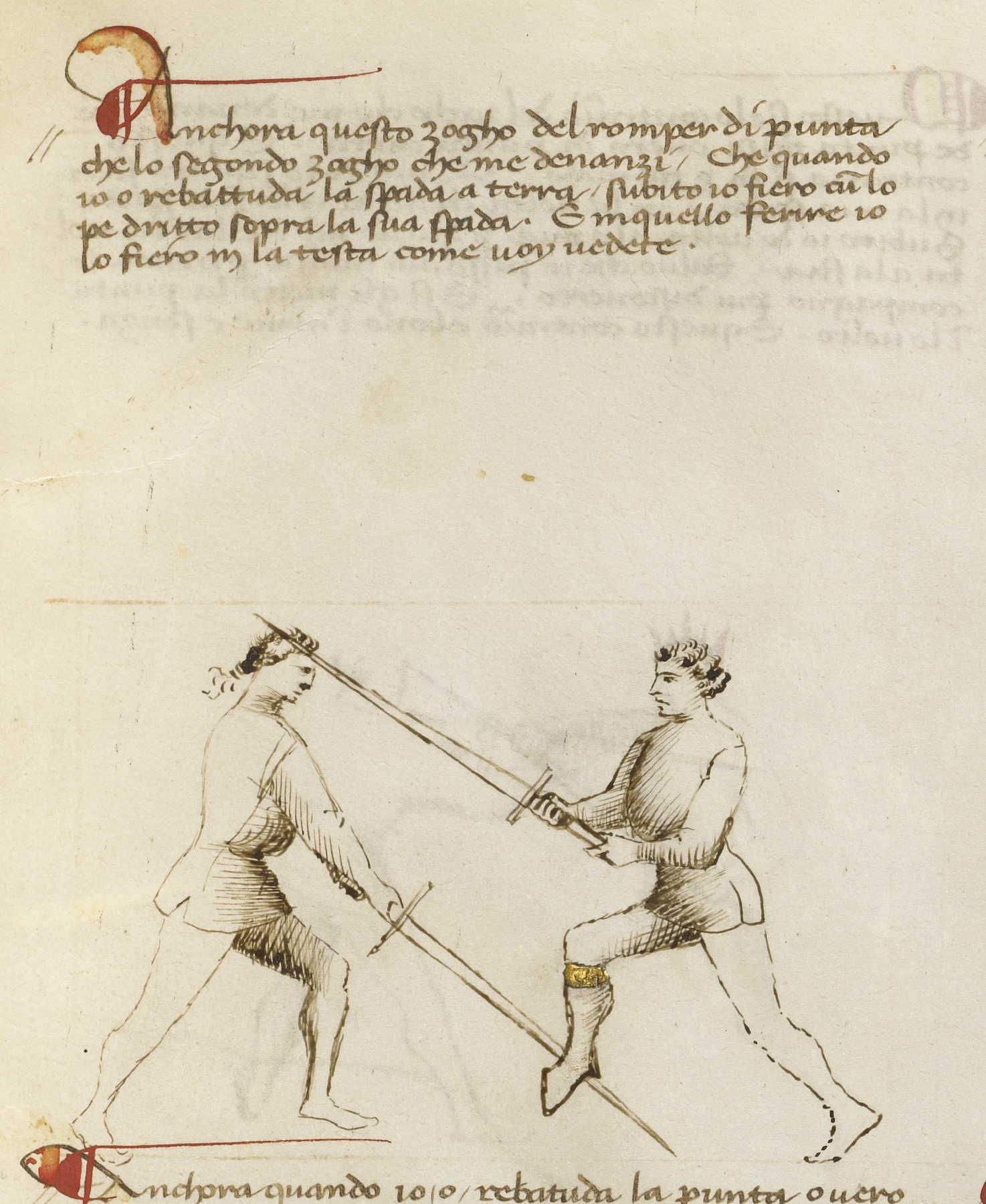
The next play, on the top left of the facing page (f27r) is also a continuation of the breaking of the thrust:
Anchora questo zogho del romper di punta ch’e lo segondo zogho ch’e me denanzi. Che quando io o rebattuda la spada a terra, subito io fiero cum lo pe dritto sopra la sua spada. E inquello ferire io lo fiero in la testa come voy vedete.
Also this play of the breaking of the thrust that is the second play that is before me. When I have beaten the sword to the ground, I immediately strike with the right foot over his sword. And in that strike I will strike him in the head as you can see.
So this is the same play as the one before it, except the strike is to a different target- directly to the head as you step on the player’s sword, rather than cutting the throat first. What follows is a way to deal with the player parrying the strike (which can only happen if you have failed to step on the sword, as indeed the first of these breaking the thrust plays shows). In practice we tend not to step on our training partners’ swords – they are likely to get damaged.
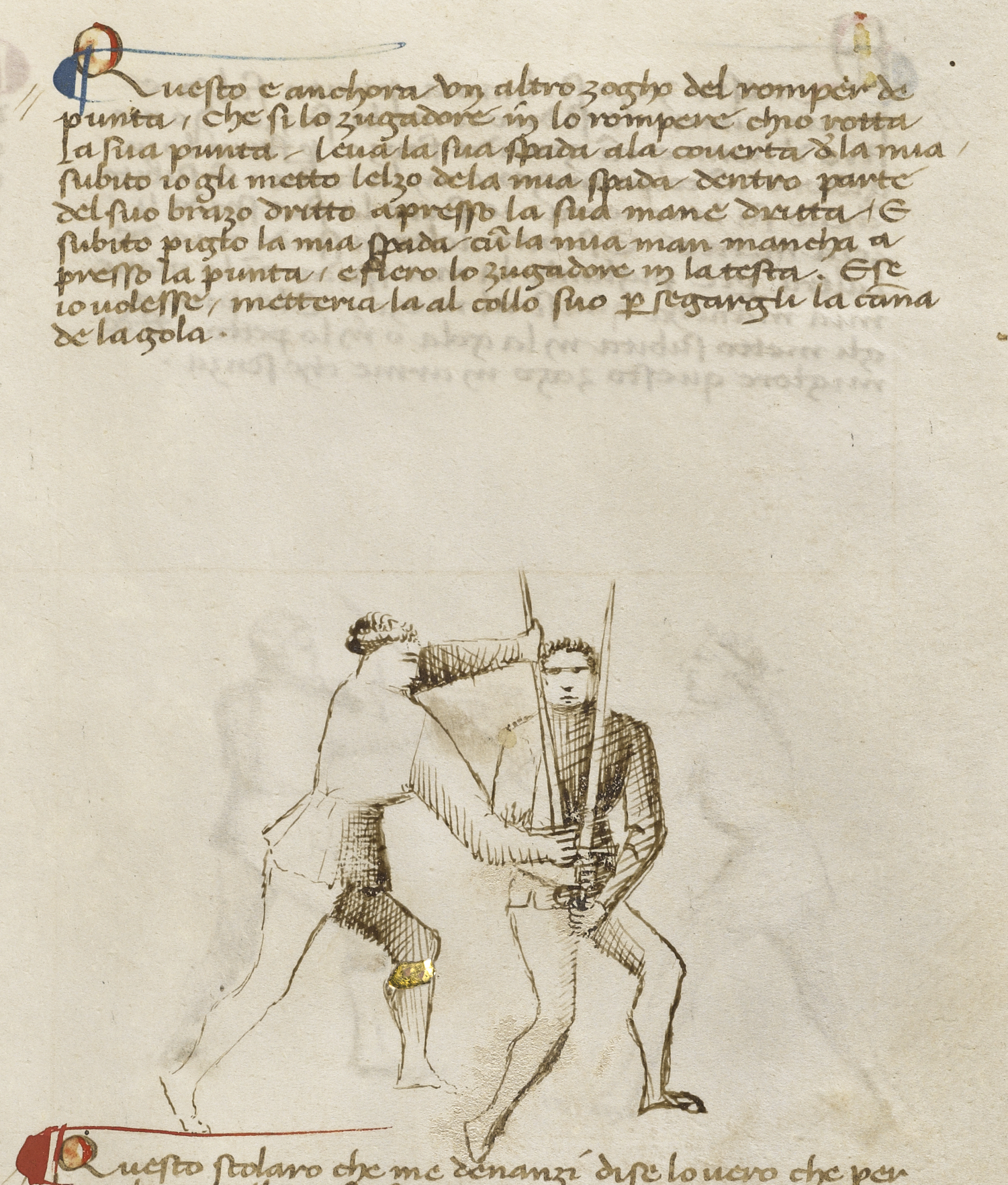
Questo e anchora un altro zogho del romper de punta, che si lo zugadore in lo rompere ch’i’o rotta la sua punta, leva la sua spada ala coverta de la mia, subito io gli metto l’elzo de la mia spada dentro parte del suo brazo dritto apresso la sua mane dritta, e subito piglo la mia spada cum la mia man mancha apresso la punta, e fiero lo zugadore in la testa. Ese io volesse, metteria la al collo suo per segargli la canna de la gola.
This is also another play of the breaking of the thrust, in which if the player, in the breaking that I have broken his thrust, lifts his sword to cover mine, I immediately put the hilt of my sword on the inside part of his right arm close to his right hand, and immediately grab my sword with my left hand close to the point, and strike the player in the head. And if I wish, I could put it to his neck to slice his windpipe.
There are a few things to note here. Firstly, though the player parries the initial riposte, his action does not count as a counter-remedy, and this scholar is not, therefore, a counter-counter-remedy master (as his lack of a crown confirms). Why not? It’s my view that because his action is not shown as a successful counter to the break, it doesn’t merit the term. As Fiore wrote in text above the first master of the dagger (f10v):
Io son primo magistro e chiamado remedio per che rimedio tanto e a dire savere rimediare che non ti sia dado e che possi dare e ferire lo tuo contrario inimigho. Per questa che meglo non si po fare la tua daga faro andar in terra. Voltando la mia mane aparte sinestra.
I am the first master and am called remedy, because remedy is as much as to say to know how to remedy, that you are not given [a blow] and can give [a blow] and strike your own counter [against] the enemy. For this it is better to make your dagger go to the ground. Turning my hand to the left side.
The definition of ‘remedy’ is quite clear- you must be able to prevent the attack from hitting you, and strike afterwards. It’s not enough just to stop the attack. You should also note the change of point of view in this passage. It begins with Fiore addressing us, the reader: ‘so that you are not given a blow’. Then it shifts to address the player so that ‘your dagger goes to the ground’ describes the play, not an instruction to us to drop our weapons! It’s worth remembering that this kind of conversational tone pervades this text.
Returning to the play in question, the player’s attempt to parry ends up with him getting his throat cut. As a matter of good training, I don’t recreate the play this way- there is really no point teaching students to parry in a way that just fails. So in this drill, I have the player countering the break with a pommel strike, closing the line of the blow to the throat or the head (or as Fiore would say, ‘passing with the cover’), which is then countered by the scholar putting their hilt over the player’s arm and following the instructions. I also tend to swap out cutting the throat with a take-down, as you can see in this video:
https://youtu.be/ttFY_EQqvU8
The last pair of plays on this page, the fifteenth and sixteenth of the second master of the zogho largo, can be done as a follow on from the breaking of the thrust, or not, as we will see:
Anchora quando io o rebatuda la punta o vero che sia incrosado cum uno zugadore, gli metto la mia mane dredo al suo cubito dritto, e penzolo forte, per modo che io lo fazzo voltare e discovrire, e poy lo fiero in quello voltare che io gli fazo fare.
Also when I have beaten aside the thrust, or when I am crossed with a player, I put my hand behind his right elbow, and push it hard, in such a way that I make him turn and be uncovered, and can strike him in that turn that I have made him do.
The next play completes this action:
Questo scolaro ch’e me denanzi dise lo vero che per la volta ch’ello ti fa fare per questo modo dredo de ti la testa ti vegno a taglare. Anchora inanzi che tu tornassi ala coverta, io ti poria fare in la schena cum la punta una piaga averta.
This scholar before me tells the truth, that by the turn that he has done to you, in that way I come to cut you from behind in the head. Also before that you would turn to parry, I could give you an open wound in the back with the point.
So, when we can reach the elbow, we can push it and strike from behind, just as we saw in the sixth play of the sword in one hand. This can be done after breaking the thrust, but also whenever we are crossed with the player (at the middle of the swords in zogho largo, at least, given the section that we are in). Notice how specific Fiore is about which elbow to push- as we saw in the 6th abrazare play, where you push ‘the elbow of the hand offending your face’, here you push the elbow of the sword arm. Pushing the other elbow may well not give you full control of the sword. And the window of opportunity is small – you must strike immediately, before they can turn back round to parry.
You can see my interpretation here:
https://youtu.be/96LDqDG9cRU
The theme of thrusting will conclude in the next post, with the punta falsa, and its counter. See you then!
This project is being published in stages. You can get part one, The Sword in One Hand, as a free PDF by subscribing to my mailing list below, or buy it in ebook format from Amazon or Gumroad. You can get Part two, Longsword Mechanics, from Amazon or Gumroad too!
Having kicked our opponent in the groin, we turn the page to see this spread:
[Note, this image is not a photograph of the manuscript opened up; I have just put the scan of each page next to each other.]The story is the same though; having dealt with a whole lot of cuts, including (if you’ll indulge me a moment) too hard, too low, and the regular kind, we now deal with thrusts. The first, and probably ideal, response is to exchange the thrust. We have seen this play before in my discussion of the eighth play of the sword in one hand.
Questo zogho si chiama scambiar de punta e se fa per tal modo zoe. Quando uno te tra una punta subito acresse lo tuo pe ch’e denanci fora de strada e cum l’altro pe passa ala traversa anchora fora di strada traversando la sua spada cum cum gli toi brazzi bassi e cum la punta de la tua spada erta in lo volto o in lo petto com’e depento.
This play is called the exchange of thrust, and it is done like this, thus. When one strikes a thrust at you immediately advance your foot that is in front out of the way and with the other foot pass also out of the way, crossing his sword with with your arms low and with the point of your sword up in the face or in the chest as is pictured.
Note the repeated ‘cum’, ‘with’. A common scribal error. Not secret messages from beyond the grave, ok? The instructions couldn’t be clearer, could they?
Rapier fencers will of course be delighted to see the classic thrust in opposition done with longswords, though one should take care to make the crossing thoroughly, and not race to get the point in. At the end of the zogho largo section, on folio 27v, Fiore wrote:
Qui finisse zogho largo dela spada a doy mani, che sono zoghi uniti gli quali ano zoghi, zoe rimedii e contrarie da parte dritta e de parte riversa. E contrapunte e contratagli de zaschuna rasone cum roture coverte ferire e ligadure, che tutte queste chose lizerissimamente se porio intendere.
Here ends the wide play of the sword in two hands, that are plays together, which plays are: remedies, and counters from the forehand and the backhand side, and counterthrusts and countercuts of ever type, with breaks, covers, strikes and binds, that all these things can be very easily understood.
I’ll discuss this translation in more depth in the post after next (there is a lot to discuss), but for now, just notice the ‘contrapunte’, counterthrust. As I see it, this refers to the exchange of thrusts. That Fiore also mentions (but as far as I can see does not show) countercuts, suggests that the lesson of this play can legitimately be applied to countering a cut with a cut.
At this stage we should remember that Fiore loves us and wants us to be happy. He understands that sometimes one might miss a stroke, and that’s okay. Because this action continues in the tenth play:
De questo scambiar de punta ch’e me denanzi, essi questo zogho, che subito che lo scholar ch’e me denanzi non mettesse la punta in lo volto del zugadore, e lassasela si che non la metesse ne in lo volto ne in lo petto, e per che fosse lo zugadore armado, subito debia lo scolaro cum lo pe stancho inanci passare, e per questo modo lo debia piglare. E la sua spada metter a bon ferire poy che lo zugador apresa sua spada e non po fuzire.
From this exchange of thrust that is before me, comes this play, that immediately that the scholar that is before me does not place the thrust in the player’s face, and leaves it such that he doesn’t place it neither in the face nor the chest, and because perhaps the player was in armour, the scholar must immediately pass forwards with the left foot, and in this way must grab. And put his sword to work with good strikes, because the player’s sword has been grabbed and he cannot get away.
So having missed our thrust, perhaps because the opponent is in armour, we pass again, grabbing the sword and striking. In practice I always teach these plays together, and you should continue with the grab whether you hit the face with the exchange or not. That way if you do miss, you’ll continue without pause.
Here are the plays in action:
https://youtu.be/JEsKnhBm_PU
Next week: breaking the thrust!
This project is being published in stages. You can get part one, The Sword in One Hand, as a free PDF by subscribing to my mailing list below, or buy it in ebook format from Amazon or Gumroad. You can get Part two, Longsword Mechanics, from Amazon or Gumroad too!
The seventh play of the sword in two hands in zogho largo punishes the opponent for offences against geometry. Pythagoras is widely credited with establishing the relationship between the lengths of the sides of a right angled triangle (though I think the Babylonians got there centuries earlier). In short, the square of the length of the hypotenuse is equal to the sum of the squares of the lengths of the other two sides. So, a right-angled triangle with sides of lengths 3 and 4 units (cm, mm, inches, miles, the unit doesn’t matter) will have a hypotenuse length of 5 (because 3×3 + 4×4 = 5×5).
Which means that the hypotenuse is always the longest side.
Your arm is attached at the shoulder, and you measure is determined by the placement of your front foot, approximately directly below your shoulder. This means that you can strike to shoulder height from further away than you can strike to shin height. If you're striking at or about shoulder height, and your opponent is striking downwards at your shin, you can be in measure to strike them while they are too far away.
This play illustrates this beautifully.
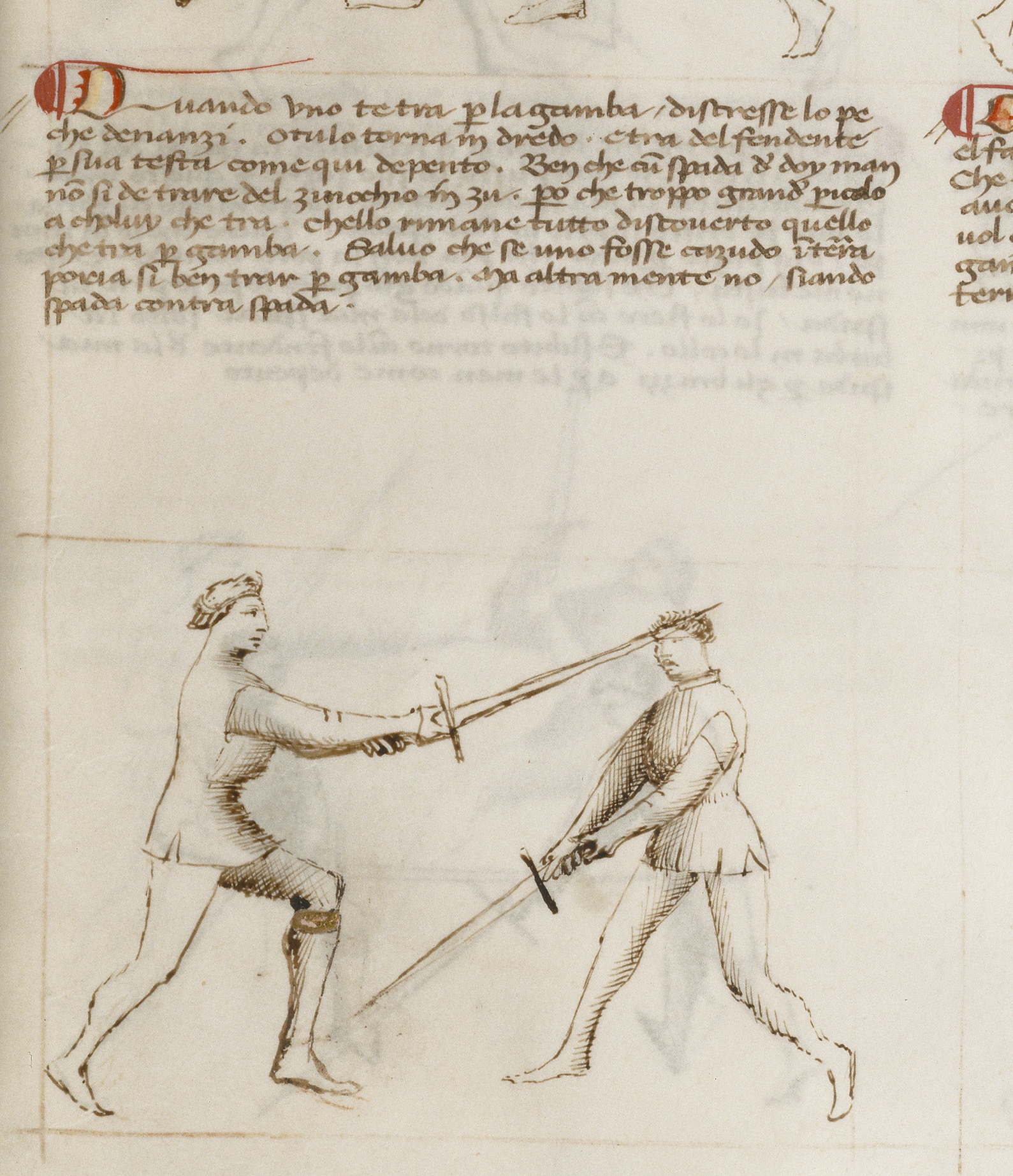
Quando una te tra per la gamba, discresse lo pe ch’e denanzi. O tu lo torna in dredo. E tra del fendente per sua testa com’e qui depento. Ben che cum spada de doy man non si de trare del zinochio in su. Per che troppo grand’ pericolo a cho luy che tra. Ch’ello rimane tutto discoverto quello che tra per gamba. Salvo che se uno fosse cazudo in terra poria si ben trar per gamba. Ma altramente no, siando spada contra spada.
When someone strikes at your leg, step the front foot back. Or you can pass it back. And strike a fendente to their head as is shown. So being with the sword in two hands, do not strike below the knee. Because there is too great a danger to the one who strikes. They, the one who strikes at the leg, would remain completely uncovered. Unless one had fallen to the ground, then you could well strike at the leg. But otherwise no, being sword against sword.
Let’s unpack this a bit:
1. When someone strikes at your leg, slip it back with a step back or a pass back.
2. And strike them in the head with a fendente.
3. With the longsword, never strike below the knee- note that this allows strikes to the thigh, and even to the knee itself.
4. If you do strike below the knee you are exposing yourself.
5. Unless you have fallen to the ground- then it’s ok to strike below the knee. One could also read that to mean if the opponent has fallen- presumably, if they are lying on the ground and the closest target is their foot, then you could strike it.
From a geometrical perspective this all makes perfect sense. And it’s very interesting to note that the fight does not necessarily stop when one player has fallen (though in a formal duelling context in this period it often would).
The set-up from this play can be as simple as your partner launching a direct attack from wide measure at your shin, or it can follow from the crossing. I see this play as an example of a general principle, not a specific technique as such.
Here's the basic play:
https://youtu.be/G8Phh4km6Q4
Please note that as with the colpo di villano, the cut to the lower leg is bad fencing. So ideally get your coach to train your response to it; don’t get comfortable with making the incorrect action.
The next play continues the geometrical theme, though less explicitly.
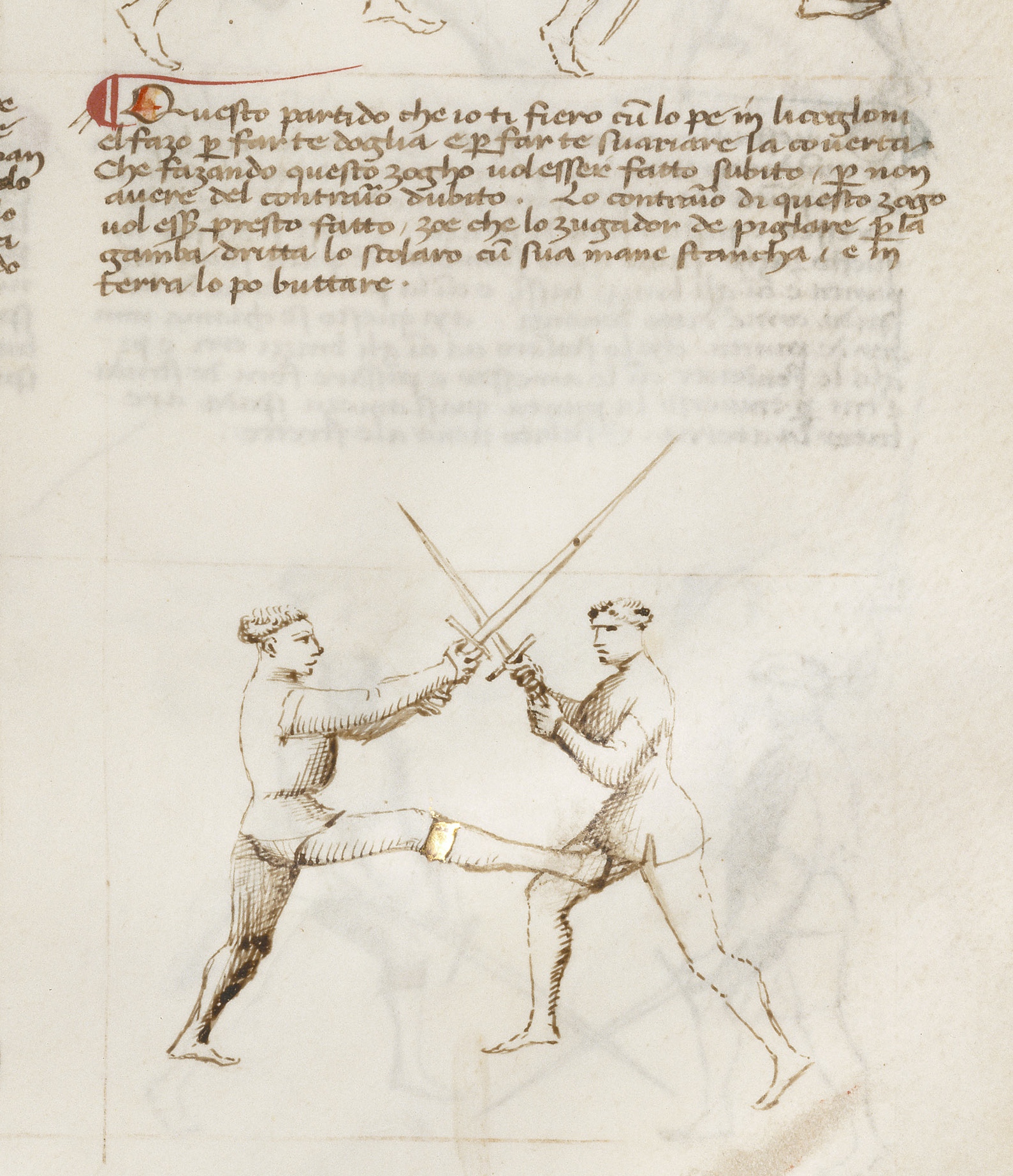
Questo partido ch’e io ti fiero cum lo pe in li cogloni el fazo per far te doglia e per far te suariare la coverta. Che fazando questo zogho volesse fatto subito, per non avere del contrario dubito. Lo contrario di questo zogo vol esse presto fatto, zoe che lo zugadore de piglare per la gamba dritta lo scolaro cum sua mane stancha, e in terra lo po buttare.
This technique is that I strike you with my foot in the balls. I do it to cause you pain, and to make your cover falter. In making this play you want to do it immediately, so you don’t have to worry about the counter. The counter to this play wants to be done quickly, thus: the player grabs the right leg of the scholar with their left hand, and can throw them to the ground.
This is quite straightforward, but note that this depends on the crossing of the swords being such that while your weapon is tied up dealing with your opponent’s, you are nonetheless able to take a foot off the ground without losing your cover.
Here it is on video:
https://youtu.be/6CXo6DcandA
What about the geometry? Well, we have seen two kicks in the zogho largo section: in plays 4 and 8. One done to the knee or shin, the other to the groin. Your foot is attached by your leg to your hip; striking at hip-height (which is pretty close to groin height) gives you the maximum reach.
For more information about kicking, hark back to this post.
Striking lower works because it’s a shorter tempo (your foot doesn’t have to go very far), but we don’t see kicks higher than the groin in this or any other medieval treatise (prove me wrong! I would LOVE to find a kick to the head in a medieval combat treatise. Why? I just like kicks).
This project is being published in stages. You can get part one, The Sword in One Hand, as a free PDF by subscribing to my mailing list below, or buy it in ebook format from Amazon or Gumroad. You can get Part two, Longsword Mechanics, from Amazon or Gumroad too!
As we saw in the 10th play of the Sword in One Hand, the solution to overwhelming force is to let it go by, while preventing it from following you. The “Peasant’s Blow”, or colpo di villano, does this by meeting the incoming sword and yielding to it, while stepping out of the way.
This is the fifth and sixth play of the master of the zogho largo crossed at the middle of the swords, on f26r.
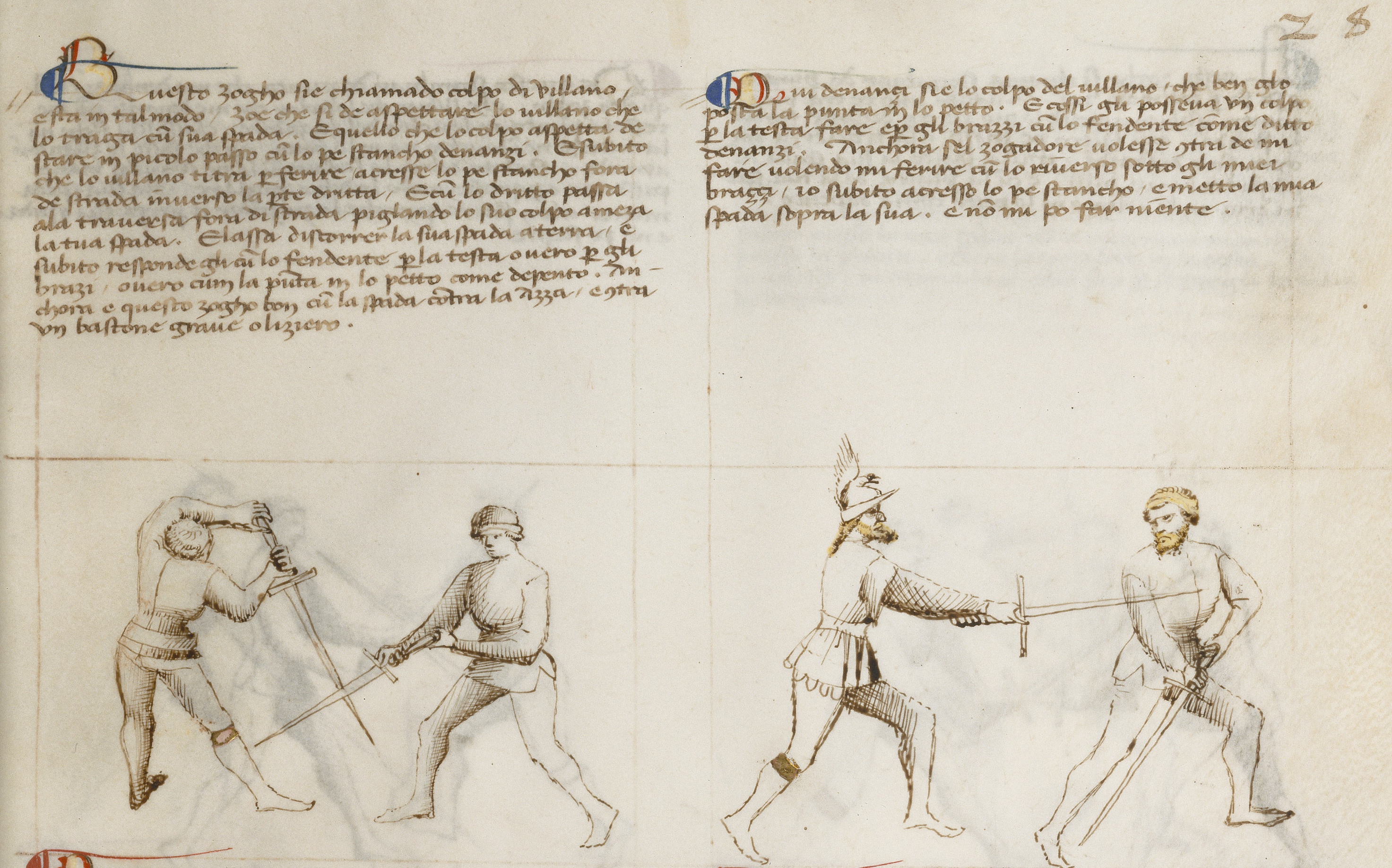
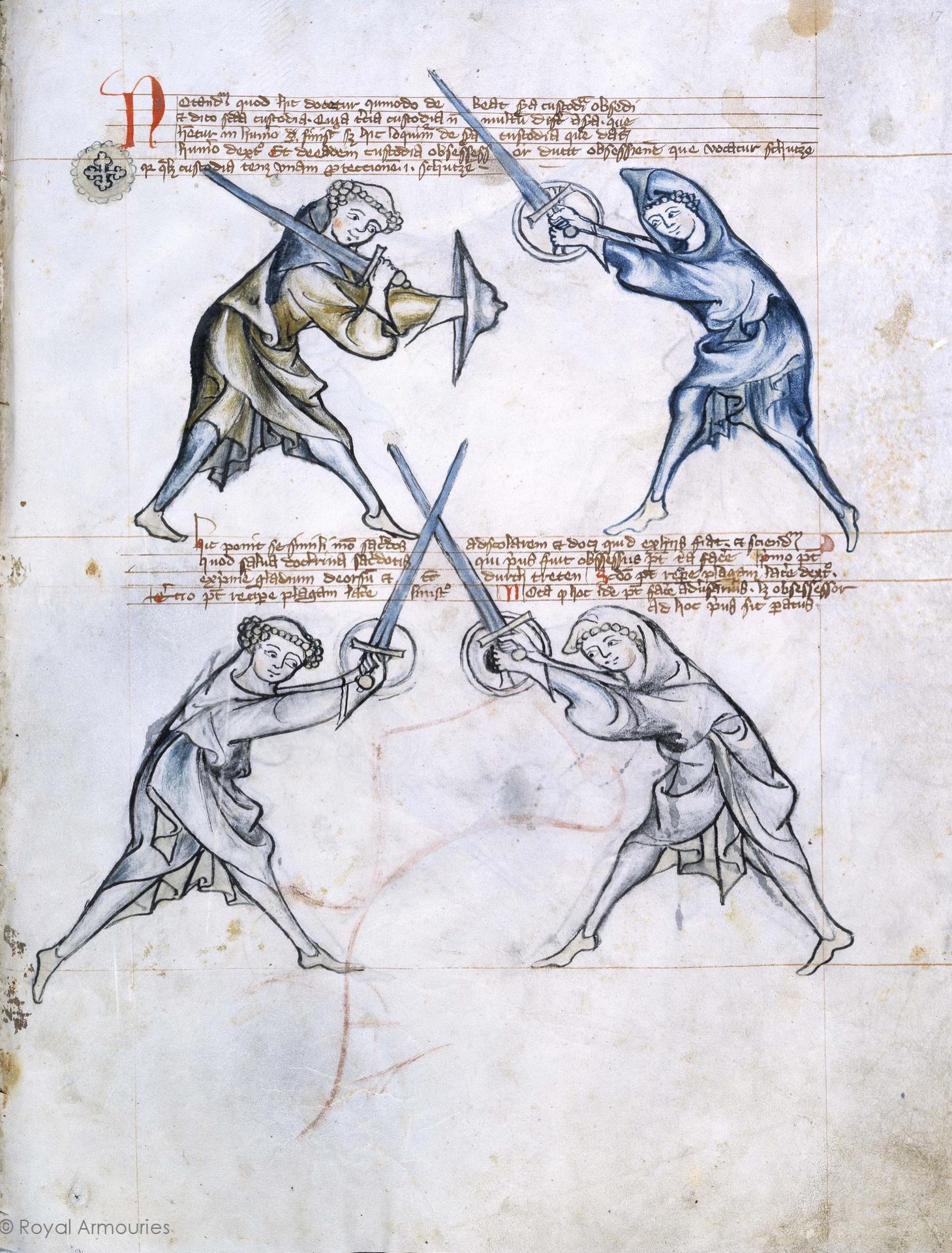
Questo zogho sie chiamado colpo di villano, e sta in tal modo, zoe, che si de aspettare lo villano che lo traga cum sua spada, e quello che lo colpo aspetta de stare in picolo passo cum lo pe stancho denanzi. E subito che lo villano ti tra per ferire acresse lo pe stancho fora de strada inverso la parte dritta. E cum lo dritto passa ala traversa fora di strada piglando lo suo colpo a meza la tua spada. E lassa discorrer la sua spada a terra e subito responde gli cum lo fendente per la testa o vero per gli brazi, overo cum la punta in lo petto com'e depento. Anchora e questo zogho bon cum la spada contra la azza, e contra un bastone grave o liziero.
This play is called the peasant’s blow, and it’s like this, thus: one awaits the peasant to attack one with his sword, and the one who waits should be in a narrow stance [piccolo passo: lit. Small pace, I.e. With the feet not too far apart] with the left foot forwards. And immediately that the peasant comes to strike, advance the left foot out of the way towards the right side [of the peasant]. And with the right pass across out of the way, grabbing his blow in the middle of your sword. And let it run off to the ground and immediately reply with the fendente to the head, or to the arms, or with the thrust in the chest as is pictured. Also this play is good with the sword against the axe, and against a staff, heavy or light.
Qui denanzi sie lo colpo del villano che ben glo posta la punta in lo petto. E cossi gli posseva un colpo per la testa fare e per gli brazzi cum lo fendente com’e ditto denanzi. Anchora s’el zogadore volesse contra de mi fare volendo mi ferire cum lo riverso sotto gli miei brazzi io subito acresso lo pe stancho e metto la mia spada sopra la sua. E non mi po far niente.
Here before is the peasant’s blow, that can well put the thrust in the chest. And thus one could do a strike to the head and to the arms with the fendente as is said above. Also, if the player might want to act against me wishing to strike me with the riverso under my arms, I immediately advance the left foot and put my sword over his. And he can do nothing to me.
I do it like so:
https://youtu.be/wi6-b0dH1EU
This play punishes an overly-hard telegraphed blow. As such it is sub-optimal to train, because one partner is repeating incorrect actions for the other to identify and exploit. That is really the domain of a paid coach, who can (and indeed is often required to) sacrifice their own training for their student’s. So when setting this up, please be careful not to incorporate peasantly striking into your system!
This project is being published in stages. You can get part one, The Sword in One Hand, as a free PDF by subscribing to my mailing list below, or buy it in ebook format from Amazon or Gumroad. You can get Part two, Longsword Mechanics, from Amazon or Gumroad too!
It might be more accurate to say, ensconced in the new study and actually getting some work done instead of unpacking boxes… Sadly, no horses involved.
Let's continue where we left off, with the next two plays of the master of the zogho largo crossed at the middle of the swords. This is from folio 25v.
The text above the first of these two plays (so, the third play of this master) reads:
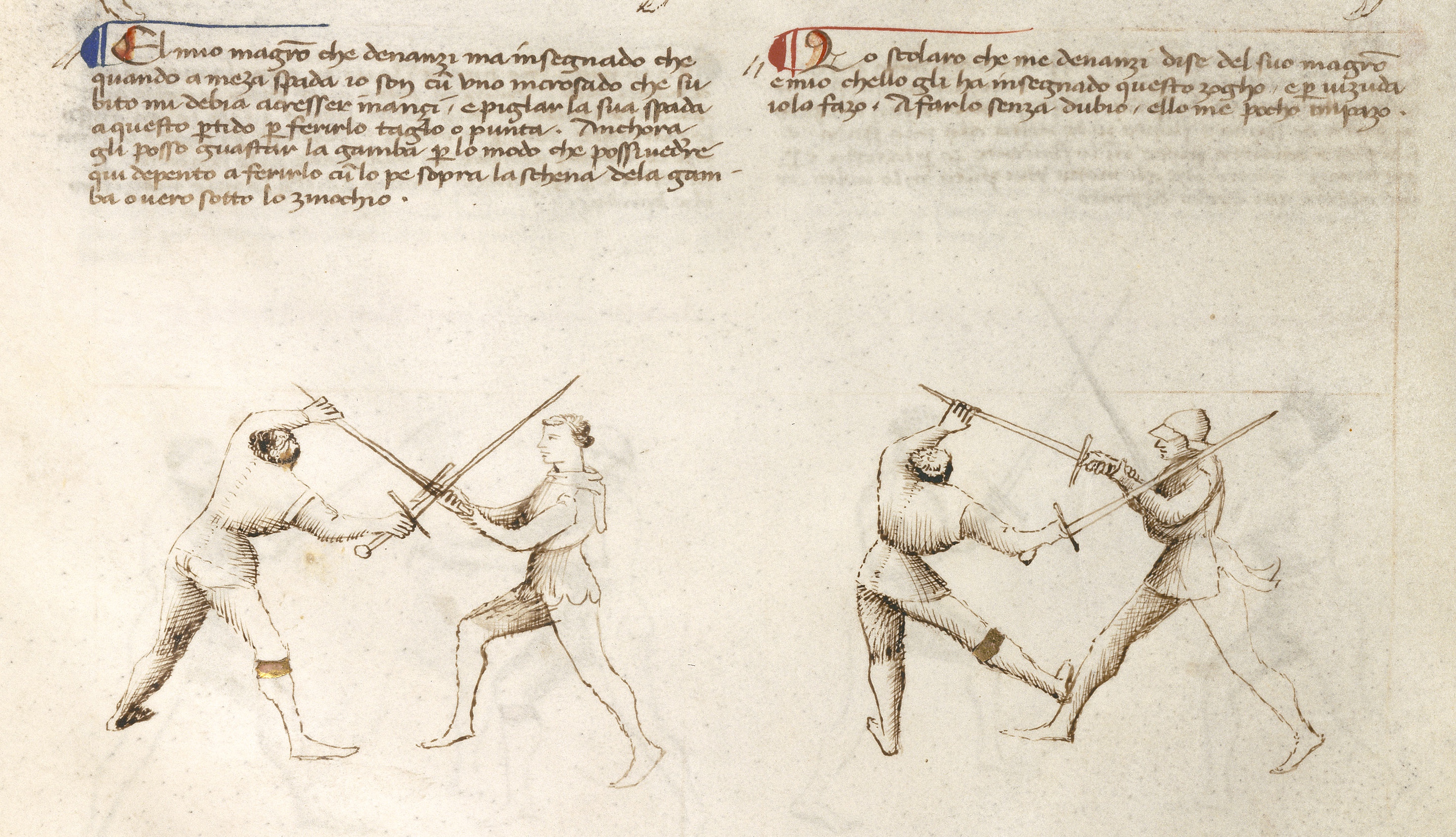
El mio magistro ch’e denanzi m’a insegnado che quando a meza spada io son cum uno incrosado che subito mi debia acresser inanci, e piglar la sua spada a questo partido per ferirlo taglo o punta. Anchora gli posso guastar la gamba per lo modo che possi vedere qui depento a ferirlo cum lo pe sopra la schena dela gamba overo sotto lo zinochio.
My master that is before [me] has taught me that when, at half sword, I am crossed with someone, that I must immediately step forwards, and grab his sword in this way, to strike him with cut or thrust. Also, I can destroy his leg in the way that you can see drawn here, by striking him with my foot in the shin, or below the knee.
And the text above the second of these plays (fourth of the master of zogho largo crossed at the middle of the swords) reads:
Lo scolaro ch’e me denanzi dise del suo magistro e mio ch’ello gli ha insegnado questo zogho, e per vizuda io lo fazo. A farlo senza dubio, ello me pocho impazo.
The scholar that is before me says that his master and mine has taught him this play, and [per vizuda– any ideas what this means?] I do it. To do it, without doubt, it is little trouble for me.
As you can see, I don’t know what per vizuda means. It seems that the translators at the Wiktenauer https://wiktenauer.com/wiki/Fiore_de%27i_Liberi#Sword_in_Two_Hands are also stuck on it, and Tom Leoni renders the paragraph in its entirety as: “the student before me cited what his and my Master taught us, which I am now doing with little trouble”, which follows the sense perfectly, but doesn’t help with the vizuda issue.
It may be related to vizio (vice): as in, I do this ‘viciously’. Thoughts?
I love demonstrating these plays with sharp swords. For those that don’t know, it’s a heart-stopping moment, as they are sure my finger are about to get sliced off. But grabbing a sharp blade is easy and safe, if you do it right, and if your opponent doesn’t twist or slice it out of your hand.
In any case, the play is quite straightforward. Here’s how I do it:
https://youtu.be/R8yrqw6tvQ0
I recommend training this without the kick, unless you are sure you can control your kicks. I cover kicking practice on the Footwork Course, or you can get a sneak peak here:
https://youtu.be/cpdHQPUNNXU
Enjoy!
This project is being published in stages. You can get part one, The Sword in One Hand, as a free PDF by subscribing to my mailing list below, or buy it in ebook format from Amazon or Gumroad. You can get Part two, Longsword Mechanics, from Amazon or Gumroad too!
Let us continue our examination of the plays of the sword in two hands in zogho largo.
The text reads:
Anchora me incroso qui per zogho largo a meza spada. E subito che son incrosado io lasso discorrer la mia spada sopra le soi mane, e se voglio passare cum lo pe dritta fuora de strada, io gli posso metter una punta in lo petto, come qui dredo e depento.
Again, I am crossed here in the wide play at middle sword. And immediately that I am crossed I let my sword run off over the arms, and if I wish to pass with my right foot out of the way, I can place a thrust in the chest, as here below is depicted.
And above the play on the right, it reads:
Lo zogho del mio magistro io lo complido, cho io ofatta la sua coverta, e subito o fatto lo suo ditto, che io oferido primo gli brazzi, e poy glo posta la punta in petto.
The play of my master I have completed, so I have made his cover, and immediately done what he said, so I have struck first the arms, and then I put the thrust in the chest.
As you can see, the Master is crossed at the middle of the swords with the player, and then steps out of the way to strike. You can start in any guard on the right, I would say, but the easiest to start with are probably posta di donna destra, or tutta porta di ferro.
Here’s how I do it in its basic form:
https://youtu.be/4k_Hl14fNGo
This action forms the basis of our ‘First Drill’, which looks like this:
https://youtu.be/1Dc9s21EDkI
Let’s have a look at all of the decisions that went into creating the first two actions of this drill (and the basic form of my interpretation of this play.) You may have come across this material before in my article One Play, One Drill, Many Questions:
Attacker ready in right side posta di donna; you wait in tutta porta di ferro
Attacker strikes with mandritto fendente, aiming at your head
Parry with frontale, meeting the middle of the attacker’s sword with the middle of your own, edge to flat
The attacker’s sword is beaten wide to your left, so pass away from it (to your right), striking with a mandritto fendente to the attacker’s left arm, and thrusting to the chest.
The answer to the question “why do you do it like that” must include answers to at least the following questions, and I’m sure you can think of more:
Why is there an attacker and defender?
Why would you wait in any guard?
Why would you wait in tutta porta di ferro?
Why is the attack coming from posta di donna?
Why is the attack a mandritto fendente?
Why is the defence a parry?
Why do you stand still to parry?
Why is the blade contact middle to middle?
Why is the blade contact edge-to-flat?
Why frontale?
Why is the attacker’s blade beaten away?
Why is the riposte a strike to the arm followed by a thrust to the chest?
Why is the passo fora di strada done to the right?
These are all fair questions, and to answer them, I will use direct quotes from the treatise wherever possible, and note any points where I have to rely on experience or other treatises. All page references are to the Getty manuscript unless otherwise noted.
Let’s start with the text on f25v: above the crowned master on the left, it says:
Anchora me incroso qui per zogho largo a meza spada. E subito che son incrosado io lasso discorrer la mia spada sopra le soi mane, e se voglio passare cum lo pe dritta fuora de strada, io gli posso metter una punta in lo petto, come qui dredo e depento.
Again, I am crossed here in the wide play at middle sword. And immediately that I am crossed I let my sword run off over the arms, and if I wish to pass with my right foot out of the way, I can place a thrust in the chest, as here below is depicted.
And above the play on the right, it reads:
Lo zogho del mio magistro io lo complido, cho io ofatta la sua coverta, e subito o fatto lo suo ditto, che io oferido primo gli brazzi, e poy glo posta la punta in petto.
The play of my master I have completed, so I have made his cover, and immediately done what he said, so I have struck first the arms, and then I put the thrust in the chest.
This begs the question, which one of the drawn figures is the “master”? We know it is the one wearing a crown because Fiore says as much in theintroduction (f2r). It is worth quoting this at some length, as we will be coming back to this section later:
The guards, or “position,” are easy to recognize. Some guards will be set against one another and will not touch one another, studying each other to see what the opponent may do. These are called poste, or guards, or First Masters of the fight. They will be wearing a crown, meaning that the position in which they wait is optimal for defense. These guards are also the foundation for carrying arms while in guard. A posta is the same as a guard. A guard (or posta) is what you use to defend or ‘guard' yourself against the opponent's attacks. A posta (or guard) is a ‘posture' against the opponent, which you use to injure him without danger to yourself.
The other Master following these four guards shows the plays that come from these guards and defends against an opponent who uses the actions deriving from the four guards. This Master, who also wears a crown, we call the Second Master or Remedy Master, since (by the rules of the art) he thwarts the attacks deriving from the poste or guards shown before,
This Second (or Remedy) Master has some students under him: these show the plays the Master or Remedy may perform after he executes the defense or grapple shown by the Remedy. These students wear an insignia below the knee. They execute all the plays of the Remedy until another Master appears who performs the counter to the Remedy and all of his students. And because he performs the counter to the Remedy and his students, this Master weans the uniform of the Remedy Master and that of his students, i.e. both the crown and the insignia below the knee. This king bears the name of Third Master or Counter, because he counters the other Masters and their plays.
(Leoni, Tom. Fiore de’ Liberi Fior di Battaglia Second English Edition, p 5)
So, given that the scholar in our second pair of figures (“play”) is wearing a garter (an “insignia below the knee”), it is clear that the crowned figure is a remedy master, who is defending against the player. Thus, while it is obvious from the second play who is hitting whom, we can be equally sure that the crowned figure is the one defending in the first play.
It is also stated in the introduction that guards may be “positions in which [the masters] wait [that are] optimal for defense.”
1. Why is there an attacker and defender? and 2. Why would you wait in any guard?
So our first question, why is there an attacker and defender, can be answered along the lines of: because that is how the play is presented in the book. It seems that this is a defence done from a stationary guard, against an awaited attack.
Note that I am not suggesting that this is the only possible, useful, or common, set-up: we do all of these drills also from a moving starting point, but we can state with confidence that it is part of Fiore’s Art to wait in guard for the attack. This also answers question 2, why would you wait in any guard: because Fiore says to. So, why tutta porta di ferro?
3. Why would you wait in tutta porta di ferro?
We know that the master has “covered”, which term is used elsewhere quite explicitly to mean “parry”, such as in the plays of the master of the sword in one hand. The text above that master reads (f20r): “E in quello passare mi crovo rebattendo le spade” “And in that pass I cross, beating the swords”. On the next page, the text above his first scholar includes “Quello che a ditto lo magistro io l’o ben fatto, zoe, ch’io passai fora de strada facendo bona coverta” “That which the master has said I have done well, thus, I have passed out of the way making a good cover.” Cover = parry seems reasonable.
We also know that the cover has been done from the right side, because of the way the swords are drawn. It is highly impractical to parry as shown, if you chamber the sword on your left. So we are looking for a guard with the sword chambered on the right, which would imply a left foot forwards stance, and one which can parry, and in which it is good to wait.
The text above tutta porta di ferro (f23v) reads:
Qui comminzano le guardie di spada a doy man. E sono xii guardie. La prima sie tutta porta di ferro che sta in grande forteza. Esi e bona daspetar ognarma manuale longa e curta. E pur chel habia bona spada non cura di troppa longeza. Ella passa cum coverta e va ale strette. E la scambi le punte e le soy ella mette. Anchora rebatte le punte a terra e sempre va cum passo e de ogni colpo ella fa coverta. E chi in quella gli da briga grand’ deffese fa senza fadiga.
Here begin the guards of the sword in two hands. There are 12 guards. The first is the whole iron gate, that stands in great strength. And she is good to await every manual weapon, long and short, and for which it has a good sword, that is not too long. And she passes with a cover and goes to the close [plays]. She exchanges the thrust and places her own. She also beats the thrusts to the ground and always goes with a pass and against all blows she makes a cover. And standing in this guard, one may easily make a defense against anyone who bothers him.
So, left foot forwards, “good to await every manual weapon”, “passes with the cover”, “against all blows she makes a cover” and “one may easily make defence”: this guard seems like a reasonable choice.
4. Why is the attack coming from posta di donna?
It appears to me from the image of the player that the attack is a descending blow from the right (mandritto fendente), done with a pass forwards, because the player is right foot forwards. Though Fiore never says so, it is generally accepted that longsword blows are usually struck with a passing step, from the side the blow comes. Experience shows that when cutting from the right, you can strike more easily if your right foot is forwards; and it is necessary to initiate the attack with the motion of the sword to prevent exposing yourself as you step forwards; this results in most mandritto attacks from one step out of measure being executed with the pass of the right foot. (This could use better supporting evidence; indeed a full and detailed academic study of cutting mechanics is long overdue. My next article project, perhaps.)
Whatever guard we chose should therefore be left foot forwards, to allow the passing step, and with the sword chambered on the right. Posta di donna destra is one such. The text above it reads:
Questa sie posta di donna che po fare tutti gli setti colpi de la spada. E de tutti colpi ella se po crovrire. E rompe le altre guardie per grandi colpi che po fare. E per scambiar una punta ella e sempre presta. Lo pe che denanzi acresse fora di strada e quello di driedo passa ala traversa. E lo compagno fa remagner discoverto, e quello fe ferir subito per certo.
This is the woman's guard, that can make all seven blows of the sword. And she can cover against all blows. And she breaks the other guards with the great blows she can make. And she is always quick to exchange a thrust. The foot which is in front advances out of the way, and that which is behind passes across. And she makes the companion remain uncovered and can immediately strike him for certain.
So there is nothing there to suggest it would be a bad choice. And if we refer back to the introduction, “Some guards will be set against one another and will not touch one another, studying each other to see what the opponent may do.” It seems fitting to me to begin the paired longsword drills in our syllabus with one such pair: the first two guards of the sword in two hands.
5. Why is the attack a mandritto fendente?
Firstly, it is a very common and natural blow; an instinctive strike. Secondly, the image of the player has the sword approximately where it would be when a mandritto fendente is parried. He is right foot forwards, the swords are crossed clearly on the each others’ left, and his point is high.
6. Why is the defence a parry?
As we have seen: because the text above the scholar says it was (“coverta”). And because parrying is what most people naturally do when attacked.
7. Why do you stand still to parry?
In the first place, Fiore does not specify any footwork to be done during the parry. This is in contrast to other plays where footwork (such as an accrescere fora di strada and passo ala traversa) is specified during the defence, as it is in the colpo di villano (f26r), exchange of thrust and breaking the thrust (f26v), the plays of the sword in one hand (f20r-f21v), and the play of the sword from dente di zenghiaro or any other left side guard (f31r). Standing still fits with the “waiting” associated with our chosen guard and is academically supportable in the absence of any other data. However, there may be good reason to step back (and offline) while parrying, especially if put under time pressure by the attacker (stepping away buys more time to act). I discard the possibility of passing in with the left foot here because it makes no mechanical sense given the parry that is clearly shown from the right, and the measure as illustrated does not support it. As this drill is taught to beginners, it makes sense to start at least with the simplest possible set-up.
8. Why is the blade contact middle to middle?
The blade contact is middle to middle because the text explicitly refers to “meza spada”, which we understand to mean about half way down the blade. This is in context with the previous master, crossed at the punta di spada, here:
The text states “Questo magistro che qui incrosado cum questo zugadore in punta de spada” “This master that is here crossed with this player at the point of the sword.”
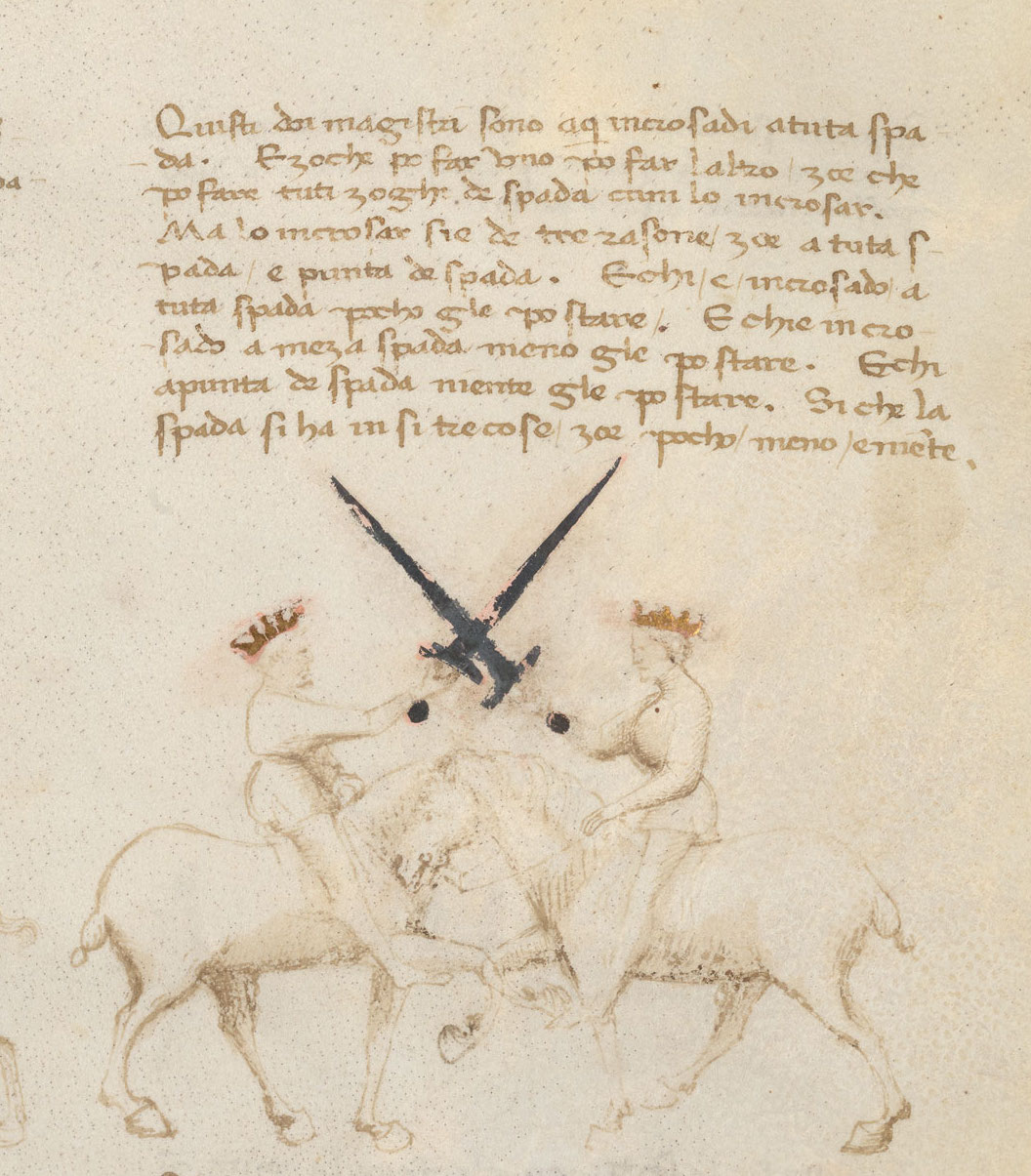
Furthermore, we can refer to the Morgan MS, which describes three crossings of the sword:
Top right image from f6r.
Quista doi magista sono aq incrosadi a tuta spada. Ezoche po far uno po far l'altro zoe che po fare tuti zoghi de spada cham lo incrosar. Ma lo incrosar sia de tre rasone, Zoe a tuta spada e punta de spada. Echi e incrosado a tuta spada pocho gle po starre. Echie mezo ?sado? a meza spada meno gle po stare. Echi a punta de spada niente gle po stare. Si che la spada si ha in si tre cose. zoe pocho, meno e niente.
These two masters are here crossed a tuta spada. And what one can do the other can do, thus they can do all the plays of the sword from the crossing. But the crossing is of three types, thus a tuta spada and at punta de spada. And the crossing a tuta spada little can it withstand. And meza spada less can it withstand. And a punta de spada nothing can it withstand. And so the sword has in it three things, thus: little, less and nothing.
Comparing these three images, it is incontrovertible that the reference “meza spada” here means “at the middle of the blades”.
In practical terms, we also find that with an open-hilted sword like a longsword, it is dangerous to parry close to the hands (for extra leverage), and to make the beating parry that Fiore describes (rebattando) the optimum balance between power and leverage, and the optimum place to aim for on the opponent’s weapon, is indeed the middle of each.
9. Why is the blade contact edge-to-flat?
It is obvious from the description that this parry is a blow of some sort, and it is clear from the illustration that it is done from the right, which means it can only reasonably be done with the true edge of the sword. The illustration clearly shows this, in my view. When striking at the opponent’s sword, it makes mechanical and practical sense to aim at his flat. This is because a) it is the weakest line of the sword itself b) it is unlikely to be supported by the opponent (see Finding Bicorno for details on this) and c) it reduces damage to your sword by spreading the contact over a larger surface than an edge-to-edge parry.
10. Why frontale?
When parrying up from a low guard, the blow you use is effectively a mandritto sottano. (A rising forehand blow.)This could be done with either edge, but for mechanical reasons I prefer the true edge. The natural ending point of a true-edge sottano aimed at the sword (as opposed to the opponent) is either a fenestra or frontale type position. For the argument regarding blows beginning and ending in guards, see both Angelo Viggiani’s Lo Schermo, and also Fiore’s statements on f23r regarding fendenti “E ogni guardia che si fa terrena, Duna guardia in laltra andamo senza pena” “And all guards that are made low, from one guard to the other we go easily”. Likewise, sottani can “remanemo in posta longa” “remain [i.e. end] in posta longa”. That Fiore provides us with the guard frontale, and says that “per la incrosar ella e bona” “she is good for crossing”, is a bonus.
Of course, if you are parrying from a high guard, then you would be parrying with a fendente, and will not arrive in frontale, so the instruction would change.
11. Why is the attacker’s blade beaten away?
The instruction that immediately follows the parry is to let your sword run off over the opponent’s arms. If his sword is still coming towards you, or indeed is stationary but close to your face, you just can’t do that without getting hit. One of the functions of the parry, as we see from the text, is to leave the opponent “uncovered”. If his sword is in the way, he is clearly covered. The treatise abounds with alternative actions after the parry, which deal with other contexts (such as the opponent’s sword being grabbed); it seems clear that in this case, the sword has simply been beaten away by the parry as the defender intended. You see a similar situation in the second play of the sword in one hand, f20v.
12. Why is the riposte a strike to the arm followed by a thrust to the chest?
Let’s start with the text, which I’ll repeat here to save you scanning back for it:
Above the crowned master it says:
Anchora me incroso qui per zogho largo a meza spada. E subito che son incrosado io lasso discorrer la mia spada sopra le soi mane, e se voglio passare cum lo pe dritta fuora de strada, io gli posso metter una punta in lo petto, come qui dredo e depento.
Again, I am crossed here in the wide play at middle sword. And immediately that I am crossed I let my sword run off over the arms, and if I wish to pass with my right foot out of the way, I can place a thrust in the chest, as here below is depicted.
And above the play on the right, it reads:
Lo zogho del mio magistro io lo complido, cho io ofatta la sua coverta, e subito o fatto lo suo ditto, che io oferido primo gli brazzi, e poy glo posta la punta in petto.
Which I translate as: “The play of my master I have completed, so I have made his cover, and immediately done what he said, so I have struck first the arms, and then I put the thrust in the chest.”
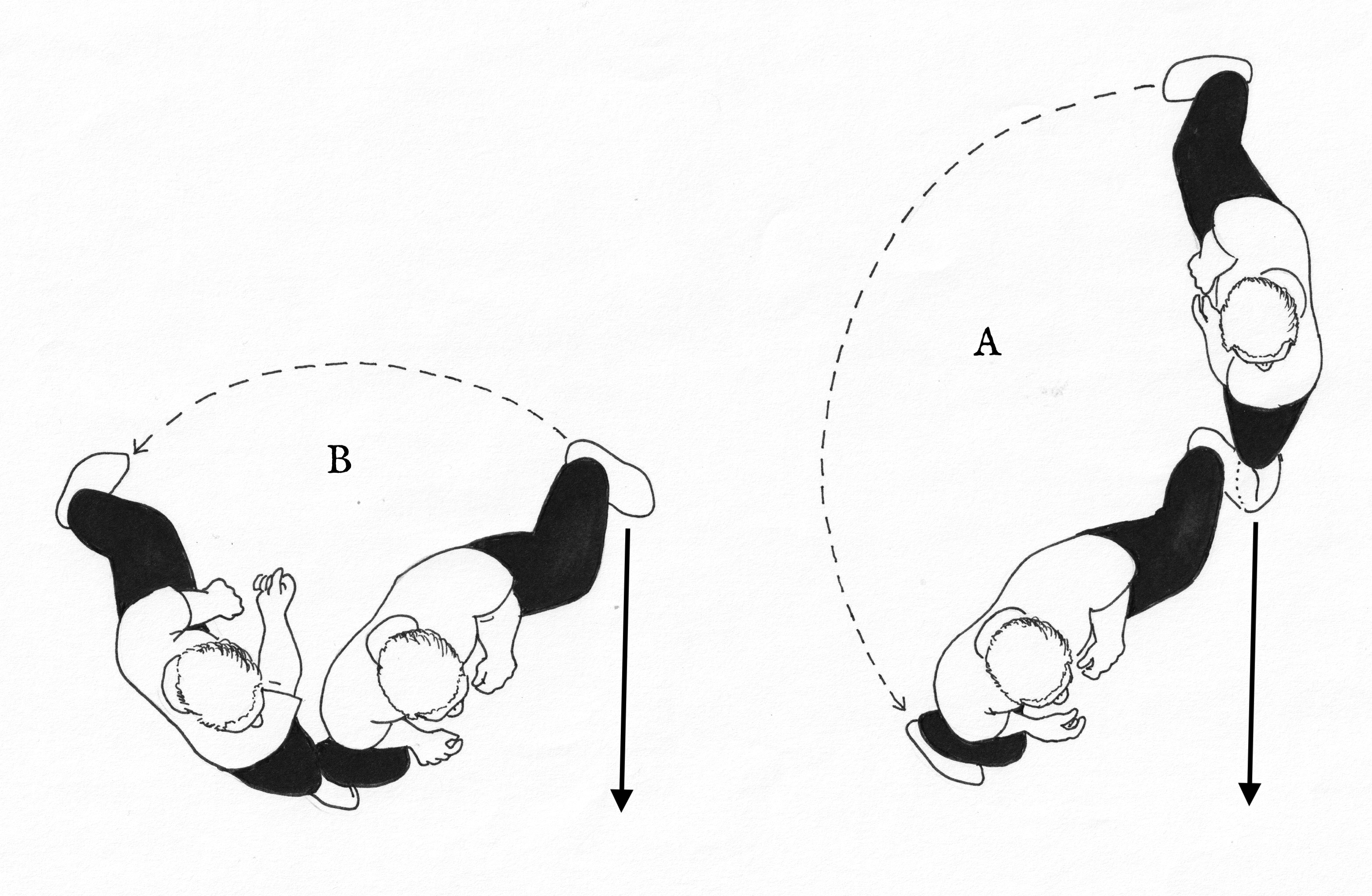
This makes the issue of where to riposte to pretty clear, I think. Timing it with the pass offline is less easy to justify according to the text, which clearly implies that the cut to the arms is done first, without stepping, and the thrust to the chest is done afterwards, with the pass offline. The reason I do it together is a matter of both mechanics and practice. The pass of the right foot diagonally to the right (for why I do it to the right please see the next section) aligns me away from the opponent; it is the shift of the left foot behind me that brings me around to face him, as you can see from these images borrowed and adapted from The Swordsman’s Companion (p. 64in the first edition; p. 92 in the second).
The solid arrow indicates the original line of direction. In practice, this first foot motion opens the line nicely for the blow to the arms, and the second aligns me for the thrust. It is arguably more correct to strike first, then time the thrust to the shift of the right foot, but it is much harder to teach that way to beginners.
13. Why is the passo fora di strada done to the right?
The pass out of the way can in theory be done in any direction. I do it to the right because it a) makes sense given the motion of the opponents sword to the left as I see it; b) it fits with the instruction to pass “out of the way” because I am literally getting out of the way of the attacker; c) I am also getting out of the way of the sword; d) it takes me to a place where I can reach with a strike, but my opponent has to step to strike; and e) by doing it this way I end up looking like the illustration.
The image could support the idea of a step done diagonally to the left, instead of to the right as I do it; but in my experience that would put me much closer to the opponent than is shown here.
And in Conclusion:
So, there we have it. Over 4,000 words written to support the interpretation that lies behind the basic execution of one drill. I hope it’s clear from this blog post series that I can do the same for any play, any drill. Feel free to ask me to do so. I stand by my interpretation and will back it up with evidence from the text at any time. If something seems off to you, ask for the supporting evidence!
And please also bear in mind, that even with all this evidence, I may still be doing it wrong. That’s historical swordsmanship for you.
In other news: I'm travelling a lot at the moment (Helsinki, Ipswich, Boston, Providence, Madison, Seattle, Ipswich, Helsinki), and we are moving house (there are a lot of books to pack), so I'm taking a break from the Fiore Translation Project. Expect the next instalment at the end of April- and feel free to bug me then if you don't get it.
This project is being published in stages. You can get part one, The Sword in One Hand, as a free PDF by subscribing to my mailing list below, or buy it in ebook format from Amazon or Gumroad. You can get Part two, Longsword Mechanics, from Amazon or Gumroad too!
Despite the fact that we’ve just had the sword in one hand, the grips, the blows, and the guards, this seems like the true beginning of the longsword section, because Fiore begins with these words, which appear over a blank space:
Spada son contra ogni arma mortale, ne lanza ne azza ni daga contra mi vale. Longae curta me posso fare e me strengho e vegno alo zogho stretto, e vegno allo tor d’spada, e allo abrazare. Mia arte sie roture e ligadure so ben fare de coverte e ferire sempre in quelle voglio finire. Chi contra me fara ben lo faro languire. Eson Reale e mantegno la justicia, la bonta acresco e destruzo la malicia. Chi me guardera fazendo in me crose, de fatto d’armizare gli faro fama e vose.
I am the sword, against all lethal weapons, no lance nor axe nor dagger is worth anything against me. I can make myself long or short, and I constrain and come to the close play, and come to the disarms, and to the wrestling. My art is breaking and binding, I can do covers and strikes very well, I always wish to finish in those. Whoever stands against me I will make them suffer. And I am Royal and maintain justice, I increase the good, and destroy malice. Who regards me, making in me a cross, I will make famous and renowned in the deeds of arms.
That’s a pretty good start to a weapons section, wouldn’t you say? You may be less overwhelmed when you compare it to a similar paragraph in the dagger section, on f9v.
While I was writing The Medieval Dagger, I wanted to point out to the reader that Il Fior di Battaglia was written in verse, as just about anything besides a shopping list would have been in that period. Not high-flung perfectly crafted poetry, but organised with simple rhymes, and intended to be read aloud. I took this passage from the top left of f9v. And rearranged it as you see, to look like a poem, and sure enough, the rhyme scheme (simple couplets) is clear on the page.
Io son la nobele arma chiamada daga
Che d’zogho stretto molto so vaga.
Echi cognosce mie malicie e mia arte
Dogni sotile armizare avera bona parte.
E por finir subito mia crudel bataglia,
Non e homo che contra me vaglia.
Echi mi vedera in fatto d’armizare,
Coverte e punte faro cum lo abrazare.
E torogli la daga cum roture e ligadure,
E contra me non valera arme ne armadure.
It’s not Dante, but it rhymes and scans occasionally and not very well, and the whole book is like this. Speak it aloud and the rhythms and pace of the language come alive.
So when I translated it, I turned it into a sonnet.
The dagger am I, a noble arm,
Knowing my malice, knowing my art,
Playing close to do you harm,
None can stand if I take part.
I make my noble feats of arms:
Who can hold against me?
No armour made resists my charms,
No arm either, you will see.
Cover, thrust, and grapple too,
I take your dagger, break and bind
Strike me? I will make you rue
The day, as you will find.
The cruel fight I’ll finish faster:
Of the art of arms, I am master.
My point is that a) you should have read the Armizare Vade Mecum by now, and b) that every weapon claims to be the best. So take the trash-talking longsword with a grain of salt, okay?
Now we’ve got that out of the way, let’s have another look at what that longsword paragraph says. As I see it it contains seven key parts:
1. “I am the sword, against all lethal weapons, no lance nor axe nor dagger is worth anything against me.” So, you can use the sword against any of Fiore’s weapons.
2. “I can make myself long or short”. This means you can hold it ‘short’ as in withdrawn, or ‘long’ as in extended, but also you can grip it to make it a shorter or longer weapon (see the post on grips of the sword for details).
3. “and I constrain and come to the close play”. Stregnire– to constrain. Past participle: stretto. This can be read as ‘I approach and come to the close play”, or “I constrain the opponent’s actions and come to the close play.” See here for a full discussion of the meaning of ‘stretto’.
4. “and come to the disarms, and to the wrestling”. In the close plays we will indeed find four disarms, and lots of plays that are based on wrestling.
5. “My art is breaking and binding”. Breaking and binding what? From the evidence of the plays, I’d say breaking arms, and thrusts (though the verb there is rompere not roture, though there meanings are very close); binding swords, and arms. This is a trope we’ve seen before in the dagger section, applied to breaking and binding arms, but I think it’s fair to extend that to binds done sword against sword.
6. “I can do covers and strikes very well, I always wish to finish in those”. That’s good to know. After pages and pages of covers (sword in one hand) and strikes (f23r), it’s nice to be reminded that you can cover and strike… but actually it is good to be reminded that all actions should finish in a strike. Many times I’ve seen students freeze after a parry, or after getting control of their partner’s arm or weapon. I think that happened back in the day, too.
7. “Whoever stands against me I will make them suffer. And I am Royal and maintain justice, I increase the good, and destroy malice. Who regards me, making in me a cross, I will make famous and renowned in the deeds of arms.” Most of this is trash-talk, of course. But it’s worth noting that ‘making in me a cross’ is (I think) deliberately ambiguous. ‘Making a cross’ is how we parry; but it also means to view the sword as a Christian cross (because recall this is 1300s Italy, a deeply Christian culture).
The space on the page under this paragraph is odd. One assumes that there ought to be some kind of illustration, but what that may be is anyone’s guess. I have some thoughts about that, so watch this space!
The page continues with this:
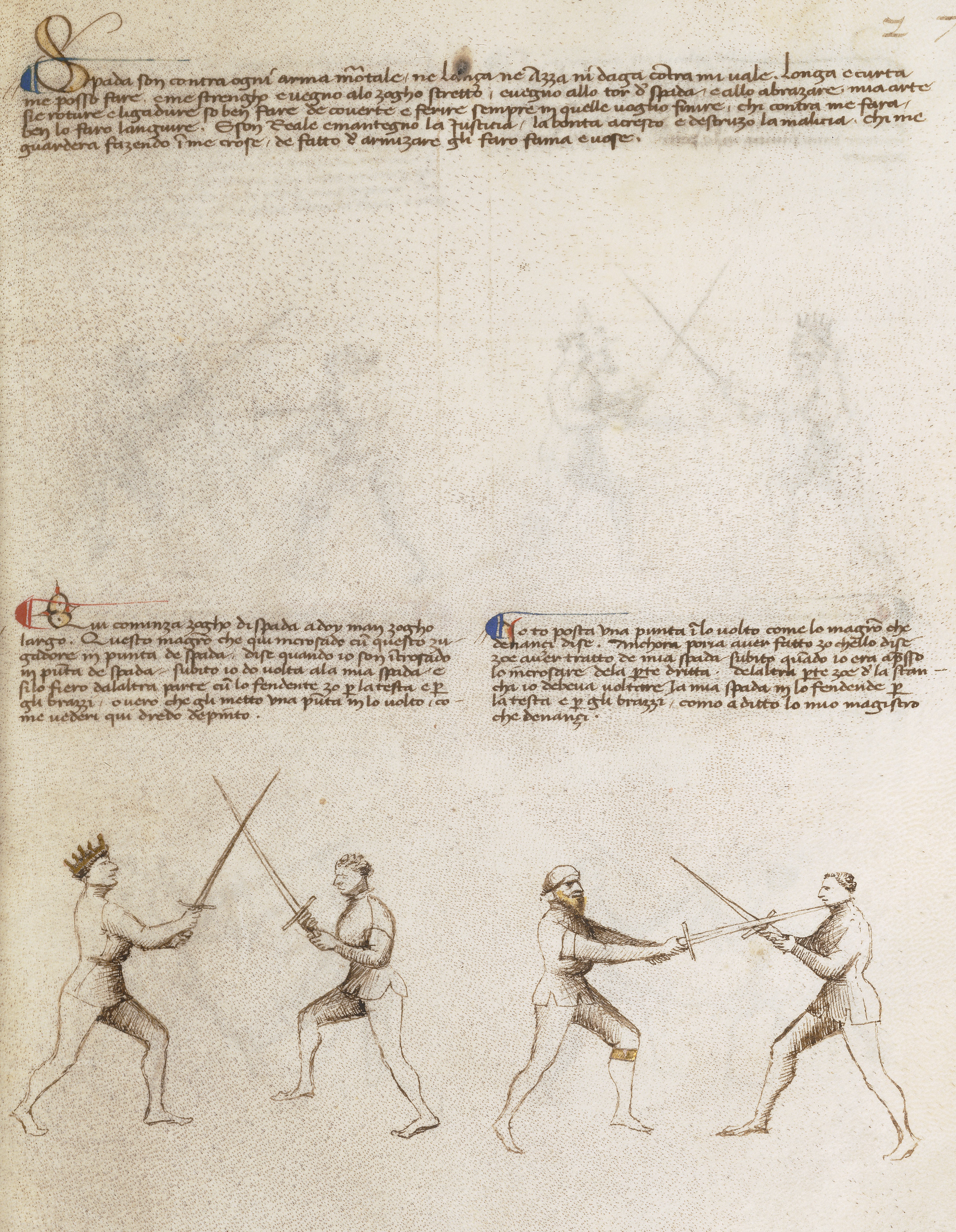
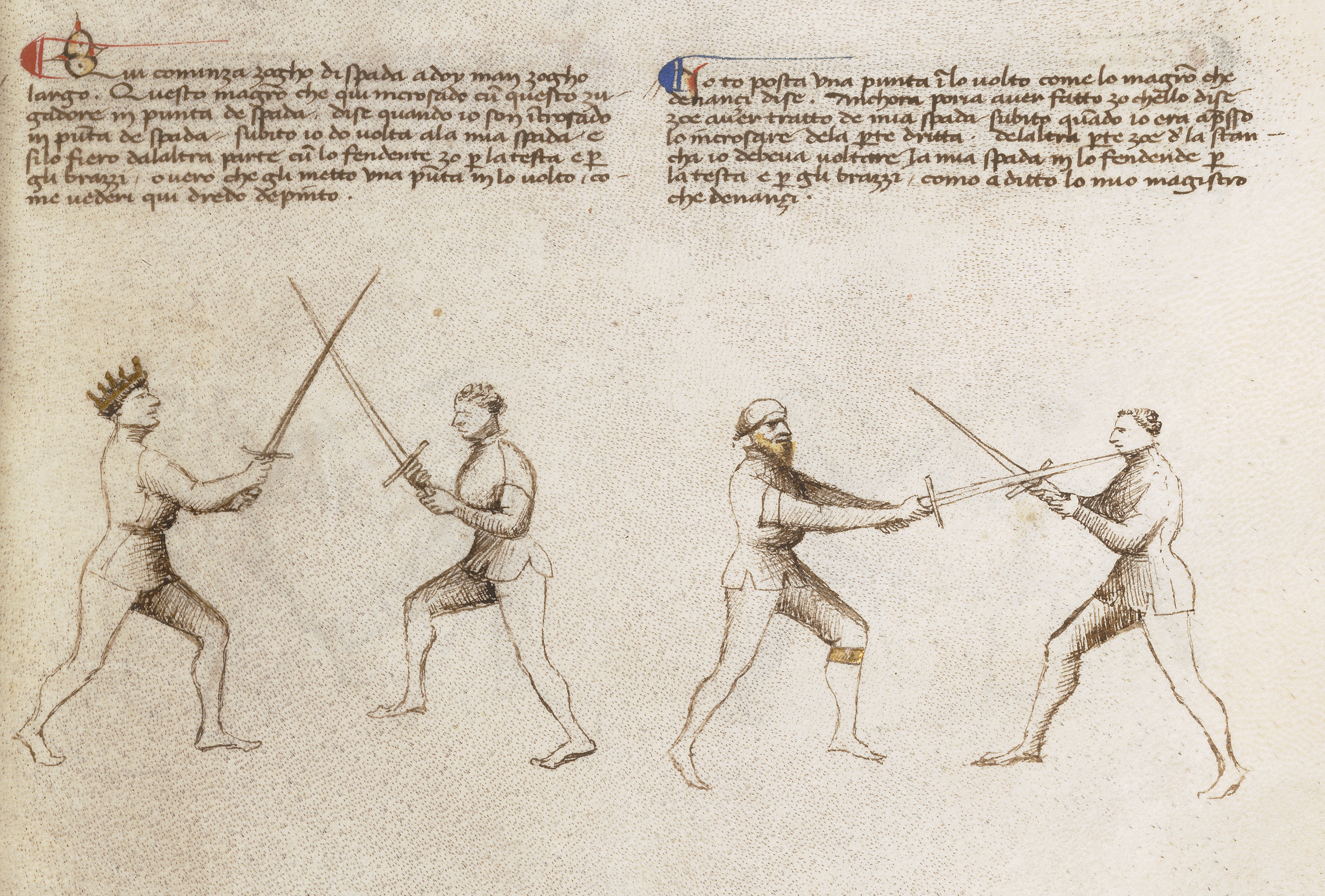
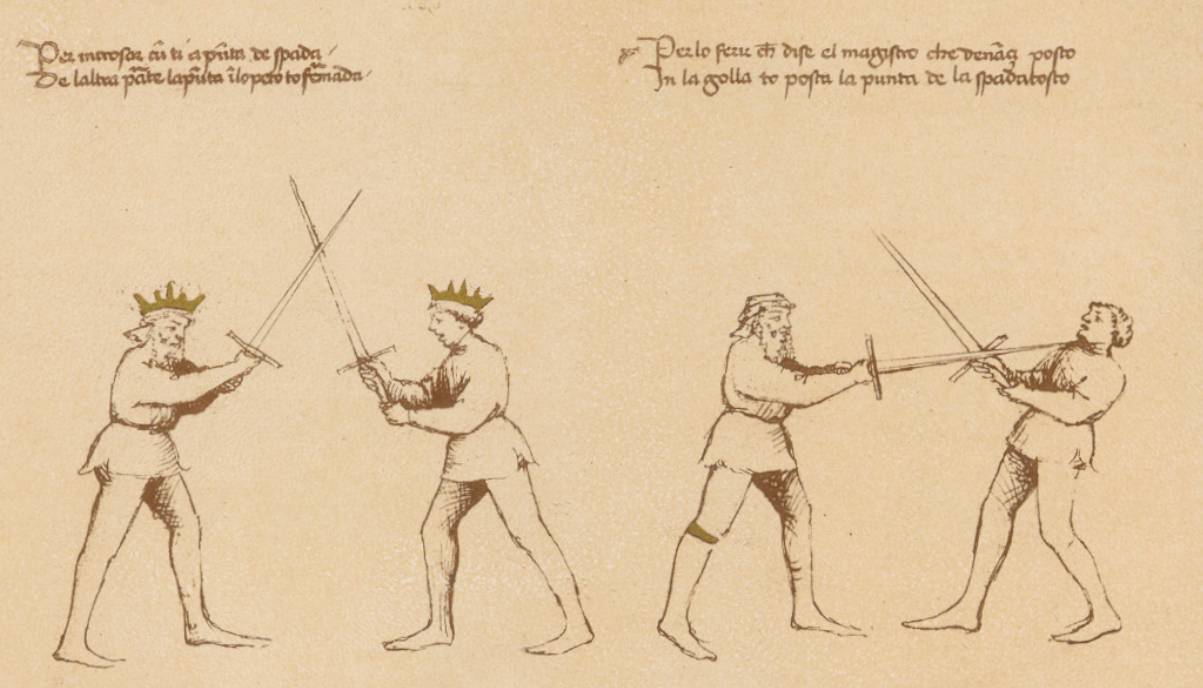
Qui cominza zogho di spada a doy man zogho largo. Questo magistro che qui incrosado cum questo zugadore in punta de spada, dise quando io son incrosado in punta de spada subito io do volta ala mia spada e filo fiero dalaltra parte cum lo fendente zo per la testa e per gli brazzi, overo che gli metto una punta in lo volto, come vederi qui dredo depinto.
Here begins the play of the sword in two hands, wide play. This Master that is here crossed with this player in the point of the sword, says “when I am crossed at the point of the sword, immediately I make a turn of my sword and strike with a cut from the other side with a fendente, thus to the head and to the arms; or I place a thrust in his face, as you will see depicted next.
While I was at the Armizare 2015 event, I had a discussion about Fiore’s first play of the first master of zogho largo with Francesco Baselice. Let me summarise our interpretations, with reference to the text.
The key point for our discussion was regarding on the other side of what? I read the line “I make a turn of my sword and strike with a cut from the other side [of the player’s sword].” Which lead to the interpretation you can see on pages 170-171 of The Medieval Longsword. Or indeed, here:
https://youtu.be/Y1DkxYqwYTc
But Francesco read it as “I make a turn of my sword and strike with a cut from the other side [of my body].” So instead of striking on the other side of the opponent’s sword, he was striking to the head with a roverso fendente.
I have shot a quick video of the two versions and uploaded it here for reference. Sorry for the crap quality.
Clearly, on the evidence above, it is impossible to choose one interpretation over the other. Both follow the text, and picture (the fendente isn’t shown), and similar actions to both can be found elsewhere in the manuscript. The first two plays of the sword in one hand show striking on one side of the player’s sword, or the other, after a parry; the first two plays of the second master of the zogho largo describe a cut followed by a thrust, on the same side.
The text of the second play, showing the thrust, was the next place to look for more data.
In the Getty MS, it reads:
Io to posta una punta in lo volto come lo magistro che denanci dise. Anchora poria aver fatto zo chello dise zoe aver tratto de mia spada subito quando io era apresso lo incrosare dela parte dritta. De l’altra parte zoe de la stancha io debeva voltare la mia spada in lo fendente per la testa e per gli brazzi, como a ditto lo mio magistro che denanzi.
I have placed a thrust in the face as the master before me says. Also I could have done what he says, so, have struck with my sword immediately when I was near the crossing from the right side. From the other side, thus from the left, I would have to turn my sword in the fendente to the head and to the arms, as my master that is before me said.
Hmmm. That is inconclusive, but it appears that the strike should be done very early; as you get close to the crossing, or immediately that the crossing is made. And he mentions that the blow is done from the left side. Stanca in modern Italian means ‘tired’, and in this period, means ‘left hand side’. Two pages on from here, in the play of the colpo di villano, Fiore tells us to “await the peasant’s blow in a narrow stance with the left foot forwards”, with lo pe stancho for ‘the left foot’. (You definitely do not want to put your tired foot forwards!) So perhaps stancha here is more likely to refer to the body than the sword, but it’s hard to say. After all, posta di donna on the left, is posta di donna la sinestra.
In the Morgan the text in both paragraphs is identical except for a few variant spellings, so that’s no help. In the Pisani Dossi ms we see:
Over the master, the lines are:
Per incrosar cum ti a punta de spada/ De l’altra parte la punta in lo peto to fermada.
By crossing with you at the point of the sword, from the other side I’ll strike you with a thrust in the chest.
The differences are obvious, I trust. No mention of the cut, and the thrust is to the chest, not face. But it’s still de l’altra parte, from the other side.
And the next play, the strike itself:
Per lo ferir che dise el magistro che denanci posto/ in la golla to posta la punta de la spada tosto.
With the strike that the master before me said/ I have quickly put the point in your throat.
[Note, again not face, or chest!]
And the image is basically identical to the strike shown in the Getty ms, as you can see.
So here is the critical point for this discussion; ‘from the other side’ is not being used here to mean the other side of the player’s sword. It is quite clearly describing a thrust that remains on the same side of the sword, so it is probably being used to refer to the way you make the blow. You got into the crossing with a blow from the right, and you leave it with a blow from the left (as all Audatia players should already know).
So it seems that Francesco is probably right: at the very least, his interpretation is supported by the text and the pictures, and makes sense.
Perhaps a more challenging question is how on earth did you end up in the crossing shown?
I think there are basically two options:
1. You were in frontale, your opponent came and engaged your blade in the same guard. This could be with you both moving, or one of you standing still. Unlikely, but possible.
2. You were attacked with a fendente, you parried from your right side, and as you went for your middle-to-middle parry, they turned their blade to intercept yours. This sort of thing happens a lot in free fencing.
However you got there, it seems there is no clear advantage on either side, so whoever moves first will get the play.
Here’s how I do the plays:
https://youtu.be/Y1DkxYqwYTc
What does that remind me of?
Oh yes. Does this look familiar?
The priest waits with the sword on his right shoulder, and the scholar besets with schutzen. The priest goes to bind the scholar’s sword, and literally “whoever is the first one ready for it” gets the play.
We could create a longsword version of this:
you wait in donna destra,
your partner approaches in frontale, closing off the line of your most natural blow (a mandritto fendente)
you go to bind their sword
and one or other of you gets the play.
I’m sure you can think of many other ways to get there. And this by itself is an interesting development. For the entirety of the treatise up to this point, it’s always been clear how you get to the position of the master; all nine dagger masters are responding to a specific attack from the player, and in the sword in one hand plays too, there is a clear attack, specified in the text and pictures.
But now we are just presented with the crossing, and play from there.
Next week we’ll see what to do from a different crossing, and go into depth regarding why I do the play the way I do it. See you then!
This project is being published in stages. You can get part one, The Sword in One Hand, as a free PDF by subscribing to my mailing list below, or buy it in ebook format from Amazon or Gumroad. You can get Part two, Longsword Mechanics, from Amazon or Gumroad too!
Ultra-geeky sword post alert: this is a lengthy and detailed discussion of some really specific terms from Fiore. Expect pedantry and nit-pickery, in the service of a definition of terms which has little bearing on how we actually fight. Read on only if that sort of thing floats your boat. I have written this because a friend and colleague asked me what I thought about ‘largo' and ‘stretto' these days. It turned out longer than I expected.
Since study began on medieval and Renaissance Italian swordsmanship, the terms giocco largo and giocco stretto have been discussed at length. The earliest reference we have to these terms is in Fiore dei Liberi’s Il Fior di Battaglia, (c.a. 1400) and they are a consistent feature of most Italian sources from then until the middle of the sixteenth century, after which they are less common.
I'm going to be using the Italian terms a lot in this article, so let's take a moment to look at translating them into English. Giocco (or zogho in FdB) means ‘play’ or ‘game’. This is consistent and unremarkable, and has about the same connotations as the English word. I can’t think of an expression in either language where you might translate the term as anything else: it even works in mechanics, where slippage in a mechanism is ‘play’ in English, and ‘gioco’ in Italian. I should note that there is no connotation of measure with this term. Measure is misura.
‘Largo’ means ‘wide’, with connotations of ‘loose’, such as in the expression ‘questa giacca mi sta larga’, ‘this jacket is loose on me’, or ‘open’, such as in the expression ‘andare al largo’, ‘to go out into the open sea’. Sticking with the maritime theme for a moment, ‘off the coast of Pisa’ would be ‘al largo di Pisa’. Freedom of movement is implied, as is space to play in.
‘Stretto’ is the past participle of the verb ‘stringere’, which means ‘to constrain’, ‘to grip’, ‘to squeeze’. It has a lot of connotations, and you can see many of them at this convenient dictionary link: https://dictionary.reverso.net/italian-english/stringere There is no one perfect English equivalent. Stretto as an adjective is ‘narrow’ or ‘tight’, such as in the expression ‘questa giacca mi sta stretta’, ‘this jacket is tight on me’, with the implication of restricted movement. To return to the maritime theme: ‘una stretta di mare’ is a ‘strait’, a narrow channel of water between two pieces of land. It’s worth noting that it’s only used to indicate ‘close’ in phrases like ‘un parente stretto’, ‘a close relative’. Close would normally be translated as ‘vicino’. The single English word that best fits the set of meanings is “constrained”.
While these examples are modern, there is no reason to believe that the meanings of these words have changed over time; I’ve tried to find evidence that they may have, and failed. In modern HMA parlance, the usual translations used are ‘wide play' and ‘close play'. Neither is particularly apt; ‘loose play' and ‘constrained play' would be better, but there's little chance of changing them in the wider community after so long. But bear the connotations in mind.
For most of the time since we began studying these sources, most people have translated and interpreted them to mean ‘wide play’, as in fencing from far away, and ‘close play’ as in getting to grips; in other words, the defining feature is measure. I published this theory myself in The Swordsman’s Companion in 2004. Many of my colleagues (excellent people all) still hold that opinion, which you can read a full discussion of in Greg Mele's article here. The article is explicit: “Zogho Stretto (close or narrow play) is the measure at which dei Liberi…”
For the last decade or so I have held a more nuanced view of their meanings. I’ll confine my interpretation remarks to Fiore, as that’s where the most disagreement lies, and also where I have the most experience and expertise. And I’ll include here all my published opinions on the subject, so you can see how they have developed over time. Before I get onto this, I should be clear that the ambiguities occur only when discussing the sword; all abrazare and dagger plays are considered ‘stretto’, and the grappling plays of the sword mostly occur in the ‘stretto’ section. On this we can all agree.
Where we disagree is the notion that the term ‘giocco stretto' is effectively synonymous with ‘misura stretta' (which in Capoferro's Gran Simulacro at least is the measure at which you can strike without passing, which we might indeed call ‘close measure').
How do the terms largo and stretto apply to our practice?
As I see it, in Fiore's plays, the defining tactical consideration (and the organising principle of the longsword section of his book) is the crossing of the swords, in which the measure is approximately the same, but the blade relationship, and so tactical situation, is quite different.
These are the three crossings from the Getty ms, centred on the front foot of the player. The outstandingly obvious conclusion is that the measure seems pretty much the same, but the blade relationship changes hugely. (With thanks to Joeli Takala who made a gif like this in 2010, which I reproduced because the original stopped moving.) There is no question that one of the two crossings shown at the middle of the blade is ‘zogho largo', and the other is ‘zogho stretto', as they are the first images from those sections. From one, we are free to strike, from the other, our best course is to enter with a pass ‘and come to the strette'. [I know that some researchers consider the images to be unreliable, but in my experience they are almost invariably very accurate. And once you start playing the ‘but the drawings aren't photos' card, you might as well discard all the pictures altogether, because it opens the door to making the images say whatever you want them to.]
So as I see it, “zogho stretto” is a tactical condition of the play, to which our best response is to enter in. Zogho stretto in general is ‘the condition of play in which you are constrained and cannot strike directly”, and zogho largo in general is “the condition of play in which you are free to strike”. “Le strette”, “the constrained ones”, is the term for techniques in which we come to grips. Yes, they are done from closer in than the “unconstrained plays”, but to say that they are defined purely by their measure is wrong; they are defined by being grappling actions.
That's the short version. I shall now expand at considerable length…
Further depth and detail on largo and stretto
Back in 2009, I published an article that described my new understanding of largo and stretto, and includes an analysis and interpretation of all of Fiore's longsword plays out of armour. Please read it, and then we'll move on… you can download the pdf from here:
It is my contention that zogho largo, wide play, describes the actions that are safe to do when the attacker’s point is driven wide. Zogho stretto, close play, describes the actions that we must do if the attacker’s sword is too close to us when we are crossed. The correct action then is to pass with the cover (i.e. without leaving the cross) and execute one of the close play plays.
As the defender, one should not seek out the close play; as Fiore states, from the stretto cross, either person can do the plays that follow. But by passing in, we prevent the attacker from winding the point into our face.
My interpretation of the basic form of these plays as it stood in 2009 can be seen in these videos:
I should point out that introducing this interpretation of largo and stretto did more to prevent double hits in freeplay in my school than any other change to the way we conceptualise Fiore's art. Suddenly, people started paying much more attention to whether an action was appropriate in the context they found themselves, simply because they now had a way to define that context.
By 2014, my thinking had not changed particularly, despite my colleagues’ best efforts to persuade me that it was all about measure: in my book The Medieval Longsword, pages 43-45, 2014, I wrote:
Perhaps the most overt tactical distinction Fiore uses is between zogho largo, universally translated as “wide play”, and zogho stretto, which may be translated as “close”, “constrained” “narrow” or “tight” play. I find “constrained” to be the most accurate rendering, but “close” is currently the most common choice. This topic has produced perhaps the most persistent and widespread disagreement amongst Fiore scholars, so I will go into some detail regarding what I think these concepts mean, and how I use them.
Fiore’s plays of the sword in two hands are clearly divided into the 20 plays of the zogho largo and the 23 plays of the zogho stretto. There are also plays done with the sword in one hand, in armour, and on horseback. The distinction between, say, the plays of the sword in armour and those of the sword on horseback are pretty obvious. The distinction between what constitutes zogho largo and what constitutes zogho stretto has been far less clear. In my first book, I defined the terms gioco largo (wide play) and gioco stretto (close play) as functions of measure: when you are close enough to touch your opponent with your hand, you are in gioco stretto. If you can reach him with your sword using one step or fewer, you are in gioco largo. This is a useful distinction to make, especially when classifying and cataloguing techniques.
For many years, this stood as the standard interpretation of zogho largo and zogho stretto, however, this is clearly not how Fiore uses the terms. (Remember our earlier discussion of changes in interpretations? Here you can see my pressure-test system in action.) In il Fior di Battaglia, we clearly see actions done close-in but placed in the zogho largo section (such as the 14th play of the second master), and actions done from quite far away placed in the zogho stretto (such as the 12th play). So what, then, do “wide” and “close” play refer to?
Simply put, the relationship between the two swords when they cross. There is a plethora of circumstances in which you are free to leave the crossing and strike as you will—these are all considered “largo”. In other circumstances the conditions of the bind are such that if you leave the crossing you will immediately be struck. In these cases you are constrained to enter in under cover, and use one of the “close plays”.
In practice, the type of crossing that demands close play is very specific: you must be crossed at the middle of the swords, with the points in presence (i.e. threatening the target) and sufficient pressure between the swords such that if one player releases the bind, he will be immediately struck. Ideally both players have their right foot forwards, which makes it easier to enter in. This is a situation of equality, in which either player should do the close play techniques.
In all other circumstances, most commonly when the opponent’s sword has been beaten aside, it is safe to leave the crossing to strike your opponent. This is the fundamental condition of wide play. If it is necessary to maintain contact with the opponent’s sword and enter to grapple or pommel strike, you are constrained to the close play. So, the plays are ordered according to the kind of crossing that they follow. These conditions exist in a continuum. As the opponent’s sword gets closer, and the bind gets firmer, your ideal response changes. As it switches from “leave the bind and strike” (largo) to “keep in contact with the bind and enter” (stretto), so you will find your ideal response in one section of the book or the other. Identifying these conditions is perhaps the key tactical distinction to make in this system. Note that close play techniques can often be done in a wide play situation, but wide play techniques cannot be done from a close-play crossing without extreme risk. The techniques we see in the 10th, 14th, and 15th plays of the second master of the zogho largo (crossed at the middle of the swords) section are clearly “close”, and there is no practical distinction between for example the 10th play here and the 2nd play of the zogho stretto. It’s apparent then that we have a choice: either Fiore organised his book as a catalogue of techniques arranged by the measure in which they occur, with several errors, or ordered them according to the tactical circumstances in which they should be done, with no errors. Which would you choose?
As a rule of thumb, if your opponent’s sword is moving towards you, or pressing in, you must bind it to prevent it from hitting you (stretto). If it is moving away from you, you can simply strike (largo).
Wide and close play describe what happens, but can also be used to describe a set of tactical preferences, an approach to the fight. When fencing an opponent who is much more comfortable in wide play, we may engineer a situation where only close play techniques will work. We can also of course deny a close-playing opponent the context he wants, and slip away into wide play as he tries to constrain us. A good fencer will be comfortable with both contexts, though most people have a preference for one type of play or the other.
This interpretation is still my default, though I would express it differently now. In short, you are in ‘wide play’ when you are free to leave the crossing to strike, and in ‘constrained play’ when you have to maintain contact with your opponent’s sword to strike.
So where do I stand now?
The defining features of largo and stretto
In combat, you are only likely to have your freedom of motion constrained by some threat or physical contact from your opponent. When it comes to making decisions under pressure, it’s usually unhelpful to have more options than necessary, because every choice slows you down. So I think the point of the largo-stretto distinction is to reduce the likelihood of getting hit by making it as clear as possible when it is safe to strike. It’s a tactical distinction, not a technical one. The tactical situation is determined by the following conditions:
Measure: how far apart are you? Yes, measure is a critical component of the condition of play, but not its defining feature.
Movement: where is everything going? Is your opponent pushing in, pulling back, binding strongly, yielding? And you?
Blade relationship: are the blades crossed, and if so, how?
I’ll expand on these one at a time:
Measure:
If you are in range to strike without stepping, this distinction is crucial. Are you free, or constrained? Outside that measure, it’s irrelevant. Fiore does not explicitly discuss measure at any point- the term is used once only, on the segno page under the lynx: E acquello mette sempre a sesta e a misura. Clearly, if he had wanted to define the plays of the sword by their measure, he had the linguistic tools to do so. We can see that at the moment the swords cross, the measure is approximately the same in all three crossings, and it's at the moment of the crossing that tactical situation is defined. To be in either largo or stretto play, you must be close enough to strike.
Movement:
The measure and the blade relationship will normally be in constant flux. Sword fighters rarely stand still when this close together. The exact positioning of the players at a given moment is less important than the direction they are moving in. If your opponent’s actions are such that you have to bind their sword, you’re probably in a stretto situation. If they are moving away from you, then you are probably freer.
Blade relationship:
Is your weapon controlling your opponent’s? If not, it should be.
Whoever masters the crossing, gets the strike. All medieval swordsmanship sources emphasise what happens when the blades cross. This crossing can be reduced to three critical factors: where on the blades the cross occurs, where the points of the swords end up, and how much pressure is being exerted. Up to now, almost every parry has been aimed middle to middle, and has worked as intended, beating the sword aside, with the exception of the “sticky” cut against the position of the sword in one hand. This was by way of introduction to the idea of binding the sword, which is a process of gaining mechanical control of your opponent’s weapon using your own.
In combat, the crossings of the sword happen so fast, and ideally last for such a short time, that it is unusual to respond to their specific conditions as they occur; more commonly, cues in our opponent’s prior movements indicate what will happen when the blades meet. It is nonetheless useful to analyse the possible crossings, to get an idea of what may occur and what you should do about it. This section is a bit like explaining traffic lights to a driving student.
Let’s start with where on the blades the cross is made. Most of the time you would be aiming for a cross at the middle of both swords, but Fiore divides the blade (as we have seen) into three parts: the tutta spada (the first section near the hilt), the mezza spada (the middle section) and the punta di spada (the last section, near the point). Mathematicians will have no difficulty working out that there are nine possible combinations of places on the sword where the crossing happens:
We must also consider the position of your point, close enough to be a threat, or wide, and his, close or wide, so multiply 9×4 and we get 36 possible crossings. Add to that (or rather multiply) the degree of pressure between the blades (let’s be binary and say strong or weak—we could have a dozen gradations of strength) and we have 72 crossings. And lastly, which side is open—inside, outside or neither? So multiply by three and we get 216 possible meetings of the swords. That is patently absurd. Let’s carve it down a bit.
What matters most is what you can do from a given relationship of the blades. In practice, it is only possible to apply pressure when meeting at the mezza or the tutta of your sword. So where there is a punta involved, that sword (or both) are always weak in the bind.
Also, when crossed at the points, the points of the swords can’t be threatening either of you directly, as you are either too far away, or they are pointing up or to the side, so it can always be consid- ered “wide”. Likewise, when crossed at the tuttas, the points must be wide, or there would have been a strike already, you’re so close. Where one point is against another’s mezza or tutta, there should be sufficient leverage advantage that the punta is always weak in the bind, and will be driven wide. So, that same table now looks like this:
It should go without saying that you strike on the side he is open; if you aren’t sure, if neither side is clearly open, go to the other side (so if your sword is on the right of his, go to the left). This is because whatever force he is using to keep you out of the centre should open that line when you release your counter-pressure.
The only part of the table where there is any real ambiguity is the middle one, where the swords have met in the middles: the points may be wide or close, and the bind may be strong or weak. If his point is close, and the bind is strong, you must enter into the close plays. This crossing leads only to the zogho stretto. If his point has been driven wide, and/or there is little pressure in the bind, it is safe to either grab his blade and strike (if it is close) or just strike (if his point is wide). These are examples of zogho largo.
Largo and stretto in other systems.
And what about Vadi? Well, he doesn’t divide his 20 plays of the longsword this way, but he does refer to largo and stretto play, principally in his Chapter 3: Theory of the Sword, especially on folio 5v. You can download my free translation of the entire manuscript from here and make up your own mind… Or if you're feeling wealthy, you could buy the snazzy hardback of the whole book: my new The Art of Sword Fighting in Earnest!
For the perspective of a Bolognese fencer, Ilkka Hartikainen has an article on the terms here.
In conclusion
So let me sum up:
Being close enough to strike is a necessary but not sufficient condition for the term ‘zogho stretto’ to apply. If you are free to strike, and have room to do so, the play is ‘largo’. If you are constrained, the play is ‘stretto’. Fiore’s solution to the problem of being constrained is to enter in with a pass, to get to grips (he does love his wrestling); grappling plays of every kind are ‘strette'. It’s worth noting that we find different solutions to the same tactical situation (as shown in the crossing of the master) in the German medieval sources, which often recommend a winding action instead.
Zogho stretto is a type of play, not a specific measure. All of Fiore’s stretto plays involve grappling, which requires you to get close. But that isn’t what the term means.
This interpretation makes teaching decision making at the crossing easy. A catalogue of techniques organised by measure is not useful; a distinction of when to do what is much more so. So whether you agree with my thesis or not, you can still use the idea behind it to make better tactical decisions in the moment. I think the best thing about this interpretation is that it is directly applicable to winning fights, of which I'm pretty sure Fiore would have approved.