Guy's Blog

Guy frequently keeps this blog updated with thoughts, challenges, interviews and more!

Tag: Tournaments

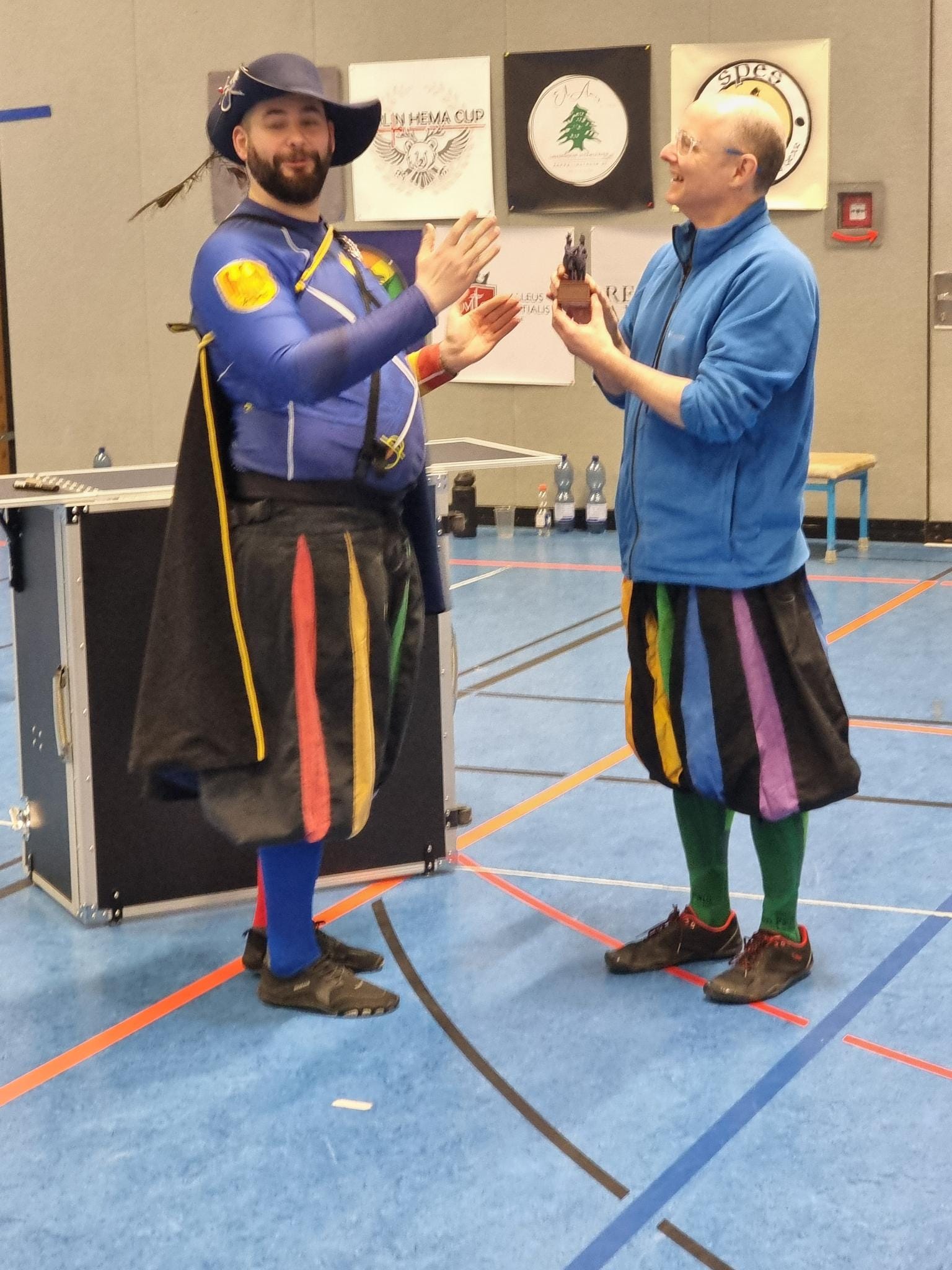
Stephan giving Guy Windsor a statuette prize for teaching a class in the worst time slot at the Torneo di Spada hema tournament
Receiving the prize for “because someone had to teach the slot”.

I'm not known as a tournament fencer these days. Indeed it's been well over 20 years since I last officially competed. But one of the great benefits of interviewing so many people on The Sword Guy is that they spark ideas in me that then get acted on. My conversation with Martin Hoeppner included a lengthy discussion of tournament rulesets, and cemented my pre-existing opinion that his club holds great events (I’ve taught at their Swords of the Renaissance four years in a row). A few weeks later I interviewed Maciej Talaga about an academic article he wrote on medieval physical culture, and we got talking about the benefits of tournaments for historical martial artists.

This got me really thinking… I have a decent amount of tournament experience from sport fencing in the 80s and early 90s, but the last time I entered a tournament was in (if I recall correctly) 2003. It was a rapier tournament, in Italy, and I won it. But I had been a professional instructor for two years by this point. If I win, so what? Being a competent fencer is part of my job. If I don’t, then what does that say about my right to teach?

Bear in mind this was a very, very, long time ago.

There are some major equipment issues with modern tournaments: most don’t allow steel gauntlets (I absolutely will not use any of the synthetic gauntlets currently on the market, for the simple reason that they prevent me from holding my sword correctly), and most probably wouldn’t allow my That Guy’s Products mask. In situations where cuts to the head with a heavy weapon are likely, anything built on a fencing mask foundation are simply inadequate.

I understand that creating equipment requirements for a tournament is a nightmare job for the organisers; it’s much easier if you can insist on established brands and models. But the restriction on steel gauntlets extends back to well before the time that companies were making synthetic gauntlets, and organisers were requiring things like lacrosse gloves because “steel gauntlets are dangerous”. Which in an activity that involves swinging steel bars at people’s heads seems at best misguided.

(I think I need to do a deep dive into sparring gear for longswords and other heavier swords… interested?)

I’d heard about the Torneo di Spada through attending Swords of the Renaissance, and checked with them that my mask and gauntlets were allowed. They are!* And they very kindly lent me some of the extra bits of kit (such as forearm guards) that I don’t have. They also asked me to teach a class on the Sunday afternoon, which made the whole thing even easier to approach.

I flew in to Berlin on Friday night, and on Saturday geared up and got stuck in. The first day was sidesword. This was perfect for me because I’m not a sidesword instructor. I haven’t taught a class in Bolognese fencing since maybe 2007, so I could go into it with no particular expectations. My goals were simple:

1. to break the seal on my tournament fencing,

2. evaluate my current level of training,

3. and, most importantly, to embody the spirit of the Art of Arms.

Bolognese Sidesword Tournament

How does one embody the spirit of the Bolognese Art of Arms? In the 16th century duels were very often public affairs. Your reputation is on the line, as well as your skin. The most important thing is to fence boldly.**

The ruleset was simple: hits to the head score 3 points, to the lower leg 2 (hence the need for shin guards), and anywhere else only 1. This is to reflect the opinion of Antonio Manciolino in his 1531 Opera Nova, in which the author writes that the head is the most noble target (a common opinion at the time), and that the lower leg should count higher because it’s so hard to hit without getting hit yourself.***

Every bout consisted of three scoring passes, so the maximum possible points in a bout was 9.

The twist was that the ranking is primarily based not on the points, but on how many passes you survive untouched. Winning 9-3, where you get 3 points in every pass and your opponent gets one, is useless; it’s better for your ranking to win 3-0.

A tournament-minded fencer will then be very cautious, and if they can’t stop the attack, at least go for a double.

To my mind though, to properly embody the spirit of the art, I needed to march in and hit them in the head, with style and control, but absolutely no dicking about at the edge of measure trying to not get hit. So that’s what I did.

The results? In my pool of 8, I had 7 bouts (21 passes), and scored 37 points, of which 33 were from hits to the head. But I had only 5 clean passes. That put me 21st out of 25 fencers. (Where the ratio of clean passes was the same, ranking was decided on points.)

I was delighted. My points per bout were the highest overall (37 out of 7, so 5.3). The next best was 38 out of 8 bouts, so 4.8. The next highest number of head hits was 7 to my 11. And several people complimented me on my fencing style.

Of course, if it was the points that counted, not the clean passes, the other fencers would have been motivated to go for head shots too, they would probably have scored a lot higher: the comparison isn’t really fair, but it is illustrative.

The Rapier Tournament

The second day was the rapier tournament. My goal was the same: to embody the spirit of the art. But the art was different. When it comes to rapier, I’m a Capoferro man, so the year is 1610, the duel is private, the top priority is going home in a whole skin. Fencing to first blood is fine: murder is an option not an obligation. So my fencing was totally different. Not just the style, but also the incentives.

The clean passes ranking was the same. Points were scored so that thrusts to the head or body were 3 points, cuts to the head 2, and cuts or thrusts anywhere else just one.

Fencers could choose rapier, or rapier and dagger, but they had to agree (so, both fencers had the same weapons). I always gave my opponent the choice, because I want their best game. In the end I think I used a dagger in three of my bouts.

In the qualifying pools I had 9 bouts (27 passes) and scored 19 clean passes, so a 70% success rate. I only scored 42 points, of which only 5 hits were to the head. This put me at the top of the rankings for all 30 fencers (the next best was 63%), but lots of fencers scored more points than me.

I conclude from this that the clean-passes ranking system rewards a private-duel mindset and approach.

Safety First

Unfortunately I wasn’t careful enough with one of my opponents. I knew he was wild, but after the halt was called he was chambered to cut me in the head. I stopped at the halt, and so didn’t parry his full-force horizontal cut to the right side of my head. As I was not expecting heavy head cuts in a rapier pool, I was wearing my regular fencing mask (it’s a bit better for face thrusts), with the usual HEMA overlay. This is totally inadequate to deal with that kind of blow, and he rung my bell. He also got a red card.

I sat down for a bit, and thought about my options. I had no obvious signs of concussion: vision and balance were fine. My last three opponents were all relative beginners, and not prone to hard hitting, and I didn’t want to drop out, so I fenced them very carefully (I got three clean passes in all three bouts).

There was about half an hour before the pools all finished up and the rankings to go on to the next round were announced. At the end of that time, over an hour after the blow, my head still hurt.  When it comes to brain injury a second hit in the same place is orders of magnitude more dangerous than the first one. And the “champions pool” would have no easy fights in which I could be reasonably certain to prevent my opponent from catching me in the same place. If I had a student in that situation I would not let them continue, so I withdrew.

The organisers and my fellow fencers were all entirely understanding and supportive of my decision. And I should say here explicitly that there was no malice or bad sportsmanship involved in the situation. I should have recovered under cover, not just stopped dead.

I should also say that none of the three medal winners were in my pool, so it could be that I would have ranked less well if I’d had stronger opponents. I don’t want you to think that coming first in the qualifying pool means terribly much. Had I continued I probably had a 50% shot at a medal.

Fitness

At the end of my first bout on the first day I was breathing quite hard. This was odd, because the bout wasn’t that challenging or athletic. It could only be tournament pressure. This was excellent! It meant I had a chance to practice controlling my level of arousal. I cycled in some breathing exercises, and got my breathing and heart rate back down to reasonable levels, and had no fitness difficulties at all for the rest of the weekend.

I could feel my thighs and shoulders a little bit on Sunday morning, but nothing significant.

More critically, my recently-recovered knees were fine, and so were my back and neck. So it seems that my physical conditioning is working really well. Hurrah!

The only point of stiffness or soreness on the Monday morning after the whole weekend was over, was the front of my ankles. A completely weird place to feel a bit of fencing, so I’ll try to figure out what caused that.

I’m being extremely cautious about my head. No alcohol (which I’m off at the moment anyway), and I won’t engage in anything where I’m likely to be hit in the head for a good long while. A minor head trauma is like priming your immune system for anaphylaxis. You have to avoid the stimulus if you don’t want a severe response.

The Tournament Fencer

Quite a few of the fencers there were clearly in it for the tournament. For them, winning the tournament itself was the goal. Medals matter. This generates a fencing style that is like a cross between sports epee and a bit of kendo, with lots of jigging about at the edge of measure and a very fast tag with the sword.

You can tell the competitors because they ask questions about the rules (what exactly counts as stepping out of the ring? Does my foot have to touch the ground? The whole foot? What if it’s just my heel?). They also use their ‘video challenge’ right. In the finals, video challenges were allowed, one per fencer per bout. If the challenge was successful you can challenge again. This means that if you disagree with the judges, you can, in effect, argue with them.

To a tournament fencer, it really does matter who gets the points. It’s what they are there for. To lose a medal because the judge made a mistake would be intolerable.

I would die in a pit of fire before I ever issued a video challenge. If I failed to hit my opponent with such clarity and in such obvious control of their weapon that the blind, drunk, biased-against-me judge who has been bribed by the opposition,** still has to give it to me, then I don’t deserve the point. “Bad” judging (as in judging you disagree with) is part of the tournament challenge. The greater the challenge, the greater the learning opportunity.

It’s really useful to have people like that to fence against, because they are usually very good at hitting you, and in ways you may not expect because they look different to the canonical style. The hit is always right. If you fail to parry, that’s on you. Also, seeing how incentives affect behaviour allows you to learn to predict some of that behaviour. Another useful learning opportunity.

It’s illustrative of the difference that, while I think I won my first bout on Saturday 7-4, and I can work out some of my clean-pass scores, I don’t actually know what my scoring was in any of the bouts. I don’t think I looked at the scoreboard more than half a dozen times in the whole weekend. Because the points aren’t relevant to my aims.

This is not virtue. There is nothing wrong with being a tournament fencer, who needs to track their score because it matters. I’m just playing a different game.

Final thoughts

Firstly, thanks to Stephan, Anna, Martin, and the rest of the Schildwache Potsdam team. Especially those noble souls who gave up their weekend to judged and score. It’s a huge amount of work putting on a tournament like this, and you all made many young fencers very happy, and one old instructor too.

Secondly, thanks to all my opponents over the weekend. I hope you enjoyed fencing me as much as I enjoyed fencing you. I do wish I’d kept a record of everyone I fenced, but I failed to. If you recall our bouts, feel free to remind me either in the comments or by email.

Thanks also to Malleus Martialis for sending me a delicious sidesword at very short notice. I only signed up for the tournament in mid-December, then realised my old sidesword was not fit for modern competition use. So I contacted Eleonora at Malleus, and a shiny new sword was waiting for me when I got there.

One interesting quirk of the way the tournament was constructed was that fencers in each pool had to find their own opponents, and keep doing so until you’d fenced everyone in your pool. This means that your first interaction with your opponents is face to face, unmasked, and arranging a match together. I didn’t notice it at the time, but chatting with Stephan afterwards it was clear that this contributed something to the feeling of the event. We weren’t fencing against anonymous numbers. We were fencing our colleagues, peers, and friends.

Overall, I’m delighted by the results. I went there to play my game: to use the tournament environment to measure and develop my historical fencing skills against motivated and resistant opponents. Most particularly, to not get sucked in to the competitive fencing mindset, where scoring touches according to the rules is the only consideration.

There was one pass in the whole weekend where I decided to play tournament. In one of my rapier bouts it seemed that the only thing the judges could see was incidental arm touches. Bending my sword on my opponent’s chest was literally invisible. So in the last pass I flicked my point under my opponent’s guard from the edge of measure. Sure enough, point to me. Ugh.

So I stopped that and went back to embodying the Art of Arms as best I know how.

Notes

*The organisers have asked me to mention that “we allow steel gloves only under circumstances where we, as organisers, can be absolutely sure that they are of proper quality, well maintained, free of burrs and sharp edges, and without loose rivets.”

** For example,  Leonard Eckstein Opdycke’s translation of Castiglione’s Book of the Courtier, Book 1, paragraph 21: “ “Moreover I deem it very important to know how to wrestle, for it is a great help in the use of all kinds of weapons on foot. Then, both for his own sake and for that of his friends, he must understand the quarrels and differences that may arise, and must be quick to seize an advantage, always showing courage and prudence in all things.

Nor should he be too ready to fight except when honour demands it; for besides the great danger that the uncertainty of fate entails, he who rushes into such affairs recklessly and without urgent cause, merits the severest censure even though he be successful.

But when he finds himself so far engaged that he cannot withdraw without reproach, he ought to be most deliberate, both in the preliminaries to the duel and in the duel itself, and always show readiness and daring. Nor must he act like some, who fritter the affair away in disputes and controversies, and who, having the choice of weapons, select those that neither cut nor pierce, and arm themselves as if they were expecting a cannonade; and thinking it enough not to be defeated, stand ever on the defensive and retreat,— showing therein their utter cowardice. And thus they make themselves a laughing-stock for boys, like those two men of Ancona who fought at Perugia not long since, and made everyone laugh who saw them.”

“And who were they?” asked my lord Gaspar Pallavicino.

“Two cousins,” replied messer Cesare.

Then the Count said:

“In their fighting they were as like as two brothers;”

*** Specifically (in Jherek Swanger’s translation):

[40] Of two playing together, he who strikes in response is more praiseworthy than the one who strikes the first blow, because he reveals himself sooner to become enraged than to lose vigour after the received hit.

[41] It is not licit after the received blow to make more than one response stepping forward with a crossing step; the reason being that one must do well with all of one’s wit, since with that one can recover honour.

[42] The blow to the head, considering the excellence of that member, counts for three; and the blow to the foot is taken for two, having regard for the difficulty of making it so low.

[43] A valorous player is he who redoubles his blows.

****Just to be clear, the judges were of varying levels of experience and skill, but were all wearing any necessary eyewear, sober, honest, and unbiased to the point of spending endless amounts of time discussing what exactly happened because they really, really, wanted to be fair. And the only way to get skilled, experienced, judges is to give less-skilled, less-experienced judges the opportunity to practice. I have no complaints, and much respect for their time and effort.
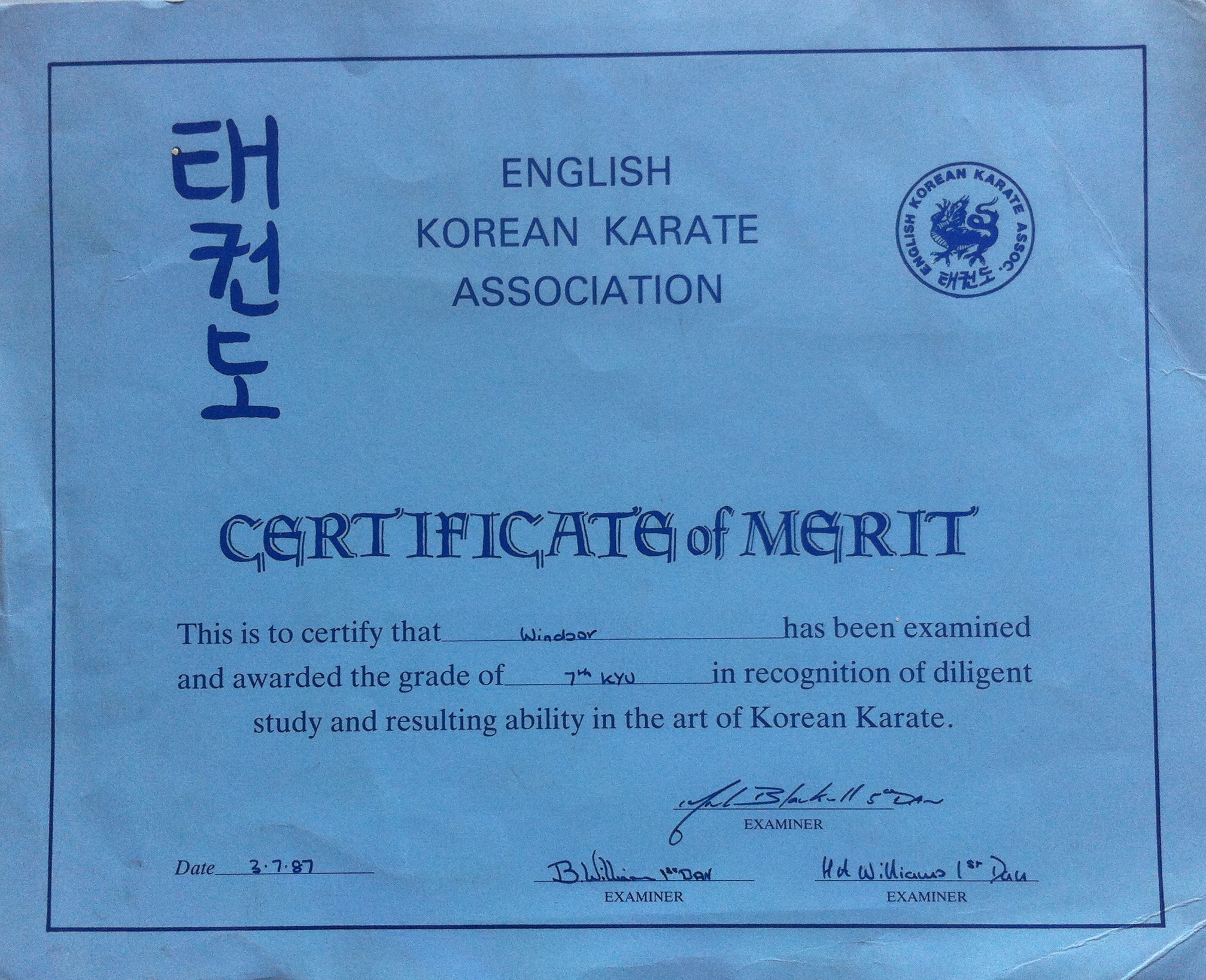
Today marks the fifteenth anniversary of the founding of my School. I date it to the first demonstration and class I gave in a small room in the Olympic Stadium in Helsinki on March 17th 2001. While going through the accumulated paperwork of the last 18 years or so, recycling most of it, scanning and shredding some of it, and keeping only the very few bits of paper that have value as artefacts in their own right (my eldest daughter’s first signature, for example), I came across this:

This is (I’m pretty sure), my green belt certificate. It’s dated July 3rd 1987, and I’d been doing karate for three school terms at that point. So this year marks my 30th year since beginning to walk the path. In that time I have dabbled in many arts, and trained relatively seriously in a few, and gone deep into a very few. I’ve liked at least something about every art I’ve practiced, and I’ve had issues with at least something in every art too. Here follow my top five martial arts, in reverse order:

5. Shooting

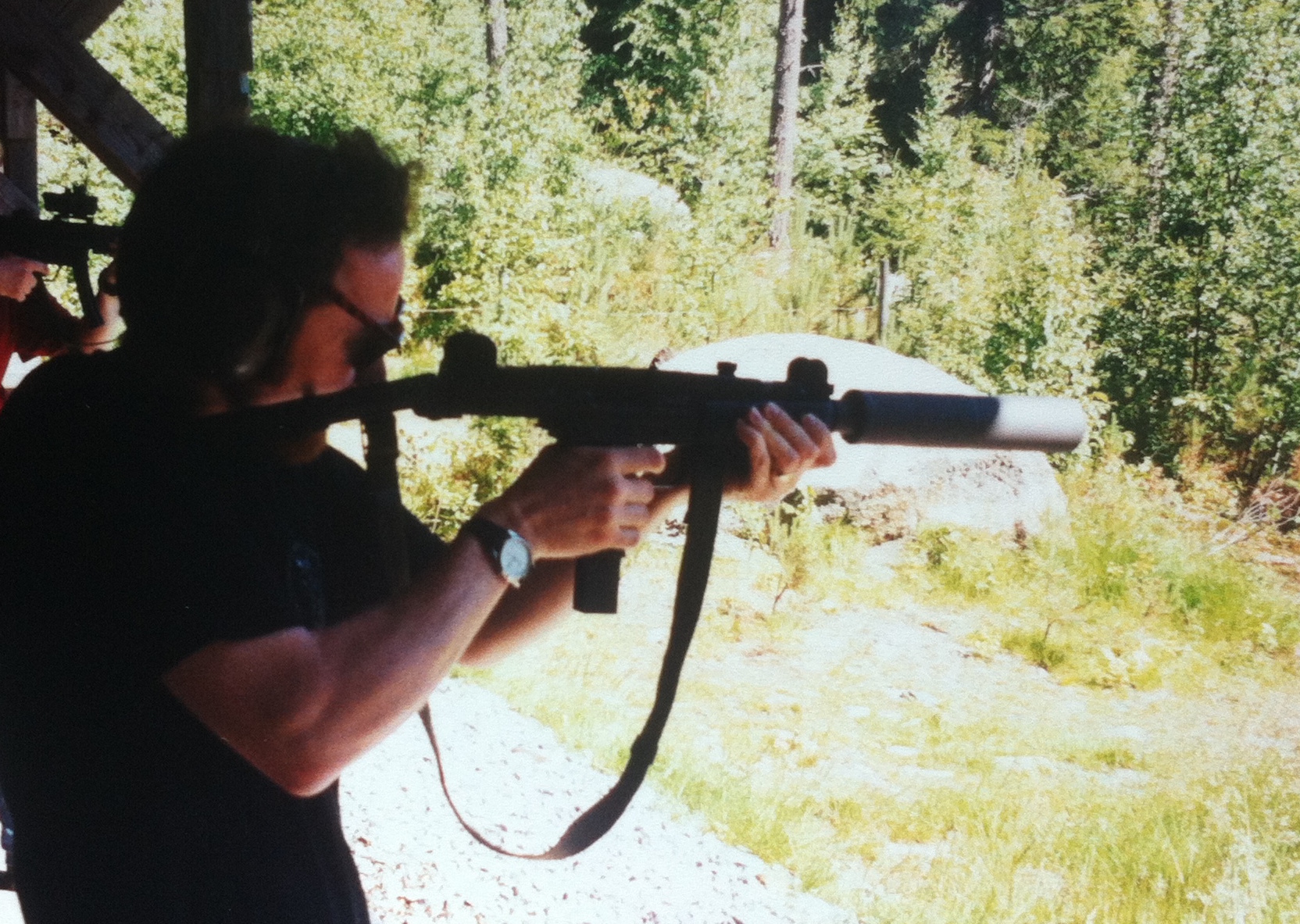
Shooting a silenced Uzi on full auto. Oh my, what fun!

Shooting a silenced Uzi on full auto. Oh my, what fun!

This trumps all other arts. A person with a few hours training and a handgun can take out just about any martial artist on the planet- unless they have also trained with and against guns. One of the major attractions of moving to Finland was that I would be able to take up shooting, and, while I’m no expert, I’ve handled lots of different firearms, and can use a pistol tolerably well. So why only #5? Because to me it  feels like a fun activity, and a practical skill, but it doesn’t feel like martial arts. Which is nonsense, of course, but there you have it. Also, in most civilized countries, carrying a gun is seriously illegal so it’s not actually as practical as it seems. Draw a gun in self defence in Finland, the UK, Italy, anywhere really outside the US, and you’re going to jail. If you don’t understand why I don’t support the notion of the right to bear arms, then read Stephen Pinker’s The Better Angels of Our Nature. But this is not the place to go into it: some of my best friends do open-carry.

4. Tai Shin Mun kung fu.

When I moved to Finland, one of my closest friends (whom I actually met in a gun club, and who gave me my first proper shooting lesson) was teaching this very traditional martial art here in Helsinki. I have always believed that martial arts should include the health and medicinal side, and this was the first time I came across an art that explicitly included massage, breathing exercises, and herbal medicine as part of its core curriculum. In 1999 I had been intermittently incapacitated by tendonitis in my wrist and forearms, thanks to my cabinet-making job. That same year Num took me to his training hall and showed me some things, and I mentioned the problem. In 20 horrendous minutes he did what the doctors of Edinburgh had failed to do, and cured my tendonitis. He also gave me a set of exercises and taught me how to massage my arms, and lo! I have been able to keep the demon at bay ever since. This literally made my career in the Art of Arms possible. When I moved to Helsinki in 2001, Num and I trained together Monday, Wednesday and Friday mornings from 7 to 9 or 10, six months of the year (he was in Asia training the other six). The Crane, and the Breathing Form that are in our Syllabus come directly from there, as does some of the massage and conditioning exercises (like the push-up-twisting-squat-jump-burpee). So why isn’t it #1? Because, being a traditional Chinese art, it came with a lot of traditional Chinese cultural baggage, including a kind of god-worship of the grandmaster, a very set hierarchy, and did not seem to encourage the actual personal growth of the students.

3. Aikido

I took up Aikido the instant it became available to me, in the summer term of 1994. Rod Biddle, who had trained in Honbu dojo, was doing a degree at Edinburgh, and started a class at 8am on Wednesday mornings. At this time, I would normally set my alarm to wake up in time for Neighbours (an Australian soap opera) at 1.30pm. So getting up at 7am was a serious matter. But I loved it. It was super-quiet; no talking at all, no explanation, Rod just showed us the move, murmured its name, and we would practice it. This went on for a few months, but the class petered out because not enough people wanted to practice at 8am on a Wednesday. Fools. I took up Aikido in Helsinki that same September, and trained a couple of times a week while I was here as an exchange student. It was lovely, but not the same as our quiet morning training. So I didn’t keep it up in Edinburgh, but on moving back here, the legendary H.P. Virkki came and watched one of my classes, introduced himself, and we trained every now and then, him throwing me around, me teaching him some swordsmanship. But when that came to a natural end, I let Aikido go altogether. Still, though, my absolute top favourite unarmed sparring session ever was with Jim Alvarez, an Aikido teacher in California, when we met for the second time at the Dallas WMAW event in 2006. Oh my, that was fun.

But Aikido suffers widely from the fact that most of its practitioners don’t seem to know what it is actually for. It was founded as a misogi (cleansing) practice, an entirely spiritual pursuit. Which is why most aikidoka I’ve met can’t handle a jab or a kick to the nuts. It does produce some astonishingly good fighters, but that’s not actually its purpose. Don’t argue with me on this, go read the outstanding Hiding in Plain Sight, by Ellis Amdur.

If I trained just for fun, it would probably be Aikido.

2. T’ai Chi Chuan

When I arrived at Edinburgh in September 1992, I went to the Fresher’s fair, walked past all the stalls until I found the T’ai Chi club, and asked where do I sign.

“Oh, T’ai Chi is an ancient martial art…”

“No, where do I sign. I’ve been wanting to do this since I can remember”

“We do a lot of forms …”

“Goddam it, where do I sign???”

Something about T’ai Chi has always drawn me; the gentle, flowing motions, the long-term view, it’s just beautiful. And, quite frankly, it is the single most vicious and direct way of hurting people you don’t like I’ve ever seen. That may sound odd, but it’s true. The form is not a set of techniques strung together, unlike most other martial arts forms. It’s the physical embodiment of a set of principles and a way of moving. We did the Cheng Man-ching short Yang form, and my teacher, Steve Fox, taught every step of the form bit by bit, getting us to test why, for example, at this point we turn the foot, or here we tuck the tailbone. Literally every movement was tested against gentle pressure, and that training formed the foundation of how I teach all martial arts. The advanced class trained at 6pm, the beginners at 7pm, so after the first week I started showing up at 5.45, and watching the advanced class. After a couple of weeks, maybe a month, Steve gestured me over and said “join in”. So I did. It’s been twenty years since I last had a lesson, but I still practice the form every now and then to keep it available.

In my first year at Edinburgh my average week looked like this: Monday night: fencing. Tuesday night: T’ai Chi. Wednesday night: fencing. Thursday night: T’ai Chi. Friday night: kobudo (Japanese weapons stuff. Get me started talking on that one day. It was great fun, with blistered bleeding hands). Saturday afternoon: karate (I joined the karate club to carry on where I’d left off after Prep school). Sunday afternoons: if there were no extra classes scheduled, or tournaments to attend, or the termly T’ai Chi weekend seminar, then nothing. I have really no idea how I ever got through my end of year exams.

I guess the only reason that T’ai Chi didn’t become my core art was that the sword stuff is just not very good if you compare it to…

1. Historical European Martial Arts

You guessed that it was coming, right?

I’m not going to kick off an internet cat-fight about which master, style, source or system is best. But what we have going for us is beyond anything any other martial art can touch. Because we can learn from any tradition, but are not tied to a single one. We can experiment with group and school structures to our heart’s content. We have the best swords on the planet, and the best armour too. No metallurgist or engineer would disagree with that. We have a gigantic library of sources, and an emerging academic and practical approach to them. We have forms and tournaments, test cutting and bag punching, sharp swords, blunt swords, big swords, small swords, long swords, short swords, knives, daggers, improvised weapons, concealed weapons, longbows, crossbows, and even cannon.

I got into historical swordsmanship when I met a beginner fencer at a tournament in 1993, and we both bemoaned how unrealistic fencing was. We were looking for “real swordfighting”. Almost by accident, we set out to create it, beginning with my grandfather’s first edition of The Sword and the Centuries and working from there. By the beginning of 1994 we were actively seeking out more people to fight with us, and in June we founded the Dawn Duellist’s Society together. It’s still going today.

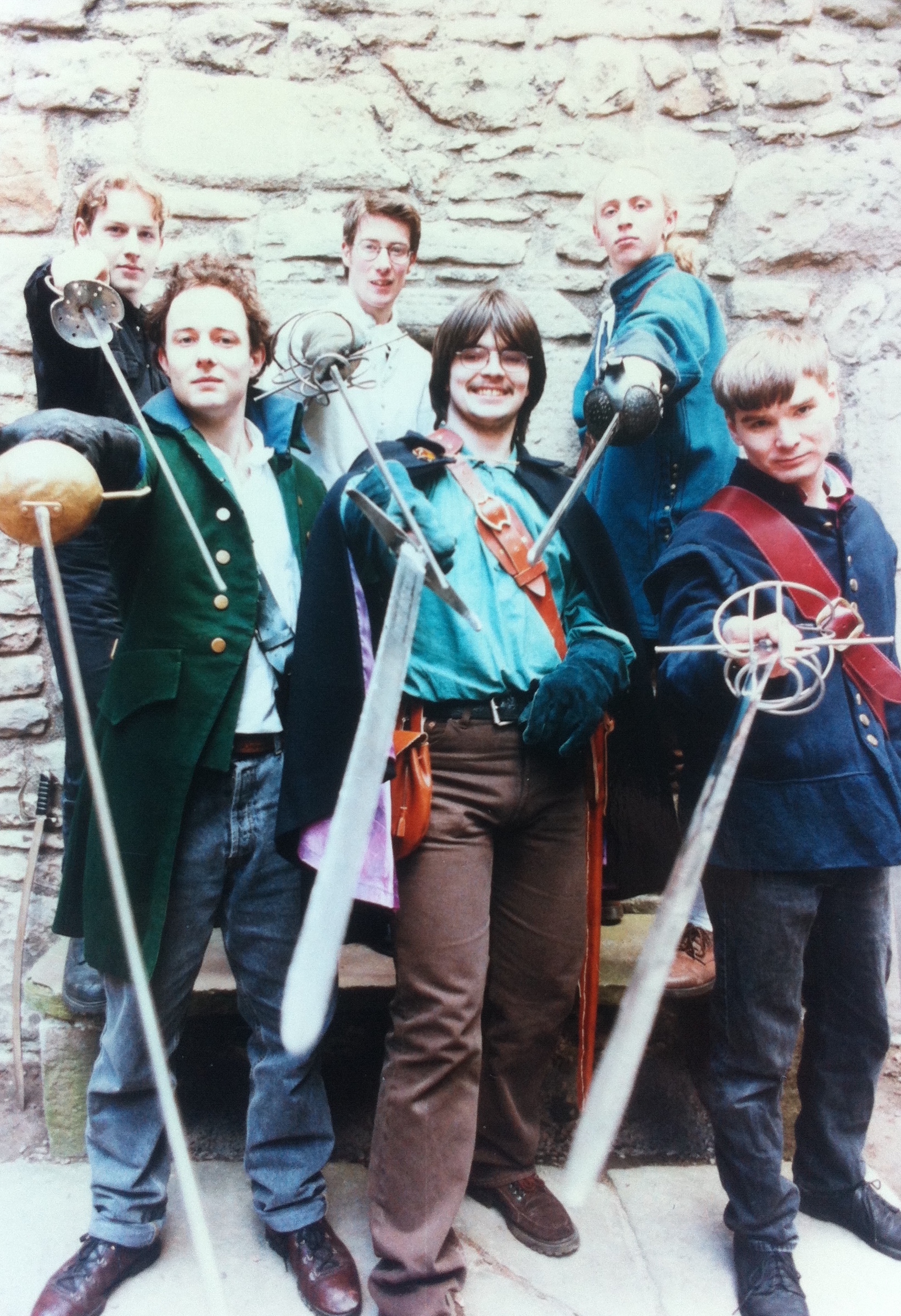
That's me on the front left. Yes, I had hair once. This was 1996, I think.

That's me on the front left. Yes, I had hair once. This was 1996, I think.

Of course, the lack of an established tradition does lead to a lot of posturing, vanity, foolish claims, errors, accidents, and that’s just me. Lots of others fall into the same bear pits every now and then. Because we can’t just ask the grandmaster, we get into foolish arguments and forget our common purpose. Which is very natural and human, but a shame nonetheless. There is also absolutely nothing preventing crooks and charlatans from taking advantage of gullible students, but every martial art has that problem.

But (this is the real reason why this is my core art) just about anybody, starting right now, could plausibly make a real and long-term contribution to the art itself, in a way that is just not possible for 99.999% of practitioners of established tradition or sport based arts. In T’ai Chi, for example, the best contribution I could make would be to become a really good teacher and train a lot of high level students and future teachers. I could help spread and maintain the art. But I couldn’t add another step to the form, or rewrite the sword syllabus, or do anything that would materially change the art for the better. Besides, I don’t want to follow someone else’s path. I want to blaze my own. And in HEMA, that’s not just possible, it’s normal. There are hundreds and hundreds of people now who are researching and developing the art itself, and therefore can reasonably expect to add to the sum of human knowledge. I just don’t see that in any other art. So that’s why it’s number one.

So, what are your favourite martial arts, and why?

So you want to stand on one of these? Why?
image from: http://www.postgraduatesearch.com/postgraduate-jargon-explained/ap-55456/


All world-class tournament competitors in low-contact combat sports use this method to succeed in tournaments. Whether you want to treat your tournament career like this is a whole other question, but, at the top level, everybody is doing this because it’s the only method that works.

1.  Analyse the Rules

Analyse the rule-sets, equipment, and every other aspect of the tournament environment. Your job is to score more points than your opponent in that environment and that’s it. You are not there to look good, be popular, or gain respect. You are there to win, and win only, according to the rules that are set.

Here’s an example of this in action: in 1999 Tim Ferriss, with a couple of months of preparation, won the Chinese kickboxing US national championship. He did this only because he found a loophole in the rules that allowed him to win by dehydrating himself before weigh-in down to 165lb, rehydrate back up to over 180 between weigh-in and the tournament, and, avoiding kicking and punching altogether, pick up his much lighter opponents and throw them out of the ring. Did he beautifully represent the spirit of the Art? No. (In the article I link to, he writes about “how to win at kickboxing the wrong way”!) Did he win? Yes.

Here’s another example: Johan Harmenberg, who pretty much single-handedly destroyed sport fencing (in my eyes at least), by ignoring conventions and analysing the rules to figure out a new and more effective way to score and not get scored on with the electronic scoring apparatus. He got from nowhere to World champion and Olympic champion in a few years. I highly recommend his book Epee 2.0 which recounts the details of how he did it. Did he beautifully represent the spirit of the Art? No. Did he win? Yes.

2. Create an Area of Excellence.

Pick one, or maximum two actions that lead to you striking, and train the hell out of them. Start with the action itself, and then work back to create the situation in which you can pull it off. Harmenberg’s action was the parry sixte-riposte. Ferriss’ was throwing people out of the wring (he has a background in judo and college wrestling). In every match, your only job is to lead your opponent into your area of excellence, where you can beat them. You need one world-class action in your repertoire. But only one, and it should suit your physical and mental strengths. Don’t waste time getting good at things you are not going to get world-class at. Will you beautifully represent the spirit of the Art? No. Will you win? Maybe.

3. Analyse your likely opponents

Who are the few individuals you are most likely to be beaten by? Go over every second of their tournament footage and analyse exactly what they are doing to win. What is their area of excellence? Your job now is to train ways to keep them out of their area of excellence, and lead them into yours. Your coach’s job is to model their behaviour to give you the opportunity to train against their specific game. For lower ranked opponents, you have to rely on your general skill at leading people into your area of excellence; you can't train specifically against more than a few opponents, there just isn't enough time.

Will you beautifully represent the spirit of the Art? No. Will you win? Probably.

The problem of course is that all world-class competitors are doing the same thing, analysing you (once you become successful enough to become a threat and so warrant attention). This is why every now and then a complete outsider comes out of nowhere and wins: he or she has prepared to fight the best; but the best have never seen his one area of excellence before.

Further reading:

The best books on this subject that I’m aware of are Josh Waitzkin’s The Art of Learning, which details how he went from chess champion to world champion in push-hands (the moment when he realised that the one opponent he had trained to beat was now in a different weight class was priceless. As was the moment when they realised that the ring was now a tad smaller), and the aforementioned Johan Harmenberg’s Epee 2.0.

This process is simple. But it is not easy. And, personally, I am much more interested in the spirit of the Art. Which is why I don’t normally train students for tournaments, but will if I’m asked to. I have the necessary skill-set, but it’s not a terribly interesting field for me.

I would also note here that I do not think that everyone should train like this for tournaments; there are plenty of ways to have fun and learn useful things from tournaments without going all-out to win them. But the topic of this post is not how to use tournaments, nor how to enjoy them. It’s how to win them. And this is the only way to train for that in any truly competitive field.

Sport longsword is not a new phenomenon. Meyer, 1570.

I love the HEMA tournament scene. This will come as a surprise to many people, because I am not really involved with it in any direct way. In fact, I have seen people referring to me as “anti-tournament”.* Nothing could be further from the truth. Just because I am not personally interested in entering or organising tournaments, does not mean that I don’t understand their value.
My own tournament life extended from 1987, when I entered my first foil tournament, through to 2002, when I entered (and won) a rapier tournament in Italy. The sport-fencing scene is especially tournament-dominated. It is fair to say that tournaments are the only meaningful measure of success in that sport (and most others). I was never a great sport fencer, but I won a local competition or two, and ended up in the last 8 in sabre at the Scottish Universities tournament in 1993. Tournaments were great if you did well, but it was equally possible that you would travel for hours, and wait around for hours, and get a few bouts in, then wait for more hours while your more successful teammates got to fence, and then travel for hours back home again. The ratio of time spent to fights fought always bugged me; you got far more bouts in far less time in less formal environments.
At school I was involved in organising our annual tournament, and so I have a pretty good idea what a huge amount of work it is to set up and run a tournament. That’s why I’ve never organised an open tournament in Finland; it’s way too much work for something I’m only peripherally interested in. But I do encourage my students worldwide to enter tournaments if they are interested, and it’s always nice to see a current or past student doing well in that environment. I do tell them not to expect to do very well though, as our training is not optimised for tournament success. (Perhaps I should write a post about how to train for tournaments sometime?)

The things I like about the tournament scene are:
1) It provides a sense of community for a very widely distributed group of like-minded people. Other events do this too, but the advantage of the tournament scene is that anyone can show up and take part, with any background, and every competitor is (at least in theory) equal and welcome. Your club or style don’t determine your value.
2)It provides external validation for fencers who need it. This can hurt as much as it helps, because poor performance on the day can be hugely discouraging. In the long run, internal validation is much better, but most fencers go through a stage of needing to test themselves, and tournaments provide one easy way to do that.
3) It creates an easy-to-explain model of what we do for the casually curious. One of the most common questions I get asked is “do you have tournaments?” If I don’t want to explain exactly what I really do, then I can just say “yes, there’s a big international circuit now, though it’s not really my focus”. Saves me so much time. Tournaments also attracts media attention, because everyone understands them.
4) It creates a much, much bigger market of fencers with particular equipment needs: the current availability of (for example) longsword free-fencing kit is directly due to the tournament circuit that has developed. This is huge: those of us doing HEMA in the early 1990’s will remember that our equipment was a hodgepodge of sport fencing kit and some dodgy re-enactment or SCA gear. Without sport fencing, there would have been no masks. How much would that have slowed our progress?
5) It provides training opportunities for working under pressure, and developing attributes such as timing, measure, speed, and tactical sense.
6) It demonstrates the effect of rule-sets. One of the hardest things to explain to beginners is how much rule-set affect behaviour. Tournaments have clearly-defined and published rule-sets, and that determines more than any other factor what kind of actions work.
7) As we saw in my last post, tournaments shine a spotlight on diversity. Who, exactly, is really welcome?
8) Most people like the idea of tournaments to give them something to train towards. So the sport-HEMA scene is always going to attract lots and lots of people. Excellent. For me and many others in the early nineties, sport fencing (and the SCA for many of my friends) provided our first entry into the sword world, but in the end proved frustrating. It was not real enough. So we left to create HEMA from scratch. The tournament scene provides a similar easy-entry route into the sword world. I look at the sport-HEMA scene as a massive pool of potential future historical-HEMA students and teachers.

The final in the rapier tournament, 2002. That's me on the right.

As with every training environment, tournaments have their limitations.
1) they serve no useful research purpose, unless you are studying historical tournament rule-sets and applying them. “It works/doesn’t work in tournaments” is just not a relevant statement when considering martial arts that have been developed for other purposes.
2) they privilege the gifted. In any sport, there is an optimum body type. As the tournament scene develops and the stakes get higher, we will start to see the different rule-sets privileging certain body types. Read The Sports Gene for super-detailed information on this phenomenon.
3) they are good for highlighting areas of weakness, but do not provide an ideal environment for fixing those weaknesses. From a training perspective, it’s more useful to be able to stop testing and start fixing immediately.
4) they privilege outcome over process. The people who “succeed” are by definition winning specific bouts. It doesn’t take into account how much they have improved or how hard they have worked. With a long enough head start, somebody could (in theory at least) win many tournaments without improving at all!

So, given how useful I think they are, and with the limitations I listed above taken into account, you might very well ask why I don’t take part? Here are my reasons:

1) I’ve been there and done that. In my current phase of training, formal tournaments are not an efficient learning environment for me. I can get just as much pressure from a demonstration bout, for instance, or from using sharp swords.
2) The stakes are not equal. I became a professional in 2001, and fought my last tournament in 2002. I won it. As a professional in a field of amateurs, I felt that I had robbed the top amateur of his deserved victory. If I win, so what? it’s my job. If I lose, then I have more to lose than the amateurs out there.
3) I don’t do things by halves. If I was to enter tournaments regularly, I’d take them seriously, and train for them seriously. But it’s not the combat environment I’m most interested in, so it’s not the one I want to train for.
4) It’s dangerous. The full-contact environment is one I enter only when necessary, because of the risk of injury. (Readers of The Seven Principles of Mastery will understand my attitude to injuries.) The tournament scene has an ok safety record, but is much more dangerous than most other training environments. All the broken bones I’ve seen since starting my school have come from one tournament or another. I’ll do it if I need to for my own training purposes, but not otherwise.

In conclusion then, I’m very pleased to see the worldwide development of the sport-HEMA scene. It grows the  wider sword community faster than any other factor: what’s not to love?


* I wrote about this in Swordfighting, pages 82-83.

Guy Windsor kicking Ilpo Luhtala in the balls (not really)
Guy kicking Ilpo (gently!) in the nuts. From The Medieval Longsword (2014).

Are testicles really an advantage in a sword fight?

I first met the illustrious Christian Tobler in 2003. We were sat chatting about something and I casually called him “Chris”. He politely replied “it’s Christian, actually”, and with a modicum of effort, I stopped shortening his name, and have called him Christian ever since.

If he’d asked me to call him Christina, I’d have done the same.

This is basic politeness. Unless somebody asks you to call them something that puts you in an awkward position (somebody you don’t really like wanting you to call them “darling snookums”, for instance; or somebody who is not your boss demanding to be called “Boss”, for another instance), the only reasonable thing to do is respect their wishes about how they are addressed.

Y’all can call me “Jedi Master Guy the living sword god” if you want. Go on, I dare you.

We have had a small number of transgender people in one or other branches of my School over the last 15 years. In every case, School policy is absolutely clear: respect their preferences. It really doesn’t matter a damn whether the person you are training with is male, female, trans, or even (gods protect us) Swedish. It matters what their weapon is doing and why.

Likewise, within the school, our tournaments are not segregated in any way. If you are smaller or weaker, or taller, or stronger, you are expected to deal with it as best you can and learn from the experience. That’s it. Weapons do not discriminate and neither should we. In our most recent tournament, students even had a free choice of weapon (axe, spear, sword, dagger or unarmed); the best fight of the day was one student with a dagger defeating another with a pollax. You gain honour in direct proportion to the difficulty of the fight.

I understand that there is an argument made regarding high-level competition having gender categories, and a stated policy regarding what is required to gain admission to one category or the other. With millions of dollars on the line, it makes a sort of sense, I suppose. And in some arts, such as MMA or wrestling, weight categories make sense. But in combat of any kind, they just don’t strike me as martial.

This is topical because a student of mine has recently been denied entry to the women’s longsword tournament at an event in the USA. This student has gone through all sorts of difficulties to become who she is meant to be; it seems perverse to me to add to those difficulties deliberately.

This is the whole point of training swordsmanship. You start out wanting to be something that you are not (yet): A swordsman. You train, and sweat, and bleed and suffer (in my classes, anyway), and through the alchemy of practice you become the person you aspire to be. For any swordsman to fail to see the similar but vastly more difficult course that trans people go through strikes me as a pathetic failure of imagination and empathy.

Training is all about personal growth, and respecting the efforts that our fellow students make to grow, in all aspects of their lives.

Frankly, I don’t care what you think about a transperson’s gender. The only polite and decent course is to respect their choice regarding how they are identified, and to respect the courage it has taken them to live as they do in a world so sadly full of people who are quick to judge.

Search

Recent Posts

Categories

Categories

Tags