The AI revolution has been growing behind the scenes for a very long time, and now with chat bots like Chat GPT and image bots like Midjourney, the iceberg is breaking the surface. It puts me in mind of the machine-tool revolution in woodwork that occurred in the 60s and 70s, and the quartz revolution in watchmaking around the same time. The short-term result of both of these was that a lot of old-fashioned craftspeople went out of business, and it became much easier for lower-skilled workers to make decent quality furniture and watches, and much cheaper for ordinary people to buy a functional chair or timepiece.
What we see in both cases, and indeed in just about every case I can think of where new technology comes along, was a change in the market, which became much more democratic, and much broader, with a lower low end, and a much higher high end.
Let’s start with the woodwork example, as woodwork is millenia older than horology.
There is nothing in woodwork that you can’t build with just hand tools. Ships? Check. Lace cravat in limewood? Check.
This is Grinling Gibbons’ cravat, hand carved in about 1690, currently held in the Victoria and Albert museum.
You can see how he (probably) did it in this astonishing video of Clunie Fretton’s partial reproduction.
Until recently, every woodworking project, including that cravat, went from tree to finished product with practically no mechanisation. All power was muscle power, human or animal. The tree was felled with axes, split with wedges, sawn by hand, planed by hand, and finished by hand. The circular saw dates back to the 18th century, when it was driven by wind or water power, and used in saw mills to cut trunks into planks, but it took a century or so to become widespread.
Mechanisation first occurred at the largest scales of woodworking: tree felling with chainsaws, ripping with giant circular saws, the planer-thicknesser (known as a jointer-planer in the US), and so on.
At one extreme, we have craftspeople making extraordinary things out of wood entirely with machines; at the other, we have craftspeople making extraordinary things out of wood with no machines at all. One great example of the latter is Tom Fidgen, author of a wonderful book The Unplugged Woodshop, who doesn’t use any machines at all! Yet he does run an online woodworking school… I wonder which makes more money?
At the level of the individual artisan working at the bench, the cataclysm of modernity didn’t really strike until the 1960s, with the development of smaller electric tools such as hand-held routers. This quickly lead to the demise of many companies making professional grade hand tools. It became very difficult to buy a decent saw or plane; all you could get was mass-produced low-grade wobbly crap. Just compare a Record plane from 1950 with one from 1975, and the cost-cutting is obvious. Plastic handles, parts made of bent mild steel rather than cast, etc. This was not the companies’ fault: the market for the high quality stuff just wasn’t big enough any more to be profitable.
But from the ashes of rubbish hand-tools, phoenixes have emerged, beginning with Lie-Nielsen Toolworks, founded in 1981. The top end of the market is now way, way, higher than it ever was before. Such as this saw from Skelton Saws:
The Chippendale, from Skelton Saws, a snip at £750
And planes from Karl Holtey, that begin at around £1k, if you can find them. Most are much more expensive.
Karl Holtey planes: the pinnacle of the art
Which make my beautiful, immaculate, Florip saws look very cheap! I have five: their bench saw, tenon saws both rip and crosscut, and dovetail saws rip and crosscut. Oh my goddess, these are amazing, and all five together cost about the same as one Skelton. But of course, about ten times what I'd pay for the cheapest options. Likewise, you can get a really high end plane from Clifton (an old brand that was going bankrupt, and was rescued by one of the few surviving handsaw makers in the UK, Thomas Flinn), Lee-Nielsen, Veritas, etc for a tenth of the price of the equivalent Holtey, but yes, about ten times what the crap in the big box store will cost you.
You can get an idea of what it takes to make a really cheap plane work properly in this video by Rex Krueger.
Putting these tools to use, most craftspeople fall somewhere in between the high-tech and the hand tool-only. I have always had a romantic and aesthetic preference for hand tools, so avoid machines where practical. But here’s the thing: from the perspective of the end-user, it is impossible to distinguish a board that has been dimensioned by machine and finished by hand, and one from which every shaving was taken away through manual labour.
There is no difference- you only get to see the final surface. Likewise, an article written by ChatGPT will be like a rough-sawn board. Usable for some applications, but by the time a craftsperson has planed it smooth, sanded it, and applied some polish, nobody will know if she wrote it from scratch, or edited it from an AI generated draft. Most end-users, most of the time, couldn’t care less how their book was written or their furniture was made. It either meets spec, or it doesn’t.
It’s also worth noting that mastering woodworking machines is in its own way as demanding and difficult as mastering hand tools. You can’t just dump a load of wood in the machine shop, turn everything on, and hey-presto! Out comes new furniture. It’s just that it expands the lower end, and speeds up production: less-skilled workers can get useful work done, and more skilled workers can work dramatically faster, especially in getting sawn lumber dimensioned and planed all round.
The major downside of machines in woodworking (other than the noise and the dust) is that one can tend to make the furniture that the machine can handle. The machines become a limiting factor. If you can’t fit a board onto your planer, you might rip it down the middle so it will… when cutting dovetails, I usually lay out the tails so close together that it’s impossible to cut them with a router (the cutter shank won’t fit through the gap between the tails).
Anyone who knows about such things will immediately see that these were hand-cut. This has nothing to do with practicality, and everything to do with satisfaction. It’s sticking one finger up to the machine-tool revolution, and quite silly because a) it doesn’t make the joint stronger and b) I’m perfectly happy to use machines for other things. The groove for the drawer bottom in this very drawer was cut with a router, and I used a planer-thicknesser to bring the front and sides to thickness.
If you are unfamiliar with woodworking machines, you can see a state of the art modern set-up here in Matt Estlea’s overview video of the making of his Roubo-style workbench, “Bertha”.
Same craftsman, different jobs, so different tools.
Of course, most furniture isn’t made by any kind of craftsperson. It comes from factory assembly lines, in massive quantities at an extraordinarily low cost. It is literally cheaper to buy a table from IKEA than it is to buy the wood to make the same table yourself. The same people who are (probably rightfully) worried about how AI will steal their jobs are almost certainly wearing clothes made on machine looms, and using furniture mass-produced by industrial processes. And probably wearing quartz watches.
The Craft of Horology
Speaking of watches, here is one of the best watches in the world:
from https://www.casio.com/intl/watches/casio/product.AE-1500WH-1AV/
The Casio AE1500. Yours for about £30. Reliable, waterproof, multi-function, does everything you could possibly ask of a watch… Except make your craftsmanship spidey-sense tingle with glee. Which this handmade IWC perpetual calendar watch (you won’t need to adjust the date, month, or moon calendar until the year 2100) certainly does.
Get this: using only gears, springs, and levers, this watch can handle date changes, including leap years. It’s all 100% mechanical. The mind boggles. Is that worth paying about a thousand times as much for the watch? Some people certainly think so. The Casio does all that the IWC can do with ease, and more, at about a thousandth of the cost. Though, if I’m 100% honest, if money were no object, the high-end watch I’d get would be the Rolex GMT Master II, with the pepsi bezel. What can I say? The heart wants what it wants. Rolex got me with their advertising in the 80s, and I’ve never quite lost the urge. I found this genuine ex-dealer wall clock on Etsy, and I love it to bits:
Getting back on track now (please admire the deftness with which I didn’t go down the wooden timepiece rabbit hole), the quartz revolution almost destroyed the Swiss watch industry. Before those cheap, reliable, tacky watches came along, all watches were purely mechanical. The fancy ones were self-winding, and had interesting complications like GMT functionality and/or showed the date, but that was about it. And when cheaper, more reliable, tackier watches became available, there was a winnowing of watch companies that is heartbreaking to contemplate. In 1970, there were approximately 1600 Swiss watchmaking companies. By 1983, there were about 600 left.
One brand that made a tremendous success out of cheap quartz watches was Swatch. They went on to buy up some of the struggling fancy brands (Breguet, developer of the Tourbillon escapement (patented in 1801). Breitling. Even James Bond’s Omega) and made them profitable. At the same time, Patek Philippe, Audemars Piguet, Vacheron Constantin, and Rolex doubled down on the exclusive luxury end of the market and went from strength to strength, because they are not competing on price or time-keeping accuracy. They are competing on craftsmanship and artistry. It’s worth noting that Rolex and Patek Philippe particularly were actively developing their own quartz movements in the early days, so they were not in any sense Luddite about their approach to watchmaking. But they recognised a fight they'd never win, and so chose new ground to compete on.
Since the quartz apocalypse, there have been some astonishing new entrants into the field, such as Richard Mille and Kari Voutilainen (whose watches start around the 200 thousand dollar mark, about ten times what the IWC watch costs), or Finnish watchmakers S.U.F Helsinki, whose watches start at about a tenth of the IWC. These newcomers are not just filling the gap left by the older brands that failed and were bought up; the market for this kind of art/craft is much, much, larger than it ever was. In terms of price, it goes approximately like so: Casio: x 100 = S.U.F Helsinki: x 100 = Voutilainen. The gap between the bottom end and the top is almost infinite: there are new watches by new makers out there that cost millions.
People will still pay for craftsmanship
What does all this have to do with AI? Well, it’s the power-tool, quartz movement, equivalent for knowledge workers of all kinds, including programmers, graphic designers, and writers. Bill Gates reckons (in his article The Age of AI Has Begun) that this is the biggest thing since the graphical user interface, and he’s pretty well placed to make that assessment.The article is relatively fair-minded, and highlights some pros and cons. Pros include better cheaper healthcare, cons include the risks of AIs being misused by the malicious, and major disruption to the livelihoods of knowledge workers.
Here is what will happen, because it’s what always happens:
The market will split. There will be some people out of work because AI does their job better and faster than they can, and they can’t adapt fast enough. There will be some people who successfully position themselves as the hand-tool/mechanical watch artisan equivalent: poets, literary fiction writers, and so on. And there will be most people in between who learn to use the new tools, and use them to make more stuff, faster, and better.
There is space in the market for the cheap, practical, gets the job done for not much money solution. And there is space for the artisanal, bespoke, gets the job done for a lot more money solution.
On the left of my wall clock, there’s a version of my publishing imprint Spada Press’s logo, done on vellum, by the incomparable Nora Cannaday (whom I interviewed in episode 28 of The Sword Guy podcast).
Spada Press logo by Nora Cannaday (nee Kirkeby, hence the signature), at https://noracannaday.com/
It’s a one-off work of art. I also have this one, that I use in all my books:
Spada press logo, by Robert Simpson, at https://www.squircle.co/
Done precisely to spec, by the excellent Robert Simpson, using digital tools (which graphic designers were up in arms about in the 80s and 90s), and which has now been reproduced thousands of times in printed books and ebooks.
Which one is “better”? That really depends on what you want. They are both exactly what I asked for and are both excellent.
The real question is, who benefits from all this progress?
Back in the 80s, one teacher at school was banging on about how, with the new desktop publishing, you could do in a morning what used to take a week. I asked if you’d expect to get the rest of the week off, then? He said no…
And this is how it will go. If you are working for yourself, or it’s your company, then increasing productivity is usually a good thing, up to the point that it decreases the value of your product, and until your competitors become similarly more productive. If you work for someone else, this will just mean that you are expected to produce x times as much, for the same money or less.
In Gates’ article, he wrote:
“When productivity goes up, society benefits because people are freed up to do other things, at work and at home.” (Emphasis mine)
This is the most egregious rubbish. When productivity goes up, people are expected to do more work in less time. End of story. AI will mean either redundancy or more product for the same pay, for most employees affected by it.
Mark Hurst at Creative Good is a technologist who is usefully sceptical of various aspects of the modern techscape, including AI. He makes the point in his article ChatGPT’s dangers are starting to show that the companies involved in AI development are working to “privatise the gains, and socialise the losses”.
One critical area where the law has simply not been written yet is the use of copyright material to train AIs. To my mind, it’s a blatant violation of the rights of the creator to use their work (usually writing or graphic art of some kind) to train a machine to create other art in that style. Creators should have the right to decline such use, or to get paid to allow it, just as they might licence a film studio to make a movie out of their novel. I think it will be extremely difficult to prove what material the AI has used- for instance, any chatbot AI probably has access to every blog post ever written. But those posts are in most cases copyrighted to the writer. How do you prove that the AI stole your work? This is a solvable problem, I just hope that our society does the work to solve it. Making the owners of the AI liable for any infringements would go a long way towards motivating them to program the bot to behave ethically.
I think that dangerous new technology requires some kind of regulation. Cars, for instance. You need a licence and insurance to drive one. With AI, the primary worry is that ignorant people will mistake an algorithm with access to a finite (though very large) database for the arbiter of truth. And unscrupulous people will use AI to manipulate us into buying more stuff we don’t need, or voting for the wrong people. These are genuine concerns, but I am more concerned with the people who will become redundant, because they either don’t adapt, or re-brand, or their specific area is simply no longer needed by anyone. There can and should be some provision for them.
There is nothing inherently moral or immoral in AI. It’s a tool. It can and will be used to make our lives easier and better; and it can and will be used to make our lives worse. This is true for every tool ever made. Swords bring justice and defend the weak. Swords murder the innocent. It’s not the tool, it’s what we do with it. I could brain you with my #7 plane, stab you with a chisel, or use a chunky steel watch as a knuckleduster, which is how Mr. Bond broke his Rolex in On Her Majesty’s Secret Service (the book, not the movie). Though the tools you have access to will tend to guide your choices, whether you're conscious of it or not. When you're holding a hammer, you look for nails. I'm much more likely to joint an edge with my #7 that I am to hit anyone with it.
When I was thinking about getting a new (to me) car back when I lived in Finland, I considered getting a four-wheel drive, because it's that much less likely to get stuck in the snow. I asked a friend who really knows cars, and he said: “with four-wheel drive, you still get stuck, but in worse places”. Tools guide choices.
It's also true that all new technologies have unanticipated, often unanticipatable, consequences, for good or ill. I'm not a prophet, so won't make any predictions about the unanticipatable. But the obvious (to me at least) negative consequence of chatbot AI, like ChatGPT, is that we will outsource our thinking, and so become less good at it. Plato famously decried writing things down as bad for the memory. Folk are continuously ascribing all sorts of things to Plato and others (as Abe Lincoln famously tweeted: don't believe everything you read on the internet), so I'll quote him at length. He puts this story into Socrates' mouth:
The story goes that Thamus [a mythical inventor of writing] said many things to Theuth [a mythical king of Egypt] in praise or blame of the various arts, which it would take too long to repeat; but when they came to the letters, “This invention, O king,” said Theuth, “will make the Egyptians wiser and will improve their memories; for it is an elixir of memory and wisdom that I have discovered.” But Thamus replied, “Most ingenious Theuth, one man has the ability to beget arts, but the ability to judge of their usefulness or harmfulness to their users belongs to another; and now you, who are the father of letters, have been led by your affection to ascribe to them a power the opposite of that which they really possess. For this invention will produce forgetfulness in the minds of those who learn to use it, because they will not practice their memory. Their trust in writing, produced by external characters which are no part of themselves, will discourage the use of their own memory within them. You have invented an elixir not of memory, but of reminding; and you offer your pupils the appearance of wisdom, not true wisdom, for they will read many things without instruction and will therefore seem to know many things, when they are for the most part ignorant and hard to get along with, since they are not wise, but only appear wise. (Source: http://www.antiquitatem.com/en/origin-of-writing-memory-plato-phaedrus/)
He was right, but I think we'd all agree that the loss of memory skill is worth the upside of writing. I think ChatGPT threatens to create a net dumbing effect on its users. Nicholas Carr warned of a similar effect of the internet itself, and most particularly Google, in his book The Shallows: What the Internet is Doing to Our Brains. He was not wrong. I don't know how many times I've explained to my kids that googling a search term is not the same thing as researching a topic. So we should be watchful for any feeling along the lines of ‘I'm too busy/tired/stressed to do this myself so I'll just get the bot to do it'. The main red flag for this is whether something you used to do yourself becomes “too difficult” if you don't have access to the AI helper.
Banning the new technology, as some people whose livelihoods are affected by it are calling for, is never an effective solution. It has been tried over and over again, just about every time a new, revolutionary, technology comes along. Banning nuclear weapons didn’t stop North Korea from getting their hands on them. It simply doesn’t work. I bet the horse-drawn carriage makers did their damndest to get those nasty mechanised car things taken off the streets. Or restricted to the speed of a horse. And guess what? Some carriage makers went into business making bodies for cars, and some people still drive horse-powered carriages for fun. But yes, an awful lot of them just went out of business. I don’t say ‘adapt or die’. But I do say ‘regulate and adapt, or die’.
Personally, as a self-employed swordsmanship instructor and writer, I can see how using AI could help me produce better books, faster, by (for instance) creating outlines, rough first drafts of specific chapters, back-cover blurb, etc. But there is no way for ChatGPT to run a seminar for me, or to conceive of the idea of a new training manual for the Art of Arms. Also, I’m very much at the bespoke, luxury, end of the market. Absolutely nobody has an existential need for a swordsmanship lesson, so automation is not a concern. You can probably tell from the headline photo, in which I'm wearing a vintage hand-winding Roamer watch from the 50s, and using a Record #4 hand plane from the 30s that belonged to my grandfather, that I'm aesthetically always on the side of the old ways. I teach swordsmanship, not shooting.
A Roamer watch, a Record plane. And the first five saws in the saw till are my Florips.
Swords, spears, and bows used to be state-of-the-art weaponry, but were superseded by guns. Swordsmanship and archery devolved into competitive sports (throwing javelins did too), and even twenty years ago there were precious few swordmakers in the Western world. But there has been a renaissance of historical martial arts, and a consequent renaissance in the craft of swordmaking. That doesn’t help those smiths who went out of business a couple of centuries ago, but it does suggest that there will be a resurgence of appreciation for older ways of doing things in the future. It’s hard to think of a technology where this doesn’t apply.
Music? CDs and tapes killed vinyl… but vinyl came back stronger than ever. We now have streaming at the bottom end, and vinyl at the top, with CDs in the middle.
Ebooks were supposed to kill print stone dead… only for print to survive, thrive, and for high-end leather bound editions to become more popular, and more profitable, than ever. Brandon Sanderson’s latest kickstarter, for a leather bound 10th anniversary edition of his Way of Kings, raised just under seven MILLION dollars! (I could get a thousand Breitling watches for that! not to mention a thousand Holtey planes!) But print is dead, right?
Midjourney image generation does not threaten David Hockney, or Lina Iris Viktor. It does threaten folk making a living producing graphics for websites. Chat GPT does not threaten poets like Simon Armitage or Amanda Gorman. It does threaten writers making generic blog posts for other people's websites (who, incidentally, keep pitching me to write completely off-topic crap for this site!).
It’s not my place to offer advice to people in different circumstances to mine (and unsolicited advice is usually obnoxious). But as I see it, if you work in areas likely to be affected by AI, you have two options. Either master the new tool and use it to make your work even better, or brand yourself at the other end of the market. Both work, and both have value. There will always be people looking for the cheapest option, but there will also always be people looking for the hand made option, and who are willing to pay for it.
Joanna Penn got me thinking about AI as it affects writers, and she has written about it extensively on her blog, here: https://www.thecreativepenn.com/blog/
John Harrison, winner of the Longitude prize, and maker of clocks, including all-wood clocks (you can jump down that rabbit hole yourself!): https://en.wikipedia.org/wiki/John_Harrison
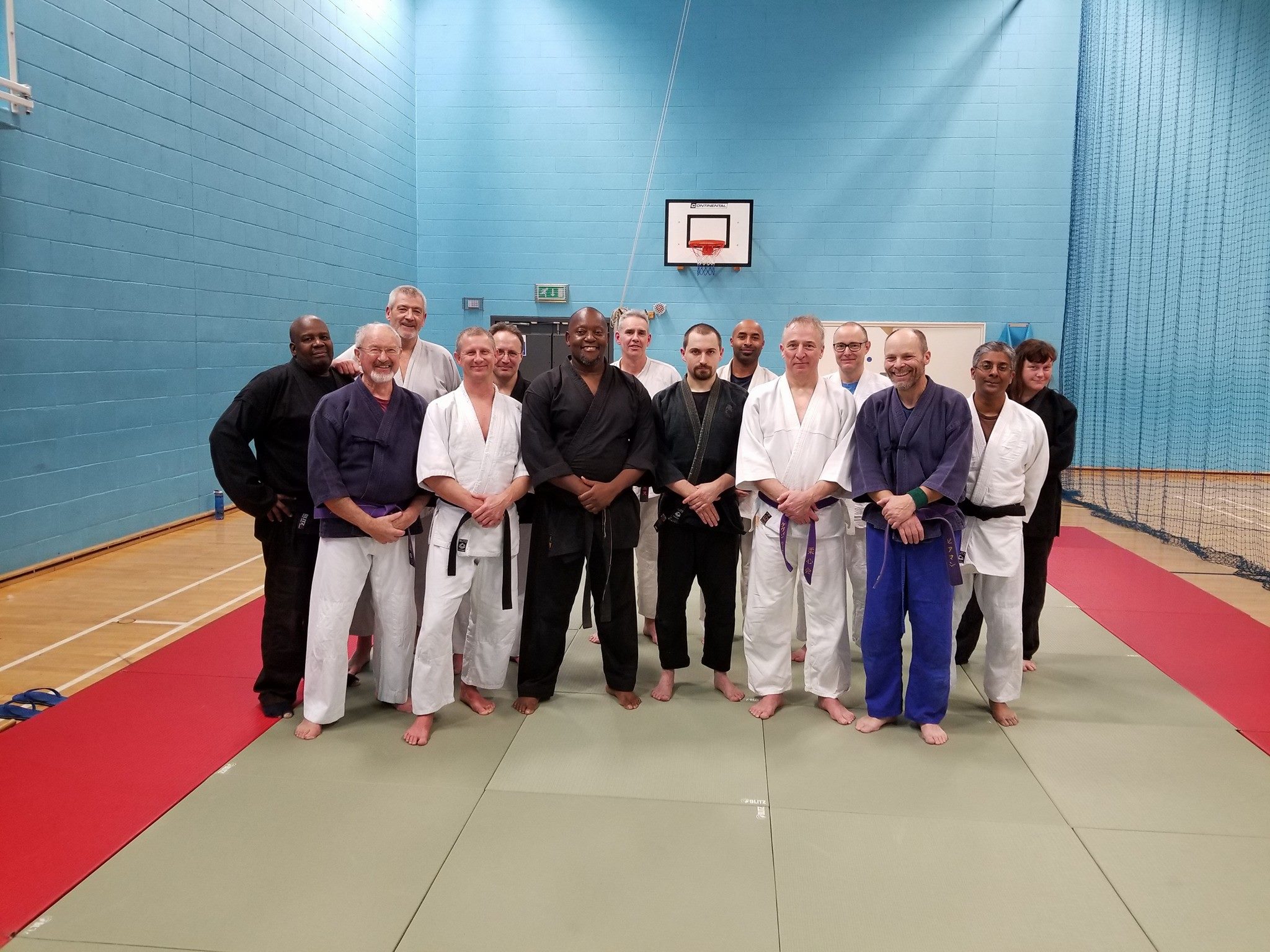
It has been a very long time since I showed up to a martial arts club as a beginner, but over the summer I found myself looking for a regular martial arts class that fit my schedule, and in which I had no experience. I stumbled upon Jushinkan, here in Ipswich. I asked about beginners’ courses, but they said to just show up, so I dug out my old gi and toddled along to class. I hadn’t really thought about it, but it turns out that in my head there was already a list of things to look for in a martial arts school or club. I realised this when the instructor (Richard, an 8th dan, who is so old-school that he doesn’t even do email) hit every single point on my unconscious checklist. He asked me whether I had any experience (I said yes, but not in this art); any disabilities or injuries he should know about (none), and told me that it was ok to sit out any exercise I felt would be bad for me. I felt welcome, and under no pressure to perform. Richard ran us through some naginata, spear, and sword kata. He said things like: “this is not self-defence” “this is stylised, for kata. The applications might look like this, or this” “now if that doesn’t work, try this” “this is a last-ditch I’m probably going to die but I’ll try this anyway situation” “no, grip me really hard as if your life depended on it, so we can see if this really works”. Hitting the items on my list like he’d read my mind. With about forty minutes left of class time, he handed the class over to a young man (about half his age) who “is much better than me at ground fighting, so he’s going to cover this stuff”. Absolutely no standing on rank whatsoever. And the person I was paired off with was not just very skilled, but an artist, alive to the nuances of the actions. After my second class I was sure I’d be coming along regularly, so I took the instructor aside and told him what I do for a living. His reaction was enthusiastic delight, and the hope that I’d perhaps teach a class for them sometime, because they are always looking for new approaches. If training is any use at all, it changes you. The demeanour of the more senior members of a club is a pretty good guide to how a club is run and what effect the training has on your character. Every other member of the class on that day (and on most days since) were very experienced: I’m usually the only one on the mat without a black belt. And everyone, without exception, has been friendly to the newbie, and highly skilled. The other night a couple of young women came to watch class, one of them in a hijab. One of the club’s founders, Brian Rogers, another 8th dan with about 40 years experience, spent the entire evening going over the absolute basics with them. Nobody found it remarkable. I have learned a great deal so far, especially about joint locks, takedowns and ground fighting, but that is perhaps the least important aspect of the club and the style. It is much more important to me that I could recommend it to anyone without even thinking about how they will be treated if they show up. If you are lucky, you’ll be wondering why I bothered to write this post: surely that’s how all martial arts clubs are run?
Safety Guidelines for the Practice of Swordsmanship
These safety guidelines come from my Recreate Historical Swordsmanship from Historical Sources Course (included in our Mastering the Art of Arms and Solo Training packages here) and have been adapted from guidelines in The Medieval Longsword,The Duellist's Companion, and The Theory and Practice of Historical Martial Arts. All of those books are included as downloadable pdfs in the additional course material.
Climb if you will, but remember that courage and strength are nothing without prudence, and that a momentary negligence may destroy the happiness of a lifetime. Do nothing in haste; look well to each step; and from the beginning think what may be the end.
Edward Whymper’s admonition, from Scrambles amongst the Alps, elegantly encapsulates the correct attitude to all potentially lethal activities. Substitute “practice swordsmanship” for “climb”, and there is the correct mindset for any swordsman, beginner or expert. Take it to heart before you start training with a partner.
When training with weapons you hold your partner's life in your hands. This is a sacred trust and must not be abused.
Disclaimer: I accept no responsibility of any kind for injuries you sustain while you are not under my direct personal supervision. During this course you will be taught how to create safe training drills, and I am certain that if you follow the instructions there is a very low likelihood of injury. But if I am not there in person to create and sustain a safe training environment, I cannot be held responsible for any accidents that may occur.
Principles
The basic principles of safe training are:
Respect: for the Art, your training partners, the weapons, and yourself.
Caution: assume everything is dangerous unless you have reason to believe otherwise.
Know your limits. Just because it’s safe for somebody else, does not necessarily mean it’s safe for you. Never train or fence when you are tired, angry, or in any state of mind or body that makes accidents and injuries more likely.
Most groups that keep going for more than a year have a pretty good set of safety guidelines in place. Make sure you know what they are, and follow them.
My senior students routinely train with sharp swords, often with no protection. That’s not as dangerous as it sounds, when you remember that they have been training usually for 5+ years at that point, under my supervision.
Safety first: you cannot afford time off training for stupid injuries. Life’s too short. Whatever training you are doing must must must leave you healthier than you started it. You will not win Olympic gold medals this way, but you won’t end up a cripple either. The path to sporting glory is littered with the shattered bodies and minds of the unlucky many who broke themselves on the way. Don’t join them.
Every time I find myself teaching a group I don’t know, I tell them that the class will be successful from my point of view if everyone finishes class healthier than they started it. Most injuries in training occur either during tournament (highly competitive) freeplay, or are self-inflicted during things like warm-ups. In my school (and other classes) we have a zero tolerance policy on macho bullshit.
If any exercise doesn’t suit you, for any reason, you can sit it out, or do some other exercise. If you are sitting it out, a good instructor will ask you why, and help you develop alternatives or work up to the exercise in easy stages, but will never pressure you to do something that might injure you.
This is also true of work-related injuries, like forearm problems from typing, or the ghastly effects of sitting all day. By avoiding the things that will hurt you, you will naturally seek out the things that are good for you. Hungry? Avoid sugar, avoid processed foods, and lo! there’s a fresh salmon salad. Tired? Sleep is better than barbiturates, no?
This requires good risk-assessment skills (I recommend Against the Gods, the Remarkable Story of Risk, by Peter Bernstein) and the courage to take risks that truly serve your overall aims. A safe life is not worth living, but foolish risk-taking will not make your life meaningful.
Try adopting these key habits:
Before any new activity, do a risk/reward calculation. How risky is it, and how
rewarding?
Practice saying no to training suggestions: even safe ones. Most people do stupidly
risky things due to peer pressure. Being able to say no to your peers is perhaps the most important skill in reducing injury rates. If this is hard, make it a habit to decline at least one suggestion every session, until it’s easy.
Equipment
Without doubt the single most important bit of safety equipment is good common sense. Fence according to the limits of your equipment, exercise control and respect the weapon at all times, and you will never have a serious injury. Minor bumps and bruises come with the territory.
There were some masters who believed that the safest course is to fence with sharp weapons and no protection. This is how it was often done in the past until the invention of fencing masks (though there are tournament records and declarations as early as the 14th century that record the use of blunt practice weapons; King Rene d’Anjou’s treatise of 1470 is perhaps the best source). Such masters are right in theory, in that freeplay with sharps is the best way for students to learn absolute respect for the weapon, and the importance of absolute control. There are a few contemporary masters with whom I will fence like this, and there is nothing like it for generating a perfect fencing approach. But try explaining that to the insurance companies, or in the event of a slip, the police or coroner.
It was often said in the eighteenth century that you could tell a fencing master from his eye-patch and missing teeth. Never forget that even a blunt blade can break bones. When free fencing, or when practicing drills at speed, it is essential that you wear appropriate safety gear. You do this not for your own sake, though self-preservation does come into it, but for the bene t of your training partner. Your protection allows him to hit you safely.
Choosing protection is a very controversial subject. Too little, and you can end up badly hurt (even in practice). Too much, and you can’t fence properly. Firstly, it is important to establish what style of fencing you will be doing. If you are practising armoured combat, then buy the best fitting, best made armour that you can from an armourer who knows how you intend to use it and has seen what you want to do. This is the hardest style of fencing to appropriately regulate, because accurate technique requires you to go for the least armoured spots (throat, eyes, armpits, joints), but safety requirements obviously prohibit that.
As a general guideline, I recommend the following for most weapons.
An FIE standard fencing mask. This allows you to thrust at the face (a very common target), and generally attack the head. This does have three major caveats. Firstly, it leaves the back of the head open, and you must be very careful not to strike at this target. An added apron of thick leather affords some protection. Secondly, it does not protect the head and neck from the wrenching force of over-vigorous blows. It is vital that you and your opponent learn control before engaging in freeplay. Thirdly it is designed to protect the face from high-speed, light, flexible weapons, not slower, heavier, rigid ones. So continually check them for wear, and make absolutely sure that your weapons are properly bated.
A steel or leather gorget, or stiff collar, to protect the throat. Points can slip under the bib of a mask and crush the larynx.
(For women) a rigid plastic chest guard.
A point-resistant fencing jacket rated at least 500 newtons. Sturdy, preferably padded and/or armoured gauntlets, which should extend at least four inches past the jacket cuff to prevent points sliding up your sleeve. I have twice had fingers broken through unpadded mail gloves, and now use a pair of fingered gauntlets from Jiri Krondak, which cost about 150€.
A padded gambeson, or a plastron. If you are making one yourself, bear in mind that it should be thick enough to take the worst out of the impact of the blows, and prevent penetration from a thrust. All openings should be covered. The collar should be high enough that thrusts coming under the bib of the mask do not make contact with your throat. A plastron must wrap around the ribs, and properly cover the collar bones and shoulders. I usually wear a fencing jacket and plastron (as pictured).
A box for men (called a “cup” in the US). You only forget this once.
Rigid plastic protectors for the knees and
For the elbows, of the sort worn by in-line skaters (worn under the
clothes for that period look if you prefer), will save a lot of pain, and some injury.
Footwear: on the matter of footwear, few practitioners agree. In the longsword treatises, there are no heavy boots, and certainly no built-up heels. For a completely historical style, it is necessary to wear completely accurate period clothing at least occasionally, because it can affect the way you move. It does not matter much what you wear on your feet provided that you understand grounding, body-mechanics and footwork, but attaining that understanding is much easier barefoot or in very thin flat soles. Excessively grippy soles can lead to joint injury as you may stop too suddenly, or get stuck when you should be turning (particularly in falls at close quarters). The dangers of wearing too slippery soles are obvious. In the salle I usually wear medieval shoes or ‘barefoot’ shoes (aka five-fingers, or ‘toe shoes’), and recommend a thin, flat sole regardless.
You can find our current equipment recommendations here.
The Sword
Training swords come in three main types. Authentic sharp reproductions, which are used for cutting practice and some pair work with advanced students, blunt swords that try to reproduce the handling characteristics of the sharps, and fencing swords that are designed to make fencing safer. These all have their pros and cons, and you should use the sword that’s right for your style and the kind of practice you will be doing.
It’s perfectly all right to use a wooden waster or something similar to start with, but do not imagine that there is any such thing as a safe training sword. Even modern sport fencing blades engineered for fencing sometimes break and puncture people, and anything heavy enough to reproduce the handling of a medieval or renaissance sidearm is going to be able to do damage.
Looking after your weapon is largely a matter of keeping it dry, clean, and free of stress risers (a stress riser is a weak point, usually a deep nick, which encourages the blade to fold at that point).
Occasional rubdowns with a moisture repellent oil and steel wool or scouring pad, followed by a coat of microcrystalline wax, should keep the blade and hilt clean (follow manufacturer’s recommendations if you have a gilt, blued or otherwise ornamented weapon). Do not be afraid to file down any large nicks, and file off any burrs: this is important from a safety perspective, as the blade is most likely to break at a nick, and burrs can be very sharp.
The edges of a blunt weapon should always be kept smooth enough that you can run your bare hand hard up the edge and not get scratches or splinters. Even the toughest and most cherished sword will not survive repeated abuse: the best guarantor of longevity for your sword (and yourself) is correct technique.
Rules of Engagement
Once you have agreed to fence with someone, it is important to agree on rules of engagement. This is partly to ensure safety, and partly to create an environment in which you can learn. The two most simple rules are these:
Confine permitted actionss to the safety limits of your protective gear
Confine permitted actions to the technical range of the least trained combatant. In other words, do not allow face-thrusts when wearing open helms, or throws when one of you is not trained to fall safely. The rules can be adapted further to develop specifi aspects of technique: for instance, you may not allow any close quarters work at all, or even restrict allowable hits to one small target. The idea is to come to a clear, common -sense agreement before facing off. You are only ready for no-holds-barred, totally “authentic” fight simulation, when you can enter such a fight with your judgement unimpaired.
Following the rules of engagement will not make you soft, nor will it dull your edge if it comes to the real thing; rather it it will develop self-control.
These rules apply to all fencing:
Agree on a mutually acceptable level of safety.
Wear at least the minimum amount of safety gear commensurate with rule 1. Confine allowable technique to those within the limits of your equipment.
Confine allowable technique to the technical ability of the least trained
combatant.
Appoint either an experienced student or one of the combatants to
preside over the bout.
Agree on allowable targets.
Agree on what constitutes a “hit”.
Agree on priority or scoring convention in the event of simultaneous hits. Usually it is better
to allow a fatal blow before a minor wound, but simultaneous hits should be avoided whenever possible.
Agree on the duration of the bout either in terms of hits, such as first to five, or in real time.
Acknowledge all hits against yourself. This can be done by raising the left arm, or by stopping the bout with a salute, or by calling “Halt!” and telling your opponent where and how you think she hit you.
Maintain self-command at all times.
Safe Training
In my experience most injuries are self-inflicted. It is far more common for students to hurt themselves by doing something they shouldn’t, than to hurt their training partners. Here are a few simple guidelines for joint safety, which should be followed during all training. I am using the lunge as an example of a stressful action, but these principles apply to any physical action.
The knee must always bend in the line of the foot. Knees are hinges, with usually a little under 180° range of movement. The do not respond well to torque (power in rotation). So whenever you bend your knees, in any style for any reason, ensure that the line of your foot, the line of movement of your knee, and the line of movement of your weight, are parallel. This prevents twisting and thus injuries. This one simple rule, carefully followed, eliminates all knee problems other than those arising from impact or genetic disadvantage.
Whenever performing any strenuous task (such as lunging, or lifting heavy objects), tighten your pelvic floor muscles (imagine you need to go to the bathroom, but are stuck in a queue). This supports the base of your spine, and helps with hip alignment.
Joints have two forms of support: active and passive. Passive support refers mainly to the ligaments, which bind the joint capsule together. This is basically set, and can’t be trained. When training your joint strength, with exercises or stretching, avoid any action that strains the joint capsule. Any action that causes pain in the joint itself should be modified or avoided, as it may damage the soft tissues (ligaments, tendons, cartilage). These tissues have a very poor blood supply and hence heal very slowly.
Active support refers to the muscles around the joint, and these can be strengthened by carefully straining the joint with small weights and rotations. To strengthen a joint you must stress these muscles, without endangering the ligaments. Any competent physiotherapist can show you a range of exercises for building up the active support around your knees, wrists and elbows, where we need it most.
Rest is part of training. Your body needs time to recover, and is stimulated by the stress of exercise to grow stronger. However, the body is efficient, and will withdraw support from any muscle group that is not used, even if for only a few weeks. So regular training is absolutely crucial.
If you can’t lunge without warming up, don’t lunge except in carefully controlled drills. Warming up is essential before pushing the boundaries of what your body can do.
If you find this advice sensible and useful, please feel free to share it as widely as you like!
If you would like these guidelines as a handy PDF, then drop your email in the box below and I'll send it to you.
Last night, Rami and I got together and played our first games with the proper printed Patron Deck and Liechtenauer expansion pack. This was lots of fun, and very exciting for us to see the project coming to completion.
The Patron deck reflects the choices made by our Patron, of course. While we couldn’t put in absolutely everything he asked for, we did manage to include some pretty cool new tricks.
Our dashing Patron
My favourite is the pouch of poison dust, the idea for which came from the pollax filled with poison dust in Il Fior di Battaglia. The way it works in the game is that when you get into a stretto bind, you throw the dust in your opponent’s face, which causes a break-off. But, you also get to take one of your opponent’s virtue cards, and the other one is invalid until the next break-off. This simulates the effect of blinding powder in their eyes.
The Patron deck doesn’t have all of the Liechtenauer material, of course; most obviously, it lacks the five meisterhau. Our idea was that the Liechtenauer Expansion Pack would work like an advanced course (which is pretty much how I see the medieval Liechtenauer material; it doesn’t cover any of the basics of normal swordplay). But he does have nasty tricks like Uberlauffen, which allows him to counterattack with an oberhau against a mittelhau or unterhau.
The Patron deck has the same suite of blows and stretto cards as the other three decks, though the balance of the blows is different, to reflect what I see in the sources. But he has some very cool Liechtenauer-specific actions up his sleeve, such as Mutieren and Duplieren. Their basic function is to allow the player to use a cut or thrust when they would normally be confined to stretto plays.
Liechtenauer wrote (I paraphrase from memory) “if he [the opponent] is strong in the bind, duplieren. If he is weak in the bind, mutieren). That’s the gist of it, anyway. So, in these cards, you can use Duplieren to play another cut, if your opponent has more Fortitudo (ie is stronger); if you have more Fortitudo, you can use Mutieren to play a thrust. It’s moments like this when apparently odd features of the game will resonate with those who know the sources as pretty much direct quotes, that to me makes this game such a worthwhile use of my time.
Sigmund Ringeck, brought to life!
The Liechtenauer Expansion pack has only six guards. They are Vom Tag, Pflug (left and right), Ochs (left and right) and Alber. Why? Because Liechtenauer wrote that they are the most important. And as an expansion pack, which can be used with any character deck, these are in addition to the regular suite of 12 guards. Of course, the Patron already has these in his deck. For the Patron, the Expansion pack adds the five meisterhau, Indes, Fuhlen, and Absetzen. This makes it perhaps less useful to him than it is to a Fiore-based deck like Galeazzo, Boucicault, or Agnes, but that is what you would expect; a swordsman trained in Germany would likely see less new stuff in Liechtenauer’s system than someone with a different basic training.
We did come across a problem with the Krumphau. As you can see from the card, there is a lot of text. But not enough. As I see it, the krumphau is used in at least three ways:
1) to defend from your right against an oberhau
2) to defend from your left against an oberhau
3) to attack from your right against left ochs (Liechtenaur states that it “breaks left ochs”).
[Liechtenauer practitioners please note: this is a card game. Yes, you can strike at the hands with the first action of the krump, but that is a level of granularity that we just had to skip. Likewise Fiore specifies all sorts of targets (face, throat, chest, arms, cheeks of the arse) and, with a couple of exceptions, we have just left out the targeting. A blow lands or it doesn’t. It would have made the game orders of magnitude more complex to try to specify where it lands, or, as in this case, to include what I think of as the “single-tempo krump”].
In each case, the blow that actually hits the opponent is coming down from the other side to the one you started on: if you krump from the right, you’ll end up striking with a left oberhau. To attack left ochs from a right-side guard such as Vom Tag, beating it out of the way and striking; the blow that hits the head is effectively a false-edge backhand oberhau, so you’d play a left oberhau. But that violates the rules of Eligibility; you can’t strike a left oberhau from Vom Tag (please see my post on posta di donna for the explanation as to why we can’t allow you to do everything from a guard in the game that you can in real life).
So we are going to have to change the text on the card, and because it’s going to be so long it wouldn’t fit on the card in a legible font size, we will have to put the full rules regarding this card in the separate Rules sheet. That kills me, because we have always tried to make all the info fit on the card, but hey ho, accuracy above all. For those of you reading this who have already got the Expansion Pack, let me summarise the use of Krumphau here:
You can play a Krumphau with a left oberhau/roverso fendente card from any right-side guard that allows a right oberhau/mandritto fendente or right mittelhau/mandritto mezano. You can do this when your opponent is in left ochs/fenestra sinestra, treating that guard as Extended. Note, to play a left oberhau/roverso fendente against left ochs/fenestra sinestra would normally be not Eligible from a right-side guard; you’d have to change guard to do it.
You can also play a Krump with a left oberhau/roverso fendente from a situation where only mandritti/ blows from the right are normally eligible, as a counterattack against your opponent’s right oberhau/mandritto fendente strike; or with a right oberhau/mandritto fendente against their attack of left oberhau/roverso fendente.
In effect, it allows you to counterattack when normally you couldn’t, and to strike from the other side when normally that would not be Eligible.
I think you can see why this won’t fit on the card!
There are a few very minor corrections to make to some other cards, but we expect to get these decks released in print very soon.
These first imperfect decks will be sent to our Patron, of course. We finished the session by writing a letter to go with them.
Hand written with a dip pen using an antique nib (a Waverly; the same brand and model that Rudyard Kipling insisted on), and sealed with wax using a seal I was given by Chris Vanslambrouk, in Florence last year (thanks, Chris!).
There has to be some advantage to being the Patron, no?
Then, of course, away with the wine and out with the single malt. Alles ist gut, ja?
You can find all of the print and play pdfs, printed decks of Galeazzo and Boucicault, and all the rules sheets, here. And print-on-demand versions of all the decks so far except the Patron and the Liechtenauer Expansion, here.
I have been working for the last nine months on creating a teaching tool for students of Fiore's art: a card game called Audatia. The game has been designed from the ground up as a way to make the abstract elements of Fiore's system, such as the terminology and the overall tactical structure, easier to learn. I know next to nothing about designing games, so of course I hired a professional, and as readers of this blog should know by now, I didn't do it all by myself. I have been working as part of a team, and my job is to keep the game faithful to the Art it is intended to serve.
Over the weekend we took the game to the gamers, by setting up playtesting at Ropecon. We were supposed to be on for two hours a day, over the three days, but three of us were at it non-stop for an average of 5 hours a day. Folk were queueing up to have a go, and many came back for more. It was fantastic. We learned a lot about what we had got right, and more importantly, what we had got wrong.
The best negative review we got was from an ex-student of mine, who said: “it's too realistic. You might as well just pick up a sword and fight.” Not an error I intend to fix.
It also proved itself as a teaching tool; the players, usually with no swordsmanship experience, quickly learned what an opponent in tutta porta di ferro could do, and what their best option was if when the blades meet you are in the zogho stretto. If tutta porta di ferro and zogho stretto are all Greek to you, then you need this game!
In class last night, a student asked a question about the uses of posta breve based on her experience playing the game at Ropecon; a question that might never have occurred to her if she had not played. That gave me the theme for the class, during which I realised that the game needed a tweak to make its representation of the guard more accurate. So the game proved its use as a teaching tool, and not only that, it set up a virtuous cycle of learning and development.
We have clearly hit some kind of a nerve, as we have been storming ahead on our indigogo project, having raised over 7,000 euros in under 7 days. If you haven't backed us yet, please do so now!
So, Audatia matters because:
1) it will help students of the Art of Arms pick up the theory side of things more quickly, encouraging them to engage with the system more closely, and helping to drive our understanding of this system forward.
2) it will draw new scholars into the Art, folk who play the game may well take up the practice of swordsmanship.
3) it will help bridge the gap between those who get why swords are cool and those who don't. If you're addicted to swords, you can use this game to help communicate why to your friends outside our sub-culture.
4) it is one more way in which those who have no idea that European martial arts exist can find out about them.
5) it will, if it does well, go some way to counteract the appalling misogyny in gaming culture today. We intend to create female character decks, because there were some fearsome women warriors in the middle ages. (I'll be blogging about this in detail soon.) And guess what: they will be wearing armour that would effectively defend them against deadly weapons, not pander to the prurience of little boys.
What do you consider “real swordfighting”? For some, only tournament bouts really count. For others, there has to be a corpse by the end. My answer to this vexing question is below.
When I was a little boy I want nothing more than to learn real swordfighting. My mum told me that real swordfighting was called “fencing”, and that her dad, my grandpa, was an expert. He had been a keen fencer for about 70 years at this point, and was duly prevailed upon to give his grandson an introductory lesson in the noble art. This involved him sitting in his armchair smoking a rollup cigarette while I stood there holding a foil. When he yelled “extension!” I stuck my arm out, and when he barked “Lunge!” I stepped forwards with my front foot. I was about eight years old, and this was heaven. REAL swordfighting! Unfortunately though he was extremely old (about 88) and my family were living in Botswana while he was in London, so I only ever got a couple of sessions with him before he died.
I made do then with what I saw on the silver screen, though at this time sword flicks were pretty rare. Conan the Barbarian was my primary source, with supporting material from such legendary high-quality movies as Hawk the Slayer. But it was very very hard to get my hands on movies like this, as a) the VCR had only just been invented and b) we didn’t have so much as a TV to plug one into.
But while I was home for the school holidays I went most Saturday afternoons to Gaborone’s one and only cinema, the Capitol. The kids’ matinee was occasionally such gems as Clash of the Titans, but usually full-length, uncut, Hong Kong kung-fu movies, complete with hardcore violence and some pretty nasty porn. My friend Mark and I would gloss over the bits with naked women in (we were only 9 or 10) but treat the rest of the film as instructional; on the walk home we practised the top-level moves we had learned. I never did quite manage to jump backwards onto a tree branch, but we waved our arms and legs with vigour, and we were both adept at the sound effects.
My martial arts education took more serious turn when a karate group started up at the local golf course. It was run by Korean man who barely spoke, and spent quite some time after most classes trying to break concrete paving slabs with his bare hands. He would set up a couple between some breeze blocks, put a thin towel on top, and slam his hand down. The top slab always cracked in two, but I never did see him break both at once.
The class consisted of three or four students, and we would start by running somewhere on the course, finding a quiet spot and going through a set of ritualised opening moves before the punching and kicking would begin. The first command, which sounded like “Chariot!” had us standing up straight with our hands by our sides; then “Chumbi!” and we would drop a little with our hands fisted in front of us. This was by way of salute, I think. What with commuting to the UK three times a year for school I didn’t get a lot of training, but the buzz of doing real martial arts for the first time will never leave me. (This still strikes me as by far the best use a golf course has ever been put to, and I would urge those of you of an activist frame of mind to set up an “occupy golf courses” movement, so that these lovely spaces can serve a worthwhile function as outdoor dojos.)
My school at this time was a boys-only boarding school in rural Suffolk, not far from Ipswich. (This was not a great experience- you can read about the fallout here.) There was a general policy that if enough boys were interested in something, the school would organise classes in it. So I campaigned for martial arts, and eventually, at the beginning of my final year there, the powers that be allowed a karate class to start. My name was first on the sign-up sheet, and I went to the deputy head, a normally terrifying individual, and begged for a guarantee that I would be picked. The list of those doing karate was posted a week later and thank the lord, there was my name.
Imagine my delight when the karate we were doing turned out to be basically the same style, chariot, chumbi and all. But this time we also had belts and ranks, and so gradings. The club began in September 1986, which was also the beginning of my final year, and the year in which we moved from Botswana to Peru. This meant that two days before my first ever grading I had a load of really nasty vaccinations, and took the test with my left arm swollen and in constant agony. There were tears running down my face for most of the exam, and I was shaking like a leaf by the end. But, and here’s the lesson, I got a first-class pass. This had nothing to do with my rather feeble ap chagis (front kicks) and everything to do with my having got through it without quitting.
This martial arts heaven lasted only a year before I was packed off to public school and there was no karate to be had. But, joy of joys, finally there was fencing. Not only that but fencing had just been designated a “major sport” in the school, which meant that taking it I was not obliged to do any other sport. In other words I never had to chase after another fucking round object again. I cannot tell you how much of my life had been wasted by my being forced to pretend to care where a leather bag (football or rugby), or solid round object (hockey or cricket) ended up relative to a white line and some posts. Hockey at least had the decency to supply me with a weapon and people to hit with it, but the rest were just so stupid.
Surrounded by boys who were sports-mad, as good little Englishmen are trained to be, I had always felt like a complete alien. Sometimes I even faked a bit of enthusiasm. But hanging about outside in a muddy field, wearing shorts in winter, and being yelled at for not paying attention to a completely arbitrary set of rules is just the single least explicable human pursuit. But fencing, that made sense. Someone is trying to stab me. I’m trying to not get stabbed and to stab them instead so they have to stop. Makes perfect sense. I am motivated.
I loved every minute of fencing, from footwork drills to technical drills to individual lessons with the coach, to the actual competitive fencing. But the tournaments themselves were a pain. It meant getting up early at the weekend, going somewhere in a coach (I despise and abhor all forms of motorised transport unless I’m driving), hanging about for endless hours waiting for it to be my turn, fiddling with stupid kit, and then finally getting to fence people I hadn’t fenced before. Total time investment: perhaps 9 hours. Total bouts: maybe 10. Less if I got eliminated early and one of my teammates didn’t so we all had to stay. Inefficient, the least good bit about the whole fencing endeavour, but with some useful aspects, mostly to do with the experience of crossing blades with new people.
I spent all five years of my secondary education doing no other sport but fencing, and by the end of it, I was reasonably good; good enough to be captain of the team, but not good enough to get into the nationals. In September 1992 I went up to Edinburgh University to read English Literature. I naturally joined the Fencing Society, and showed up to my first session wondering what the level would be like. Fencing clubs are one of the few environments on Earth where it is perfectly polite, friendly even, to go up to someone you don’t know and say “fancy a fight?”.
This I did, to a tall Chinese-looking chap who was already kitted up. He agreed, and we set to. On the first pass it was obvious to me he was out of my league, but I did ok- I even pulled off a lovely doublé in carte (he was a left hander). The score was 4-3 in his favour when I saw the opportunity for another doublé. As I took it, he neatly stepped offline with his back foot and counterattacked under my arm, my point went sailing inches past his chest. 5-3, I lose. Then I noticed the logos on his kit- he was just back from the Barcelona Olympics, where he was on the British team. Suddenly losing was far less important than the fact that I’d got three hits! And having seen my predilection for the doublé, he had set me up for the second one. Lovely.
Sad to say though, that bout was the highlight of my University fencing, because at the time a completely erroneous interpretation of the FIE rules was being applied by pretty much all tournament referees. The rule states (in foil) that the attack is determined as the extension of the sword arm with the point threatening the target. But it was interpreted as “whoever moves forward first is attacking”. This lead to people running forwards with their point back over their left shoulder, and walking onto my extended arm, while flicking their point around to touch my shoulder. According to the rules, my attack on their preparation. In a duel, their pierced liver versus my small bruise on the shoulder. According to the referees, a hit against me. Given that my interest was in real swordfighting, I was not prepared to fence like that, so I stopped going to competitions. But around this time I fell in with some other fencers who wanted to do things for real, and started meeting up with them to fight the way we wanted to- in a way that felt real. (I describe this experience in more detail in my book Swordfighting.)
One of the books in my grandfather’s house was a first edition of Alfred Hutton’s The Sword and the Centuries. It opened my eyes to the possibility of researching historical fencing styles, and even provided some details about the sources I might work from. Amazing- there were books that could tell us how real swordfighters really fought with real swords for real! Then in the National Library of Scotland, I stumbled upon a little book that was to change everything: The Expert Sword-man’s Companion, by Donald Mcbane. What a book!
I wangled it onto my English Lit course Identity in 17th century Literature with Dr. Jonquil Bevan, and even managed to get course credit for it- I wrote an essay on it called The Gallant Pander. Best of all, from my perspective, was that the smallsword material McBane presents did not contradict my early fencing training, but allowed me to apply what I knew in a historical way. It may come as a surprise, given that these days I am best known for my work on medieval Italian swordsmanship, but my first love was 18th century French smallsword as taught by a Scottish thug.
So, my friends and I started the Dawn Duellists Society, in 1994, to bring together like-minded people to fight with. I quickly found that in order for the fights to be anything like the books, I had to teach these people first. So I ended up teaching historical swordsmanship in order to create opponents. The whole point of researching these historical systems was to pick up new tricks for winning fencing matches with historical weapons. I had a complete separation in my mind between stuff done with swords, and martial arts. Martial arts were about killing people; sword-activities were about fencing. Martial arts were serious, fencing was not. Martial arts was about the Path, swordsmanship was about scoring touches. Given my interest in real swordfighting, this makes no sense now, but it was how my head worked back then.
The psychological wall I had built between swordsmanship and martial arts melted away during the summer of 2000. I won’t go into the full story here- suffice to say it involves witches and angels, sex and violence, lust, betrayal and a mountain-top revelation. Yes, really. And no, not while sober. Suffice to say I suddenly decided to move to Helsinki and open a school- a school devoted to historical, martial, swordsmanship. Above all, restoring the arts of our ancestors, and maintaining at all costs the martial depth of the practice. Because that, to me, is real swordfighting.
I spent the weekend 13-14 October in El Escorial, Spain, attending the Asociación Española de Esgrima Antigua annual meeting, as an invited instructor. It was a welcome opportunity to catch up with their chief instructor, an old friend (and a fellow full-time professional colleague), Alberto Bomprezzi, and to see how things are done in Spain.
La primera cosa que quiero decir es que fue un placer e un honor estar invitado a este evento; y quiero agradecer a todos los instructores y estudiantes por darme la bienvenida a mi, y su paciencia con mi español. Me alegría mucho encontrarme a tantos nuevos hermanos y hermanas del espada. ¡Gracias a todos! Y he aprendido una nueva palabra importantísima: ¡Porrón!
The event was well run, and organised in a way I haven’t come across before. Each day began with an hour of free fencing, in which everyone who wants to take part, finds a partner and fences fro three minutes. A whistle is blown, and you change partners. After three such rounds there is a five-minute break. After an hour, there has been a lot of very happy chaos, and everyone is nicely warmed up. I spent the time watching the students fencing, which told me (in the first five minutes) what to cover in my classes.
Alberto is very upfront about what he is doing- he teaches fencing, with historical weapons, taking his theory from Spanish rapier sources (Pacheco y Narvaez, and Carranza, if I recall correctly). This is very different to my own approach which is very much by the book. Indeed, one of the reasons Alberto invited me was so that his students could experience a different way of doing things.
In my first class I covered entering into measure and attacking from wide measure, and what to do when you get very close. This is because almost every action I saw in the longsword freeplay was done after the fencers came close enough to cross swords, then played from there. So they know how to bind and wind, but mostly they didn’t know how to attack with vigour without exposing their hands. So we took one parry and riposte (from first drill, so second play second master of the zogho largo), and worked in a tempo before the attack, and before the parry. We then took the pommel strike from the 8th play of the sword on horseback, and played with that as the attacker’s back-up if the strike fails. It was a very interesting class, clearly somewhat outside the students’ experience- and also outside mine as I taught the whole thing in Spanish, for the first time ever. I learned Spanish growing up in Peru during the school holidays from ’87 to ’92, which makes it 20 years since I last spoke the language regularly. But with plenty of goodwill from the students, we got by.
There were only two class slots per day, with four classes running in each slot. In the afternoon I watched Chris Chatfield teach pugilism based on Saviolo, and Alberto teaching rapier and dagger. I also got to talk to Rob Runacres, who had asked his colleagues to suggest whatever tips they may have for his improvement. So I took him aside and taught him the basics of establishing a groundpath from the sword to the feet. (I’ll cover this in a blog post next month.) It was a pleasure to teach him, as he was very open to correction, and willing to learn.
The second day began predictably late, but with so much free time built into the schedule it didn’t matter. When in Spain, chill out! I had originally been asked to teach one longsword and one rapier class, but Alberto asked me to teach a second longsword class instead, so I did. This one focussed on one basic drill (first drill again), and looked at how the blows create the guards, what the guards are for, the difference between zogho largo and zogho stretto, and making your actions work despite your opponent’s best efforts to stop it.
In the afternoon, after another short lesson in the mighty porrón, I got to spend about half an hour in Manel Avrillon’s knife class. I adore martial arts of just about any type, and after an unrelieved diet of European food, the occasional Indonesian curry or Japanese sushi is very welcome. But I spotted Chris Chatfield waiting for me, and I had asked him to take me through his interpretation of the first set of plays from Vincentio Saviolo’s His Practice.
Back in 2000 at the second annual meeting of the British Federation of Historical Swordplay (which I helped to found in 1998) I saw a demonstration of this form that has stayed with me. Duncan Fatz was reading the treatise aloud, while Chris and a chap called Alistair O'Loughlin performed the actions. It was a perfect example of by-the-book historical swordsmanship. Yes, it was probably mostly wrong in terms of the specifics of execution, this was 12 years ago after all, but the approach was perfect. The spectators could see the words of the book come alive. So I was very curious to see how Chris’s interpretation had changed. And changed it has- the footwork alone is a very interesting set of mechanics that echoes both 19th-century pugilism and T’ai Chi Chuan. Chris walked me through it for about an hour, and while my left heel stubbornly refused to plant itself the way he wanted it to, the mechanics made perfect sense. I look forward to trying them again- perhaps at a weekend seminar in Helsinki next year…
Anyway, you couldn’t ask for a better host than Alberto, and his students were keen, enthusiastic, open to alternative approaches and fun to teach. All in all, a great weekend.
I've been reading again, this time Tom Hodgkinson's Brave Old World, which is a charming book all about living well, in defiance of corporate greed and the ghastly Puritan work ethic. I'm not hugely interested in gardening or rearing my own chickens and pigs, but even so the book was well worth the time, The first paragraph says it all:
The most important but generally the most neglected of the arts of everyday living are simply these: philosophy, husbandry and merriment. Philosophy is the search for truth and the study of how to live well. Husbandry is the art of providing for oneself and one's family, and merriment is the important skill of enjoying yourself: feasting, dancing, joking and singing.
It is especially interesting as he takes as his authorities mostly long-dead authors such as Virgil, Horace, Thomas Tusser, and many more. In a sense he is recreating the lost arts of husbandry and revelry according to the historical sources, which bears an obvious relationship to our own recreation of the lost arts of the sword.
What I found most enchanting about this book was the author's absolute insistence on quality over quantity, right over convenient, and his candid admission that he routinely falls short of his own ideals, as do we all.


Revolutions: Woodworking, Watches, and AI
The AI revolution has been growing behind the scenes for a very long time, and now with chat bots like Chat GPT and image bots like Midjourney, the iceberg is breaking the surface. It puts me in mind of the machine-tool revolution in woodwork that occurred in the 60s and 70s, and the quartz revolution in watchmaking around the same time. The short-term result of both of these was that a lot of old-fashioned craftspeople went out of business, and it became much easier for lower-skilled workers to make decent quality furniture and watches, and much cheaper for ordinary people to buy a functional chair or timepiece.
What we see in both cases, and indeed in just about every case I can think of where new technology comes along, was a change in the market, which became much more democratic, and much broader, with a lower low end, and a much higher high end.
Let’s start with the woodwork example, as woodwork is millenia older than horology.
Table of Contents
The Craft of Woodwork
There is nothing in woodwork that you can’t build with just hand tools. Ships? Check. Lace cravat in limewood? Check.
This is Grinling Gibbons’ cravat, hand carved in about 1690, currently held in the Victoria and Albert museum.
You can see how he (probably) did it in this astonishing video of Clunie Fretton’s partial reproduction.
Until recently, every woodworking project, including that cravat, went from tree to finished product with practically no mechanisation. All power was muscle power, human or animal. The tree was felled with axes, split with wedges, sawn by hand, planed by hand, and finished by hand. The circular saw dates back to the 18th century, when it was driven by wind or water power, and used in saw mills to cut trunks into planks, but it took a century or so to become widespread.
Mechanisation first occurred at the largest scales of woodworking: tree felling with chainsaws, ripping with giant circular saws, the planer-thicknesser (known as a jointer-planer in the US), and so on.
At one extreme, we have craftspeople making extraordinary things out of wood entirely with machines; at the other, we have craftspeople making extraordinary things out of wood with no machines at all. One great example of the latter is Tom Fidgen, author of a wonderful book The Unplugged Woodshop, who doesn’t use any machines at all! Yet he does run an online woodworking school… I wonder which makes more money?
At the level of the individual artisan working at the bench, the cataclysm of modernity didn’t really strike until the 1960s, with the development of smaller electric tools such as hand-held routers. This quickly lead to the demise of many companies making professional grade hand tools. It became very difficult to buy a decent saw or plane; all you could get was mass-produced low-grade wobbly crap. Just compare a Record plane from 1950 with one from 1975, and the cost-cutting is obvious. Plastic handles, parts made of bent mild steel rather than cast, etc. This was not the companies’ fault: the market for the high quality stuff just wasn’t big enough any more to be profitable.
But from the ashes of rubbish hand-tools, phoenixes have emerged, beginning with Lie-Nielsen Toolworks, founded in 1981. The top end of the market is now way, way, higher than it ever was before. Such as this saw from Skelton Saws:
And planes from Karl Holtey, that begin at around £1k, if you can find them. Most are much more expensive.
Which make my beautiful, immaculate, Florip saws look very cheap! I have five: their bench saw, tenon saws both rip and crosscut, and dovetail saws rip and crosscut. Oh my goddess, these are amazing, and all five together cost about the same as one Skelton. But of course, about ten times what I'd pay for the cheapest options. Likewise, you can get a really high end plane from Clifton (an old brand that was going bankrupt, and was rescued by one of the few surviving handsaw makers in the UK, Thomas Flinn), Lee-Nielsen, Veritas, etc for a tenth of the price of the equivalent Holtey, but yes, about ten times what the crap in the big box store will cost you.
You can get an idea of what it takes to make a really cheap plane work properly in this video by Rex Krueger.
Putting these tools to use, most craftspeople fall somewhere in between the high-tech and the hand tool-only. I have always had a romantic and aesthetic preference for hand tools, so avoid machines where practical. But here’s the thing: from the perspective of the end-user, it is impossible to distinguish a board that has been dimensioned by machine and finished by hand, and one from which every shaving was taken away through manual labour.
There is no difference- you only get to see the final surface. Likewise, an article written by ChatGPT will be like a rough-sawn board. Usable for some applications, but by the time a craftsperson has planed it smooth, sanded it, and applied some polish, nobody will know if she wrote it from scratch, or edited it from an AI generated draft. Most end-users, most of the time, couldn’t care less how their book was written or their furniture was made. It either meets spec, or it doesn’t.
It’s also worth noting that mastering woodworking machines is in its own way as demanding and difficult as mastering hand tools. You can’t just dump a load of wood in the machine shop, turn everything on, and hey-presto! Out comes new furniture. It’s just that it expands the lower end, and speeds up production: less-skilled workers can get useful work done, and more skilled workers can work dramatically faster, especially in getting sawn lumber dimensioned and planed all round.
The major downside of machines in woodworking (other than the noise and the dust) is that one can tend to make the furniture that the machine can handle. The machines become a limiting factor. If you can’t fit a board onto your planer, you might rip it down the middle so it will… when cutting dovetails, I usually lay out the tails so close together that it’s impossible to cut them with a router (the cutter shank won’t fit through the gap between the tails).
Anyone who knows about such things will immediately see that these were hand-cut. This has nothing to do with practicality, and everything to do with satisfaction. It’s sticking one finger up to the machine-tool revolution, and quite silly because a) it doesn’t make the joint stronger and b) I’m perfectly happy to use machines for other things. The groove for the drawer bottom in this very drawer was cut with a router, and I used a planer-thicknesser to bring the front and sides to thickness.
If you are unfamiliar with woodworking machines, you can see a state of the art modern set-up here in Matt Estlea’s overview video of the making of his Roubo-style workbench, “Bertha”.
And compare that to his traditional dovetail cutting tutorial.
Same craftsman, different jobs, so different tools.
Of course, most furniture isn’t made by any kind of craftsperson. It comes from factory assembly lines, in massive quantities at an extraordinarily low cost. It is literally cheaper to buy a table from IKEA than it is to buy the wood to make the same table yourself. The same people who are (probably rightfully) worried about how AI will steal their jobs are almost certainly wearing clothes made on machine looms, and using furniture mass-produced by industrial processes. And probably wearing quartz watches.
The Craft of Horology
Speaking of watches, here is one of the best watches in the world:
The Casio AE1500. Yours for about £30. Reliable, waterproof, multi-function, does everything you could possibly ask of a watch… Except make your craftsmanship spidey-sense tingle with glee. Which this handmade IWC perpetual calendar watch (you won’t need to adjust the date, month, or moon calendar until the year 2100) certainly does.
Get this: using only gears, springs, and levers, this watch can handle date changes, including leap years. It’s all 100% mechanical. The mind boggles. Is that worth paying about a thousand times as much for the watch? Some people certainly think so. The Casio does all that the IWC can do with ease, and more, at about a thousandth of the cost. Though, if I’m 100% honest, if money were no object, the high-end watch I’d get would be the Rolex GMT Master II, with the pepsi bezel. What can I say? The heart wants what it wants. Rolex got me with their advertising in the 80s, and I’ve never quite lost the urge. I found this genuine ex-dealer wall clock on Etsy, and I love it to bits:
Getting back on track now (please admire the deftness with which I didn’t go down the wooden timepiece rabbit hole), the quartz revolution almost destroyed the Swiss watch industry. Before those cheap, reliable, tacky watches came along, all watches were purely mechanical. The fancy ones were self-winding, and had interesting complications like GMT functionality and/or showed the date, but that was about it. And when cheaper, more reliable, tackier watches became available, there was a winnowing of watch companies that is heartbreaking to contemplate. In 1970, there were approximately 1600 Swiss watchmaking companies. By 1983, there were about 600 left.
One brand that made a tremendous success out of cheap quartz watches was Swatch. They went on to buy up some of the struggling fancy brands (Breguet, developer of the Tourbillon escapement (patented in 1801). Breitling. Even James Bond’s Omega) and made them profitable. At the same time, Patek Philippe, Audemars Piguet, Vacheron Constantin, and Rolex doubled down on the exclusive luxury end of the market and went from strength to strength, because they are not competing on price or time-keeping accuracy. They are competing on craftsmanship and artistry. It’s worth noting that Rolex and Patek Philippe particularly were actively developing their own quartz movements in the early days, so they were not in any sense Luddite about their approach to watchmaking. But they recognised a fight they'd never win, and so chose new ground to compete on.
Since the quartz apocalypse, there have been some astonishing new entrants into the field, such as Richard Mille and Kari Voutilainen (whose watches start around the 200 thousand dollar mark, about ten times what the IWC watch costs), or Finnish watchmakers S.U.F Helsinki, whose watches start at about a tenth of the IWC. These newcomers are not just filling the gap left by the older brands that failed and were bought up; the market for this kind of art/craft is much, much, larger than it ever was. In terms of price, it goes approximately like so: Casio: x 100 = S.U.F Helsinki: x 100 = Voutilainen. The gap between the bottom end and the top is almost infinite: there are new watches by new makers out there that cost millions.
People will still pay for craftsmanship
What does all this have to do with AI? Well, it’s the power-tool, quartz movement, equivalent for knowledge workers of all kinds, including programmers, graphic designers, and writers. Bill Gates reckons (in his article The Age of AI Has Begun) that this is the biggest thing since the graphical user interface, and he’s pretty well placed to make that assessment. The article is relatively fair-minded, and highlights some pros and cons. Pros include better cheaper healthcare, cons include the risks of AIs being misused by the malicious, and major disruption to the livelihoods of knowledge workers.
Here is what will happen, because it’s what always happens:
The market will split. There will be some people out of work because AI does their job better and faster than they can, and they can’t adapt fast enough. There will be some people who successfully position themselves as the hand-tool/mechanical watch artisan equivalent: poets, literary fiction writers, and so on. And there will be most people in between who learn to use the new tools, and use them to make more stuff, faster, and better.
There is space in the market for the cheap, practical, gets the job done for not much money solution. And there is space for the artisanal, bespoke, gets the job done for a lot more money solution.
On the left of my wall clock, there’s a version of my publishing imprint Spada Press’s logo, done on vellum, by the incomparable Nora Cannaday (whom I interviewed in episode 28 of The Sword Guy podcast).
It’s a one-off work of art. I also have this one, that I use in all my books:
Done precisely to spec, by the excellent Robert Simpson, using digital tools (which graphic designers were up in arms about in the 80s and 90s), and which has now been reproduced thousands of times in printed books and ebooks.
Which one is “better”? That really depends on what you want. They are both exactly what I asked for and are both excellent.
The real question is, who benefits from all this progress?
Back in the 80s, one teacher at school was banging on about how, with the new desktop publishing, you could do in a morning what used to take a week. I asked if you’d expect to get the rest of the week off, then? He said no…
And this is how it will go. If you are working for yourself, or it’s your company, then increasing productivity is usually a good thing, up to the point that it decreases the value of your product, and until your competitors become similarly more productive. If you work for someone else, this will just mean that you are expected to produce x times as much, for the same money or less.
In Gates’ article, he wrote:
“When productivity goes up, society benefits because people are freed up to do other things, at work and at home.” (Emphasis mine)
This is the most egregious rubbish. When productivity goes up, people are expected to do more work in less time. End of story. AI will mean either redundancy or more product for the same pay, for most employees affected by it.
Mark Hurst at Creative Good is a technologist who is usefully sceptical of various aspects of the modern techscape, including AI. He makes the point in his article ChatGPT’s dangers are starting to show that the companies involved in AI development are working to “privatise the gains, and socialise the losses”.
One critical area where the law has simply not been written yet is the use of copyright material to train AIs. To my mind, it’s a blatant violation of the rights of the creator to use their work (usually writing or graphic art of some kind) to train a machine to create other art in that style. Creators should have the right to decline such use, or to get paid to allow it, just as they might licence a film studio to make a movie out of their novel. I think it will be extremely difficult to prove what material the AI has used- for instance, any chatbot AI probably has access to every blog post ever written. But those posts are in most cases copyrighted to the writer. How do you prove that the AI stole your work? This is a solvable problem, I just hope that our society does the work to solve it. Making the owners of the AI liable for any infringements would go a long way towards motivating them to program the bot to behave ethically.
I think that dangerous new technology requires some kind of regulation. Cars, for instance. You need a licence and insurance to drive one. With AI, the primary worry is that ignorant people will mistake an algorithm with access to a finite (though very large) database for the arbiter of truth. And unscrupulous people will use AI to manipulate us into buying more stuff we don’t need, or voting for the wrong people. These are genuine concerns, but I am more concerned with the people who will become redundant, because they either don’t adapt, or re-brand, or their specific area is simply no longer needed by anyone. There can and should be some provision for them.
There is nothing inherently moral or immoral in AI. It’s a tool. It can and will be used to make our lives easier and better; and it can and will be used to make our lives worse. This is true for every tool ever made. Swords bring justice and defend the weak. Swords murder the innocent. It’s not the tool, it’s what we do with it. I could brain you with my #7 plane, stab you with a chisel, or use a chunky steel watch as a knuckleduster, which is how Mr. Bond broke his Rolex in On Her Majesty’s Secret Service (the book, not the movie). Though the tools you have access to will tend to guide your choices, whether you're conscious of it or not. When you're holding a hammer, you look for nails. I'm much more likely to joint an edge with my #7 that I am to hit anyone with it.
When I was thinking about getting a new (to me) car back when I lived in Finland, I considered getting a four-wheel drive, because it's that much less likely to get stuck in the snow. I asked a friend who really knows cars, and he said: “with four-wheel drive, you still get stuck, but in worse places”. Tools guide choices.
It's also true that all new technologies have unanticipated, often unanticipatable, consequences, for good or ill. I'm not a prophet, so won't make any predictions about the unanticipatable. But the obvious (to me at least) negative consequence of chatbot AI, like ChatGPT, is that we will outsource our thinking, and so become less good at it. Plato famously decried writing things down as bad for the memory. Folk are continuously ascribing all sorts of things to Plato and others (as Abe Lincoln famously tweeted: don't believe everything you read on the internet), so I'll quote him at length. He puts this story into Socrates' mouth:
He was right, but I think we'd all agree that the loss of memory skill is worth the upside of writing. I think ChatGPT threatens to create a net dumbing effect on its users. Nicholas Carr warned of a similar effect of the internet itself, and most particularly Google, in his book The Shallows: What the Internet is Doing to Our Brains. He was not wrong. I don't know how many times I've explained to my kids that googling a search term is not the same thing as researching a topic. So we should be watchful for any feeling along the lines of ‘I'm too busy/tired/stressed to do this myself so I'll just get the bot to do it'. The main red flag for this is whether something you used to do yourself becomes “too difficult” if you don't have access to the AI helper.
Banning the new technology, as some people whose livelihoods are affected by it are calling for, is never an effective solution. It has been tried over and over again, just about every time a new, revolutionary, technology comes along. Banning nuclear weapons didn’t stop North Korea from getting their hands on them. It simply doesn’t work. I bet the horse-drawn carriage makers did their damndest to get those nasty mechanised car things taken off the streets. Or restricted to the speed of a horse. And guess what? Some carriage makers went into business making bodies for cars, and some people still drive horse-powered carriages for fun. But yes, an awful lot of them just went out of business. I don’t say ‘adapt or die’. But I do say ‘regulate and adapt, or die’.
Personally, as a self-employed swordsmanship instructor and writer, I can see how using AI could help me produce better books, faster, by (for instance) creating outlines, rough first drafts of specific chapters, back-cover blurb, etc. But there is no way for ChatGPT to run a seminar for me, or to conceive of the idea of a new training manual for the Art of Arms. Also, I’m very much at the bespoke, luxury, end of the market. Absolutely nobody has an existential need for a swordsmanship lesson, so automation is not a concern. You can probably tell from the headline photo, in which I'm wearing a vintage hand-winding Roamer watch from the 50s, and using a Record #4 hand plane from the 30s that belonged to my grandfather, that I'm aesthetically always on the side of the old ways. I teach swordsmanship, not shooting.
Swords, spears, and bows used to be state-of-the-art weaponry, but were superseded by guns. Swordsmanship and archery devolved into competitive sports (throwing javelins did too), and even twenty years ago there were precious few swordmakers in the Western world. But there has been a renaissance of historical martial arts, and a consequent renaissance in the craft of swordmaking. That doesn’t help those smiths who went out of business a couple of centuries ago, but it does suggest that there will be a resurgence of appreciation for older ways of doing things in the future. It’s hard to think of a technology where this doesn’t apply.
Music? CDs and tapes killed vinyl… but vinyl came back stronger than ever. We now have streaming at the bottom end, and vinyl at the top, with CDs in the middle.
Ebooks were supposed to kill print stone dead… only for print to survive, thrive, and for high-end leather bound editions to become more popular, and more profitable, than ever. Brandon Sanderson’s latest kickstarter, for a leather bound 10th anniversary edition of his Way of Kings, raised just under seven MILLION dollars! (I could get a thousand Breitling watches for that! not to mention a thousand Holtey planes!) But print is dead, right?
Midjourney image generation does not threaten David Hockney, or Lina Iris Viktor. It does threaten folk making a living producing graphics for websites. Chat GPT does not threaten poets like Simon Armitage or Amanda Gorman. It does threaten writers making generic blog posts for other people's websites (who, incidentally, keep pitching me to write completely off-topic crap for this site!).
It’s not my place to offer advice to people in different circumstances to mine (and unsolicited advice is usually obnoxious). But as I see it, if you work in areas likely to be affected by AI, you have two options. Either master the new tool and use it to make your work even better, or brand yourself at the other end of the market. Both work, and both have value. There will always be people looking for the cheapest option, but there will also always be people looking for the hand made option, and who are willing to pay for it.
Further reading:
My brother Richard Windsor blogs about all sorts of tech stuff, including AI, from the perspective of investment advice. You can find his bearish take on GPT-4 here: https://www.radiofreemobile.com/gpt-4-the-law-of-diminishing-returns/
Joanna Penn got me thinking about AI as it affects writers, and she has written about it extensively on her blog, here: https://www.thecreativepenn.com/blog/
Wikipedia article on the “quartz crisis”: https://en.wikipedia.org/wiki/Quartz_crisis
John Harrison, winner of the Longitude prize, and maker of clocks, including all-wood clocks (you can jump down that rabbit hole yourself!): https://en.wikipedia.org/wiki/John_Harrison