

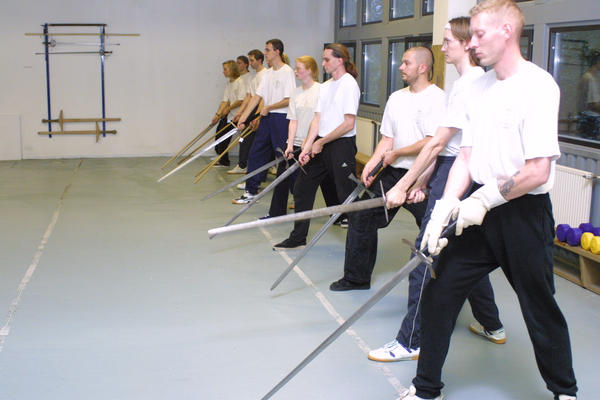
When I started Swordschool in 2001 I had no business plan, nor any other kind of plan, really. Just a clear idea of what I was supposed to do: show up and teach classes.
From that unstructured beginning, the School grew. It’s hard to separate “The School” from “the Guy”, because especially in the early years they were very much one thing. Was my first book a “school” project? Well, yes and no. Were my seminars in other countries part of the school? Yes and no.
The School, as I see it, is the emergent property of students, space, curriculum, and instructor. Remove any one element and you don’t really have “The School”.
Whatever it actually is, the School has attracted helpful people every step of the way. I won't list them all here, but everything from finding training spaces, to setting up websites, to building the wiki, to covering classes for me, to sourcing equipment, to getting the word out, to organising photo shoots, and on and on, whatever it was we were doing, there were people stepping up to help. Without them the school would have died in infancy. Just in case you thought I did it all by myself.
The Swordschool Salle(s)
From a martial arts school perspective, we started out as a single salle under a single instructor.
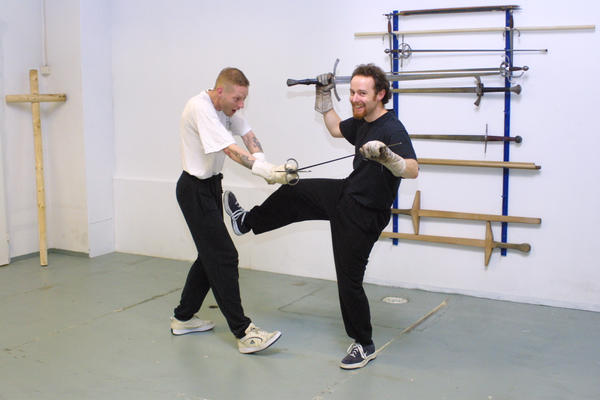
Within a couple of years the first branch opened, in Linköping, Sweden. I had nothing to do with it directly— I was approached by three enthusiasts who wanted to start training under my direction.
This was the pattern for all the branches that followed: local people starting something and wanting help to make it more organised, more official. The Singapore founders originally got in touch because they needed a bit of paper to show the police that would allow them to import swords! Branches opened in many Finnish cities too.
I don’t take credit for any of that growth. It was always and entirely the idea and the work of a person or group that wanted to be able to train closer to home.
Over time just about all of these groups became independent, as founders moved on, and those that kept things going wanted either to keep training using my interpretations and syllabi but without the formal connection, or wanted to go off in other directions, such as focussing on tournaments or taking up a different style (such as German longsword).
It’s a simple fact that thousands of people owe their training, and dozens of clubs owe their existence, to their current or previous connection with the School.
That is beyond awesome.
The effect is especially noticeable in Finland, where just about every person currently training in historical martial arts has trained under me, or one of my students, or one of my students’ students, at some point.
None of that was part of the original plan. There was no plan.
Key milestones
Over time the School expanded in ways I could never have predicted. Here are some of the milestones along the way (leaving aside book publications, of which there have been over 20):
• August 2000: I decided to move to Finland and open a school of historical swordsmanship.
• January 22nd 2001: I registered the swordschool.com domain.
• March 17th 2001: the first, free, taster class was held at the Olympic Stadium.
• June 1st 2001: we move into our first permanent training space, in Jakomäki, Helsinki.
• 2001: demos and classes at Finnconn, Jyväskylä, brought in a lot of new students.
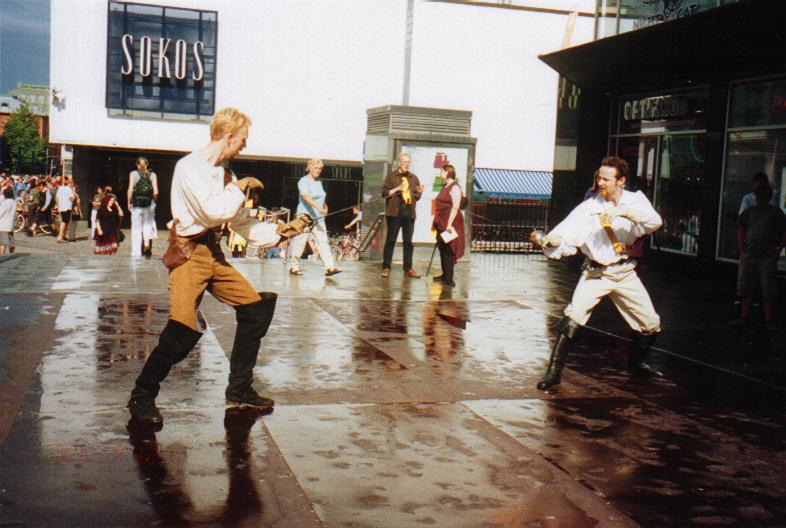
• 2002: the first branch opens, in Linköping, Sweden.
• 2004: The Swordsman’s Companion is published in the USA.
• 2006: The Duellist’s Companion is published in the USA.
• 2010: I began uploading free videos of the School’s syllabus, published the entire school syllabus online for free, and later pioneered the use of crowdfunding for HMA projects.
• 2012: I began blogging, providing useful free content to the HMA community.
• 2013: I published Veni Vadi Vici, a translation of Philippo Vadi’s manuscript De Arte Gladiatoria Dimicandi, and released the translation online for free.
• 2014: The number of free training videos online passed 100, including many full-length seminars. I also published the first two decks of Audatia, the first ever card game that teaches historical swordsmanship.
• 2016: I released the first online course to help students research HMA, called Recreate Historical Swordsmanship from Historical Sources. We also moved to the UK.
• 2018: I was awarded a PhD by Research Publications by Edinburgh University.
• 2020: I started The Sword Guy podcast, which also led to the newsletter becoming much more regular.
• 2022: The Sword People social media platform launches.
• 2025: The Helsinki Salle is sold to the SHMS Ry. Major overhaul of the Syllabus Wiki and the blog begun.
The Swordschool “Business”
From a business perspective, the School has been:
2001–2007 my toiminimi, or sole tradership, “The School of European Swordsmanship, Helsinki tmi”.
In 2002 my students created the Suomen Historiallisen Miekkailun Seura Ry, a non-profit, which simplified things greatly and also enabled us to apply for certain grants.
For legal and practical reasons in 2007 I folded the sole tradership and created a limited liability company, “The School of European Swordsmanship Oy”, which trades under Swordschool Oy, and which is still running.
I bought a larger space in the same building in 2007, and we moved across the hall. I had to buy it personally because the bank wouldn’t lend money to the tiny wee company. The SHMS paid me personally rent on the space, and paid training fees to my company.
In 2016, after moving to the UK, I created Swordschool Ltd, another limited liability company here in the UK, because it’s much simpler to run everything through a company in the same country that you live in.
None of these legal entities are “The School”. They are necessary legal fictions that allow me to get paid and pay taxes without going to jail, while keeping a legal wall between me personally and the business activities (publishing, teaching, etc.) that I engage in.
For the first dozen years the business of the school was only and entirely me teaching in person.
My books were published by small presses in the USA, and brought in no real income at all (there's a story there, but also a legal settlement preventing me from telling it). When I started publishing my own books (starting with Veni Vadi Vici, in 2012), they began to bring in real income.
By 2016 we could— with a lot of belt-tightening— live off my book earnings, the salle rent, and occasional weekend seminar fees, to the point that we could move to the UK to look after elderly parents.
In 2016 I got the idea to create online courses, which swiftly overtook books as the single biggest income stream.
Leaving Helsinki
My family left Helsinki in 2016 primarily due to ageing parents in the UK.
I officially retired as the School’s director in November 2015, to give my students time to adjust while I was still around to help as needed.
The original branch is still running in the salle in Jakomäki, Helsinki, and is solely owned and operated by the Suomen Historiallisen Miekkailun Seura Ry. We figured out a way for them to buy the salle off me without involving bank loans, and they now own the space.
Swordschool Today
The School currently offers a ton of free and paid resources for anyone interested in the Art of Arms.
Free resources
We are currently rebuilding it, but it’s as usable as it ever was during the process. It’s how we host and organise our free reference resource for syllabus and interpretation. We started it in 2011, and while it was neglected somewhat as we built the online school, it’s still useful and is being thoroughly reorganised, expanded, and brought up to date. We have added over 200 new pages this year alone.
I started this during lockdown so that sword people stuck at home and missing the social aspect of training could virtually hang out while sword geeks chatted about swords. It now boasts over 200 episodes with a range of well-known and less well-known guests.
GuyWindsor.net
I started this blog in 2012, and it now has over 500 posts on various topics. I recently reorganised it and created a “start here” page.
With over 500 videos, it’s a monster and hard to navigate, which is why we have the Syllabus Wiki. Almost all public interpretation and training videos are on the wiki (or will be soon). It also hosts backups of our online courses in case that platform goes down, so not all of those 500 videos are public.
This has existed since about 2015, but I didn’t do much with it until lockdown. Since then it’s been a regular fortnightly bit of swordy positivity in your inbox. About 6,000 people subscribe at present—you should join them.
Paid resources
This is the best place to get my books. The fact is that most online retailers of ebooks, audiobooks, and print have pretty bad terms of service, and like to hide your work unless you pay them to advertise it. So this is the place to go to get ebooks, audiobooks, paperbacks, hardbacks, and even T-shirts.
I began creating online courses in 2016, and they have proved extremely popular. You can get online courses on a huge range of topics, from Solo Training to Fiore’s art of arms, Vadi’s art of arms, Capoferro rapier, I.33 sword and buckler, and more.
Buying courses individually can get quite expensive, but you can get access to whatever you are interested in through one of our subscription packages at very reasonable prices. All courses are fully downloadable, and you can unsubscribe at any time.
Seminars
My favourite thing to do is teach classes. I’m a consulting swordsman, so you tell me what you need, and I deliver it. Drop me an email to discuss your needs.
Looking back
When I started in 2001 I had no thought beyond teaching full time in one place. What actually happened was something much bigger: a network of people, clubs, books, courses, and conversations about the Art of Arms that has now been growing for a quarter of a century.
The School has never really been a building, or a company, or even a curriculum.
It’s the people who show up to train, to teach, to research, and to share what they’ve learned.
Now the real question is: what about the next 25 years?