I was in Dumfries in April visiting my mum, and a friend of the family there happened to buy a set of four balloon-back chairs, and mentioned it when they came over for dinner. I immediately asked whether they were coming apart in the usual place (where the balloon top rail meets the uprights). Of course they were. So I naturally offered to have a look…
Three of the balloon back rails needed fixing.
(The black and white photo of two kids in a pram are me and my sister in about 1976. Guess which one’s which!)
Two of the chairs needed their rear joints (where the rails meet the backs) tightened up and their corner blocks re-fitted.
But one poor chair, oh my. This chair had been broken more than once in the past, most notably having the front left leg shattered at the top, the critical bit where it’s jointed to the rails. I didn’t take a photo of the chair in its original state, but take my word for it, this chair needed some love.
The original repair was done by a professional working fast (as professionals must). The two-part break was glued up in one go, and held together by screws. One part remains stuck fast, the other worked its way loose again. All four corner pieces were loose, two of them actually broken at the dowel holes. The one at the broken leg was broken in two places, and had been stuck back together with hide glue.
The rear joints where the rails meet the back were also very loose. They wouldn’t quite come apart without violence, but they had been very clearly repaired at least twice in the past. Two out of three of the ⅜” dowels on one side had been replaced with ½” ones. In the end I had to cut through all the dowels to take the joints apart.
The rear joints had been fixed at least twice: once properly-ish, including replacing those two dowels, and once by someone opening it up a bit, squooging in some white glue, and hoping for the best. They had done the same with the rear corner pieces. Very helpful. Really. Do that with all your nice old furniture. Future restorers will thank you.
This is exactly the kind of fun restoration that is simply uncommercial. There is no way to do a proper job on it in an amount of time that costs less than the chair is worth. I’m not a professional restorer any more, so I had no need to do this quickly. Where the previous restorer did the whole thing in one, maybe two, glue-ups, I did at least eight separate glue-ups. And a bunch of colouring in, as you shall see.
My overall goal is to return the chair to active service, and have the repairs un-datable. There is no way to tell whether they were done the day after the chair was made, or last week. To this end the only glue I use (and the only glue I would ever use on an antique because I’m not an animal) is hide glue (aka scotch glue, horse glue, hot glue, etc.). I cleaned out my glue pot (which took a while!), got a fresh batch warming up, and got to work.
Firstly I cleaned up and re-fitted the front right corner block. This was to stabilise the only unbroken joint while I was fiddling about with the broken ones. Once it was glued in, I re-drilled the dowel holes and glued the dowels in. Doing this in two separate glue-ups makes it much easier to be certain of a perfect fit. One issue with the original assembly and the subsequent professional repair was the old habit of just dipping the end of the dowel in glue and tapping it into the hole. The edges of the hole scrapes almost all the glue off the dowel, leaving it basically loose in its hole. I was careful to use a small brush to get a thorough coat of glue inside the hole, and painted more on the dowel, before knocking them home. Pro-tip: the dowel must have a groove cut in its side to allow glue to squeeze out, otherwise it can pool at the bottom of the hole and stop the dowel getting all the way in. Modern mass-produced dowels for dowel-joints are grooved all round for this reason. But they would date the repair, so I cut my own dowels from clean dowel rods, and cut the groove in by hand with a chisel.
Then I cleaned out all the dowels in the rear joints.
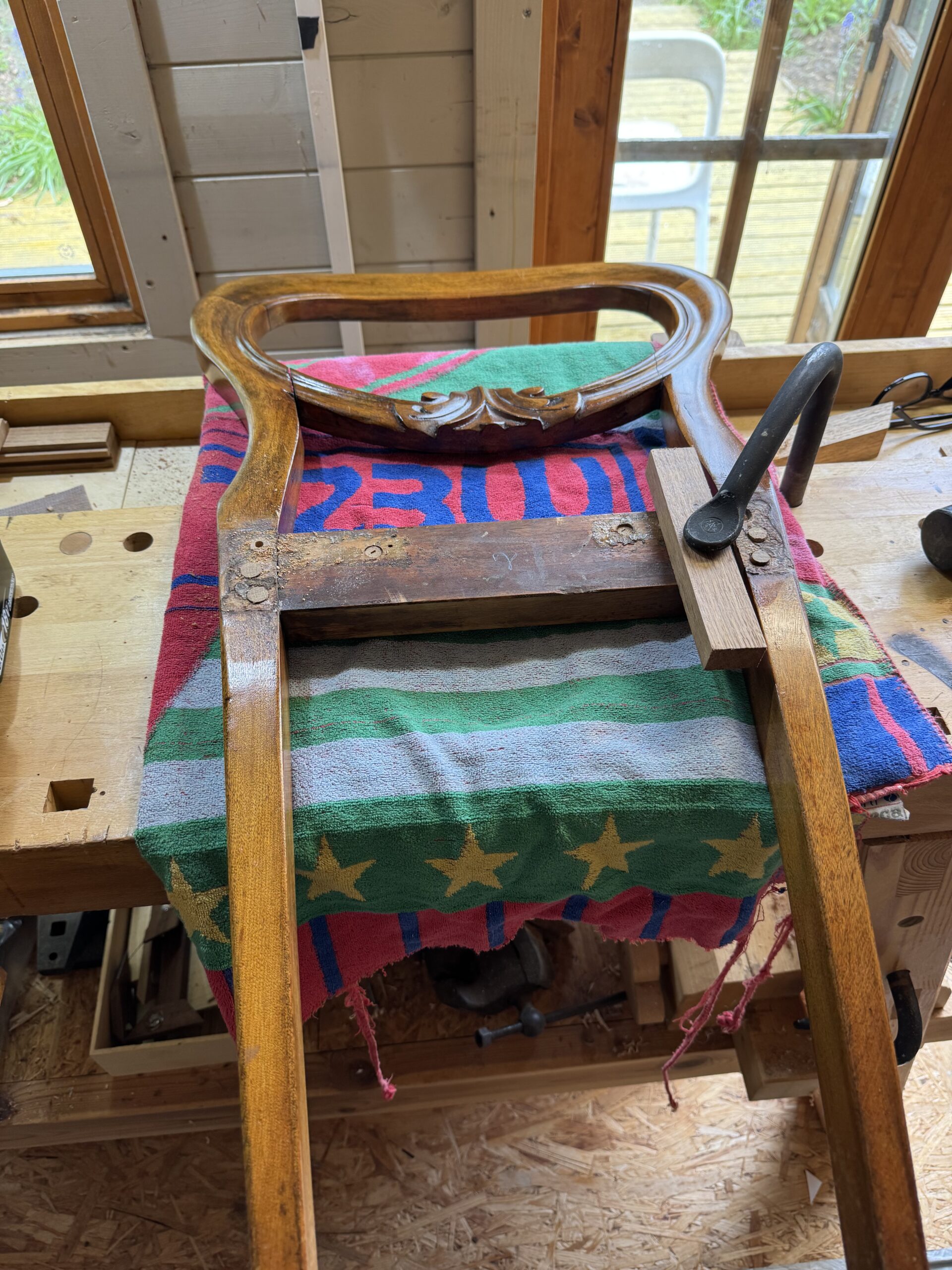
This involved drilling a smallish hole and cutting them out with a small chisel, then cleaning the holes out with a drill. I wanted to do this before repairing the leg break so there would be minimal fiddling with front legs after the break was repaired.
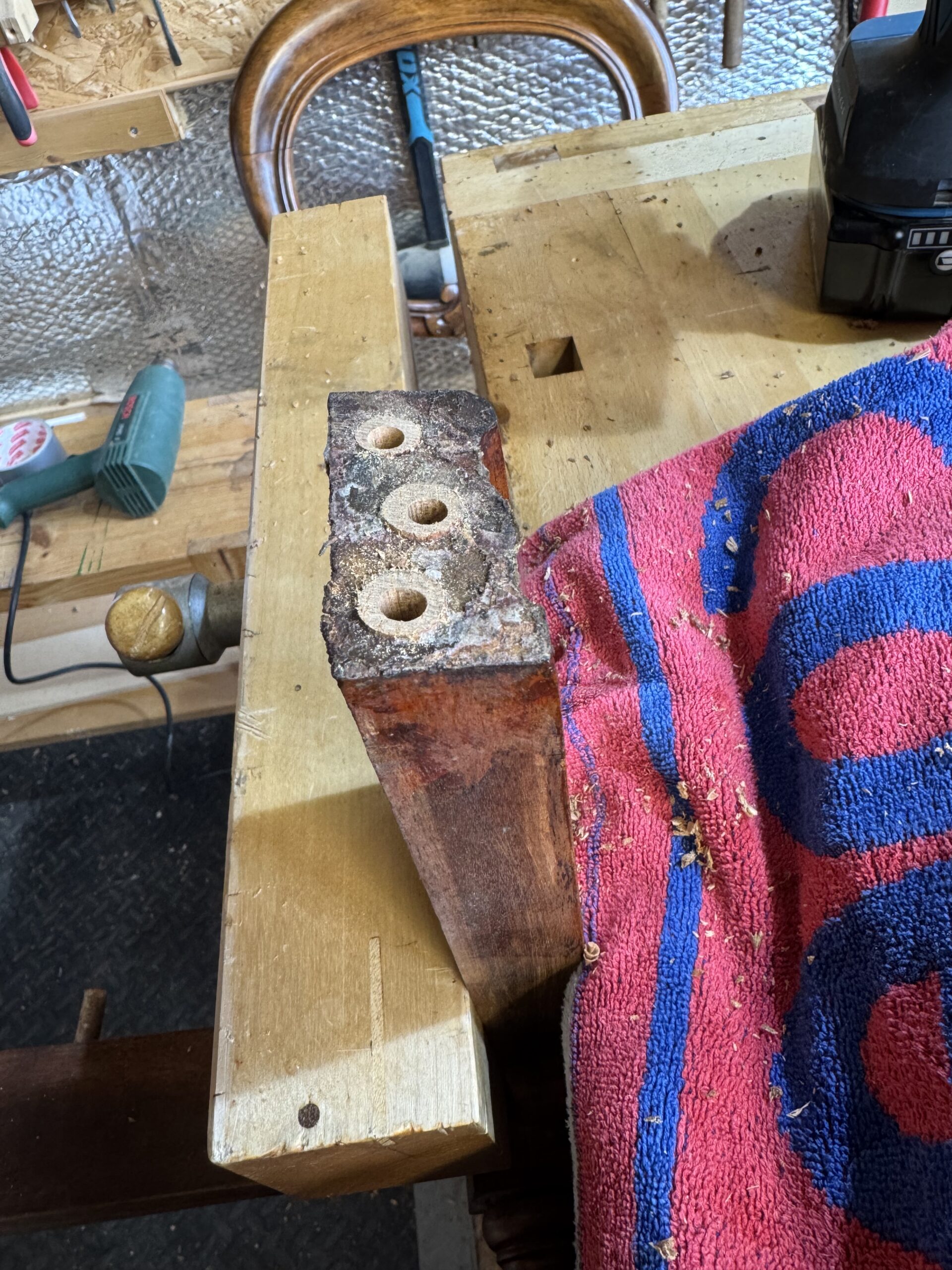
Then I dismantled the big leg break.
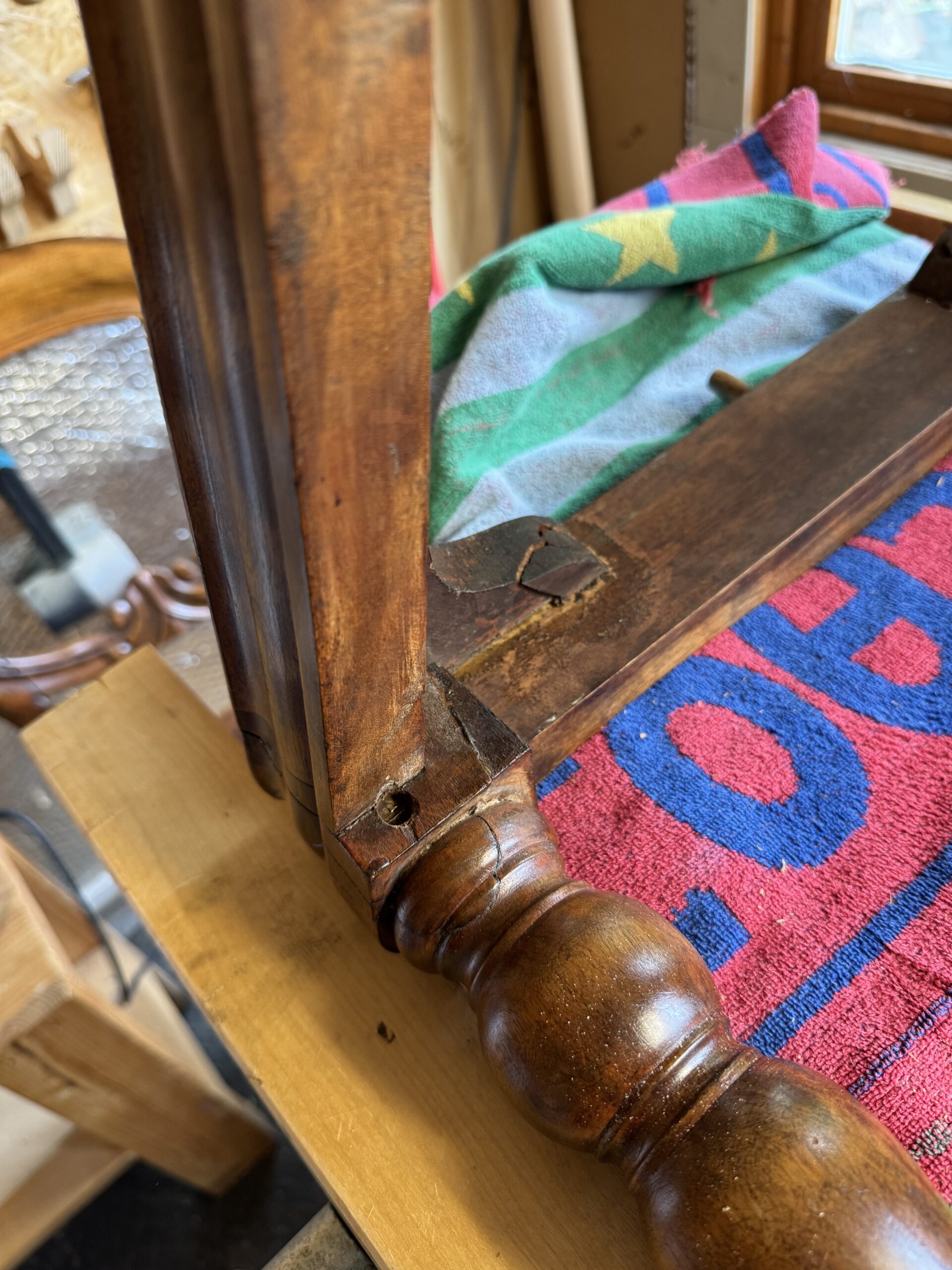
One of the screws was absolutely welded in place, so I heated it up with the heat gun and let it cool a few times to break the seal, got one of my biggest screwdrivers out, and it eventually yielded without damaging the wood. Here are the two halves before cleaning off the old glue:
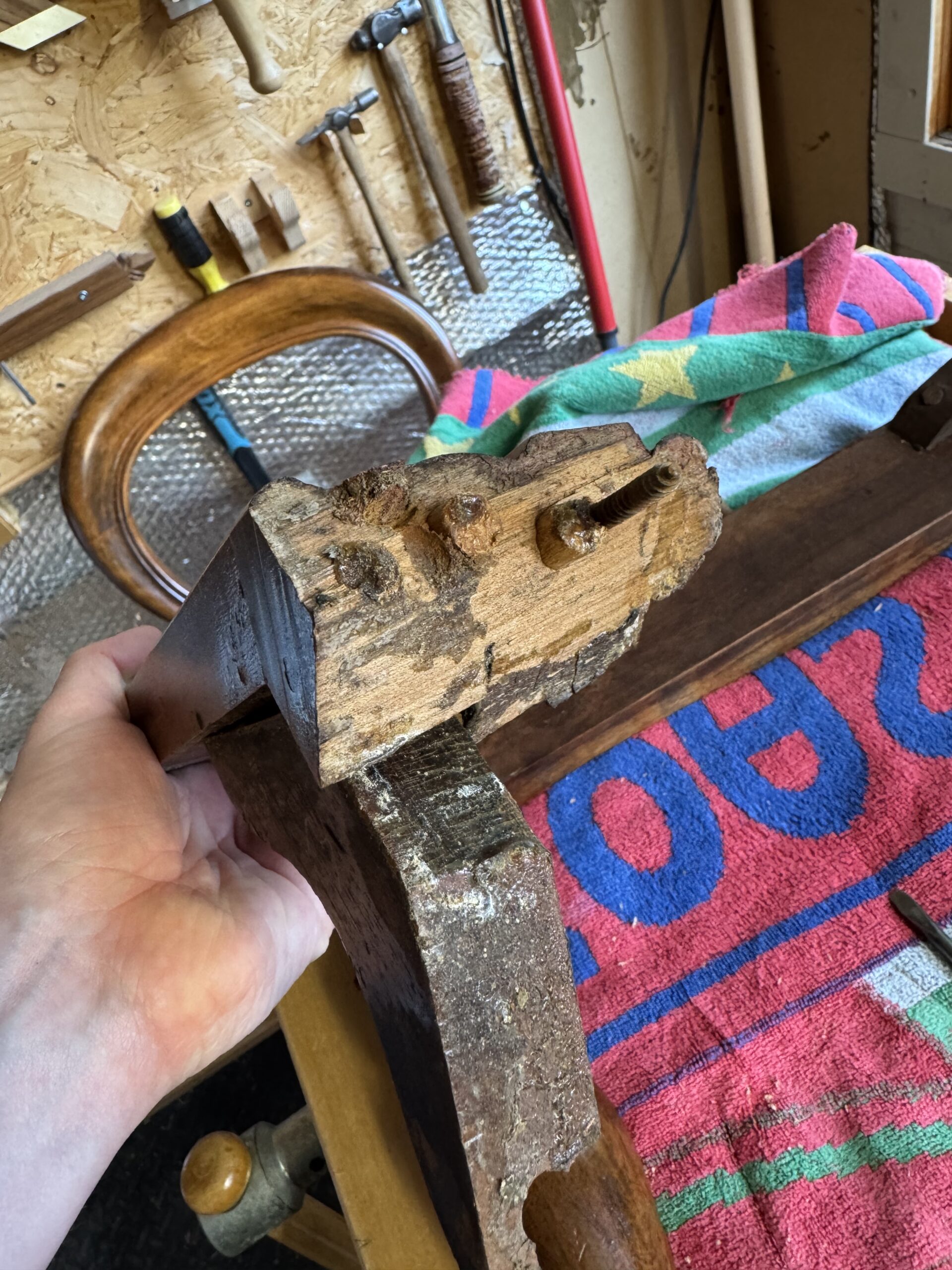
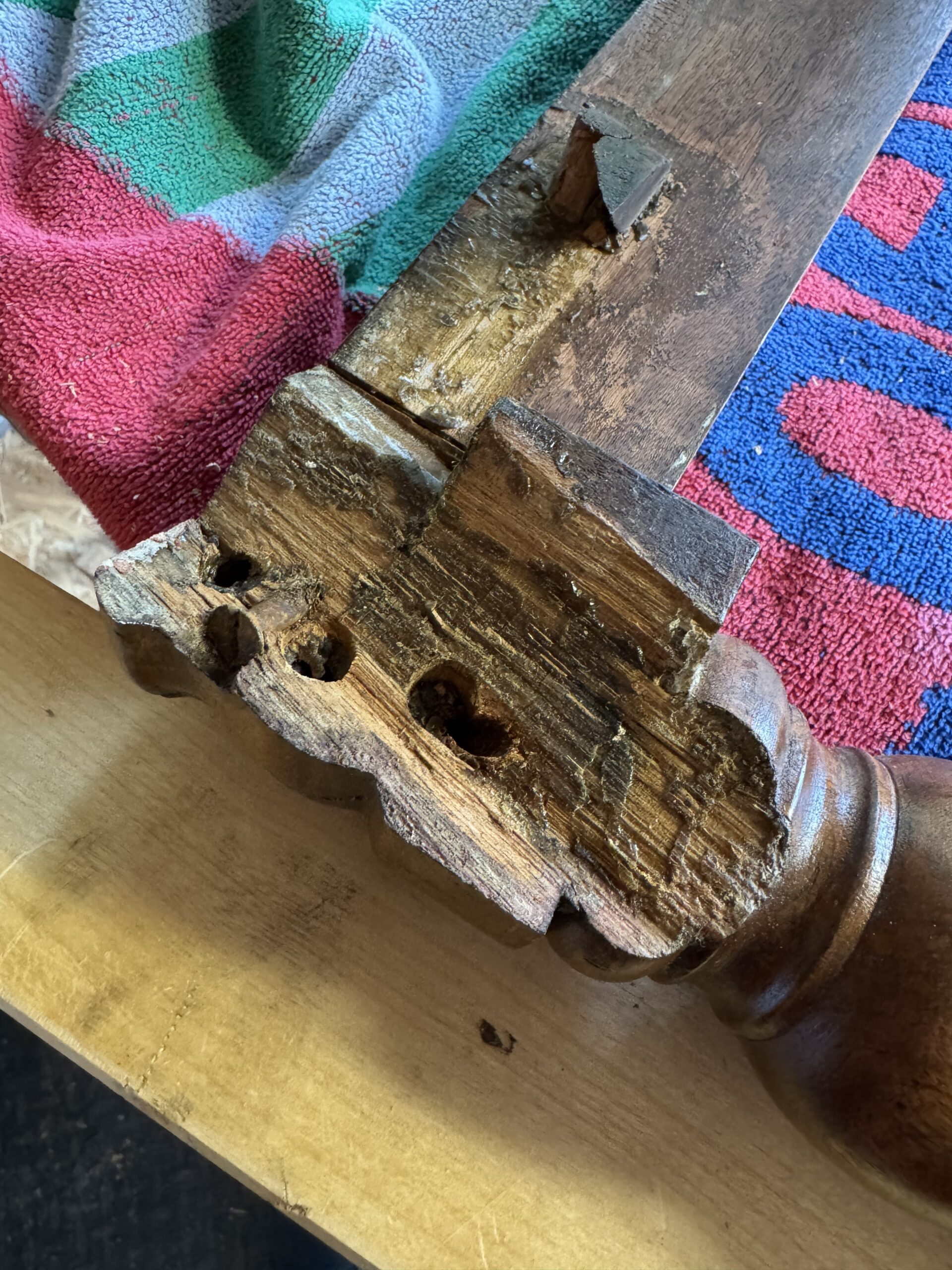
Then I cleaned it all up and glued it back together with moderate clamping force.
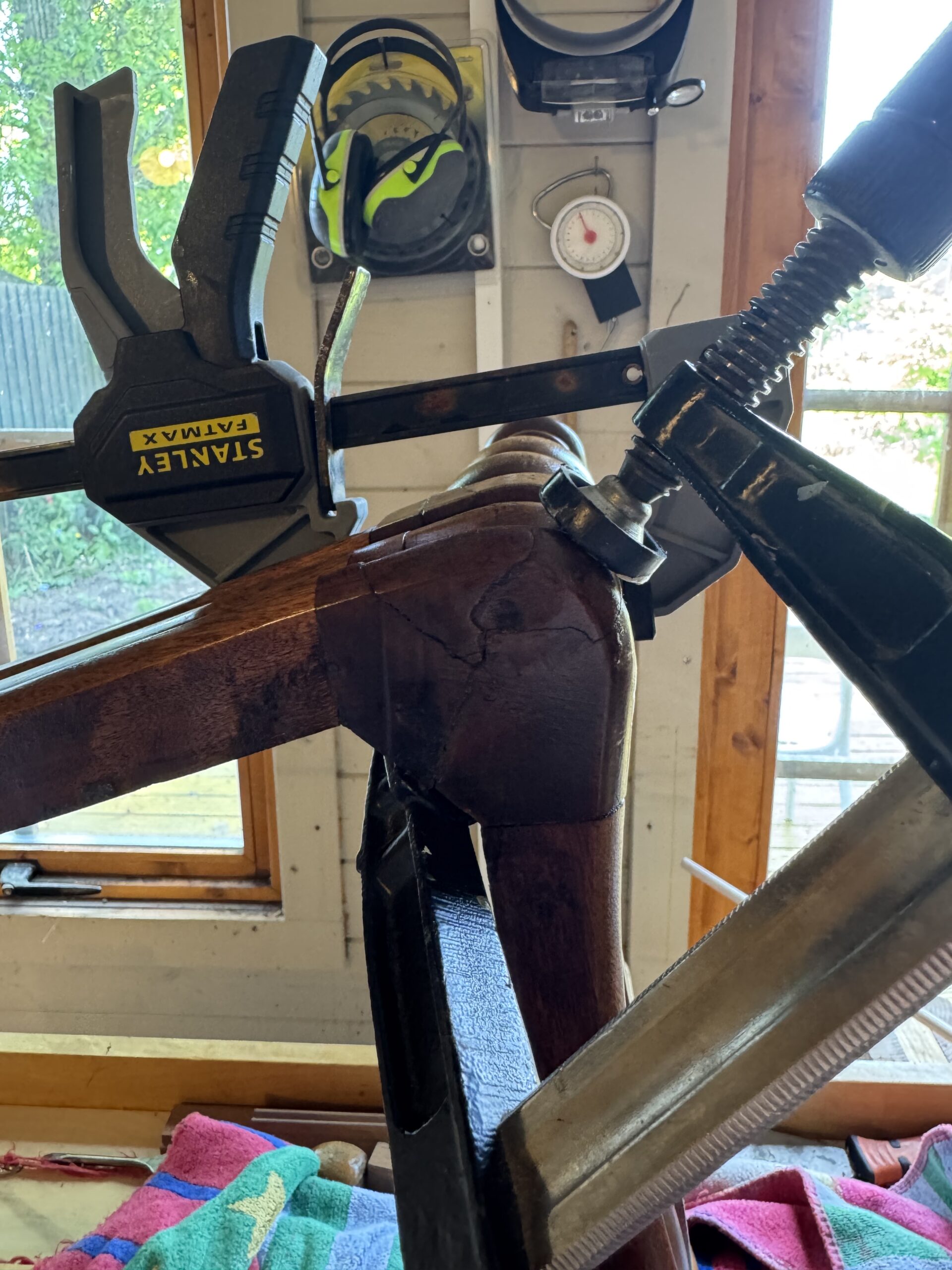
Because I couldn’t open up one part of the previous repair without doing more damage the break is still slightly off, but it’s much more together than it was.
After it had dried I then I drilled 10mm dowel holes where the screws had been, and glued them in. They should make the repair much more stable.
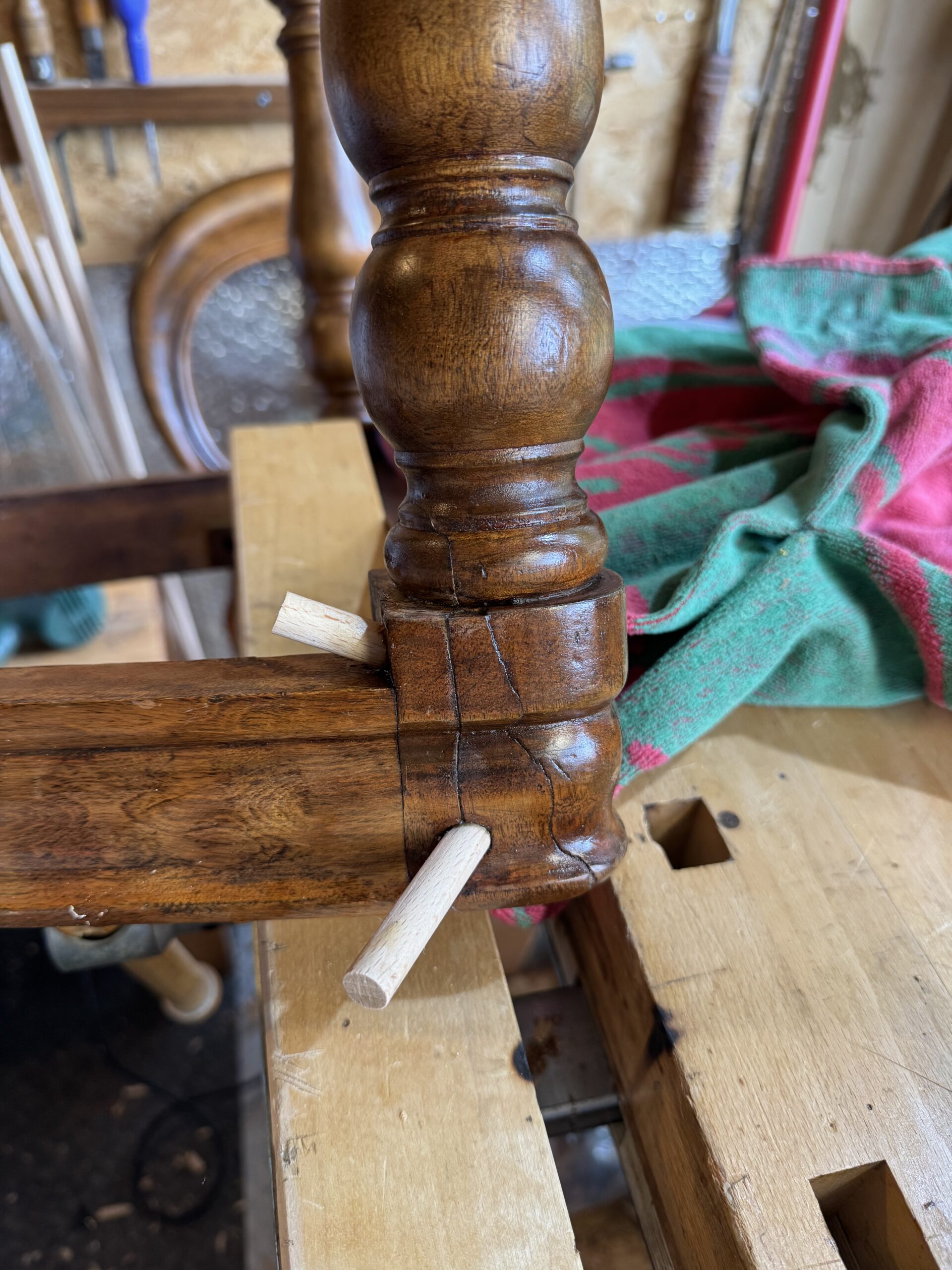
They then had to be cut down, the ends shaped to the form of the rail, and stained and polished. This could have been done at the end of the job, but I felt like doing it then and there. I also disappeared the cracks with some coloured hard wax.
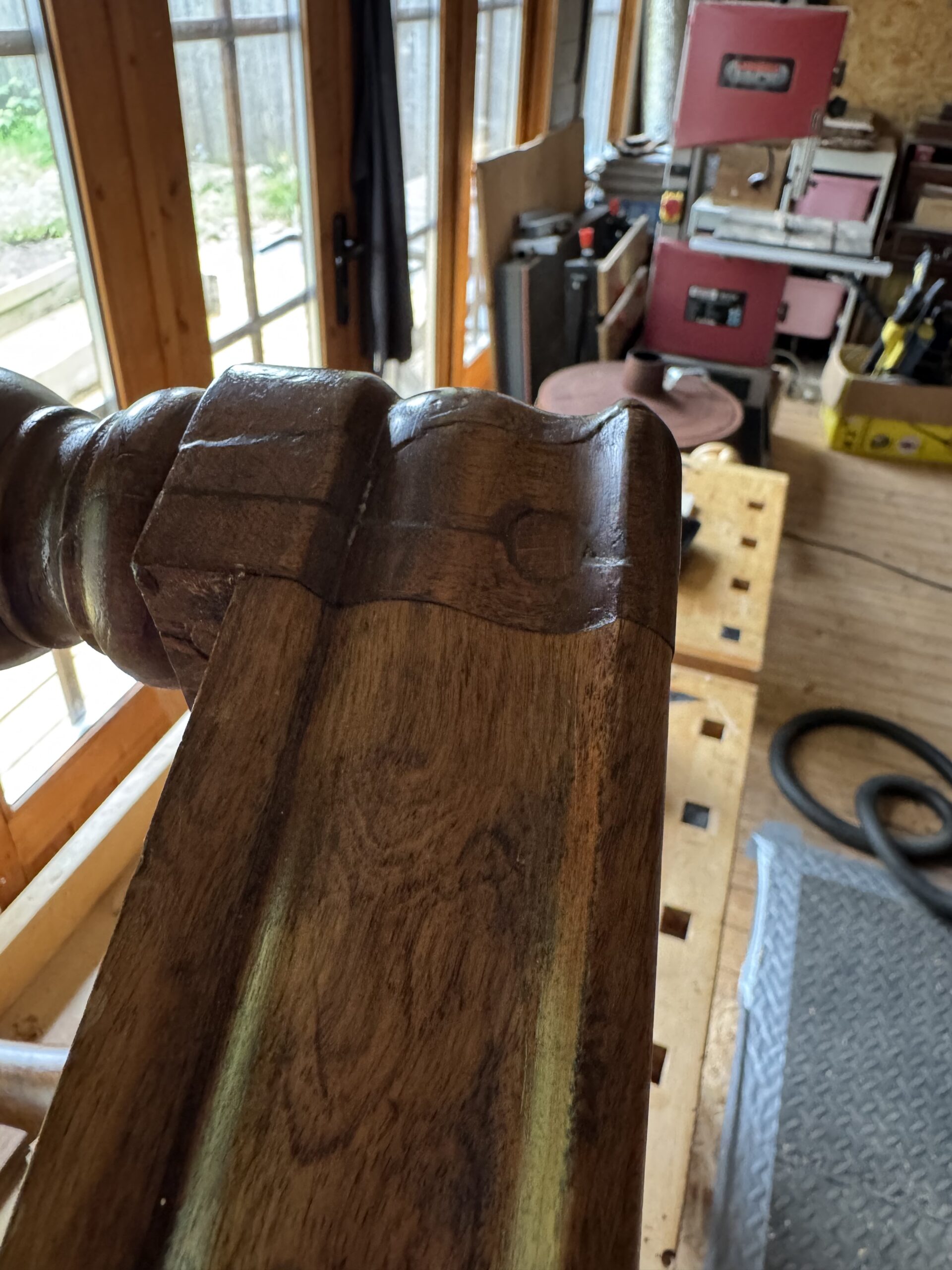
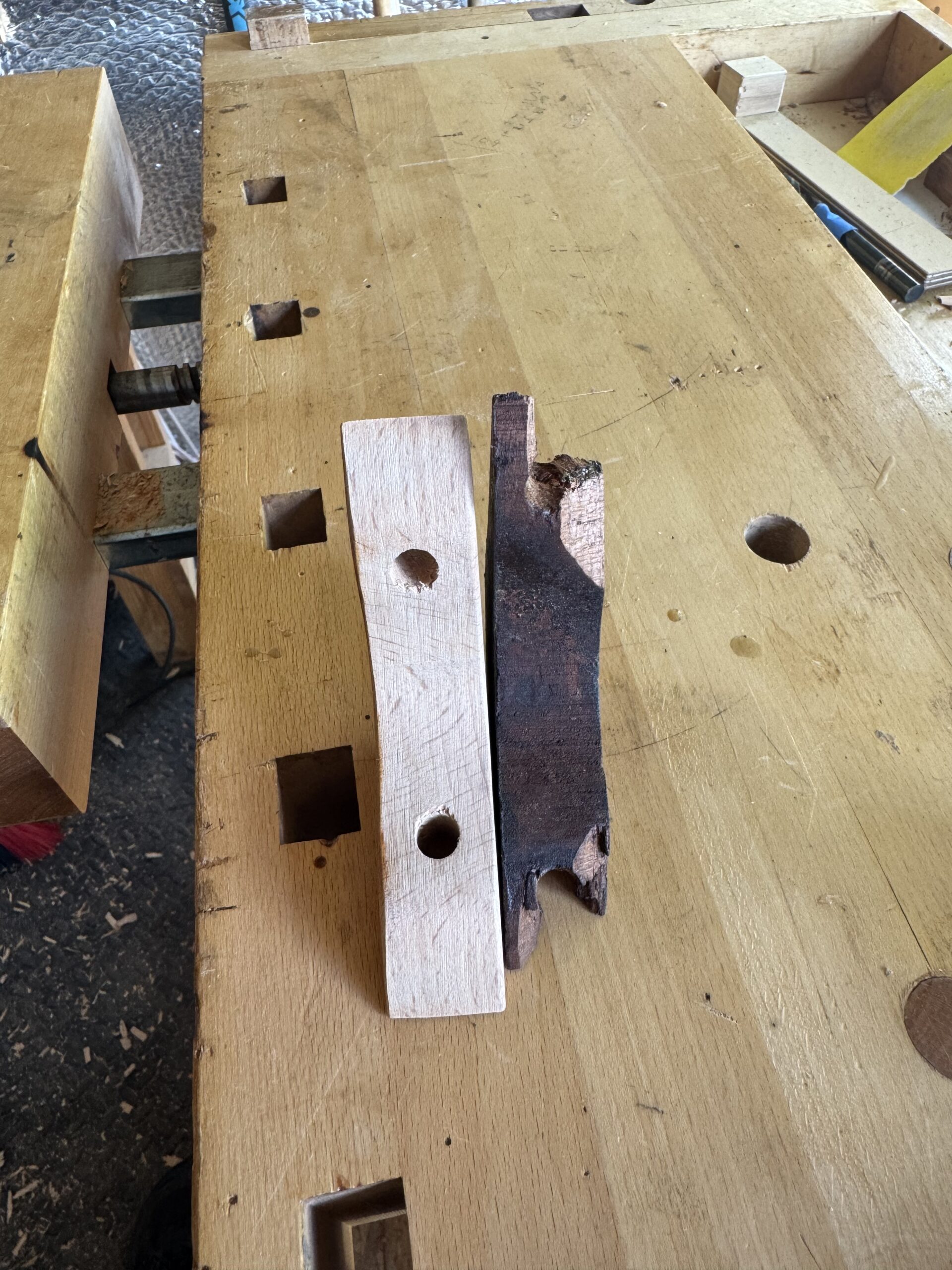
I decided to replace the front left corner block with a slightly beefier version. It will always be a somewhat weakened area, but at least it has a solid, unbroken, properly-fitted corner block helping to keep it together. You can see the new block next to the shattered old one here:
I decided to do the main glue-up in two stages. First I cut and fit the six new dowels, then glued them in to the rails.
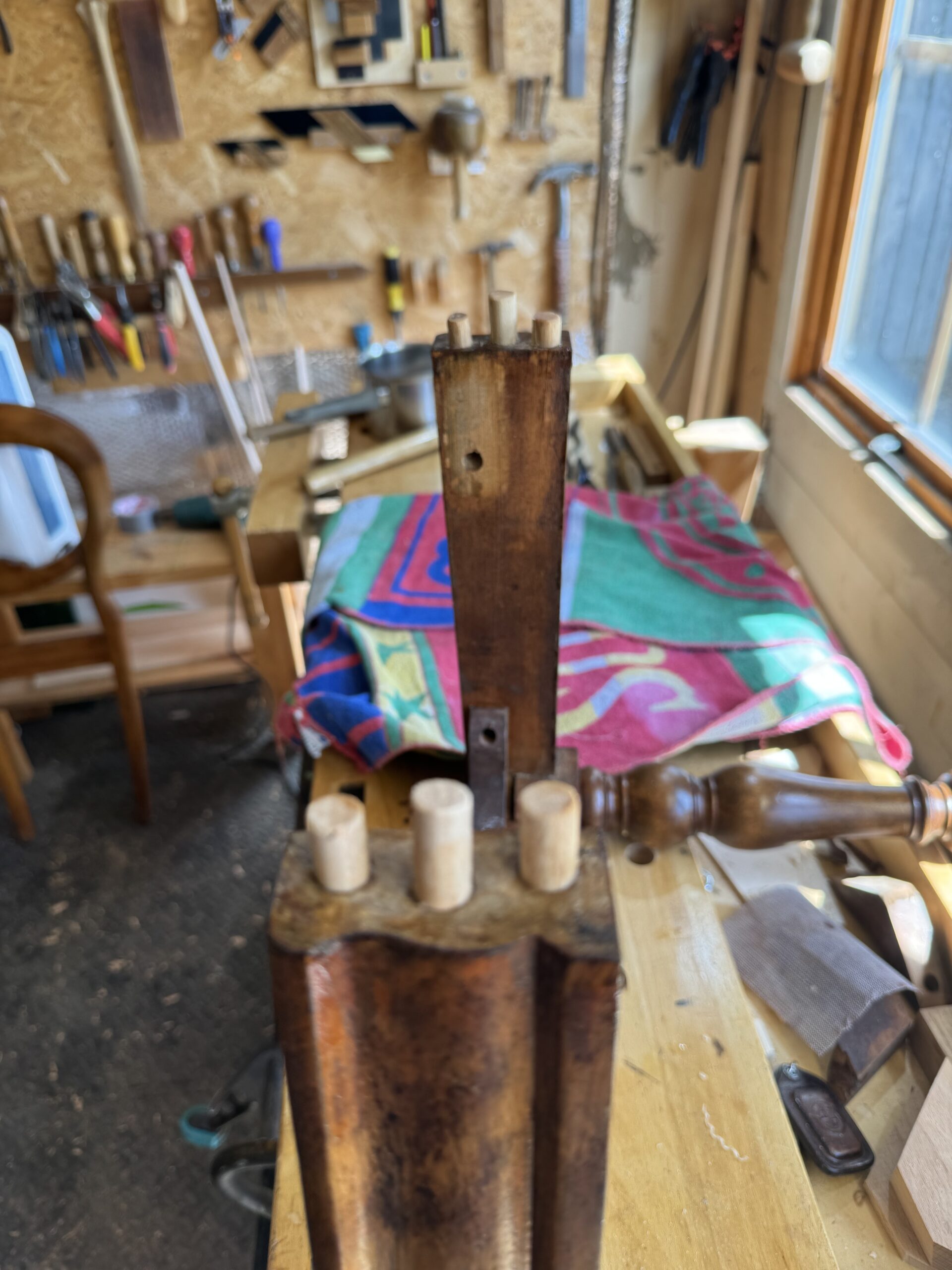
You’ll notice they’re all different lengths. This is because the dowel holes are very irregular. I then did two dry-run assemblies, adjusting the dowels slightly each time to get an immaculate fit.
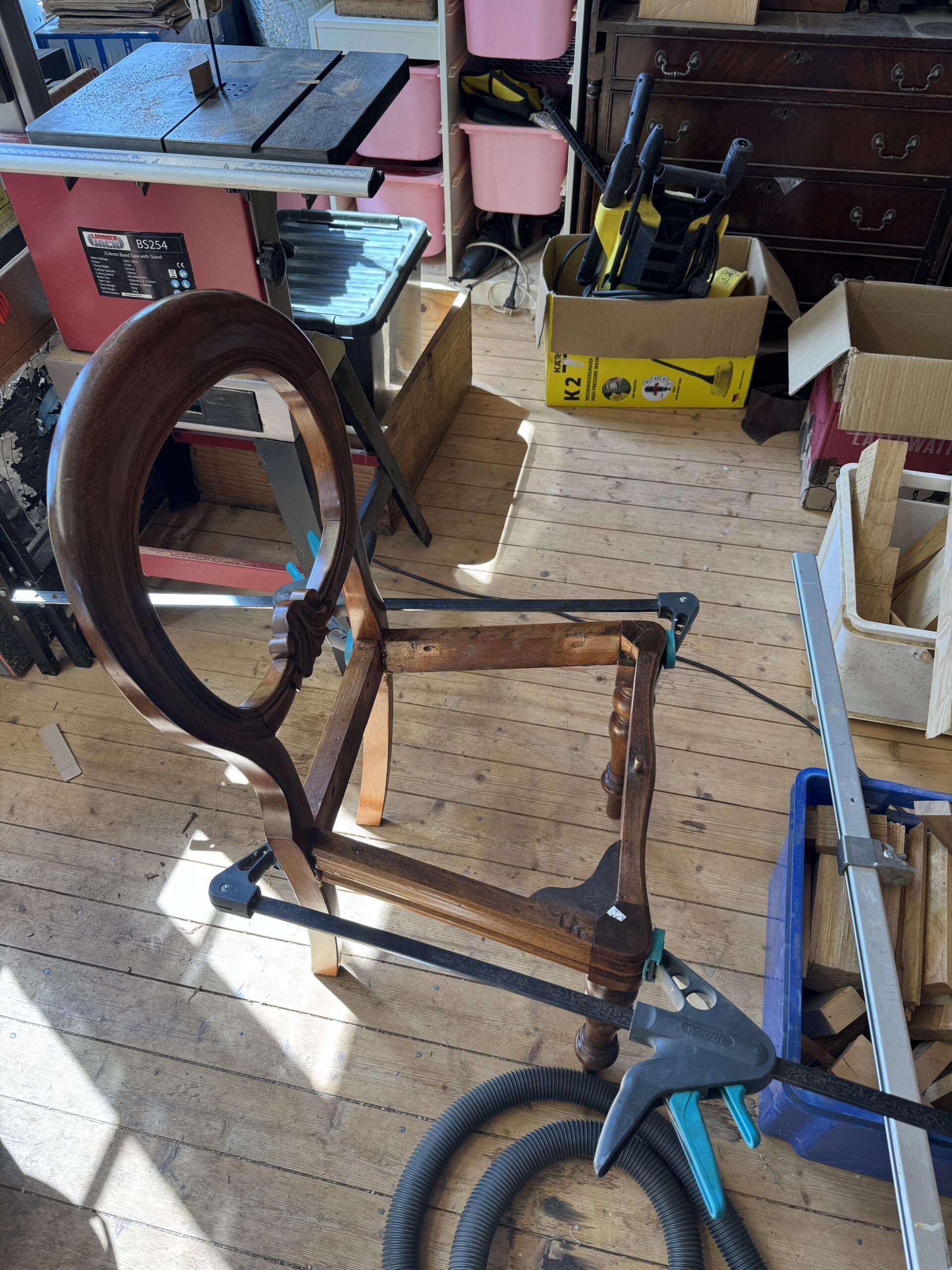
Then I glued up the rear joints. I used light trigger clamps for this, because I don’t want to introduce any tension into the system which will work away at the joints over time.
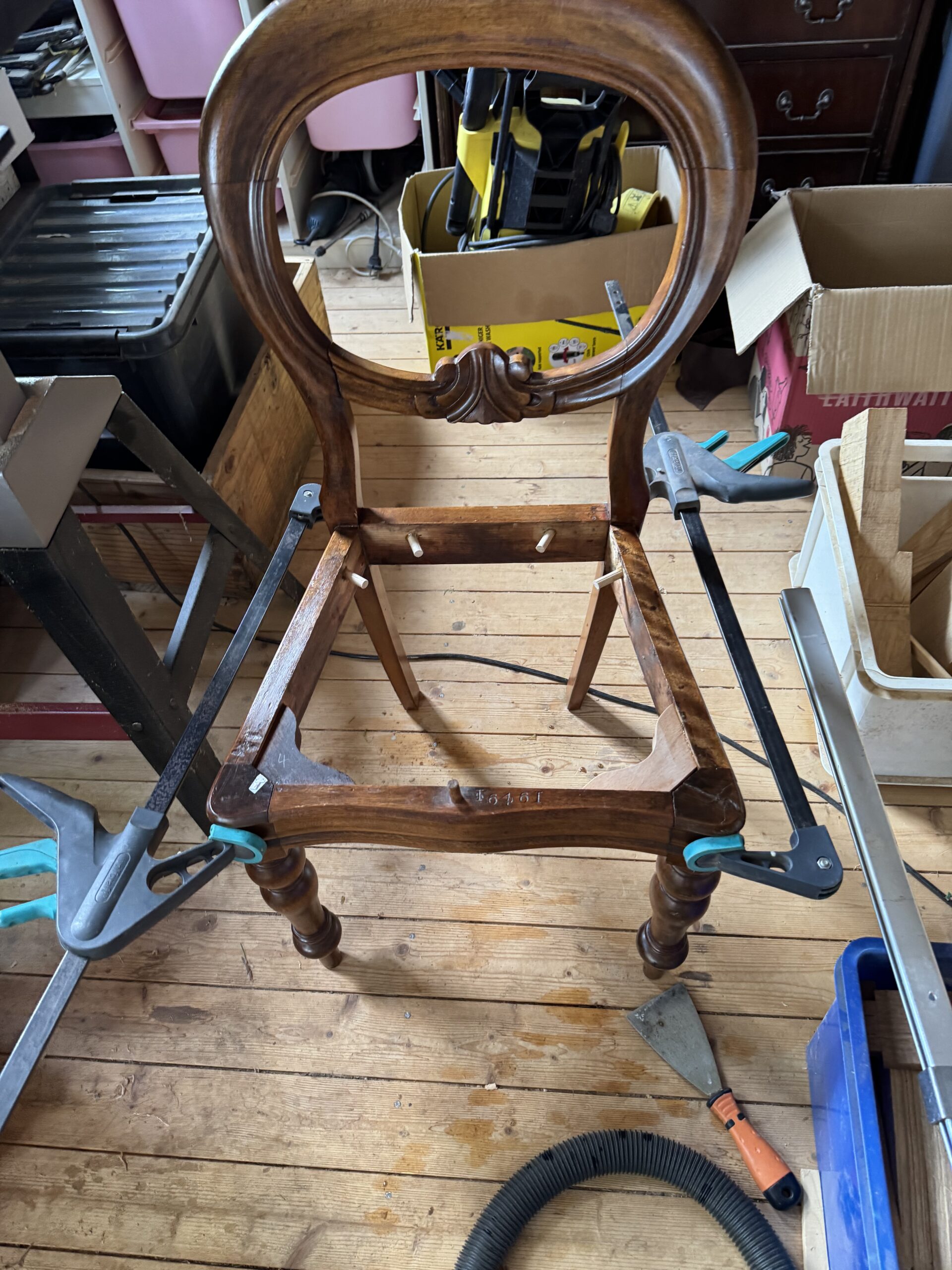
At this point I decided to fill the dowel holes for the corner blocks, by gluing in new dowels and trimming them down. The blocks will be slightly re-shaped to fit, so the original dowel holes won’t line up quite perfectly. This way I can glue them in, re-drill the holes, and the patches will accommodate any shift in the holes so the dowels will fit perfectly.
Having glued in the two rear corner blocks, and the new front corner block, I let the glue dry before re-drilling all the dowel holes, and fitting new dowels. Once the dowels were in, I cut them down and coloured all the new wood, then gave the whole thing a clean and wax.
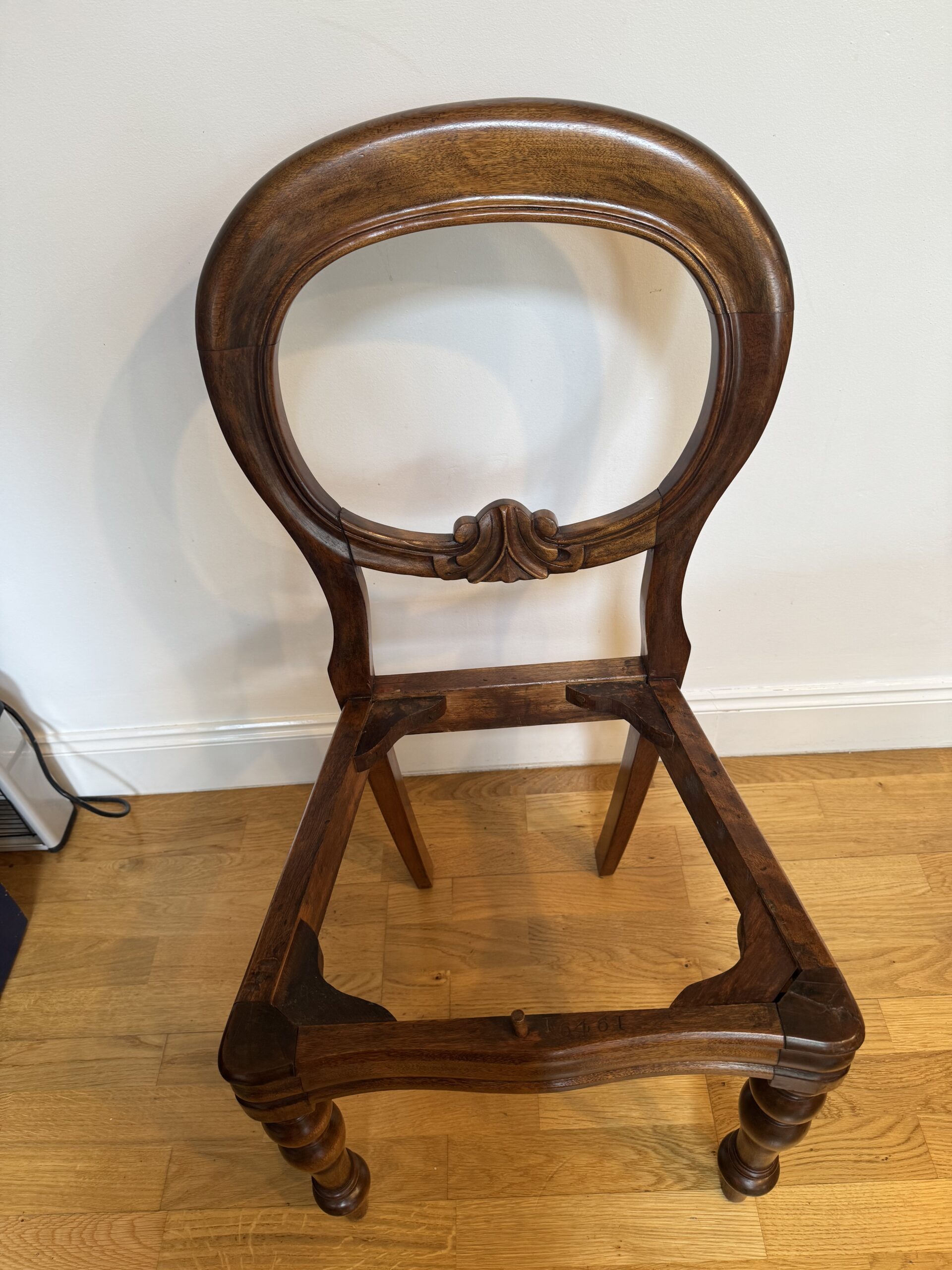
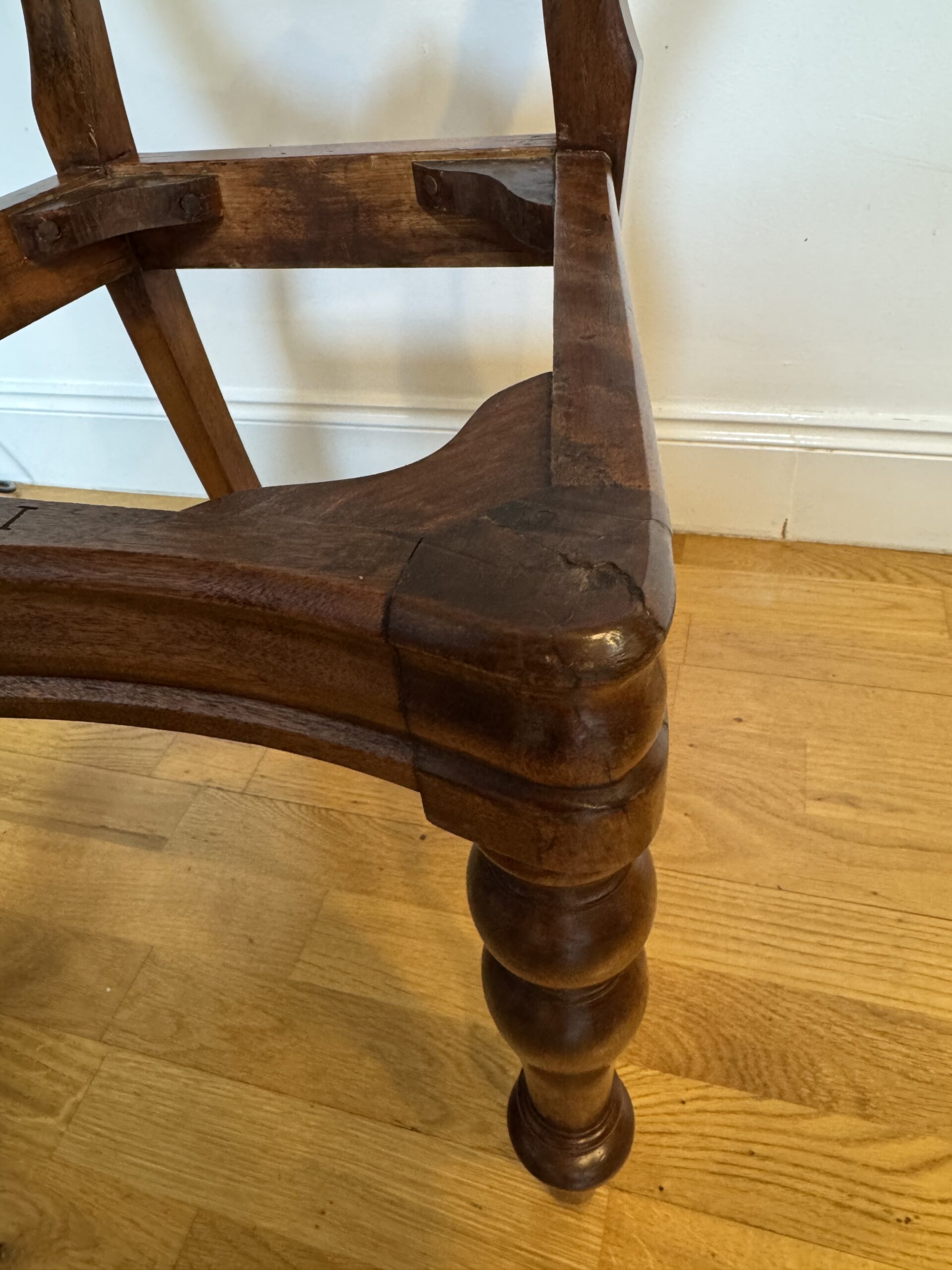
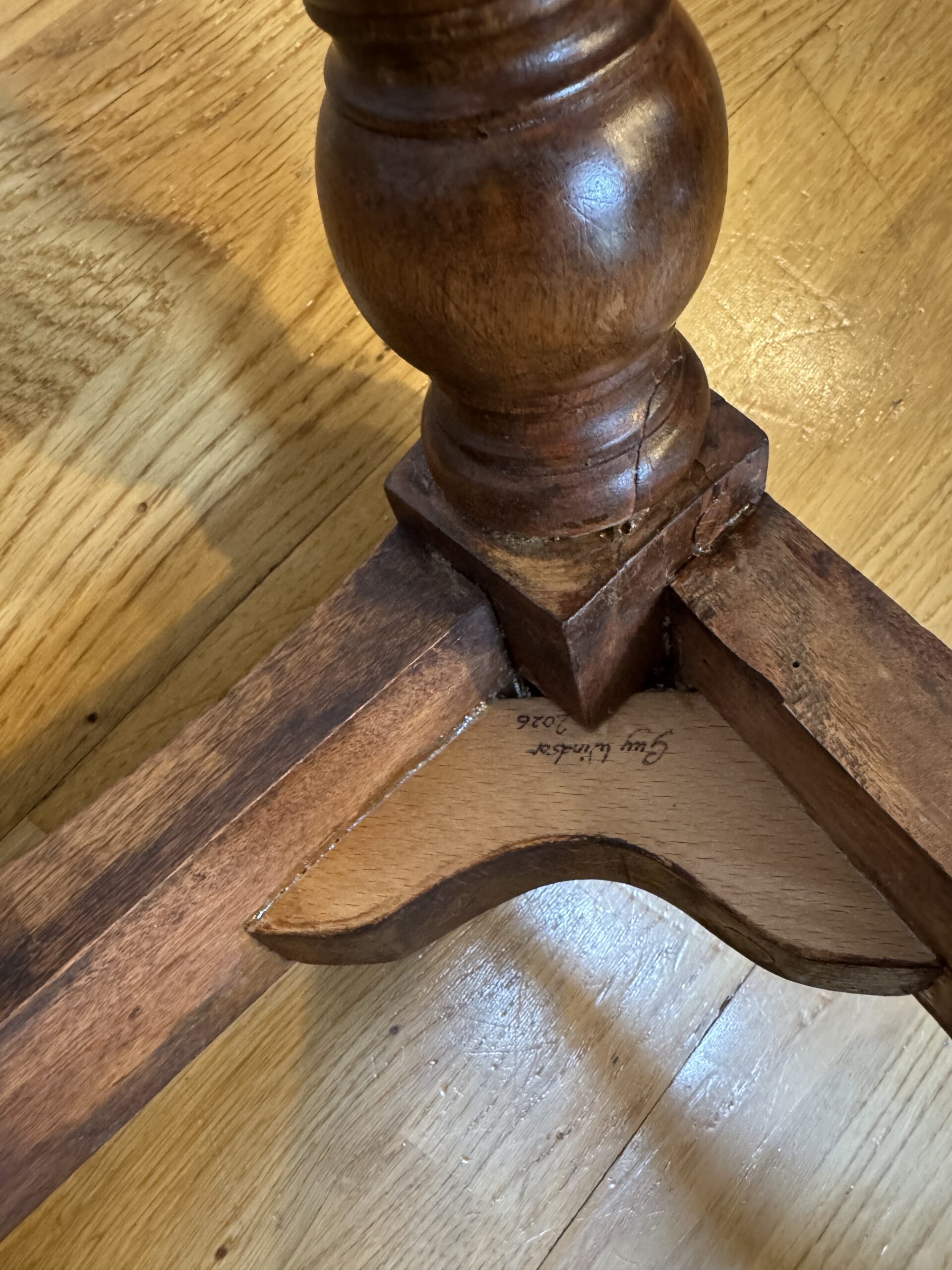
I left the new glue block uncoloured on the underside so it is clearly a replacement. Back when I trained there was a boom in antique furniture, so it was quite common for restorers to get into trouble for faking. Unscrupulous dealers would get you to fix up a nice old piece, and then sell it as being in immaculate condition, which is fraud. The difference between ‘immaculate’ and ‘nicely restored’ could be thousands of pounds. While there should be nothing in the repair itself to date it, any new pieces really ought to be discreetly named and dated. And besides, I’m quite please with how this chair turned out, so don’t mind putting my name to it!
If you’re on my mailing list you’ll be aware that I’m currently on compassionate leave. I’ve had no brain for dealing with proper work stuff (books, courses, podcast, etc.) but having a project like this to tinker with has been very good for my mental health. It’s straightforward, you can see your progress, and it’s very satisfying to see a nice old chair brought back to life.